

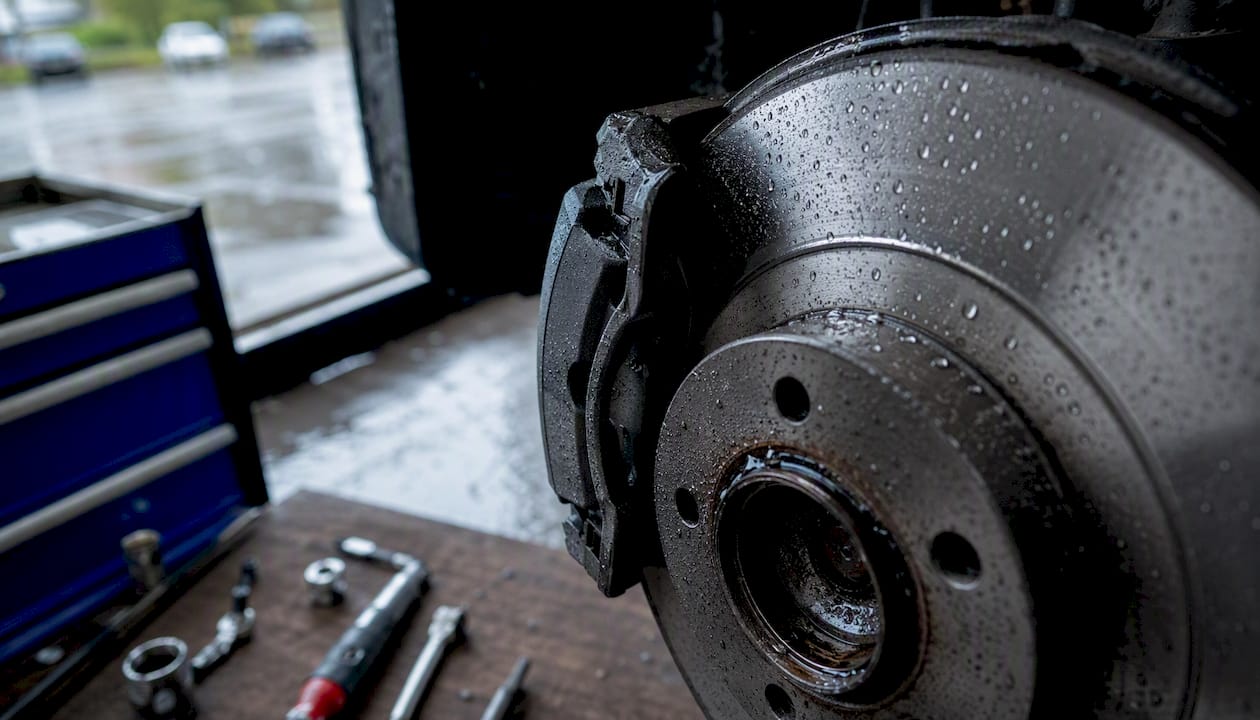
That light grinding sound when you first pull out after a rainstorm is almost always harmless flash rust, a microscopic layer of iron oxide that forms on cast-iron rotors within hours of moisture exposure. It clears within 5–10 brake applications under normal driving. If the noise persists beyond that, or if you feel roughness through the pedal, something mechanical needs attention.
Quick-check verdict:
- Grinding clears within 5–10 stops, pedal feels normal: flash rust, no action needed beyond a short drive
- Grinding persists past 10 stops or through the day: worn pads, warped rotors, or a stuck caliper
- Pedal feels spongy, rough, or the car pulls to one side: stop driving and get an inspection
- Wheel feels hot to the touch or you smell burning: stop immediately
Immediate action: Find a safe, low-traffic area and perform one firm, controlled stop from about 30 km/h. That single application scrapes the rotor face clean. If the noise disappears, you are good to continue. If it stays, treat the brakes as suspect and drive conservatively to a shop.
Key Takeaways
Brakes grinding after rain is usually harmless flash rust that clears within 5–10 stops, but persistent grinding, pedal roughness, or pulling always signals a mechanical fault that needs professional inspection.
| Point | Details |
|---|---|
| Flash rust is normal | Light grinding that clears within 5–10 stops after rain is surface oxidation, not a brake fault. |
| Persistent grinding is not normal | Grinding that lasts through the day or produces pedal roughness points to worn pads, warped rotors, or a seized caliper. |
| One firm stop clears rotors | Perform a single controlled stop from 30 km/h in a safe area to scrape the rotor face and confirm whether the noise is weather-related. |
| Stop driving if the wheel is hot | A hot wheel, burning smell, or severe pulling means stop immediately and arrange inspection before driving further. |
| Aaafrictions HydroAdaptive pads | Ceramic formulation and coated rotors reduce moisture-driven stiction and deliver consistent friction from the first wet stop. |
Table of Contents
- Why do brakes grind after rain? The most common technical causes
- How do you know if the grinding is dangerous?
- What to do right now if your brakes grind after rain
- When should you see a mechanic, and what will they check?
- How to reduce brake grinding after wet weather
- What does the research say about moisture and corrosion stiction?
- Our perspective: what we see in the shop and what actually matters
- Weather-resistant brake components from Aaafrictions
- Sources
Why do brakes grind after rain? The most common technical causes
The industry term for that post-rain scrape is surface oxidation or, colloquially, flash rust. Gray cast iron, the standard rotor material in most passenger vehicles, oxidizes rapidly when exposed to humidity, dew, or standing water. Rotors can show a visible orange film within hours, and the first few stops physically abrade that layer off the contact surface.
Beyond flash rust, several other mechanisms produce wet-weather brake noise:
- Wet or glazed pads: A thin water film between the pad and rotor changes the stick-slip behavior on the first application, producing a squeal or scrape that disappears once the surfaces dry and re-seat.
- Backing plate contact: A bent dust shield or a pad backing plate sitting too close to the rotor becomes noticeably louder when the rotor is wet. This is often a simple shop fix: a technician bends the shield back into position.
- Stuck caliper slide pins: Moisture accelerates corrosion on slide pins. When a pin seizes, the pad drags unevenly against the rotor, creating a persistent metallic grinding that does not clear after a few stops. Caliper slide-pin corrosion is one of the more common wet-climate complaints we see.
- Seized parking brake cable: Overnight moisture can cause the cable to bind, leaving the rear pad partially engaged. The result is a grinding or dragging sensation that fades once the cable frees up, or does not fade at all if the seizure is complete.
- Corrosion pitting: A vehicle parked for weeks in wet conditions can develop deep pitting on the rotor surface. Light braking will not clear this; it requires resurfacing or replacement.
Pro Tip: Match the sound-feel pair to the cause. A quick metallic scrape that disappears in two stops is flash rust. A persistent grinding with pedal vibration points to a mechanical fault. A rhythmic thud or wobble through the steering wheel on braking suggests rotor runout or warping.
How do you know if the grinding is dangerous?
The threshold is straightforward: noise that clears within 1–3 stops is almost always normal; noise that persists through the day or produces a rough pedal feel is not.
| Symptom | Most Likely Cause | Time to Clear / Action |
|---|---|---|
| Light scrape, first 1–5 stops, smooth pedal | Flash rust (surface oxidation) | Clears on its own; no action needed |
| Squeal on first stop, disappears quickly | Wet pads, transient stick-slip | Clears within 1–3 stops |
| Grinding persists beyond 10 stops | Worn pads, pitted rotors, stuck caliper | Schedule inspection within days |
| Pedal feels rough or pulsates | Warped rotor or rotor runout | Inspect soon; avoid highway speeds |
| Car pulls to one side under braking | Seized caliper or uneven pad wear | Inspect promptly; limit driving |
| Wheel hot to touch, burning smell | Dragging caliper or seized parking brake | Stop driving; tow if necessary |
Warning: Stop driving immediately if you notice any of the following. These are not wait-and-see situations.
- Heavy pedal fade or a spongy pedal that gets worse with repeated stops
- Severe pulling to one side that requires steering correction
- A wheel that is hot to the touch after a short, normal drive
- Grinding that intensifies rather than fades over the first few kilometers
What to do right now if your brakes grind after rain
Work through these steps in order before deciding whether to continue driving or head to a shop.
- Find a safe, low-traffic area. A quiet parking lot or a side street with good visibility works well. You need room to brake without risk.
- Perform one firm, controlled stop from approximately 30 km/h. Apply steady, moderate pressure, not a panic stop. This scrapes the rotor face and gives you an immediate read on whether the noise clears.
- Check the pedal feel. A normal pedal is firm and progressive. If it feels spongy, rough, or pulses under your foot, the issue is mechanical, not weather-related.
- Repeat two or three gentle stops. If the noise fades with each application and the pedal feels solid by stop three, flash rust was the cause. Continue your drive normally.
- If the noise persists: Reduce your speed, increase your following distance, and avoid highway driving. Wet roads already increase stopping distance by roughly 30–40% before any brake-specific issue is factored in. A compromised system on a wet road compounds that risk significantly.
- Schedule an inspection. Do not let a persistent grind run for days. Worn pads that reach metal-on-metal contact will score the rotor, turning a pad replacement into a rotor replacement as well.
A few things to avoid:
- Do not pump the brakes repeatedly to try to clear the noise. One or two firm stops are more effective and safer.
- Do not ride the brakes at low speed for an extended distance. This generates heat without the scraping action that clears rust.
- If your brakes were hot from heavy use before the rain, avoid driving through deep standing water. Thermal shock from rapid cooling can warp thinner rotors, adding a new problem on top of the existing one.
When should you see a mechanic, and what will they check?
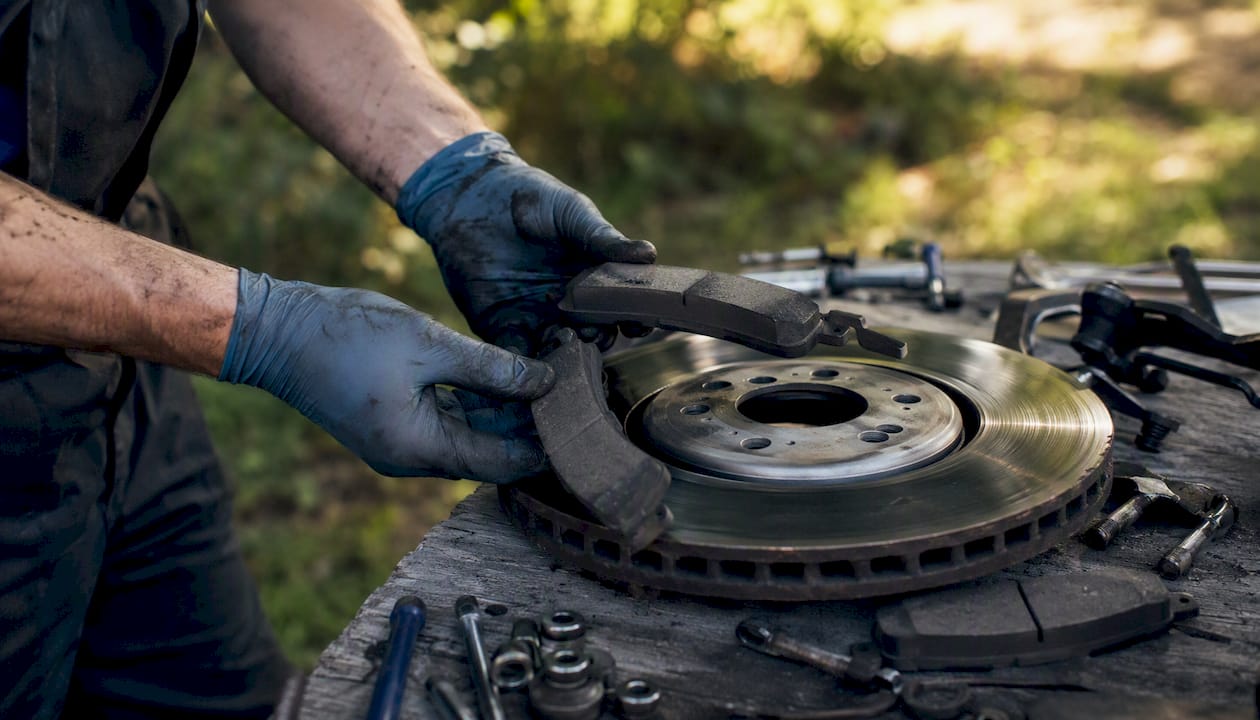
Persistent grinding, pedal roughness, pulling, or any of the warning signs above all warrant a professional inspection. A thorough brake inspection covers these areas:
- Pad thickness: Pads worn below the manufacturer’s minimum (typically 2–3 mm) need immediate replacement.
- Rotor runout and warp: A dial indicator measures lateral runout; warped rotors cause pedal pulsation.
- Rotor surface condition: Pitting, deep grooves, or a rotor below minimum thickness spec requires resurfacing or replacement. Extended parking in wet conditions can pit the rotor surface beyond what braking can clear, making resurfacing or replacement necessary.
- Caliper slide-pin operation: Pins should move freely and return the caliper squarely. Seized pins cause uneven pad wear and persistent drag.
- Parking brake condition: Cable tension, hardware condition, and rear pad contact are all checked.
- Brake fluid and hoses: Moisture-contaminated fluid lowers the boiling point; cracked hoses can cause pressure loss.
Common shop interventions by symptom category:
| Symptom Category | Typical Intervention |
|---|---|
| Flash rust, noise clears in a few stops | No repair needed; driver education only |
| Minor surface rust, light scoring | Rotor cleaning or light resurfacing; pad inspection |
| Worn pads, light rotor wear | Pad replacement, rotor inspection, hardware service |
| Warped or pitted rotors | Rotor resurfacing (if within spec) or replacement |
| Seized caliper or slide pins | Caliper service, slide-pin cleaning and lubrication |
| Metal-on-metal contact, deep scoring | Full pad and rotor replacement, caliper rebuild |
Pricing in Canada varies by vehicle make, whether rotors can be resurfaced or must be replaced, and local labor rates. Always ask for a written inspection estimate before authorizing work. A shop that cannot give you a written breakdown before starting is worth reconsidering.
How to reduce brake grinding after wet weather
Prevention is mostly about moisture management and material choices. A few consistent habits make a measurable difference.
- Short drive after washing your car. After a car wash, take a short drive and apply the brakes gently two or three times. This evaporates surface moisture and reduces the risk of the pad bonding to the rotor during an extended park.
- Avoid setting the parking brake on wet rotors for long-term storage. If you park for more than a day or two, use wheel chocks instead. Static contact between a wet pad and a wet rotor is exactly the condition that promotes corrosion stiction.
- One firm stop before a long park. Before leaving the car for several hours after driving in rain, a single firm stop generates enough heat and friction to dry the rotor contact surface.
- Inspect and lubricate caliper slide pins annually. Routine lubrication of slide pins is a high-impact, low-cost step that prevents the uneven pad wear and persistent drag that wet climates accelerate.
- Replace pads before they reach the wear indicator. Thin pads have less thermal mass and less friction material, making them more susceptible to moisture effects and faster to develop noise.
- Undercarriage rinses after road salt exposure. Salt-laden spray from winter roads in provinces like Ontario, Quebec, and British Columbia accelerates corrosion on rotors, calipers, and hardware. A rinse after salted-road driving extends component life.
Material upgrades also reduce wet-weather symptoms. High-carbon rotors resist thermal shock and surface oxidation better than standard gray iron castings. GEOMET-coated or semi-coated rotors add a corrosion-resistant layer to the hat and vane areas, slowing the rust that spreads from unswept surfaces. Ceramic pads with moisture-management formulations maintain a more consistent friction profile on the first wet stop compared to standard organic or semi-metallic compounds.
Pro Tip: If you live near the coast or drive on salted winter roads regularly, plan a full brake inspection every spring. Salt chlorides penetrate hardware and slide-pin boots faster than plain moisture, and the damage accumulates invisibly until a component seizes.
What does the research say about moisture and corrosion stiction?
Most drivers think of brake noise as a mechanical problem. The materials science behind it is more specific, and understanding it helps explain why some vehicles are more prone to wet-weather grinding than others.
The 2025 SAE study on friction-material moisture diffusion describes a two-stage process. In the first stage, moisture saturates the pad surface rapidly. In the second, it diffuses more slowly into the pad body. Pads with higher diffusion coefficients reach surface saturation faster, which accelerates the corrosion reaction at the pad-rotor interface. The practical implication: a more porous or hydrophilic pad compound will develop stiction conditions sooner than a denser, less water-absorbent formulation.
| Research Finding | Practical Meaning for Drivers |
|---|---|
| Two-stage moisture diffusion in NAO pads | Surface saturation happens quickly; interior saturation takes longer |
| Higher diffusion coefficient = faster stiction risk | Porous pads in wet climates develop bonding conditions sooner |
| Surface topography after braking affects stiction | Worn or scored pad surfaces are more vulnerable than fresh ones |
| Chloride environments accelerate corrosion products | Coastal and salted-road driving increases stiction frequency |
ISO 6315-style testing procedures measure the static force required to break pad-rotor adhesion after a controlled soak period. Shops rarely perform this test on consumer vehicles, but the principle informs why a vehicle parked overnight in a humid garage after a rainy commute may feel stiff on the first brake application the next morning. That initial resistance is corrosion stiction at a mild level. When it progresses, the pad surface can tear rather than slide cleanly.
Our perspective: what we see in the shop and what actually matters
Flash rust accounts for the majority of brake noise complaints that come in after rain. The pattern is consistent: a driver hears grinding on the first stop of the morning after an overnight rain, applies the brakes two or three more times, and the noise is gone. No fault, no repair needed. The challenge is that the same symptom, grinding after wet weather, can also be the first sign of a caliper that has been seizing for months or pads that are a few hundred kilometers from metal-on-metal contact.
The rule we rely on is simple: if the noise clears within 3–10 stops and the pedal feels normal, it is almost always harmless. Anything beyond that deserves a look. A professional inspection takes less than an hour and gives you a written picture of where every component stands. That is worth far more than guessing.
Canadian drivers face a specific compounding factor. Road salt from October through April does not just rust the rotor face; it penetrates caliper boots, corrodes slide pins, and works into parking brake cables. By the time spring rain arrives, some of that hardware is already compromised. A post-winter brake inspection is not optional maintenance in this climate. It is the baseline.
We also want to be direct about one thing: a grinding noise that clears is not a reason to skip your next scheduled brake service. Flash rust is normal. Ignoring the interval that follows is not.
Weather-resistant brake components from Aaafrictions

If wet-weather grinding is a recurring issue for your vehicle, the component materials are worth examining. Aaafrictions engineers its HydroAdaptive ceramic brake pads to manage moisture at the friction interface, maintaining a consistent friction profile from the first wet stop rather than the third or fourth. The ceramic compound is denser and less hydrophilic than standard NAO formulations, which directly reduces the surface saturation rate that the 2025 SAE research identifies as the primary driver of corrosion stiction risk.
Paired with semi-coated or GEOMET-coated rotors, the system addresses both the rotor face and the surrounding metal that standard pads leave exposed to rust. The result is a braking ecosystem that behaves predictably in rain, humidity, and the salted winter conditions common across Alberta, Ontario, Quebec, and British Columbia.
Browse the full range of weather-ready brake kits at Aaafrictions.ca, or use the vehicle search tool to find the kit built for your specific make and model. Professional installation is recommended for full system kits; Aaafrictions components are compatible with standard shop procedures and come with manufacturer warranty coverage.
Sources
- Brakes Grinding After Driving in Rain: Surface Rust & Wet Pads | AmpAuto
- Why Brake Rotors Rust Overnight—And When To Worry | Motor1
- Wet Weather Braking Dangers: How Rain Affects Your Brakes | Direct Brakes