

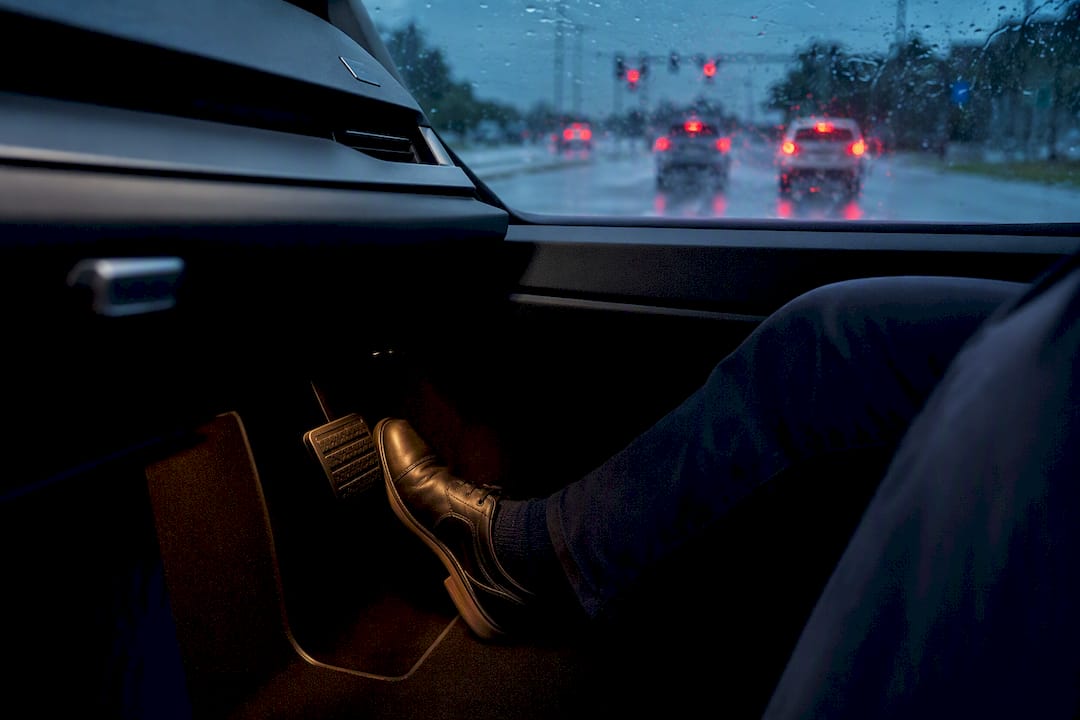
Spongy brakes in rain almost always come from a water film between your pads and rotors, moisture that’s worked into the pad material, or trapped air and vapor in the brake lines. The fix for the first two is immediate: on a clear, empty stretch of road, gently press the brake pedal several times at low speed to sweep water off the rotors. If the pedal keeps sinking, an ABS light comes on, or stopping distance stays long after drying, stop and get the car inspected.
TL;DR:
- Water film on rotors and moisture absorbed into brake pads can cause temporary sponginess during rain, which usually clears with gentle dry-out routines.
- Checking brake fluid color, rotor surface, and pedal feel helps differentiate between surface moisture and mechanical issues requiring professional inspection.
- Repeated gentle pressing at low speed on a clear road can quickly dry moisture and restore normal braking feel, but persistent softness indicates needed repair.
- Upgrading to moisture-resistant brake pads and coatings, along with regular fluid flushes, can mitigate wet-weather pedal softness for frequent rainy-day drivers.
- Hydraulic issues like air in lines or worn hoses do not resolve with drying routines and require a mechanic’s intervention to ensure safe braking performance.
Table of Contents
- Why Do Brakes Feel Spongy in Rain? What to Do Right Now
- What Causes Spongy Brakes in Wet Conditions?
- How to Check If Your Brakes Need Service
- When Should You Take Your Car to a Mechanic?
- How to Prevent Spongy Brakes Before the Next Rainstorm
- AAA Frictions’ Take on Wet Braking Performance
- What Owners Should Actually Expect From Wet Brake Fixes
- Get Wet-Weather Brakes Built for Consistent Stops
- Sources
Why Do Brakes Feel Spongy in Rain? What to Do Right Now
You don’t need to diagnose the exact cause before acting. You need to restore bite safely, and there’s a well-established way to do it.
-
Find a clear, low-traffic stretch of road. Never test braking in traffic, on a hill, or in an intersection. Give yourself extra following distance the moment you notice the softness.
-
Slow to a safe, controlled speed. A slow, controlled speed typical for most conditions is advisable.
-
Apply light, repeated pressure to the pedal. Several gentle presses in a row help sweep the water film off the rotor surface, which is the same drying technique safety guides recommend after heavy rain or a shallow water crossing.
-
Check the pedal feel after each attempt. A pedal that firms up within a few tries usually confirms a temporary water film, not a mechanical fault.
-
Adjust your driving in the meantime. Slower speeds, longer gaps, and lighter braking inputs buy you margin while the system recovers.
If the pedal firms up and stopping distance feels normal again, you’re clear to continue, though it’s worth staying alert for a few more miles. If nothing changes after several attempts, or the pedal continues to sink toward the floor, don’t keep testing it. Pull over safely and arrange a tow or roadside inspection instead of driving further on a brake system that isn’t responding.
Pro Tip: Do this drying maneuver the first time you drive through a deep puddle or a car wash, not just when you feel a problem. It takes ten seconds and can prevent a scary surprise at the next stop sign.
For a step-by-step version of this routine you can save for later, see our guide on drying brakes while driving.
What Causes Spongy Brakes in Wet Conditions?
Wet weather brake issues rarely come from one single problem. Several separate mechanisms can produce the same soft, mushy pedal feel, and knowing which one you’re dealing with changes how you should respond.
- Water film at the pad/rotor interface. A thin layer of water sits between the pad and the rotor surface, cutting initial friction and shifting how the system vibrates until it’s swept away.
- Moisture soaked into the pad material itself. This is different from a surface film. Research on copper-free NAO pads shows moisture adsorbed into the friction material lowers the in-stop friction coefficient and increases low-frequency oscillation, which is exactly what a spongy pedal feels like at low speed.
- Air or vapor in the hydraulic lines. Brake fluid is hygroscopic, meaning it absorbs moisture over time. That absorbed water can flash to vapor under heat, and both air and vapor compress under pedal pressure, unlike fluid, which doesn’t.
- Flash rust and thermal shock on rotors. Hot rotors hitting cold rainwater, or rotors sitting wet overnight, can develop a thin rust layer or surface pitting that produces an uneven, sometimes noisy first few stops.
Water on the disc surface doesn’t just dilute friction mechanically. Thermokinetic research on friction pairs under wet conditions found that water can act as an electrolyte on the disc, triggering electrochemical reactions that alter friction and accelerate localized corrosion. That’s a chemical process layered on top of the simple physical film, which is part of why some wet-brake symptoms linger longer than a quick dry-out.
The moisture-adsorption effect is worth pausing on. It’s strongest at low and moderate speeds, which lines up with real-world complaints: drivers notice the soft pedal pulling into a driveway or stopping at a light far more than they do braking hard from highway speed, when heat and pad pressure work in their favor.
How to Check If Your Brakes Need Service
A soft pedal after rain isn’t automatically a red flag, but it’s worth running through a short checklist before you decide it’s nothing.
- Press and hold the pedal at a stop. If it holds firm without sinking, that’s a good sign. A pedal that slowly sinks toward the floor points to air, vapor, or a fluid leak, not just surface moisture.
- Do a repeated-press test. Pump the brake a few times in a row. If it firms up with each press, you likely have air in the lines rather than a wet-film issue, which typically clears with a single round of gentle driving.
- Check fluid level and color at the master cylinder. Fluid should be close to clear or light amber. Dark, cloudy, or visibly contaminated fluid suggests moisture buildup or overdue service.
- Look at the rotor surface. Light surface rust that clears after a few stops is normal. Deep pitting, grooving, or an uneven glaze on the pad face is not.
- Pay attention to road behavior. Pulling to one side, ABS activating on light braking, or persistent grinding or squeal after the first few stops all point past simple wet-film friction loss. Our guide on brakes squealing when wet covers what that specific symptom usually means.
Steps 1, 2, and 5 you can safely judge from the driver’s seat. Fluid condition and rotor surface inspection are easy to eyeball in a driveway, but a full diagnosis of internal corrosion or hose integrity needs a lift and a trained eye. Wet roads also reduce tire grip on their own, and hydraulic braking research on wet pavement shows deceleration capability drops even with a perfectly healthy brake system, so factor that into how you’re reading the road behavior test.
When Should You Take Your Car to a Mechanic?
If drying attempts don’t restore a firm pedal, or the softness returns every time it rains, the issue has moved past a simple water film into something a shop needs to address.
- Fluid bleed and flush. Because brake fluid absorbs moisture over time, shops can test its water content and flush contaminated fluid that’s boiling or vaporizing under heat.
- Hose, caliper, or wheel cylinder inspection. Cracked hoses, sticking calipers, or worn wheel cylinders can trap air or leak fluid, both of which produce a chronically soft pedal.
- Rotor resurfacing or replacement. Warped or corroded rotors from repeated flash rust cycles need to be machined or swapped, along with any pads that have picked up glaze or contamination.
- Immediate stop-driving situations. A pedal that sinks to the floor, a brake warning light paired with a soft pedal, or a pull that gets worse rather than better after drying attempts means the car should be towed, not driven to the shop.
If you need a starting point for local service, directories like GarageMap list brake shops by region that can handle a full bleed or hose replacement.
How to Prevent Spongy Brakes Before the Next Rainstorm
Brake maintenance for rainy days works best as routine upkeep, not a reaction to a scary pedal. A few habits meaningfully cut how often this happens.
- Flush brake fluid on schedule. Because DOT fluid pulls in moisture from the air over time, a two-to-three-year flush interval (check your owner’s manual) keeps water content low enough to avoid vapor formation.
- Choose pad material with your climate in mind. Ceramic compounds generally handle moisture uptake and noise better than semi-metallic pads in wet, humid regions, though semi-metallic can still make sense for heavy towing or track use. Our comparison of ceramic and semi-metallic pads breaks down the trade-off in more detail.
- Ask about corrosion-resistant rotor coatings. Protective coatings reduce flash rust buildup on rotors that sit wet overnight, and pairing them with rust-prevention products for winter driving helps in regions that see salt and slush on top of rain.
- Have hoses checked for age and cracking. Rubber brake hoses degrade over years, and a hose with internal collapse can trap air invisibly. Ask your shop to check hose age at every fluid service.
AAA Frictions’ Take on Wet Braking Performance
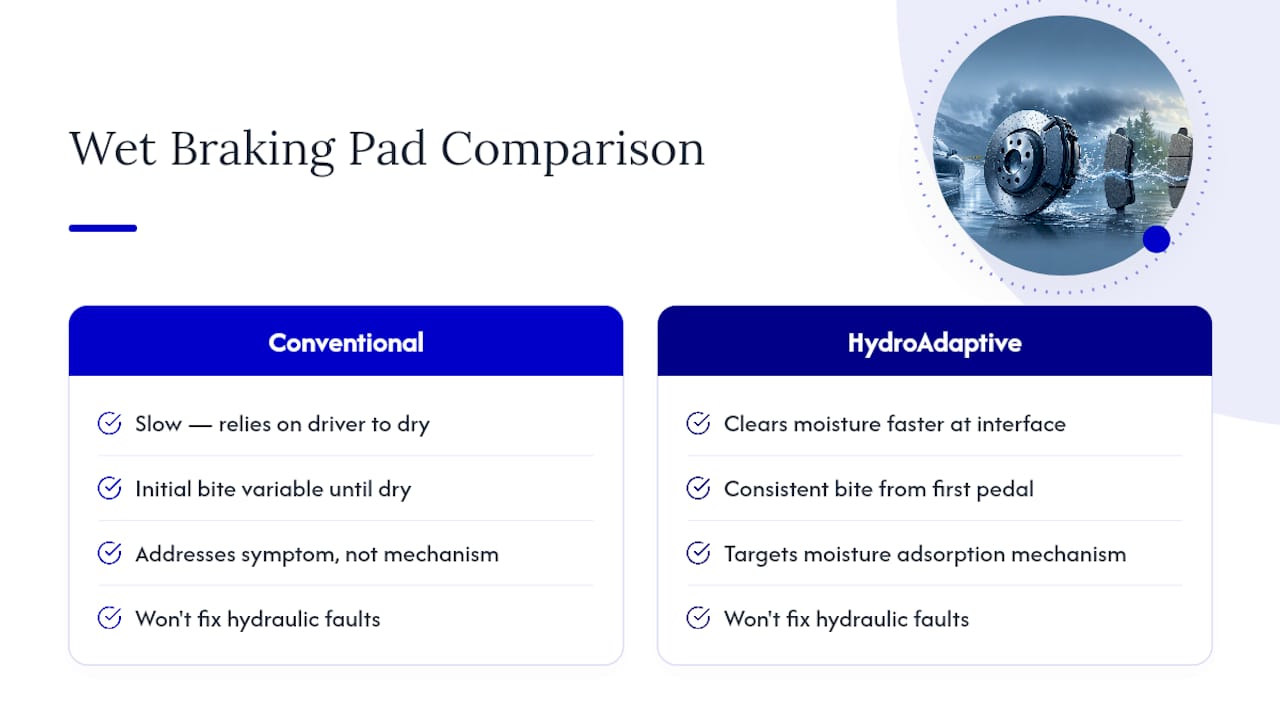
Standard pad and rotor combinations rely on the driver to physically dry the rotors before full bite returns, and that dependency is the real weak point in wet weather. Our HydroAdaptive ceramic formulation is engineered around that gap: the friction material is designed to clear moisture from the pad/rotor interface faster than a conventional compound, so the initial friction coefficient stays more consistent from the very first pedal press in the rain.
Moisture adsorption into pad material is one of the clearest, most reproducible causes of wet-weather friction loss at low speeds. A friction material engineered to shed that moisture faster directly targets the mechanism, not just the symptom.
That’s a meaningful mitigation, not a cure-all. HydroAdaptive pads reduce the variability in friction coefficient that moisture causes, but they don’t fix air in your lines, a failing hose, or fluid overdue for a flush. If your hydraulic system needs bleeding, that work still has to happen regardless of which pads sit on the rotor.
Pro Tip: When shopping for a wet-weather kit, check that the rotor coating and pad compound are matched as a set rather than mixed. Our vehicle-specific HydroAdaptive kits are built that way for a reason.
What Owners Should Actually Expect From Wet Brake Fixes
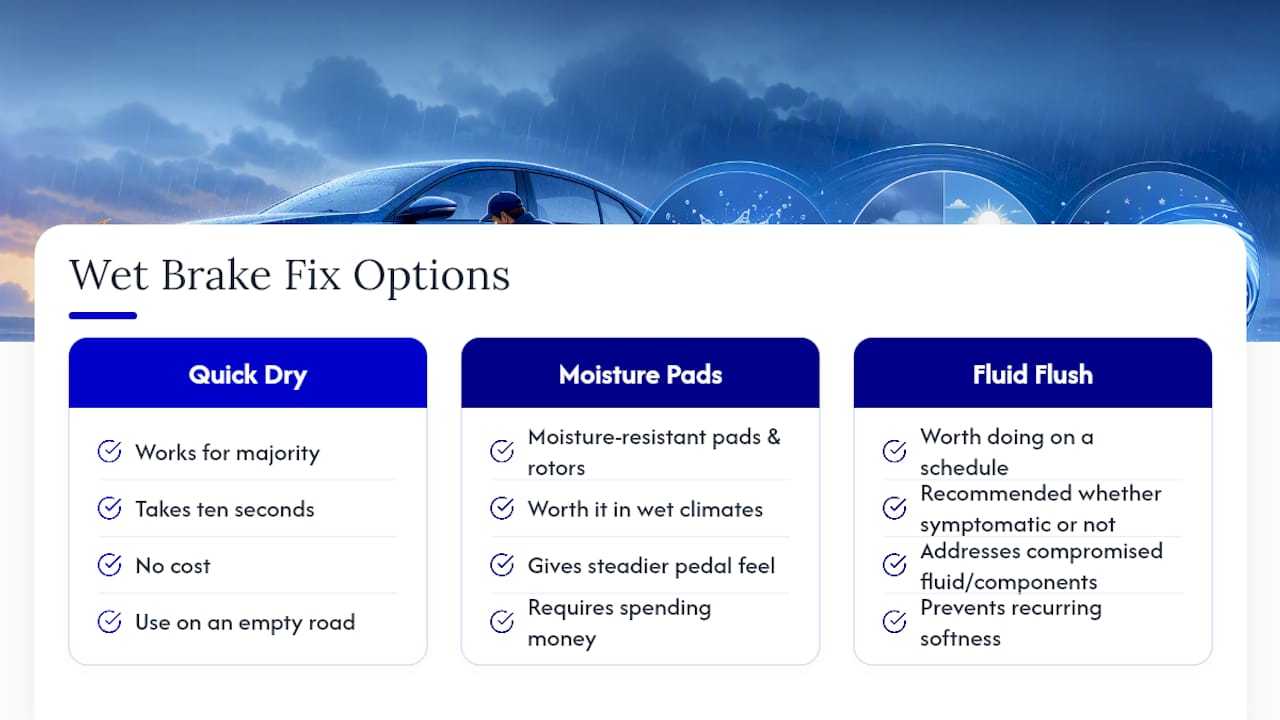
Quick drying works fine for the majority of rain-related soft pedals, and it costs nothing but ten seconds on an empty road. Where owners get surprised is assuming that trick fixes everything: if the softness returns rain after rain, that’s a signal the fluid or a component is compromised, and no amount of pumping the pedal changes that.
Upgrading to moisture-resistant pads and rotors is worth the money if you drive in wet climates often and want steadier pedal feel; a fluid flush is worth it regardless, on a schedule, whether or not you’ve felt a problem yet.
— AAA
Get Wet-Weather Brakes Built for Consistent Stops
If drying tricks and fluid flushes only get you partway there, the next step is a brake system that doesn’t lose bite in the first place. A direct alternative to living with seasonal pedal softness is available: some advanced brake pads and rotors are engineered to clear moisture from the friction surface faster than standard compounds, aiming to provide more consistent pedal feel across rain, humidity, and cold without swapping parts every season.

Every kit is sold as a vehicle-specific match rather than a generic fit, meaning the pad compound and rotor coating are paired for exact vehicle makes and models instead of guessed at. You can search your vehicle here to find your kit, or browse the full HydroAdaptive lineup if you want to compare options first. Once you’ve picked a kit, installation is a standard brake job at any shop equipped to do rotor and pad service, no special tools required. If you’re not sure which kit fits your car or want fitment help before you order, reach out through the landing page and get pointed to the right part before you check out.
Sources
- Effect of Moisture Adsorption on Low-Speed and Moderate-Speed Braking: Effect on In-Stop Friction Coefficient and Low Frequency Noise
- Thermokinetic studies of friction pairs under wet conditions (journal article)
- Engineerskill
- Wet-road braking distance estimates using hydroplaning analysis (journal article)