

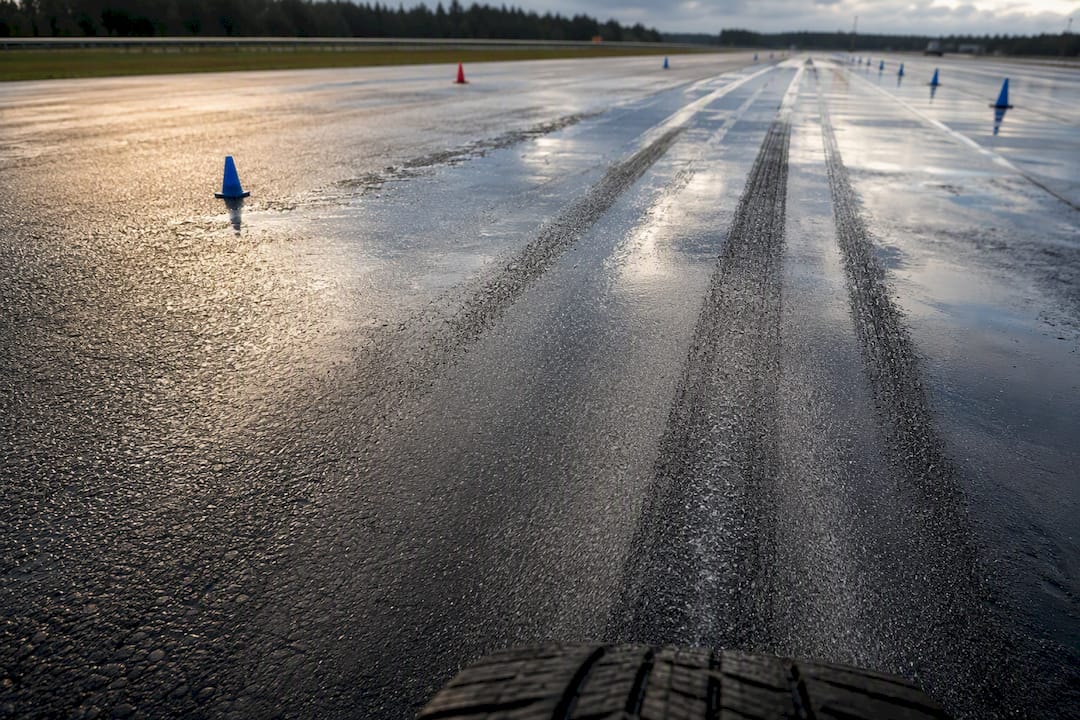
Wet roads roughly double your total stopping distance compared to dry pavement, and the single biggest fix costs nothing: stop following at two seconds and start following at four. Both halves of your stopping distance, the thinking part and the braking part, get worse in the rain. Build the extra gap into your driving before the rain does it for you.
TL;DR:
- Wet roads can increase total stopping distance to at least double the dry distance, making a four-second following gap essential at all speeds.
- Rain extends both thinking and braking distances, with higher speeds disproportionately increasing the overall stopping distance due to nonlinear scaling.
- Tire tread depth, vehicle condition, and road surface quality are critical factors influencing wet stopping distances, especially with worn tires or standing water.
- Reducing wet-weather risk relies more on slowing down early, extending following distance, and managing visibility than on hardware upgrades alone.
- Proper vehicle maintenance, including tire tread, brakes, and wipers, combined with driving habits, significantly improves safety in rainy conditions.
Table of Contents
- How Rain Changes Your Stopping Distance in the First Place
- Wet Road Braking Distance by Speed: The Real Numbers
- What Actually Determines Wet Road Stopping Distance
- Practical Adjustments That Cut Your Risk in the Rain
- Your Wet-Weather Vehicle Maintenance Checklist
- Where Brake Technology Fits Into the Picture
- A Word From AAA on What Actually Matters
- Get Brakes Built for the Weather You Actually Drive In
- Sources
How Rain Changes Your Stopping Distance in the First Place
Total stopping distance breaks into two pieces: thinking distance, the ground you cover between spotting a hazard and touching the brake, and braking distance, the ground you cover once the pads bite. Rain lengthens both.
Spray off other vehicles, fogged glass, and dimmer light all slow down how fast your eyes and brain process a hazard. That extra half second of hesitation at highway speed adds real distance before your foot even moves. Then, once you brake, a thin film of water sits between your tire and the road, cutting the friction your tires can generate.
- Thinking distance grows with reduced visibility and spray from surrounding traffic.
- Braking distance grows because water reduces the contact between rubber and asphalt.
- Hydroplaning happens when tires can’t channel water away fast enough and lose contact with the road entirely, most common at higher speeds in standing water.
This is why Gov states plainly that wet stopping distances run at least double dry distances, and instructs drivers to keep well back and ease off if the steering feels light or unresponsive.
Wet Road Braking Distance by Speed: The Real Numbers
Numbers make this concrete. At around 30 mph, a dry stop takes roughly 75 feet total; in the rain, that stopping distance can increase to about double due to extended thinking and braking phases, as described in official guidance. Push that to highway speeds and the gap widens further, because braking distance scales with the square of speed, not a straight line, according to Brake’s analysis of stopping distances. A small increase in speed produces a disproportionately larger increase in how far you travel before stopping, and that effect only gets worse on a wet surface.
Quick reference: what “four seconds” actually looks like on the road
- At 30 mph, four seconds of following distance is roughly 176 feet, about 12 car lengths.
- At 50 mph, four seconds stretch to nearly 300 feet, closer to 20 car lengths.
- At highway speeds, that gap can exceed 400 feet, longer than a football field.
These figures shift with your specific vehicle, tire condition, and road surface, so treat them as a baseline, not a guarantee. Heavier vehicles, worn brakes, or bald tires will need more room than these numbers suggest.
What Actually Determines Wet Road Stopping Distance
Not every wet-weather drive carries the same risk. A few variables do most of the work in determining how much distance you actually need.
- Tire tread depth matters more than most drivers realize. Kwik Fit’s research on wet weather stopping distances notes that tread channels water away from the contact patch, and performance drops sharply as tread wears down, especially below 7°C when rubber stiffens.
- Speed compounds every other factor, since braking distance rises with the square of speed rather than in a straight line.
- Road surface condition varies a lot. Standing water, painted lane markings, and the oily film that builds up during a dry spell all reduce grip, and that first rain after weeks of dry weather is often the slickest driving you’ll encounter all year.
- Vehicle condition including brake pad wear, tire pressure, and cargo load changes how quickly your car can convert pedal pressure into an actual stop.
- Visibility through spray and rain reduces reaction time before you even reach the braking phase.
Practical Adjustments That Cut Your Risk in the Rain
Reducing risk in wet weather is less about heroics and more about small, consistent habits applied before conditions turn dangerous.
- Slow down before you need to, not after. Ease off ahead of heavy spray, pooled water, or reduced visibility rather than reacting once you’re already in it.
- Extend your following distance to a minimum of four seconds, and add more as speed or rain intensity increases. Driving school guidance backs this figure specifically because it accounts for the added thinking and braking distance rain creates.
- Brake progressively rather than stomping the pedal. If the steering suddenly feels light or unresponsive, a sign of early hydroplaning, ease off the accelerator and hold the wheel steady instead of braking hard, which can worsen the loss of control.
- Manage your visibility actively. Turn on headlights in heavy rain, keep wipers in good condition, and avoid tucking in close behind trucks or buses that throw up heavy spray.
- Adjust your approach to match rainfall intensity. Light rain calls for a wider gap and a lighter foot; standing water calls for a full stop in speed and a wide detour around the puddle if one is visible.
Pro Tip: If you ever feel your steering go light and unresponsive on a wet road, resist the instinct to brake harder. Ease off the gas and hold your line. Fighting the wheel or stabbing the brakes during hydroplaning almost always makes things worse.
Your Wet-Weather Vehicle Maintenance Checklist
Good habits behind the wheel only go so far if the car underneath you isn’t ready for rain. A short maintenance routine closes that gap.
- Tires: check tread depth regularly, and don’t wait until you hit the legal minimum. A drop from roughly 8mm to 3mm meaningfully lengthens wet braking distance, so replacing tires early is cheap insurance.
- Brakes: listen for grinding or grabbing after wet drives. If pads feel inconsistent when damp, it’s worth reading through the specifics of why brakes grab when wet before assuming it’s normal.
- Wipers and washer fluid: replace wiper blades at the first sign of streaking, and keep washer fluid topped up year round.
- Lights, tire pressure, and load: confirm all lights work, keep tires at the recommended pressure, and avoid overloading the vehicle, since added weight changes how quickly it stops.
Pro Tip: Test your wipers on a dry windshield before the next storm. If they squeak, skip, or leave streaks, replace them now. You don’t want to discover a bad blade during your first heavy downpour of the season.
Where Brake Technology Fits Into the Picture
Driving habits and maintenance handle most of the risk rain creates, but the hardware under your car plays a role too. AAA Frictions built its HydroAdaptive technology specifically to address how standard brake pads behave once water gets between the pad and rotor.
- The ceramic formulation is engineered to clear moisture quickly and hold consistent friction across wet, humid, and cold conditions.
- This targets the exact problem drivers feel as brake fade or hesitation right after driving through a puddle or a car wash.
- Hardware like this supplements safe driving; it doesn’t replace slowing down, extending your following distance, or keeping tires in good shape.
If you’ve noticed brakes squealing when wet or grinding after rain, those symptoms are worth investigating regardless of what’s installed under the hood.
A Word From AAA on What Actually Matters
Three things move the needle more than anything else we could sell you: slow down before conditions demand it, keep four seconds of space instead of two, and check your tires and brakes before the rain does it for you. Everything else, including the hardware in your car, works best on top of those habits, not instead of them.
— AAA
Get Brakes Built for the Weather You Actually Drive In
Standard brake pads were designed with dry pavement in mind, which is exactly why performance dips the moment water gets involved. Some brake pad product lines are built around the assumption that rain, slush, and humidity are normal driving conditions, not edge cases.

Some brake kits pair ceramic pads designed to clear moisture quickly with corrosion-resistant rotors, aiming for consistent pedal feel whether the road is dry, soaked, or somewhere in between. Drivers who commute through unpredictable seasonal weather tend to notice the difference first during that first heavy rain after a dry spell, when standard pads feel inconsistent and HydroAdaptive pads don’t. Browse wet-weather brake pad options built for your vehicle, or head to the AAA Frictions landing page to check fitment and get a kit ordered before the next storm rolls in. Installation should always be handled by a qualified technician familiar with your specific make and model.
Sources
- The Highway Code – Driving in adverse weather conditions (226 to 237)
- Wet Weather Stopping Distances | Kwik Fit
- Stopping distances | Brake
- Driving in Rain: DVSA Skill 25 — Adverse Weather Guide | DriveSchoolPro