

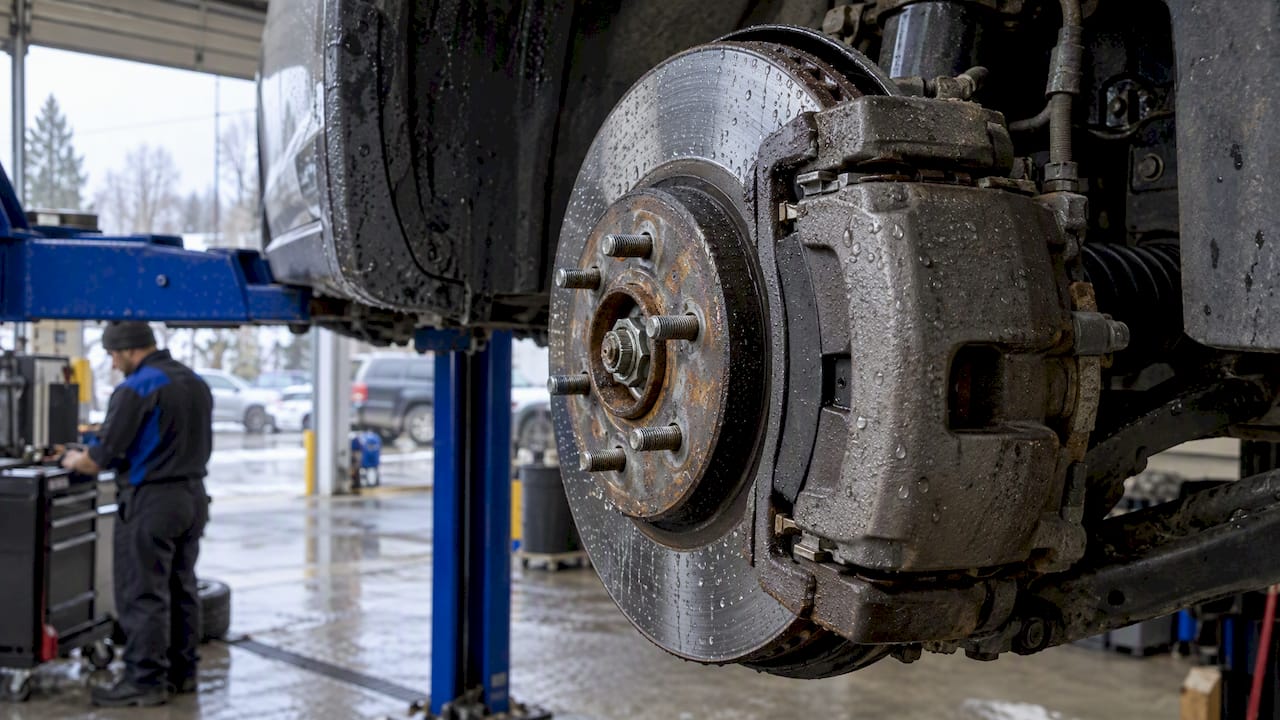
Moisture management in a brake pad is the pad’s ability to deal with water at the friction surface, so the first stop on a wet road feels like the tenth. It is a property of the pad compound, but the rest of the system matters too: the rotor surface, the caliper and the fluid all decide whether your pedal stays predictable when the weather turns. This guide explains what happens to brakes in rain, humidity and slush, what a moisture-managing pad is built to do, and what you still need to maintain yourself.
TL;DR
- Water on the rotor and humidity in the pad change the friction coefficient, which is why braking can feel delayed or inconsistent in wet weather.
- A moisture management pad is engineered to clear water quickly and hold a stable friction profile. Our HydroAdaptive ceramic formulation is built for exactly that.
- Pads are only one part of the answer. Brake fluid absorbs moisture over time, and road salt attacks calipers and lines.
- Check brakes at least every six months and inspect pads every 15,000 to 30,000 kilometres, sooner if you drive in harsh conditions.
- Match pads, rotors and calipers as a system for the most consistent pedal feel through all four seasons.
Table of Contents
- What moisture does to a brake pad
- What “moisture management” means in practice
- How HydroAdaptive ceramic technology approaches it
- Pads are not the whole system: the other places moisture hits
- A seasonal view for Canadian drivers
- Maintenance intervals worth following
- Our perspective
- Choosing pads and rotors for moisture-prone driving
- Our moisture-managing range
- Fitting tips for DIY owners and mechanics
- Moisture management and the rest of your safety margin
- FAQ
- Sources
What moisture does to a brake pad
A brake works by pressing a friction material against a spinning rotor and turning motion into heat. Anything that gets between those two surfaces, or into the pad itself, changes how much grip you get.
There are two separate effects, and people often mix them up.
Surface water. In rain or through slush, a thin film coats the rotor. On the first brake application the pad has to wipe that film away before it bites fully. You feel it as a slight delay or a softer initial response, and it normally clears within a few applications as heat evaporates the water.
Absorbed humidity. Pad materials are porous composites. Research on automotive friction materials from Southern Illinois University found that humidity alters friction performance: moisture can act as a temporary lubricant that may reduce wear, but it often produces unstable friction coefficients and more adhesion between surfaces, which can show up as noise such as creep-groan. The same work points to advanced friction materials as the way to keep pedal feel consistent as humidity swings.

For Canadian drivers the swings are large. A Vancouver winter is damp for months. A Calgary chinook can take a road from frozen to wet in an afternoon. Nova Scotia and Newfoundland add fog and salt air. Ontario and Quebec add freeze-thaw cycles and heavy salting. A pad that only performs well when everything is dry and warm will spend a lot of the year outside its comfort zone.
We cover the diagnosis side in more detail in our guide to how humidity affects brake performance in Canada.
What “moisture management” means in practice
The phrase gets used loosely, so here is what we mean by it. A pad with real moisture management does three things.
- Clears water quickly. The compound and surface design help evacuate water from the pad-to-rotor interface so full friction arrives sooner.
- Holds a stable friction profile. The friction coefficient stays within a narrow band as humidity and temperature change, rather than jumping between cold-damp and hot-dry behaviour.
- Recovers predictably. After a wet stretch, the pad returns to normal behaviour without a long period of vague pedal feel.
There is a good reason to engineer for this rather than simply buy a harder or denser pad. Published work on friction material selection notes that properties such as hardness or porosity cannot reliably predict real-world friction. Performance depends on the whole tribosystem: pad, rotor, interface temperature and environmental factors such as humidity. In other words, a pad needs to be designed for the environment it will meet, not just for raw strength on a data sheet.
How HydroAdaptive ceramic technology approaches it
Standard ceramic pads are quiet and clean, which is why so many drivers choose them. In wet or humid climates, though, they can show delayed braking and an inconsistent pedal feel. That is the problem our patented HydroAdaptive system was developed to solve.
HydroAdaptive is a ceramic formulation designed to clear moisture rapidly and maintain reliable friction in rain, snow and humidity. The aim is a consistent, predictable stop whatever the season. You can read the technical background on our HydroAdaptive formulation page, and the basics of friction behaviour in our explainer on brake pad friction, materials and test codes.
What this means for you on the road:
- A more composed first stop after rain or a car wash.
- Less variation in pedal feel between dry mornings and damp evenings.
- Clean, stable braking behaviour across a wide temperature band.
We do not claim any pad removes the laws of physics. Water on a road still lengthens stopping distances, and tires matter at least as much as pads. What a well-engineered pad can do is make sure the brake itself is not adding to the problem.
Pads are not the whole system: the other places moisture hits
This is where many wet-weather problems actually start. Even the best pad performs poorly when the rest of the system is compromised by water and salt.
Brake fluid
Brake fluid is hygroscopic: it absorbs moisture from the air over time, even in a sealed-looking system. That moisture lowers the fluid’s boiling point. Under heavy braking, such as a long descent in the Rockies or the Coquihalla, fluid can boil and form vapour, leaving a soft or sinking pedal and much less stopping power. This is vapour lock, and it is described in Autosphere’s brake hardware analysis.
Two practical points follow:
- You cannot judge fluid by looking at the level or even the colour. Moisture content is invisible and needs a dedicated tester.
- Moisture also drives internal corrosion. The same source notes that technicians can overlook galvanic corrosion, with pitting in aluminum components that is close to impossible to spot visually, which is why professional testing and scheduled flushing matter.
Our page on brake fluid moisture for drivers and mechanics goes through what to ask your shop for.
Calipers and slide pins
In salted-road regions, moisture and contaminants migrate to the lowest point of the brake system, which is the caliper. Pistons can bind or seize, and slide pins can stick. A caliper that does not release fully drags the pad against the rotor, heating it and wearing it unevenly. That ruins the best pad compound quickly.
The same Autosphere piece adds that if a technician finds one corroded brake line, standard practice is to replace all of them, because the corrosion is systemic. Ignoring these parts will prematurely wear out even high-quality pads.
If you do your own work, our caliper slide pin maintenance guide is a short job that makes a real difference. For a caliper designed with seasonal moisture in mind, see our ClimateFlex brake calipers.
Rotors
Rotors rust the moment they get wet, and in winter salt speeds it up. Light surface rust is normal and wipes off in the first stops. Deep corrosion, pitting or a rusted rotor hat is a different matter, because it reduces the clean contact surface the pad needs. Research on brake disc materials in a high-salinity environment, published on Academia.edu, examines exactly how humidity and corrosion change friction and wear behaviour, which is why we treat the rotor as part of the moisture strategy and not an afterthought.
Our GC Type rotors and SC Type rotors are engineered with corrosion resistance in mind. If you are unsure which rotor design suits your axle, our notes on vented versus solid rotors explain why the front axle often changes the answer.
A seasonal view for Canadian drivers
Moisture shows up differently across the year. This table summarizes what to expect and what to do.
| Season | What the brakes face | What to check |
|---|---|---|
| Spring | Meltwater, slush residue, salt left on components | Rinse underbody, inspect calipers and slide pins, look at rotor surface |
| Summer | Heat, humid air, sudden downpours, mountain descents | Fluid condition, pad thickness, first-stop response after rain |
| Fall | Rain, fog, fallen leaves, temperature drops | Pad wear before winter, fluid test, rotor condition |
| Winter | Salt, slush, freezing and thawing | Caliper movement, rust on rotor edges, pedal feel after cold starts |
Timing matters. Fall is the best moment to fit new pads and rotors, so that the system is in good shape before the first salted road.
Maintenance intervals worth following
General industry guidance published in 2023 says that brake maintenance, including checks for moisture and fluid condition, should happen at least every six months, typically alongside a tire rotation. The same source suggests inspecting pads for replacement every 15,000 to 30,000 kilometres, and more often if you drive in extreme climates. Treat these as a baseline. Your vehicle’s manual and a qualified technician have the final say, particularly for towing, heavy loads or mountain driving.
A sensible routine looks like this:
- Twice a year, with seasonal tire changes, have pads, rotors, calipers and lines inspected.
- Have brake fluid tested for moisture, not just checked for level.
- Lubricate slide pins and check that the caliper moves freely.
- Keep wheels and brakes clean. Built-up dust and grime can reduce braking efficiency, and there are good notes on removing brake dust safely without harsh treatment of your wheels.
- Replace pads and rotors as a matched set when you can, so the surfaces bed in together.
Signs your brakes are struggling with moisture
See a qualified technician promptly if you notice any of these:
- A pedal that is soft, spongy or sinks slowly under steady pressure. This can point to fluid problems and should not wait.
- The vehicle pulling to one side under braking, which can indicate a seized caliper or slide pin.
- Grinding noises, which mean metal-on-metal contact.
- Brakes that remain weak after several stops once the pads are warm.
A brief squeal on a damp morning and a thin layer of rust that clears after the first stop are common and usually harmless.
Our perspective
We build brakes for climates that do not behave. In our experience the most common mistake is treating wet-weather braking as a pad problem alone. It is an ecosystem: the pad compound, the rotor surface, the caliper’s ability to release and the condition of the fluid all feed into the pedal you feel.
That is why our range is organized around the whole system. HydroAdaptive ceramic pads handle the friction interface. Corrosion-resistant rotors protect the surface the pad works against. ClimateFlex calipers and the right lubricants address the point where moisture and salt do their damage. When these parts are specified to work together, the temperature band in which the brake behaves consistently is wider, and the driver notices it as confidence rather than as a feature.
We would rather you ask the right questions than take our word. Ask any brake supplier how its pad behaves on the first wet stop, how it handles a cold, damp start and what it recommends for the rotor and caliper. If the answer is only about pad hardness, keep asking.
— AAA
Choosing pads and rotors for moisture-prone driving
Start with how you drive and where.
- Daily commuter in a wet or humid region (coastal British Columbia, the Maritimes): prioritize consistent first-stop response and corrosion protection on the rotor.
- Four-season driver in salt country (Ontario, Quebec, Manitoba): prioritize rotor coating, caliper movement and a fall installation.
- Mountain or towing use (Alberta, British Columbia): add fluid condition to the list and keep a shorter inspection interval.
- DIY owner or mechanic: confirm fitment for your exact vehicle, replace hardware as needed and follow bedding instructions.
Our guide to choosing brake pads for your car walks through fitment and use cases in more detail.
Our moisture-managing range
If you are ready to replace parts, our Type 03 brake pads and Type 07 brake pads both use HydroAdaptive ceramic technology and are matched to specific vehicles. Pair them with GC or SC Type rotors, or choose a complete kit such as the Type 03 pads and GC rotors kit, so that pad and rotor are designed to work together. You can also browse every disc brake pad set by vehicle, or see our overview of wet weather brake pads.
Fitting tips for DIY owners and mechanics
A moisture-managing pad performs best when it is installed on a clean, healthy system. A few habits help:
- Clean the caliper bracket contact areas and use the correct lubricant on slide pins and contact points, never on the friction surfaces.
- Check that pistons retract smoothly. A sticky piston is a sign of moisture damage and should be addressed before new pads go on.
- Inspect brake hoses and lines. If you find corrosion on one line, inspect all of them.
- Do not reuse a rotor with deep pitting or uneven wear just to save time.
- Follow the bedding procedure for the pad, and avoid hard stops from high speed in the first kilometres.
- Test fluid moisture with a proper tester, and flush if it is out of range.
If any step is outside your comfort zone, especially the hydraulic side, a qualified technician should do it. Brakes are a safety system, and a mistake is expensive.
Moisture management and the rest of your safety margin
Brake performance in wet weather depends on more than the brake. Tires with adequate tread and the right compound for the season set the limit of how hard you can actually stop. Following distance should grow in rain, and braking early and smoothly lets the pads and rotors clear surface water before you need full force.
A moisture-managing pad takes one variable out of the equation. It does not replace good tires, good habits or good maintenance, and we would be uncomfortable if anyone treated it that way.
FAQ
How do I get rid of moisture in my brakes?
Surface moisture on the rotor clears by itself through a few gentle brake applications, as friction heat dries the surface. Moisture inside the brake fluid does not clear that way. It needs a moisture test and, if the fluid is over the limit, a professional flush.
Do ceramic pads handle wet weather well?
Standard ceramic pads are quiet and clean, but some can feel delayed or inconsistent in wet or humid conditions. Our HydroAdaptive ceramic formulation was developed to clear moisture quickly and hold a stable friction level, which addresses that weakness.
How often should I have my brakes checked for moisture?
General guidance is at least every six months, typically with a tire rotation, with pad inspection between 15,000 and 30,000 kilometres. Drivers in extreme climates, or those who tow or descend mountain grades, should check more often.
Can brake fluid moisture cause a soft pedal?
Yes. Moisture lowers the fluid’s boiling point, and under heavy braking the fluid can boil and form vapour, which makes the pedal soft or sinking. If this happens, stop driving safely and have the system inspected by a qualified technician.
Sources
- Safe and Secure: Analyzing Brake Hardware, Autosphere
- Benefits of Brake Service, Charlottetown Mitsubishi
- Impact of Humidity on Wear and Creep Groan of Automotive Brake Friction Materials, Southern Illinois University
- Selection of Best Formulation for Semi-Metallic Brake Friction Materials Development
- Effects of humidity and corrosion on the tribological behaviour of the brake disc materials