

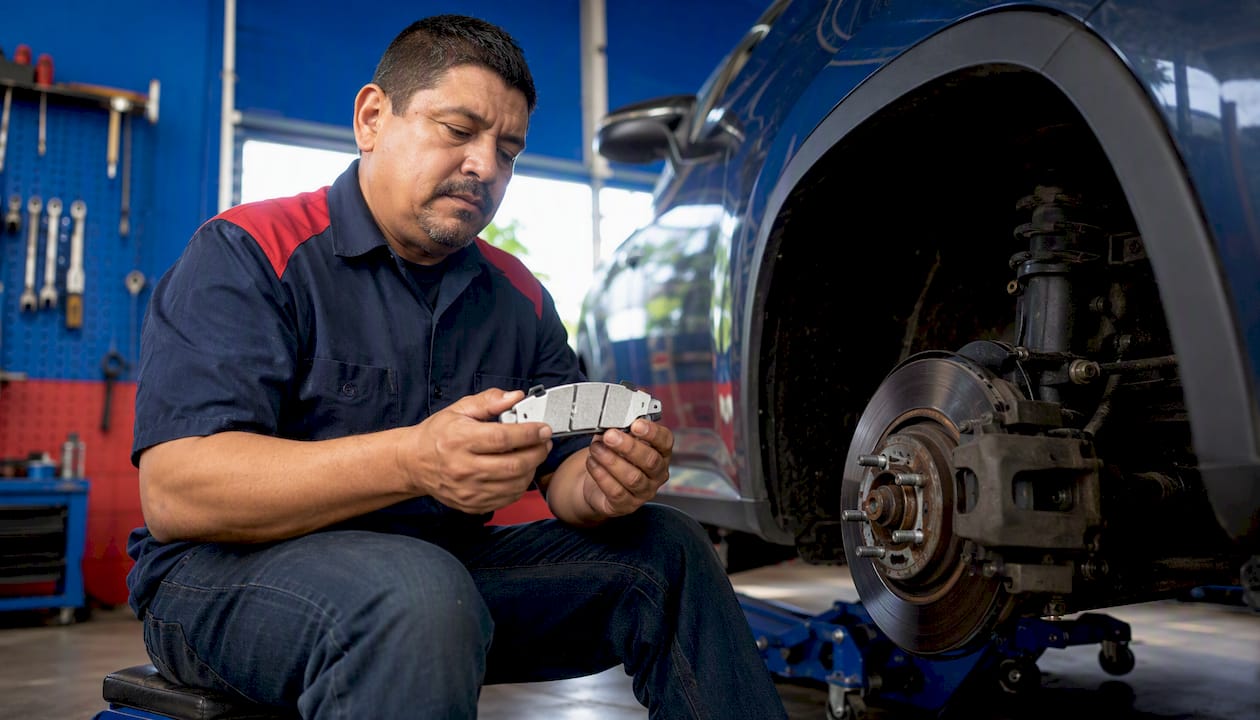
For most U.S. daily drivers, Aaafrictions’ HydroAdaptive ceramic pads are the clear recommendation. They combine low dust output, quiet NVH characteristics, and moisture-adaptive friction management that standard ceramics simply don’t offer. The primary trade-off is straightforward: if you tow heavy loads or run track days, you’ll want a semi-metallic compound instead. For everyone else, commuting through rain, road salt, or cold snaps, these pads deliver consistent pedal feel and clean wheels.
At a glance:
- Best for: Daily commuting, wet/salt-belt climates, low-dust and quiet-operation priorities
- Primary trade-off: Comfort and cleanliness over extreme sustained-heat performance
- Typical pad life: 50,000–60,000 miles under normal driving conditions
- Testing standard: SAE-style friction curve and dynamometer fade testing are the benchmarks for comparing compound performance across temperature bands
- Product families: Type 07 HydroAdaptive+, Type 03, and vehicle-specific front/rear kits
Table of Contents
- Which Aaafrictions ceramic variants match your driving needs?
- Why do most daily drivers prefer ceramic pads over semi-metallic or organic?
- When are ceramic pads not the right choice?
- How do you choose the right ceramic pads for your car and driving habits?
- Installation, bedding-in, lifespan, and typical replacement costs
- How does Aaafrictions’ HydroAdaptive technology work?
- Key Takeaways
- Why HydroAdaptive ceramics are the right call for most U.S. drivers
- Get the right Aaafrictions kit for your vehicle
- Useful sources and further reading
Which Aaafrictions ceramic variants match your driving needs?
Aaafrictions offers three distinct product families. Each is engineered for a specific friction profile and driving environment, so the right choice depends on your vehicle, climate, and how hard you use your brakes.
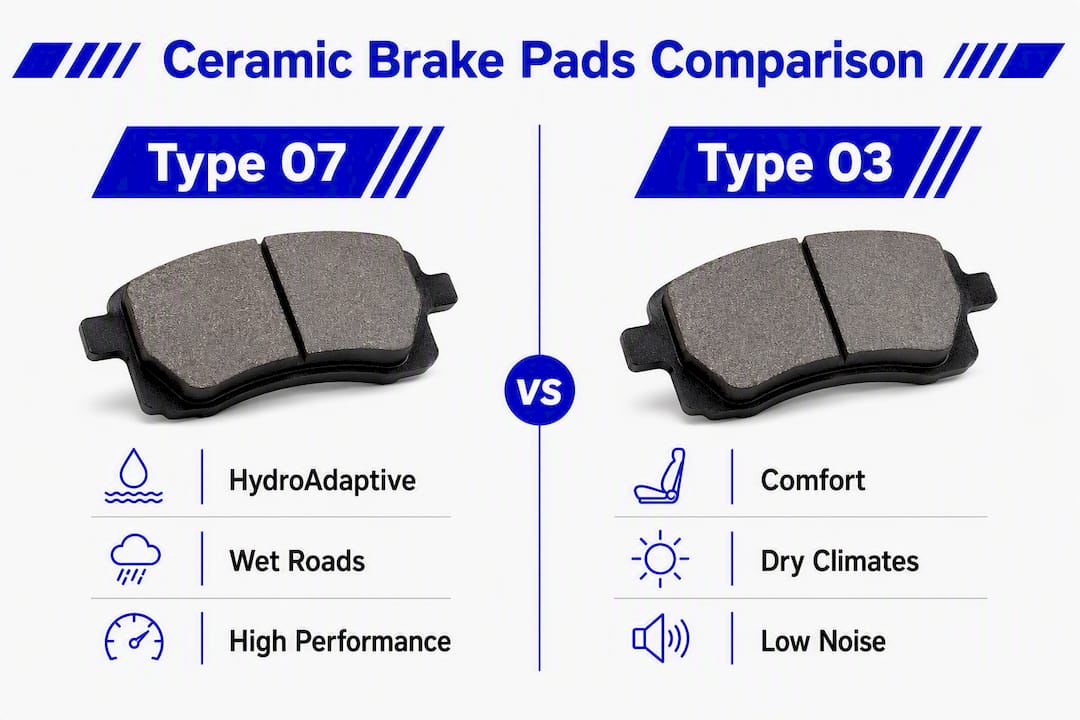
Type 07 HydroAdaptive+
This is the flagship formulation. Type 07 is built around Aaafrictions’ patented HydroAdaptive chemistry, which actively manages moisture at the pad-rotor interface. It’s the best fit for drivers in the Northeast, Midwest, and Pacific Northwest, where rain, slush, and road salt are seasonal constants. The friction profile stays stable from cold morning starts through highway-speed stops, and dust output is minimal enough to keep alloy wheels clean between washes.
Type 07 is available as a pads-only set or as a bundled kit pairing the ceramic pads with SC-Type semi-coated rotors or GC-Type GEOMET-coated rotors. Vehicle-specific kits cover a wide range of common commuter models, including the Honda Accord 2003–2007, Ford Fusion 2017–2019, Ford Escape 2017–2019, and the Acura TSX 2004–2008, among many others.
Type 03
Type 03 is Aaafrictions’ comfort-focused ceramic formulation, optimized for drivers in drier or more temperate climates where moisture management is less critical. It delivers the same low-dust, low-NVH characteristics as Type 07 but without the full HydroAdaptive moisture-channeling architecture. It’s a strong choice for drivers in the Sun Belt or Southwest who prioritize rotor friendliness and quiet operation above all-weather adaptability.

Vehicle-specific front/rear kits
Both Type 07 and Type 03 are available as matched front/rear brake kits. These bundles pair the correct pad set with a rotor grade matched to the vehicle’s OEM venting and metallurgy spec. Buying a kit eliminates the guesswork of sourcing compatible components separately and ensures the full braking system behaves as a cohesive unit.
| Variant | Best for | Dust level | Noise/NVH | Initial bite | Heat tolerance | Price/value | Warranty/fitment |
|---|---|---|---|---|---|---|---|
| Type 07 HydroAdaptive+ | Daily driving, wet/salt-belt, cold weather | Very low | Very quiet | Progressive, consistent | Moderate (street use) | Premium | Vehicle-specific kits available |
| Type 03 | Daily driving, dry/temperate climates | Very low | Very quiet | Progressive | Moderate (street use) | Mid-range | Vehicle-specific kits available |
| Type 07 + GC Rotor Kit | Full system upgrade, all-weather | Very low | Very quiet | Progressive, consistent | Moderate (street use) | Best value per system | Matched rotor/pad fitment |
| Type 07 + SC Rotor Kit | Budget-conscious all-weather upgrade | Very low | Very quiet | Progressive, consistent | Moderate (street use) | Value-oriented | Matched rotor/pad fitment |
Why do most daily drivers prefer ceramic pads over semi-metallic or organic?
Ceramic brake pads are widely recognized as the premium choice for everyday commuting in the United States. Three functional advantages drive that preference: quieter operation, less visible wheel dust, and gentler rotor wear over time.
Noise and NVH
Semi-metallic pads contain iron and steel fibers that generate more friction noise, especially during light, low-speed stops. Ceramics use a denser, more uniform compound that dampens vibration at the pad-rotor interface. The result is a quieter pedal feel that most drivers notice immediately after switching from a mid-grade metallic set.
Dust production and wheel cleanliness
Comfort-oriented ceramic compounds produce significantly less visible dust than semi-metallic alternatives. The dust ceramics do shed tends to be lighter in color and doesn’t adhere to wheel surfaces as aggressively, which matters if you care about keeping alloy or painted wheels clean between washes.
Rotor wear and lifespan
| Pad type | Typical lifespan | Rotor wear rate | Best climate fit |
|---|---|---|---|
| Ceramic (standard) | 50,000–60,000 miles | Low | Dry to moderate |
| Ceramic (HydroAdaptive) | 50,000–60,000 miles | Low | All-season, wet/salt |
| Semi-metallic | 35,000–45,000 miles | Moderate to high | High-heat, performance |
| Organic | a shorter lifespan | Low to moderate | Light-duty, mild climates |
Ceramics tend to be gentler on rotor surfaces because the compound’s hardness is more closely matched to cast iron than steel-fiber blends are. That translates to longer rotor life and fewer combined replacement cycles over the vehicle’s lifetime.
One nuance worth knowing: ceramics transmit more heat into the braking system than metal-rich compounds do. That’s why rotor venting and brake fluid rating matter when you upgrade. A DOT 4 fluid and properly vented rotors are the right pairing for a ceramic upgrade on most passenger vehicles.
When are ceramic pads not the right choice?
Ceramics excel in normal street conditions. Under sustained extreme heat, that advantage reverses. Semi-metallic materials offer higher thermal conductivity and maintain stronger initial bite under repeated high-temperature loads, which is why they remain the standard for performance and heavy-duty applications.
Avoid ceramic pads in these situations:
- Heavy towing or hauling: Repeated high-load stops generate sustained heat that exceeds the optimal temperature band for most ceramic compounds. Fade resistance drops, and pedal feel becomes inconsistent.
- Frequent mountain descents: Long downhill grades with repeated braking cycles push pad temperatures into ranges where ceramics lose friction consistency faster than semi-metallics.
- Track or autocross use: Lap after lap of hard braking generates temperatures that ceramic street compounds aren’t engineered to handle. Purpose-built performance compounds are the correct choice here.
- Extreme cold without moisture-adaptive chemistry: Standard ceramics can suffer from freeze-thaw glazing, a documented failure mode where trapped moisture freezes in the pad compound and reduces initial friction until the system warms up. HydroAdaptive formulations are specifically engineered to address this.
- Vehicles with undersized or poorly vented rotors: Because ceramics push more heat into the rotor and caliper, a vehicle with marginal OEM rotor sizing may experience accelerated rotor warping.
If your driving profile includes any of these scenarios regularly, a semi-metallic or performance-ceramic compound is the more appropriate fit.
How do you choose the right ceramic pads for your car and driving habits?
Match the pad family to your primary use case first. Everything else follows from that decision.
Before you buy, work through this checklist:
- Climate: Do you drive in a wet, snowy, or salt-belt region? Type 07 HydroAdaptive+ is the correct choice. Drier climates can use Type 03.
- OEM recommendations: Check your vehicle’s owner manual for pad compound guidance. Some manufacturers specify minimum friction coefficients that affect compound selection.
- Towing or load: If you regularly tow more than your vehicle’s light-duty rating, ceramic pads are not the right primary compound.
- Wheel cleanliness: If low dust is a priority, ceramics outperform semi-metallics on every comparable vehicle.
- Expected mileage: Ceramic pads typically last a long time under normal use, making them cost-effective over a full replacement cycle.
- Fitment: Use Aaafrictions’ vehicle fitment lookup to confirm the correct part number for your year, make, model, and axle before ordering.
- Rotor and fluid spec: Confirm your rotors are properly vented for the compound grade and that your brake fluid meets DOT 4 minimum spec when upgrading to a full HydroAdaptive kit.
Pro Tip: When stepping up to a full Type 07 kit, check your rotor’s venting configuration and wall thickness before ordering. A rotor at or below minimum thickness won’t dissipate heat correctly with any ceramic compound, and the pad’s friction profile will suffer regardless of formulation quality.
The ceramic vs. semi-metallic comparison on Aaafrictions’ site walks through this decision in more detail if you want a deeper material breakdown before committing.
Installation, bedding-in, lifespan, and typical replacement costs
DIY vs. professional installation: Ceramic pad swaps are within reach for a competent home mechanic with basic tools. If you’re replacing rotors at the same time, a professional installation is worth considering to ensure proper torque specs and caliper slide pin lubrication.
Bedding-in procedure
Bedding-in transfers a thin, even layer of pad material onto the rotor surface, which is what produces consistent friction behavior. Skip this step and you’ll get uneven deposits, vibration, and reduced stopping power.
- Find a safe, low-traffic road or empty parking lot.
- Accelerate to 30 mph and apply moderate brake pressure to slow to 5 mph. Do not come to a complete stop.
- Repeat 6–8 times, allowing 30–60 seconds between each stop for the system to cool slightly.
- Accelerate to 50 mph and apply firm (not panic-stop) brake pressure to slow to 5 mph. Repeat 4–6 times.
- Allow the brakes to cool for 10–15 minutes without coming to a complete stop. Drive gently during this period.
- After cooling, the pads are bedded. Normal driving can resume.
Lifespan and cost reference
| Item | Typical range | Notes |
|---|---|---|
| Ceramic pad set lifespan | 50,000–60,000 miles | Normal commuting; shorter with aggressive driving |
| Semi-metallic pad set lifespan | 35,000–45,000 miles | Higher heat tolerance, faster wear |
| Pad replacement interval | Generally every few years | Inspect at every tire rotation |
| Rotor inspection | At every pad change | Check for minimum thickness and surface scoring |
Maintenance reminders: Inspect pad thickness at every tire rotation. Check rotor surface for deep scoring or heat discoloration at each pad change. Flush brake fluid every two years regardless of pad type, since moisture absorption in the fluid raises boiling point risk under hard use.
How does Aaafrictions’ HydroAdaptive technology work?
The core engineering claim behind HydroAdaptive is moisture management at the friction interface. Standard ceramic pads can trap water between the pad face and rotor surface, which temporarily reduces friction coefficient until the moisture burns off. In wet or cold conditions, that delay is when you need stopping power most.
Aaafrictions’ HydroAdaptive formulation addresses this through a combination of moisture-channeling geometry and hydrophobic additives in the compound matrix. The design actively displaces water from the contact patch rather than waiting for heat to evaporate it. The result is more consistent friction from the first pedal application, even after the vehicle has been sitting overnight in rain or snow.
Key technical and testing points:
- Lab moisture tests evaluate friction coefficient before and after controlled water exposure to verify that the HydroAdaptive compound maintains consistent performance.
- SAE-style friction curves and dynamometer fade tests are the standard methodology for comparing compounds across temperature bands. Aaafrictions uses this framework to validate friction consistency across cold, wet, and normal operating ranges.
- Salt-belt field testing confirms corrosion resistance on SC-Type and GC-Type rotors paired with Type 07 pads.
- Cold-optimized ceramics report dependable friction at near-freezing temperatures and better resistance to moisture absorption than standard formulations.
- Freeze-thaw glazing, a documented failure mode in cold climates, is specifically mitigated by the HydroAdaptive compound’s channeling design.
For warranty and fitment details, Aaafrictions provides vehicle-specific part numbers for every kit. Customers can verify fitment through the product comparisons page or the fitment lookup tool. Return policy details are listed at checkout. Vehicle-specific kits include matched rotor grades to ensure the full braking system performs as engineered.
Key Takeaways
Aaafrictions’ Type 07 HydroAdaptive+ ceramic pads are the most capable everyday ceramic option for U.S. drivers in wet, cold, or salt-belt conditions, combining moisture-adaptive friction management with low dust and quiet operation.
| Point | Details |
|---|---|
| Best daily driver choice | Type 07 HydroAdaptive+ delivers consistent friction in wet, cold, and salt-belt conditions. |
| Ceramic lifespan advantage | Ceramic pads typically last 50,000–60,000 miles versus 35,000–45,000 miles for semi-metallic sets. |
| Know the limits | Avoid ceramics for heavy towing, track use, or repeated mountain descents where sustained heat exceeds street compound ratings. |
| Bed in every new set | A proper bedding-in sequence prevents uneven deposits and ensures full friction consistency from day one. |
| Aaafrictions fitment | Use Aaafrictions’ vehicle-specific kits to match pad compound, rotor grade, and part number to your exact year, make, and model. |
Why HydroAdaptive ceramics are the right call for most U.S. drivers
The conventional wisdom in brake pad selection is that ceramics are simply “the quiet, clean option” and semi-metallics are “the performance option.” That framing is too blunt to be useful. The real question is where your friction coefficient needs to be most reliable, and under what conditions.
For the majority of U.S. drivers, that answer is cold, wet, or salted roads. Not a track. Not a mountain pass. A Tuesday morning commute in February when the rotors are cold and the road is wet. Standard ceramics handle that adequately. HydroAdaptive ceramics handle it with a measurably more consistent initial bite, because the compound is engineered specifically for that moment.
The system-level thinking matters here too. Matching pad compound to rotor metallurgy, venting, and brake fluid spec produces better real-world results than upgrading pads alone. Aaafrictions’ bundled kits are built around that principle. The Type 07 paired with a GC-Type GEOMET-coated rotor isn’t just a convenience bundle; it’s a matched friction ecosystem where every component’s thermal and chemical behavior is accounted for.
Drivers who focus only on pad material and ignore rotor condition or fluid spec often underdeliver on the performance the pad is capable of. That’s the gap most buying guides don’t address.
Get the right Aaafrictions kit for your vehicle
Aaafrictions’ HydroAdaptive ceramic pads give everyday U.S. drivers something most brake pads don’t: friction you can count on from the first cold-morning stop of the season. The Type 07 HydroAdaptive+ line covers a wide range of commuter vehicles, from sedans to crossovers, with vehicle-specific kits that pair the correct pad compound with a matched rotor grade. No guesswork on compatibility, no mismatched components.
Use the fitment lookup tool to find the exact kit for your year, make, and model. If you want the full system upgrade, the Type 07 + GC Rotor Kit is the most complete option, combining HydroAdaptive pads with corrosion-resistant GEOMET-coated rotors in a single order. Browse the full catalog and confirm your fitment at aaafrictions.ca.
Useful sources and further reading
The following sources informed the technical claims and material comparisons in this article:
- HydroAdaptive Formulation — Aaafrictions: Technical overview of the HydroAdaptive chemistry, moisture-channeling design, and testing claims.
- Ceramic vs. Semi-Metallic Brake Pads: Which Is Actually Better? — Aaafrictions: In-depth material comparison supporting the selection framework in this article.
Recommended
- Ceramic vs Semi-Metallic Brake Pads: Which Is Right for You?
- Ceramic vs. Semi Metallic Brake Pads: Which Is Actually Better for Your Vehicle? – AAA Frictions
- Front and Rear Brake Kit for Honda Pilot 2003-2008, Type 07 HydroAdaptive+ Ceramic Disc Brake Pad and Rotor Set with GC Type GEOMET Coated Rotors
- Best Brake Pad Brands for Canadian Drivers: Expert Guide