

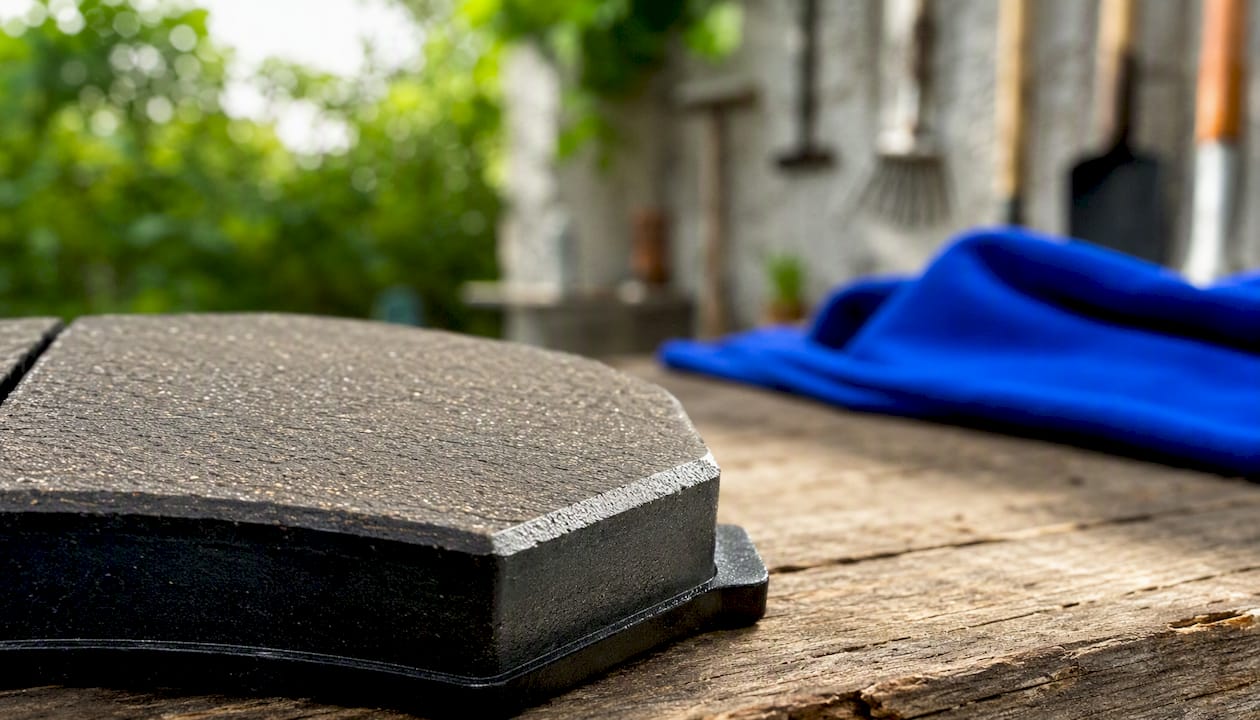
Chamfered brake pads are brake pads with an angled, beveled edge machined along the leading edge, trailing edge, or both, designed to smooth the pad’s entry and exit across the rotor face. That single geometric detail does more engineering work than most drivers realize. According to Tomorrow’s Technician, chamfers smooth rotor entry and exit, help prevent edge bite, and manage NVH (noise, vibration, and harshness) at the system level. OEMs tune pad shapes, including chamfer profiles, to the complete brake assembly, not just the pad in isolation.
The primary engineering benefits of chamfered brake pads are:
- Noise and vibration reduction: A beveled edge reduces the abrupt contact transition that can excite resonant frequencies and cause squeal.
- Edge bite prevention: Without a chamfer, a square pad edge can dig into the rotor surface unevenly, accelerating wear on both components.
- Bedding-in support: Controlled initial contact helps the friction material transfer more uniformly onto the rotor during the break-in period.
- Pad flex compensation: On longer pads, chamfers offset the edge loading that occurs when the pad body flexes under braking pressure.
One caution worth stating upfront: chamfer geometry is application-specific. Changing the bevel angle or profile from what the OEM specified can alter NVH behavior and wear patterns in ways that are difficult to predict without system-level testing.
Key Takeaways
Chamfered brake pads reduce NVH, prevent edge bite, and support bedding-in by controlling how the friction material contacts the rotor at entry and exit. Matching OE chamfer geometry is the single most reliable way to preserve the brake system’s original noise and wear calibration.
| Point | Details |
|---|---|
| Chamfer definition | An angled bevel on the pad’s leading and/or trailing edge that smooths rotor contact and reduces pressure spikes. |
| Primary NVH benefit | Chamfer geometry changes mode coupling frequencies; SAE FEA and dynamometer testing confirm it can reduce squeal propensity. |
| OE geometry rule | OEMs tune chamfer profiles to the full brake system; mismatched replacement geometry can introduce noise even with a comparable friction compound. |
| Material interaction | Aramid/Zylon fiber pads reduced brake noise by about 1.2–1.5 dBA and improved vibration measures by roughly 20–25% versus reference pads; geometry and material must be co-designed. |
| Aaafrictions Type 07 | Application-specific chamfer geometry, HydroAdaptive ceramic formulation, and matched rotors in one vehicle-specific kit. |
Table of Contents
- What types of chamfer shapes do brake pads use?
- How do chamfers affect contact pressure, NVH, and bedding-in?
- Why matching OEM pad geometry usually matters
- How to inspect, install, and bed in chamfered pads correctly
- How chamfers work with slots and friction material composition
- How Aaafrictions applies chamfer design in the Type 07 HydroAdaptive+ pads
- When chamfers actually change your driving experience
- Aaafrictions Type 07 HydroAdaptive+ pads: vehicle-specific fit, engineered geometry
- Sources
What types of chamfer shapes do brake pads use?
Brake pad manufacturers use several distinct chamfer profiles, each engineered for a specific contact behavior. Knowing how to identify them helps you confirm that a replacement pad matches the original geometry.
Parallel (flat) chamfer is the most common profile: a straight bevel cut at a consistent angle along the pad edge. It reduces the initial contact area at rotor entry, lowering the pressure spike that can trigger squeal. You will see this on the majority of OEM and aftermarket street pads.
Radial or arc chamfer follows the curved outline of the pad’s friction surface rather than cutting a straight line. This profile maintains a more uniform contact entry across the full width of the pad, which is particularly useful on pads with a pronounced arc shape.
V-type or tapered chamfer narrows the contact zone progressively toward the center of the leading edge. Engineers use this profile for targeted NVH control in applications where a standard flat bevel is not aggressive enough to suppress a specific resonance mode.
Compound chamfer (double bevel) applies different bevel angles to the leading and trailing edges. The asymmetry is intentional: the leading edge gets a steeper bevel to manage initial contact, while the trailing edge uses a shallower angle to control exit behavior. This is common on pads designed for vehicles with known NVH sensitivities.
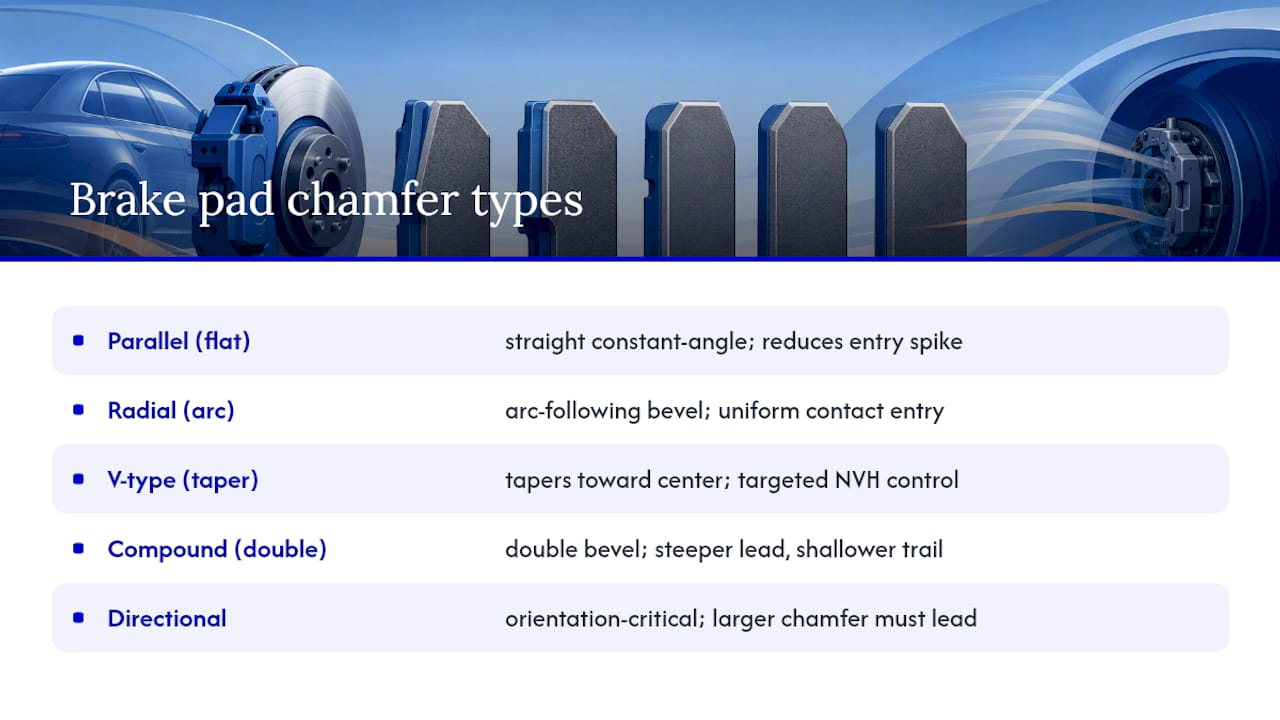
Directional chamfers are the most installation-critical type. According to Ferodo’s directional pad installation guide, directional chamfers or crescent cut-outs introduce the pad to the disc at a controlled angle, preventing the leading edge from lifting and reducing noise and uneven wear. These pads must be installed with the larger chamfer as the leading edge, or per the printed arrows on the backing plate. Installing them backward reverses the NVH benefit entirely.
Symmetric chamfers, by contrast, use the same bevel on both edges and can be installed in either orientation without consequence.
How do chamfers affect contact pressure, NVH, and bedding-in?
The engineering explanation for why chamfer geometry matters comes down to contact mechanics and mode coupling.
When a square-edged pad meets a spinning rotor, the full edge contacts the surface simultaneously, creating a sharp pressure spike at that leading corner. A chamfer reduces the initial contact area, distributing that pressure rise over a slightly longer arc of rotor travel. The result is a smoother pressure gradient at entry and exit.
That pressure gradient directly influences squeal. Brake squeal is primarily a mode-coupling phenomenon: two or more vibration modes of the pad-rotor system merge into an unstable coupled mode that self-excites at audible frequencies. Chamfer geometry changes the natural frequencies and mode shapes of the pad, which can shift those modes apart and reduce the likelihood of coupling. SAE paper 2019-01-1419 confirms this through finite-element analysis, impact-hammer testing, and dynamometer validation: slot and chamfer shape influence mode coupling, and geometry choices made at the design stage can reduce squeal by altering natural frequencies and mode shapes.
Backing-plate stiffness interacts with chamfer design in a way that often goes unmentioned. On longer pads, the backing plate flexes slightly under load, concentrating pressure at the leading and trailing edges. A chamfer compensates for that flex-induced edge loading by pre-reducing the contact area at the edges, so the pressure distribution under load remains closer to uniform.
Key effects on bedding-in and wear:
- Bedding-in: A well-sized chamfer allows the friction material to seat progressively, promoting even transfer film development on the rotor. An oversized chamfer delays full contact and can extend the bedding period or leave uneven transfer patches.
- Wear pattern: Correct chamfer geometry prevents the “lipped” wear pattern that appears when a square edge repeatedly loads the rotor at the same point.
- Vibration excitation: Edge geometry that creates a sudden pressure step is more likely to excite the rotor’s natural frequencies, which is why Tomorrow’s Technician notes that chamfers help prevent vibration excitation and premature wear.
Geometry and material damping must work together. An optimally chamfered pad in a poorly damped friction material will still squeal under the right conditions. The chamfer reduces the excitation opportunity; the material determines how much energy the system absorbs.
Why matching OEM pad geometry usually matters
OEMs tune pad shapes to the entire brake system: caliper stiffness, rotor geometry, shim stack-up, and hub resonance all factor into the chamfer profile specified for a given application. Swapping in a replacement pad with a significantly different chamfer can disrupt that system-level NVH calibration, even if the friction material is otherwise identical.
For most street vehicles, the practical rule is straightforward:
- Match OE geometry on late-model cars with tuned NVH systems, luxury vehicles, and any application where the OEM pad carries directional markings or asymmetric chamfers.
- Confirm orientation on directional pads before installation. The Ferodo installation guide is explicit: install with the larger chamfer as the leading edge or follow the printed arrows. There is no workaround for a reversed directional pad.
- Verify part-number specificity when sourcing replacements. Application-correct chamfer geometry is often proprietary and part-number specific; a generic chamfer profile across multiple applications is a signal that the supplier has not matched OE intent.
The exceptions are narrow but real. Track and racing applications sometimes use pads with intentionally modified edge profiles to alter initial bite characteristics at high temperatures. Some performance compound manufacturers specify a different chamfer to match the thermal and friction behavior of their formulation. In both cases, the change is deliberate and documented by the manufacturer or tuner, not a substitution made because a matching part was unavailable.
Pro Tip: When ordering replacement pads, ask the supplier whether the chamfer geometry is application-specific or shared across multiple part numbers. A supplier who can provide dimensional references or approved-sample photos for your vehicle’s application is demonstrating the kind of process control that consistent NVH performance requires.
How to inspect, install, and bed in chamfered pads correctly
Visual inspection checklist
Before installation, examine each pad:
- Confirm a chamfer is present on the leading and/or trailing edge as specified for your application.
- Check that left and right pads have the correct orientation (directional pads: larger chamfer faces the direction of rotor rotation).
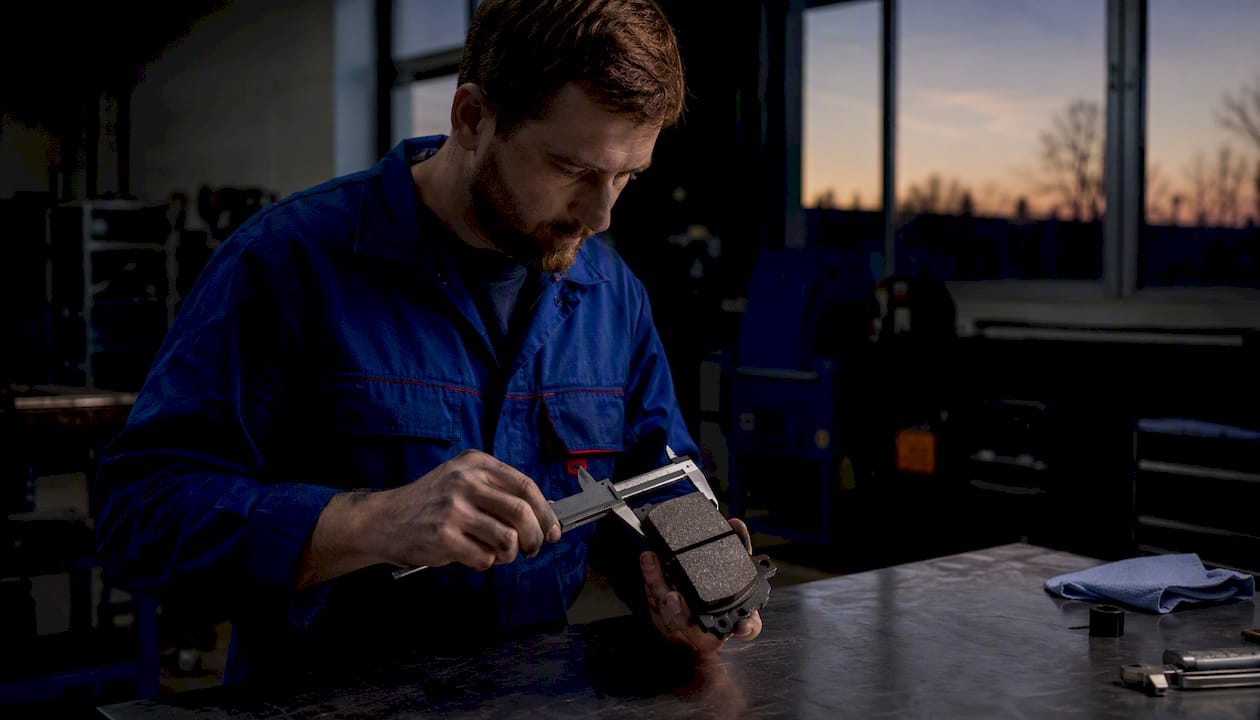
- Look for machining irregularities: uneven bevel angles, chipping at the chamfer edge, or flashing from the molding process.
- Verify the chamfer is consistent from pad to pad within the set. Batch-to-batch NVH variance often traces back to inconsistent chamfer grinding.
Should you re-chamfer or file existing pads?
The short answer is no. Modern pads arrive pre-chamfered as part of an integrated final-geometry operation performed after grinding, slotting, and curing. Grinding your own chamfers is an older practice that is now largely unnecessary and can harm bedding and pad structure. The only exception is a specific manufacturer recommendation for a racing or niche application, and even then, the specification should come with exact angle and depth dimensions.
If a used pad shows a damaged chamfer or extreme taper wear, replace the pad rather than attempt to repair the geometry. A compromised chamfer edge changes the contact pressure distribution in ways that are difficult to control with hand tools, and the underlying wear pattern usually indicates the friction material is already unevenly consumed. For diagnostic guidance on whether noise is coming from the pad geometry or another component, this squeal diagnostic guide can help you isolate the source before you pull the caliper.
Bedding-in steps
- Perform 6–8 moderate stops from 35 mph, allowing 30 seconds of cooling between each.
- Follow with 4–6 firmer stops from 45 mph, again with cooling intervals.
- Avoid hard stops or prolonged drag braking during the first 200 miles.
- Allow the system to cool completely before parking after the final bedding cycle.
Do not do the following:
- Over-grind or file the chamfer edges on new pads.
- Flip directional pads to the wrong side of the axle.
- Skip cleaning the caliper slides, shims, and abutment hardware before installation. Contaminated hardware forces the pad to bind and load unevenly, negating the chamfer’s contact-distribution benefit.
How chamfers work with slots and friction material composition
Slots and chamfers are both controlled geometry features, but they address different problems. Slots evacuate gas, brake dust, and heat from the pad-rotor interface, maintaining consistent friction coefficient under sustained braking. Chamfers manage contact entry and exit, reducing the pressure spikes that excite squeal. Both contribute to NVH performance, but through distinct mechanisms, and both must be specified and held to tight tolerances in production to deliver repeatable results.
The friction material formulation determines how effective either geometry feature will be. Two findings from peer-reviewed research make this concrete:
- Aramid and Zylon fiber-based formulations improved damping and reduced brake noise by about 1.2–1.5 dBA and improved vibration measures by roughly 20–25% in controlled tests compared to reference pads without those fibers. The fibers add internal damping that absorbs vibrational energy the chamfer alone cannot dissipate.
- Graphite type and particle-size distribution affect noise intensity and thermal conductivity, with finer graphite mixes reducing squeal intensity in tested formulations. This matters especially for copper-free formulations, where graphite content and particle size become primary levers for managing both thermal performance and NVH after copper is removed from the mix.
Material damping and geometry must be co-designed. A pad with engineered fibers and a correctly specified chamfer consistently outperforms a pad that relies on geometry alone, because the fiber network absorbs the residual vibrational energy that the chamfer reduces but does not eliminate.
Copper reduction driven by U.S. regulatory requirements (California and Washington’s copper-free brake pad mandates) has pushed formulators to increase graphite content and introduce aramid or ceramic fibers as substitutes. That shift makes the interaction between chamfer geometry and material damping more important, not less, because the friction material’s damping characteristics change with each reformulation.
How Aaafrictions applies chamfer design in the Type 07 HydroAdaptive+ pads
The Aaafrictions Type 07 HydroAdaptive+ ceramic disc brake pad is built around the principle that geometry and material must be engineered together for the specific vehicle application. Chamfer design in the Type 07 line reflects that approach directly.
- Application-specific geometry: Type 07 pads ship with chamfer profiles matched to the vehicle application, not a generic bevel applied across all part numbers. This preserves the OEM-tuned contact behavior and NVH calibration for each fitment.
- Integration with HydroAdaptive ceramic formulation: The chamfer geometry works alongside the HydroAdaptive ceramic compound, which is engineered to clear moisture rapidly and maintain consistent friction in rain, snow, and cold. In wet conditions, a correctly chamfered leading edge prevents water film from being trapped at the pad-rotor interface, supporting the formulation’s moisture-management function.
- Controlled slotting: Slots in the Type 07 pad evacuate water and debris while the chamfer manages entry pressure. The two features are specified together, not independently, so their NVH contributions are additive rather than redundant.
- Fitment confidence: Vehicle-specific kits, such as the Type 07 Brake Pads + GC Rotors Kit, pair chamfered pads with matched GEOMET-coated rotors, ensuring the full contact geometry aligns with OE intent from the first stop.
For vehicles where cold-weather squeal is a known concern, the combination of application-specific chamfer geometry and the HydroAdaptive ceramic formulation addresses both the geometric and material sources of the problem. More on the cold-squeal mechanism is covered in this detailed explanation of why brakes squeal when cold.
When chamfers actually change your driving experience
The honest answer is that chamfer geometry matters most in specific scenarios, and in others, the friction material formula dominates the outcome.
Chamfers have the clearest impact on vehicles with tuned NVH systems: luxury sedans, late-model crossovers, and minivans where the brake system was calibrated to meet strict noise targets. On these platforms, a replacement pad with a mismatched chamfer profile can introduce squeal that the original pad never produced, even if the friction material is nominally equivalent. Heavy-duty applications, towing vehicles, and trucks with long-pad designs are similarly sensitive, because pad flex under load amplifies edge-loading effects that a correct chamfer is specifically designed to offset.
Directional pad applications are non-negotiable. The geometry only works in one orientation, and the NVH benefit disappears completely if the pad is installed backward. This is not a marginal difference.
Small economy cars with short, stiff pads and forgiving brake systems are the low-sensitivity end of the spectrum. On these platforms, the friction material’s damping characteristics tend to dominate over geometric details, and a pad with a slightly different chamfer profile will often perform comparably to the OEM geometry. That said, matching OE geometry still costs nothing when you source vehicle-specific kits, so there is no practical reason to accept a generic profile.
The actionable verdict: if you are replacing pads on a vehicle with known NVH sensitivity, a directional pad application, or a long-pad design, insist on application-specific geometry. For everything else, a vehicle-specific kit from a supplier who specifies chamfer geometry by part number is the lowest-risk choice.
Aaafrictions Type 07 HydroAdaptive+ pads: vehicle-specific fit, engineered geometry
Most brake noise problems that appear after a pad swap trace back to one of two causes: a mismatched chamfer profile or a friction compound that was not designed for the vehicle’s thermal and NVH environment. Aaafrictions solves both at once.

The Type 07 HydroAdaptive+ kit pairs application-specific chamfered ceramic pads with matched rotors, verified by vehicle fitment so the geometry aligns with OE intent from the first stop. The HydroAdaptive ceramic formulation adds moisture management that standard ceramic pads do not provide, keeping friction consistent in rain, cold, and humidity. To get started, confirm your vehicle fitment on the Aaafrictions site, inspect the pads on receipt for correct chamfer orientation, install per the directional markings, and follow the bedding-in cycle. Your brake system performs the way it was engineered to perform.
Sources
- Brake Pad Chamfers, Slots And Shapes: Controlling Brake Noise
- PMC article on aramid/Zylon fiber influence on brake NV performance
- Effect of Slot and Chamfer Shape of Brake Pad on Mode Coupling (SAE paper)
Recommended
- Brake Pad Shims: What They Do and Why They Matter
- Ceramic vs. Semi Metallic Brake Pads: Which Is Actually Better for Your Vehicle? – AAA Frictions
- Ceramic vs Semi-Metallic Brake Pads: Which Is Right for You?
- My Brakes Are Squeaking, But Is It Really Because of Your Brake Pads or Brake Rotors? – AAA Frictions