

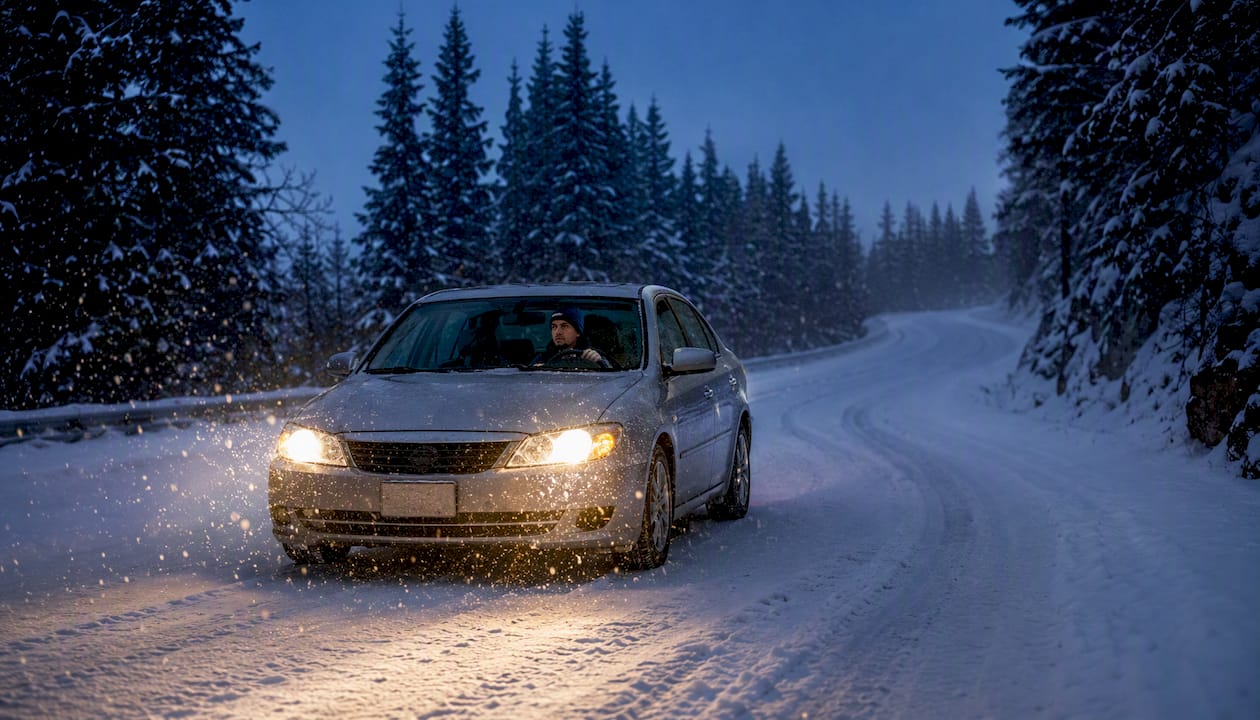
On snow, your stopping distance is significantly longer than on dry pavement. On ice, that figure increases substantially, often many times longer. At 30 mph on dry asphalt, a typical passenger car stops within a certain distance. On packed snow at the same speed, that stopping distance is much longer. That single fact should change how you follow traffic every time temperatures drop.
The two immediate actions that matter most:
- Increase your following distance to 8–10 seconds on snow, and beyond 10 seconds on ice, up from the 3–4 seconds you use on dry roads.
- Reduce your speed before you need to stop, not during the stop itself.
At 60 mph on a snowy road, your total stopping distance can be very long, approaching the length of multiple city blocks. No amount of braking technique recovers distance you never left yourself.
Table of Contents
- How snow stopping distance actually works
- Stopping distance on snow and ice: numbers at common speeds
- How to set your following distance on snow and ice
- What actually changes your stopping distance in winter
- How to brake on snow and recover from a skid
- Reducing your stopping distance before and during winter driving
- How brake components affect winter stopping performance
- Key Takeaways
- The case for taking winter braking seriously
- Aaafrictions winter-ready brake components
- Useful sources for winter driving and stopping distance
How snow stopping distance actually works
Total stopping distance has two components: reaction distance and braking distance. Reaction distance is how far your vehicle travels from the moment you perceive a hazard to the moment your foot reaches the brake pedal. At a reaction time of 1.5–2.0 seconds, that distance is fixed by your speed alone, not by road conditions. Braking distance is everything after your foot hits the pedal, and that is where snow changes everything.
Braking distance is governed by the friction coefficient (μ) between your tires and the road surface. The formula is straightforward: braking distance = v² ÷ (2 × μ × g), where v is speed and g is gravitational acceleration. On dry asphalt, μ sits around 0.70–0.85. On snow, μ drops to roughly 0.20–0.30. On ice, it falls further to 0.05–0.10. Because braking distance is inversely proportional to μ, cutting friction by a factor of three triples your stopping distance. Cutting it by a factor of ten does exactly what the math suggests.
Worked example (assumptions: mid-size sedan, standard all-season tires, 1.5-second reaction time, 30 mph):
- Reaction distance: consistent and depends on speed, not surface.
- Braking distance on dry (μ ≈ 0.80): ~38 feet → total: ~104 feet
- Braking distance on snow (μ ≈ 0.25): ~122 feet → total: ~188 feet
The reaction portion does not change. The braking portion nearly quadruples. That is the physics behind why slowing down before a hazard, not during it, is the only reliable strategy.
Stopping distance on snow and ice: numbers at common speeds
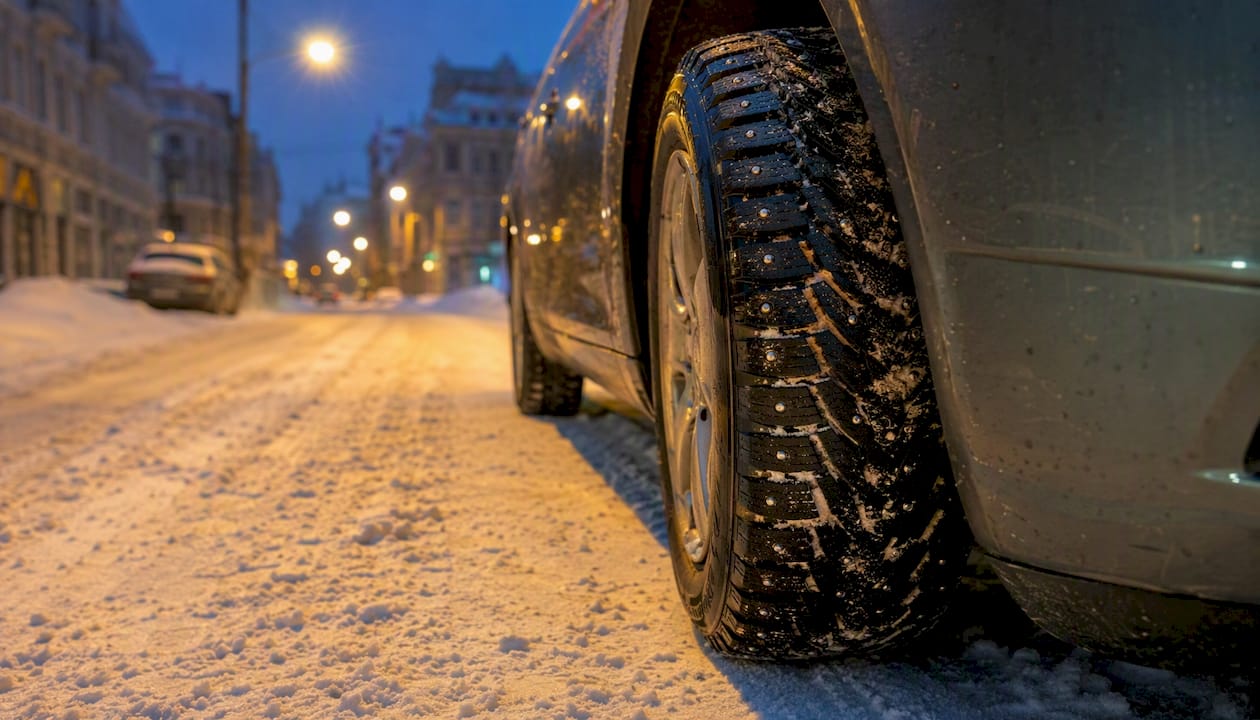
The table below uses representative friction coefficients (dry μ ≈ 0.85, snow μ ≈ 0.25, packed snow μ ≈ 0.20, ice μ ≈ 0.10) and a 1.5-second reaction time for a mid-size passenger vehicle on level ground with standard all-season tires. Treat these as estimates: real-world μ varies with tire tread, temperature, and surface texture.
| Speed | Condition | Reaction Distance | Braking Distance | Total Stopping Distance |
|---|---|---|---|---|
| 30 mph | Dry asphalt | — | — | — |
| 30 mph | Snow | — | ~122 ft | ~188 ft |
| 30 mph | Packed snow | — | — | — |
| 30 mph | Ice | — | — | — |
| — | Dry asphalt | — | — | — |
| — | Snow | — | — | — |
| — | Ice | — | — | — |
| 60 mph | Dry asphalt | — | — | — |
| 60 mph | Snow | — | — | — |
| 60 mph | Ice | — | — | — |
At 60 mph on ice, your theoretical stopping distance is extremely long. Braking distance on ice is substantially longer than on dry pavement, and these numbers show why. Winter tires with a higher cold-weather μ shorten those distances materially, but they do not return you to dry-road performance.
How to set your following distance on snow and ice
The standard 3–4 second rule for dry roads is not a starting point for winter driving. Safety guidance recommends increasing your following distance to 8–10 seconds on snow, and beyond 10 seconds on ice.
Converting seconds to feet at common speeds:
| Speed | 6 seconds | 8 seconds | 10 seconds |
|---|---|---|---|
| 30 mph | — | — | 440 ft |
| 40 mph | — | 469 ft | 587 ft |
| — | 440 ft | 587 ft | 733 ft |
| 60 mph | 528 ft | 704 ft | 880 ft |
How to measure your gap on the road:
- Pick a fixed roadside object (a sign, an overpass, a shadow line).
- When the vehicle ahead passes it, count “one-one-thousand, two-one-thousand…” until your front bumper reaches the same point.
- If you reach 8 before you pass the marker, you have your gap. If not, ease off the throttle.
Pro Tip: The 10-second rule is a conservative heuristic, not a physics constant. Surface conditions change quickly, especially on bridges and shaded stretches. When in doubt, add more gap rather than hold the minimum.
What actually changes your stopping distance in winter
Speed is the single largest variable. Because braking distance scales with the square of your speed, going from 30 mph to 60 mph does not double your stopping distance on snow; it roughly quadruples it.
Tire type and condition come next. Winter tire compounds stay flexible in freezing temperatures where all-season or summer tires harden, and that flexibility is the primary mechanical reason winter tires reduce stopping distances in snow and ice. Tread depth matters too: worn tires cannot channel slush away from the contact patch, reducing the effective friction area. The legal minimum tread depth in most U.S. states is 2/32 inch, but winter driving performance degrades noticeably below 4/32 inch.
Surface type determines the friction coefficient your tires work with. Loose snow is more forgiving than packed snow, which is more forgiving than glare ice. Slush is deceptive: it looks like snow but can behave closer to wet ice under load. Black ice, which forms when moisture freezes on pavement with no visible cue, is the most dangerous because drivers do not adjust their speed or following distance.
Vehicle weight and slope both affect stopping. Heavier vehicles carry more kinetic energy at the same speed and require more force to stop. A downhill grade reduces the effective friction available for braking because gravity is working against you. On a 6% grade in snow, stopping distances increase substantially beyond the flat-road estimates in the table above.
ABS and traction control are frequently misunderstood. ABS maintains steering control during heavy braking on slippery surfaces. It does not reliably shorten stopping distances on very low-friction surfaces like glare ice. Traction control helps prevent wheel spin during acceleration, not during braking. Understanding what these systems do, and what they do not do, prevents the overconfidence that causes rear-end collisions. How traction control interacts with AWD systems is a separate consideration from braking distance, but both systems share the same traction budget your tires provide.
How to brake on snow and recover from a skid
Correct braking technique in winter is about maintaining control, not maximizing deceleration force.
Proper braking on snow:
- Anticipate early. Lift off the throttle well before you need to stop. Engine braking reduces speed without engaging the brakes and keeps all four wheels contributing to stability.
- Apply pressure progressively. Press the brake pedal firmly and steadily. Do not stab it. On vehicles with ABS, apply firm, continuous pressure and let the system modulate.
- Steer while braking (ABS vehicles). ABS allows you to steer around an obstacle while braking hard. Use that capability. Without ABS, threshold braking (just below lockup) preserves some steering, but it requires practice.
- Avoid simultaneous inputs. Braking and turning at the same time splits your available traction. Straighten the wheel before braking when possible.
Skid recovery by drive type:
- Front-wheel skid (understeer): Ease off the brake and throttle. Do not turn harder into the corner; the front tires need traction to steer, and adding steering input while they are sliding does nothing. Let speed drop until grip returns.
- Rear-wheel skid (oversteer): Steer gently in the direction the rear is sliding (counter-steer). Ease off the throttle. Do not brake sharply; that shifts weight forward and worsens the slide.
- All-wheel skid (all four wheels sliding): Ease off all inputs. Reduce brake pressure slightly to let the tires rotate and regain grip. Steer toward where you want to go once traction returns.
Do not:
- Slam the brakes from highway speed on ice.
- Turn sharply while braking.
- Assume AWD shortens your stopping distance (it does not; AWD helps acceleration, not braking).
- Overcorrect during a rear skid.
Reducing your stopping distance before and during winter driving
The most effective changes happen before you leave the driveway.
Pre-trip maintenance checklist:
- Check tread depth. Use a quarter: if Washington’s head is fully visible, you are at or below 4/32 inch. Replace tires before winter driving.
- Set correct tire pressure. Cold air contracts; tire pressure drops roughly 1 PSI for every 10°F temperature decrease. Under-inflated tires reduce the contact patch and increase stopping distances.
- Inspect your brake system. Worn pads, scored rotors, or stiff calipers all extend stopping distance. A brake inspection before the first hard freeze is standard practice.
- Remove ice and packed snow from wheel wells and rotors. Ice buildup around the rotor and caliper can cause uneven pad contact and delayed initial bite.
- Use climate-rated lubricants on caliper guide pins. Standard lubricants stiffen in freezing temperatures, causing uneven pad actuation and inconsistent pedal feel.
- Clear all snow and ice from the vehicle before driving, including the roof. Sliding roof snow can obstruct your windshield or the windshield of the driver behind you.
Driving behavior adjustments:
- Reduce speed to match conditions, not the posted limit.
- Choose lanes with the most visible traction (avoid shaded lanes on bridges).
- Avoid sudden steering inputs; smooth inputs preserve traction budget.
- On steep grades, use lower gears to manage speed with engine braking.
Chains and studded tires: These provide the highest traction on packed snow and ice, but their legality varies by state. NHTSA’s winter driving guidance recommends checking your state DOT’s rules before installing chains or studded tires, as some states restrict or prohibit studded tires on paved roads. Always follow your state DOT’s current regulations.
How brake components affect winter stopping performance
The brake pad compound, rotor condition, and caliper function all influence how quickly your vehicle responds from the moment you press the pedal. On a cold morning, this matters more than most drivers realize.
Many conventional pad formulations require several miles of use to reach their optimal friction range. That “first-stop fade” on an icy morning is not a myth; it is a documented characteristic of pads not engineered for immediate cold-start bite. Pads designed for cold-start responsiveness reduce that hazard by maintaining a consistent friction profile from the first application.
Rotor condition affects heat distribution and pad contact. A scored or lipped rotor reduces the effective contact area between pad and rotor, which lowers the friction force available for stopping. Corrosion on rotors, common after a vehicle sits through a wet freeze, can cause an initial roughness in pedal feel and uneven braking until the surface clears.
Caliper guide pins and lubricants are the mechanical element most often overlooked. In freezing temperatures, standard lubricants stiffen, which can cause one pad to engage before the other. The result is uneven braking force and a pedal that feels inconsistent. Climate-rated lubricants maintain their viscosity at low temperatures, keeping both pads engaging simultaneously.
This article provides general guidance. Verify component fitment with your vehicle’s year, make, and model, and consult a qualified mechanic before purchasing or installing brake parts.
Key Takeaways
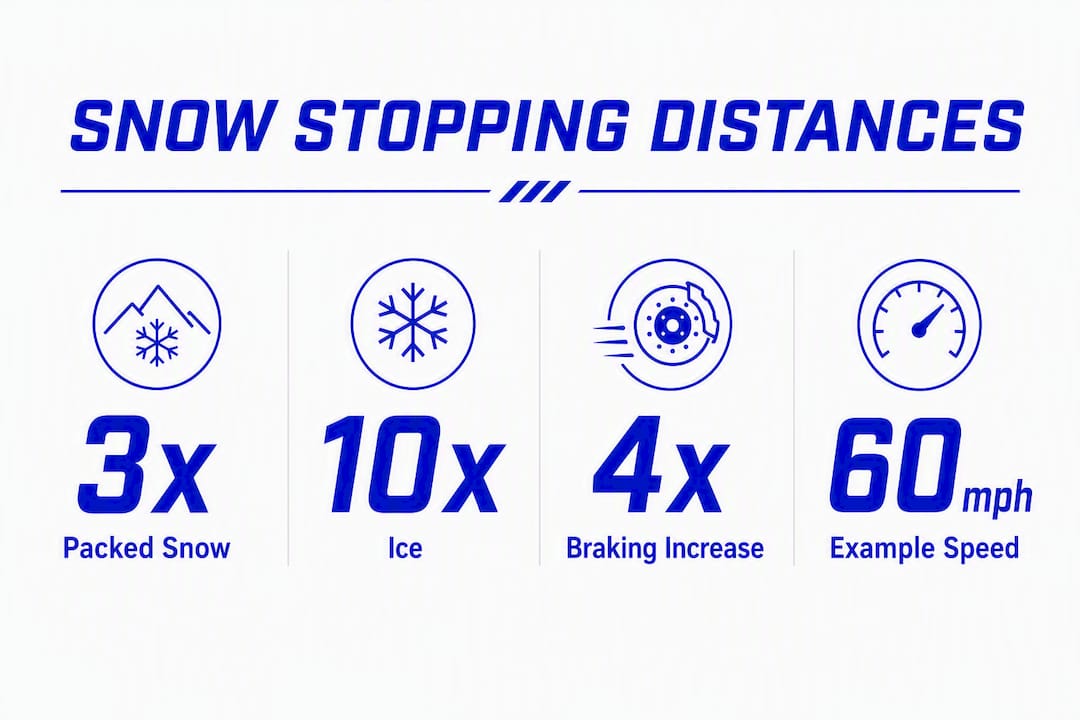
Snow stopping distance is about 3 times longer than dry-road stopping distance on packed snow, and up to 10 times longer on ice, making following distance and speed the two most critical variables drivers control.
| Point | Details |
|---|---|
| Snow multiplies stopping distance | Packed snow triples dry-road stopping distance; ice extends it up to 10 times. |
| Use the seconds rule | Maintain 8–10 seconds of following distance on snow, beyond 10 on ice. |
| Speed compounds the risk | Braking distance scales with the square of speed; halving your speed cuts braking distance by roughly 75%. |
| Winter tires reduce stopping distance | Winter compounds stay flexible in cold, materially shortening snow and ice stopping distances versus all-season tires. |
| Aaafrictions HydroAdaptive pads | Engineered for cold-start bite and moisture management, addressing the two brake variables most critical on winter mornings. |
The case for taking winter braking seriously
Most drivers treat winter braking as a technique problem. Apply the brakes more gently, leave more space, done. The technique guidance in this article is real and worth following. But the part of the conversation that gets less attention is the mechanical side: what your brake system is actually doing on a 20°F morning after sitting overnight in a wet freeze.
The first stop of the day on an icy road is the highest-risk stop you will make. Pad compound, rotor surface condition, and caliper responsiveness all affect that first application. Drivers who have upgraded their tires for winter but left a set of worn, conventional pads on the car have addressed the traction side of the equation while leaving the friction side unchanged. Both matter.
We focus on the brake system side because that is where the engineering gap between a standard pad and a winter-ready pad is most visible in real conditions. Consistent pedal feel, immediate bite, and predictable friction under cold and wet conditions are not marketing claims. They are measurable performance characteristics that show up in the stops that count most.
Aaafrictions winter-ready brake components
Standard brake pads are not designed with a January morning in mind. Aaafrictions’ HydroAdaptive ceramic brake pads address the two variables that matter most in winter: cold-start responsiveness and moisture management. The HydroAdaptive+ formulation clears frost and slush from the contact zone to deliver immediate bite from the first pedal application, and the ceramic compound maintains a consistent friction profile across a wide temperature range.
Complete brake kits pair the pads with corrosion-resistant rotors and climate-adaptive caliper lubricants, so the full system performs consistently rather than just one component. Before purchasing, confirm fitment for your vehicle’s year, make, and model, and consult a mechanic if you are unsure about installation.
Check compatibility and browse winter-ready brake kits for your vehicle at Aaafrictions.ca.
Useful sources for winter driving and stopping distance
- NHTSA Winter Driving Tips: The federal authority on vehicle safety; covers pre-trip preparation, chain/studded tire guidance, and general winter driving recommendations for U.S. drivers.
- Michelin USA: Safe Driving Distances and Skid Recovery: Tire-maker guidance on following distance multipliers, winter tire recommendations, and skid recovery technique.
- Continental Tires: What Is Braking Distance: Manufacturer-level explanation of braking distance, ABS behavior on low-friction surfaces, and weather effects on stopping.
- Calculover Stopping Distance Calculator: Interactive tool for estimating stopping distances by speed and road condition; useful for visualizing the seconds-to-feet conversion.
- Miniwebtool Stopping Distance Calculator: Friction coefficient reference and reaction-time presets for worked stopping-distance examples.
- Aaafrictions HydroAdaptive Technology: Technical overview of the HydroAdaptive+ ceramic formulation, moisture management design, and cold-start performance engineering.
- Your state DOT website: For chain and studded tire regulations specific to your state, search “[your state] DOT winter driving” or “[your state] chain law.” Rules vary significantly across U.S. states and change seasonally.