

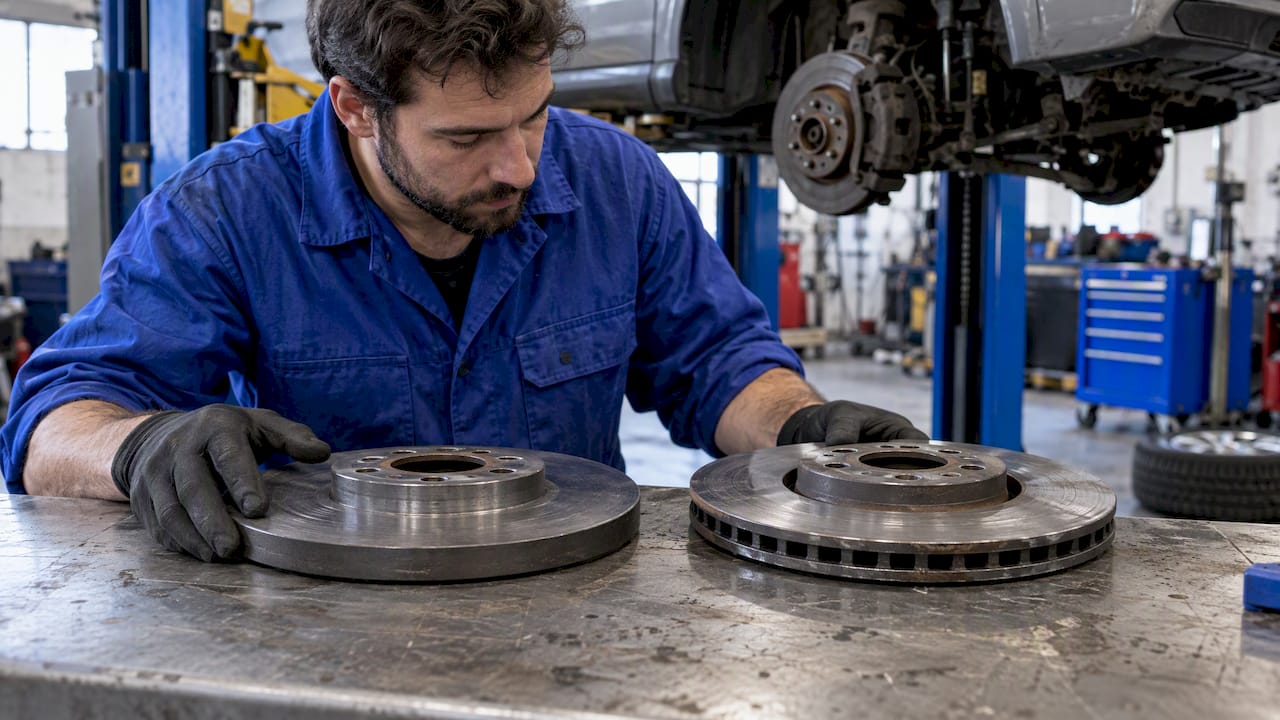
Vented rotors are the better choice for repeated heavy braking, towing, or any driving that builds up sustained heat, because their internal vanes dissipate that heat faster and resist fade. Solid rotors remain a sound, cost-effective option for low-load rear axles and light daily driving, where heat buildup is minimal. The right answer for your vehicle depends on fitment, axle position, and how hard you actually drive.
TL;DR:
- At low speeds, vented rotors receive less airflow, so their cooling advantage shrinks; upgraded vane patterns matter most during sustained high heat.
- Before ordering, confirm the original rotor type and thickness, then check wheel, caliper, hub, and stud clearance because thicker vented rotors may not fit.
- Inspect rotors at least once a year, or sooner for vibration, grabbing, or changes in pedal feel; measure thickness against the stamped minimum.
- In frequent rain, snow, or humidity, pair the rotor with pads designed to clear moisture; rotor airflow alone cannot ensure consistent friction initially.
Table of Contents
- What solid and vented rotors are and how they behave differently
- Heat management and performance: the evidence behind vented rotors and brake fade
- Vane and cut-pattern differences: straight, tapered, modified tapered and pillared rotors
- Fitment and vehicle suitability: axle choice, wheel clearance, and shop checks
- Maintenance, inspection, and when to replace your rotors
- How rotor choice affects braking in wet and humid conditions
- Materials and manufacturing differences between vented and solid rotors
- How AAA Frictions’ rotor and pad lineup fits the vented vs solid decision
- A simple decision rule: which rotor to pick for most drivers
- How to buy a matched rotor and pad solution from AAA Frictions
- FAQ
- Sources
What solid and vented rotors are and how they behave differently
A solid rotor is a single flat disc of cast iron or a carbon-based blend, machined smooth on both braking surfaces. A vented rotor looks similar from the outside but is built from two parallel faces separated by an internal structure of vanes or ribs, creating a hollow channel that air can move through as the wheel spins.
That internal channel is the whole story. More surface area inside the rotor means more contact with moving air, and moving air pulls heat away through convection far more efficiently than a solid mass can shed it on its own. Research on cut-pattern ventilation designs found a much higher heat dissipation rate for ventilated rotors compared with solid rotors under similar braking loads. The vented design essentially turns the rotor into a small air pump: as it rotates, it draws air in near the hub and pushes it out toward the edge, carrying heat with it.
The trade-offs are straightforward once you see the construction difference:
- Solid rotors are simpler, generally lighter per unit of material, and cost less to produce and machine.
- Vented rotors run cooler under sustained braking but add some weight and complexity to the casting.
- Solid rotors suit lower-heat applications where thinner profiles matter, such as many rear axles.
- Vented rotors suit front axles and any scenario where heat accumulates quickly, since fronts typically handle the majority of braking load.
Neither design is universally correct. The decision hinges on how much heat your driving actually generates, which is the question the next section answers in more detail.
Heat management and performance: the evidence behind vented rotors and brake fade
Brake fade happens when a rotor and pad combination gets hot enough that the friction material’s grip starts to drop off, even though you’re pressing the pedal just as hard. The symptom shows up as a pedal that feels normal at first, then progressively softer or longer as a long downhill grade or repeated hard stops pile on heat. In severe cases, the rotor develops thermal gradients across its surface, uneven hot and cool zones that can warp the disc or create localized hard spots.
Venting addresses this problem directly by increasing the surface area in contact with moving air. SAE cooling analysis of disc brake rotors confirms that ventilated rotors dissipate heat more effectively than solid designs under comparable conditions, which is why nearly every front rotor on a modern vehicle is vented. The faster a rotor sheds heat between braking events, the more consistent your pedal feel stays over a long drive, a mountain descent, or a loaded tow.
That said, the benefit isn’t constant across every driving condition. The same cooling analysis found that ventilated rotor cooling capacity drops sharply at low vehicle speeds, because there simply isn’t enough airflow moving through the internal channels to pull heat out efficiently. At a crawl in stop and go traffic, a vented rotor isn’t working nearly as hard as it does at highway speed. Interestingly, the research also found that increased surface area still accounts for most of the cooling benefit even when speed is low, which means the design advantage of venting doesn’t disappear entirely. It just scales with how fast you’re moving and how much airflow the rotor is actually receiving.

This is worth keeping in mind if you’re comparing two vehicles with similar rotor designs but very different use cases. A commuter doing mostly low-speed city driving will see less of the theoretical cooling advantage than a driver doing sustained highway braking or descending a long grade with a loaded trailer. The physics doesn’t change, but the conditions that activate it do.
Mechanics who work on brakes every day tend to frame this as a systems problem rather than a rotor problem in isolation. As maintenance guidance points out, the “best” rotor is the one that matches your driving demands, because rotors work as part of a system with pads and calipers. A vented rotor paired with a friction compound that can’t handle heat well still fades. A solid rotor paired with light, consistent use rarely gets hot enough to matter. The rotor type sets the ceiling; your driving conditions and pad choice determine whether you ever get close to it.
Fade itself tends to follow a recognizable pattern: a slightly longer stopping distance first, then a soft or sinking pedal, then, if ignored, a burning smell or visible smoke from the wheel area. Any of those signs during a long descent or heavy towing session means it’s time to let the brakes cool before continuing, and to have the rotors inspected afterward for heat damage.
Vane and cut-pattern differences: straight, tapered, modified tapered and pillared rotors
Not all vented rotors move air the same way. The internal vane pattern, the shape and angle of the ribs connecting the two rotor faces, has a direct effect on how much air gets pulled through and how efficiently that air removes heat.
The most common patterns are:
- Straight vanes (SRV): simple radial ribs running directly from hub to edge, the baseline design against which others are measured.
- Tapered radial vanes (TRV): angled ribs that improve airflow slightly over straight designs.
- Modified tapered radial vanes (MTRV): a curved, optimized vane shape that channels air more aggressively toward the outer edge.
- Pillared designs: short, individual posts instead of continuous ribs, allowing air to move in more directions through the rotor.
The performance gap between these designs is measurable. Comparative testing of chamber designs found that MTRV and certain pillared configurations produced significantly greater airflow and notably higher heat dissipation than basic straight-vane designs at 1,800 rpm. Separate CFD and flow analysis work comparing six rotor configurations found that MTRV and some pillared types delivered the best mass flow and surface heat transfer among the designs tested, particularly at higher operating speeds.
For most daily driving, the difference between a straight-vane and an MTRV rotor is unlikely to be noticeable. The gap matters most when heat accumulates faster than the rotor can shed it, which is exactly the situation that sustained towing, mountain driving, or track days create.
Pro Tip: If your driving involves regular towing, long mountain grades, or track days, a rotor with an upgraded vane geometry like MTRV or a pillared design is worth the extra cost. For routine commuting, a standard vented rotor is usually all you need.
Fitment and vehicle suitability: axle choice, wheel clearance, and shop checks
Most vehicles use vented rotors on the front axle and solid rotors on the rear, and that split isn’t arbitrary. Front brakes absorb the majority of stopping force during a typical stop because weight transfers forward under braking, which means front rotors run hotter and benefit more from the extra cooling capacity venting provides. Rear rotors, carrying a lighter braking load, often perform perfectly well as solid discs while staying thinner and lighter.
Before ordering replacement rotors, a few fitment details determine whether a given rotor will actually bolt up and work correctly on your vehicle:
- Confirm rotor thickness matches your vehicle’s original specification, since a vented rotor is inherently thicker than a solid one and won’t fit where a solid rotor was designed to sit.
- Check wheel and caliper clearance, particularly if you’re considering a larger or thicker rotor than stock, since aftermarket wheels can sometimes interfere with a vented rotor’s wider profile.
- Verify hub and stud compatibility, especially with aftermarket hubs, since mismatched stud patterns or hub geometry can prevent proper seating.
- Inspect for interference issues if your vehicle has had aftermarket hub components installed. A Transport Canada recall notice described hub stud geometry that could make assembling certain aftermarket rotors difficult, leading to vibration or wheel wobble if not caught before installation.
- Match rotor type to axle position unless you have a specific performance reason to deviate, since manufacturers engineer the front and rear heat loads differently for good reason.
Getting these checks right before you order saves a return shipment and, more importantly, avoids a rotor that looks correct but doesn’t seat properly against the hub.
Maintenance, inspection, and when to replace your rotors
Rotors deserve a full inspection at least once a year, and sooner if you notice vibration through the pedal or steering wheel, grabbing during light braking, squealing, or a pedal that feels different than it used to. Maintenance guidance from Be Car Care Aware lists these symptoms as the clearest signals that rotors or linings need attention, and recommends measuring rotor thickness directly rather than estimating wear by eye.
A proper thickness check uses a gauge accurate to at least ±0.05 millimetres, and the measurement gets compared against the minimum thickness stamped on the rotor itself. Beyond thickness, a few visual checks matter:
- Cracks that extend through to the cooling vents or the outer edge are an automatic rejection criterion in Canadian inspection guidance, since they compromise structural integrity.
- Hot spots that can’t be removed by machining also fail inspection, as they indicate the rotor has been heat-damaged beyond safe use.
- Fine hairline heat checking below a small threshold is typically considered normal wear, not a defect.
- Deep grooves or scoring that push the rotor below its minimum thickness call for replacement rather than resurfacing.
If you’re doing your own visual inspection between professional checks, a clean rotor surface also makes small defects easier to spot. Removing brake dust safely with a short dwell time before rinsing keeps corrosion and buildup from masking early warning signs like light scoring or uneven wear.
How rotor choice affects braking in wet and humid conditions
Water on a rotor’s surface briefly reduces friction the moment a pad makes contact, which is why stopping distances can feel longer in the rain, especially on the first hard stop after driving through standing water. Vented rotors have a practical advantage here, since the airflow moving through their internal channels helps fling off surface water faster than a solid rotor can clear it.
That airflow advantage is still secondary to the pad material doing the actual gripping. A rotor can be perfectly designed and still deliver an inconsistent first stop if the pad compound doesn’t clear moisture quickly from the contact surface. This is where pad chemistry and rotor design need to work together rather than being chosen independently. For drivers who deal with frequent rain, high humidity, or slush, pairing a well-ventilated rotor with a pad engineered for moisture clearing matters more than chasing rotor upgrades alone. Our wet weather brake pads guide goes into more detail on how pad selection affects stopping consistency in these conditions.
Materials and manufacturing differences between vented and solid rotors
Most rotors, vented or solid, start as cast iron, valued for its heat capacity and relatively low cost. The manufacturing path diverges significantly from there. A solid rotor is cast as a single flat disc and machined on both faces, a relatively simple process with fewer opportunities for casting defects.
A vented rotor requires a more complex mould that forms the internal vane structure between the two faces in a single casting, or in some designs, joins two separately cast halves. That internal geometry has to be precise, since uneven vane spacing or wall thickness can create weak points that crack under thermal stress over time.
Some rotors use a carbon-enriched iron blend rather than standard cast iron, which can improve heat capacity and reduce the tendency to warp under repeated thermal cycling. Our high carbon rotors guide covers how that material choice affects durability and long-term performance for drivers who put their brakes under heavier or more frequent use. Coating choices also vary: corrosion-resistant coatings on the rotor’s non-braking surfaces help prevent rust buildup during winter storage or in climates with heavy road salt use, which matters regardless of whether the rotor underneath is vented or solid.
How AAA Frictions’ rotor and pad lineup fits the vented vs solid decision
Our rotors are built for drivers who want dependable, consistent stopping across daily driving and winter conditions, including semi-coated protection against corrosion during salt-heavy months. Our rotors carry a GEOMET coating and are positioned for drivers who want stronger corrosion resistance alongside solid performance, a good fit for vehicles that see year-round exposure to road moisture and salt.
Choosing the right rotor is only half the equation. Ceramic technology used across various pad lines is engineered to clear surface moisture quickly and maintain consistent friction in rain, snow, and humidity. That matters most on the front axle, where a vented rotor’s airflow and a pad’s moisture-clearing ability work together during the hardest, hottest stops. Pairing either rotor line with a HydroAdaptive pad gives you a matched system rather than two components chosen in isolation, which is the combination that tends to deliver the steadiest pedal feel across changing weather.
A simple decision rule: which rotor to pick for most drivers
Choose vented rotors for any front axle, any vehicle that tows, and any driving that involves sustained hard braking on grades. Choose solid rotors for light-duty rear axles where heat buildup is minimal and the lighter, simpler design is sufficient. Within that general rule, always confirm the rotor type and thickness your specific vehicle was designed around, since manufacturers already engineered the front and rear heat loads differently for good reason. Pair whichever rotor you choose with a pad suited to your climate, particularly a moisture-clearing compound if you drive through rain, snow, or humidity regularly, since the rotor and pad work as one system, not two separate decisions.
— AAA
How to buy a matched rotor and pad solution from AAA Frictions
Getting the heat management benefits of a vented rotor only pays off when the pad riding against it clears moisture and holds friction consistently, which is exactly what we built our HydroAdaptive lineup to do. For front axles carrying the bulk of your braking load, we pair our SC Type Rotors or GC Type Rotors with Type 07 Brake Pads for drivers who deal with rain, snow, or humidity, and with Type 03 Brake Pads for milder, lower-moisture conditions.

Before you order, run through this short checklist:
- Confirm your vehicle’s fitment using your make, model, and year against the rotor’s listed specifications.
- Check rotor thickness and vane geometry against your original equipment to avoid clearance issues.
- Match pad chemistry to your climate, choosing a HydroAdaptive option if wet or cold weather is a regular factor.
- Review warranty and shipping details on the product page before completing your order.
Browse our SC Type Rotors and GC Type Rotors to find the match for your vehicle, or start with our pad selection guide if you’re not sure which compound suits your driving conditions.
FAQ
Are ventilated rotors better than solid rotors?
For front axles, towing, and heavy braking, yes: ventilated rotors dissipate heat more effectively than solid designs, which reduces fade during sustained use. For light-duty rear axles, a solid rotor is still a perfectly sound and simpler choice.
What does a vented brake rotor look like?
A vented rotor has two separate braking surfaces joined by internal vanes or ribs, creating a hollow channel you can see by looking straight into the edge of the rotor. A solid rotor, by contrast, is a single flat disc with no visible gap or internal structure.
Are brake rotors smooth or rough?
New rotors have a smooth, machined finish on both braking surfaces, which is how they’re designed to perform. Rough, scored, or grooved surfaces on a used rotor usually indicate wear or worn-out pads and should be checked against minimum thickness and rejection standards.
How often should rotors be inspected?
Brake inspection guidance recommends checking your rotors at least once a year, along with watching for vibration, grabbing, or unusual pedal feel between scheduled checks. Any of those symptoms warrants an inspection sooner rather than waiting for the annual check.
Can I mix vented front rotors with solid rear rotors?
Yes, this is the standard configuration on most vehicles, since front rotors handle more braking load and heat than rear rotors. Always follow your vehicle’s original specification for which axle uses which rotor type rather than choosing independently.
Sources
- Numerical investigations on thermo-structural behavior of various cut patterns for ventilation on automobile brake discs (2020)
- Stop and check your brakes – Be Car Care Aware (2020)
- VSIS: S3H Hydraulic brakes (inspection guidance)