

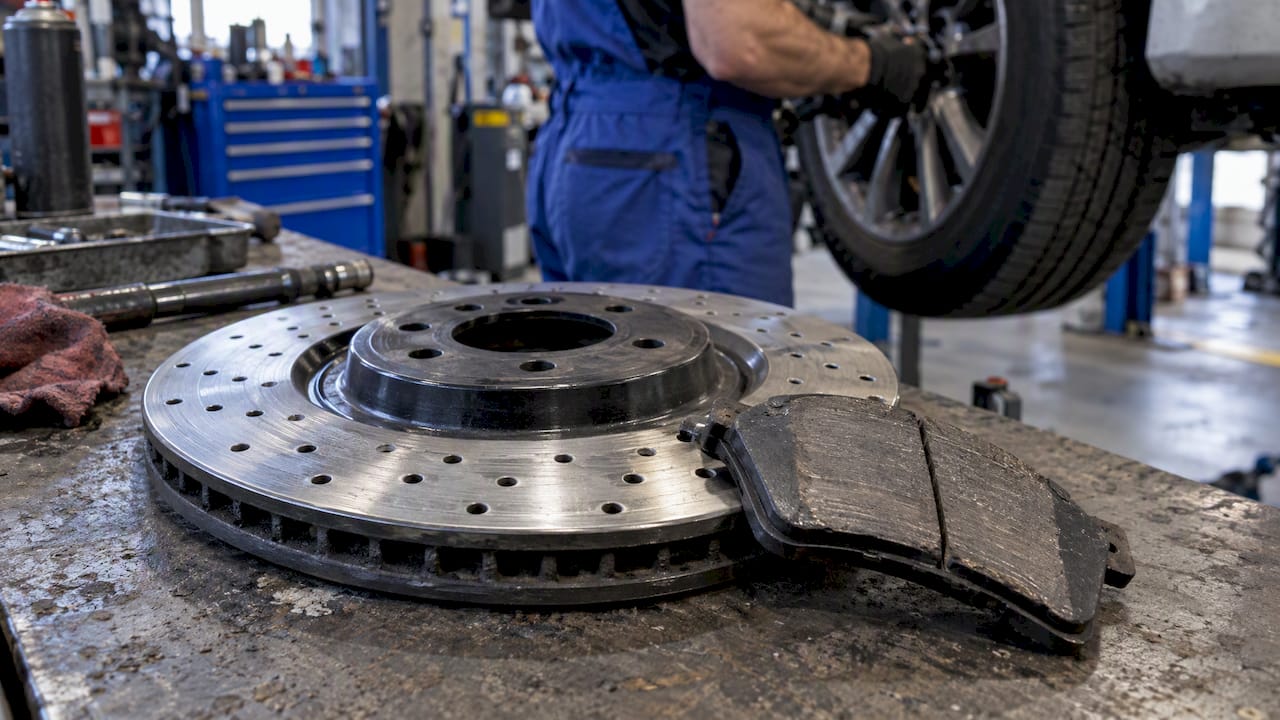
Yes, drilled rotors usually wear brake pads faster than plain, blank rotors. The holes put sharp edges into the pad’s path, and every pass over them removes a little extra friction material. How much faster depends on the pad compound, the quality of the drilling and how you drive. In Canada, road salt adds a second problem on top of the pad wear: the holes themselves.
This guide explains the mechanism, what it means for ceramic pads, and how to decide whether drilled rotors are worth it on a car you drive through a Canadian winter.
TL;DR
- Drilled rotors generally wear pads faster than blank rotors because the hole edges act like a file on the pad surface.
- Mechanics who see the results firsthand report that salt and moisture collect in the holes, which speeds up corrosion and pitting.
- Ceramic pads are not the cause of rotor wear. A worn or pitted rotor is what shortens the life of a new pad.
- Before fitting new pads, measure the rotor against its stamped minimum thickness. Replace it if it is under spec, deeply grooved or warped.
- For a daily driver in wet, salty conditions, a well-made plain or coated rotor paired with a climate-adapted ceramic pad is the lower-risk choice.
Table of Contents
- Why drilled rotors wear pads faster
- What road salt does to drilled rotors
- Do ceramic pads wear rotors faster?
- Check the rotor before you fit new pads
- Drilled, slotted, plain or coated: how they compare for pad wear
- Our perspective: match the rotor to the road you drive
- How to make a new pad and rotor last
- Choosing pads and rotors that work together
- Shop pads and rotors built for Canadian weather
- FAQ
- Sources
Why drilled rotors wear pads faster
A brake pad works by pressing a friction material against the rotor face. On a blank rotor, that face is a continuous surface. The pad wears gradually and evenly, and the contact patch stays stable.
Drill holes through that face and you introduce edges. Each time a section of pad passes a hole, the leading edge of the hole scrapes it. Some mechanics describe the effect as a cheese grater on the pad, and the comparison is fair: the pad loses material it would not lose on a smooth surface.
Three factors decide how much extra wear you actually see:
- Edge finish. Holes that are chamfered and deburred are gentler on the pad than rough, as-drilled edges.
- Pad compound. A softer compound sheds material faster against hole edges. A harder compound lasts longer but can be less forgiving to the rotor.
- Driving. Light commuting produces little difference you would notice. Repeated hard stops, towing and mountain descents magnify it.
The holes were originally meant to give gases a path to escape and to shed water. On modern pads, which produce far less outgassing than older formulations, that benefit is small for street driving. For a deeper look at the hole-versus-slot question, see our guide to drilled vs slotted rotors.
What road salt does to drilled rotors
This is where the Canadian context matters. A flat rotor face is wiped clean by the pad on every stop. A hole is not. The inside wall of a drilled hole is a place the pad never reaches, so moisture and road salt can sit there between drives.
The same Alberta shop that describes the cheese-grater effect also points out that these non-wiped areas collect salt and moisture, which accelerates corrosion and pitting, and can lead to structural failure before the rotor reaches its minimum thickness. That is the shop’s observation, not a lab study, but it matches what many drivers find when they pull wheels in spring.
Pitting matters for pads too. A pitted surface behaves like a rough file, so the pad wears faster even if the rotor was originally flat. If you want to understand what you are looking at, read our pages on rotor pitting and rotor hat rust in Canada.
Do ceramic pads wear rotors faster?
This is the other question drivers ask, and the answer is mostly no. Ceramic pads are formulated to be gentle on rotors, and a rotor that is chewed up after a pad change is usually showing a problem that was already there: heat damage, corrosion, a seized caliper slide or a worn rotor that should have been replaced.
Where ceramic pads do get a bad name is in wet or humid weather. A standard ceramic pad can be slow to clear moisture from the rotor face, which leads to a delayed bite and an inconsistent pedal feel. That is the specific problem our HydroAdaptive ceramic formulation was designed to address, by clearing moisture quickly and keeping friction stable. You can read how it works on our HydroAdaptive Formulation page.
The pad is only half of the pairing. A ceramic pad on a clean, flat, in-spec rotor wears evenly and leaves a smooth rotor face. The same pad on a rough or undersized rotor does not. That is why the next section matters more than the pad brand.

Check the rotor before you fit new pads
New pads on a degraded rotor can wear prematurely, often within a few months. Before buying pads, do this check:
- Find the stamp. Every rotor has a minimum thickness marked on it by the manufacturer, usually on the hat or the edge.
- Measure with a micrometer. Measure in several places around the friction surface and use the lowest reading. Our guide to the minimum rotor thickness check walks through the technique.
- Compare. If the reading is at or below the stamped minimum, replace the rotor.
- Look at the surface. Deep grooves, blue heat spots, or a pulsing pedal point toward replacement. See rotor glazing symptoms for what heat damage looks like.
- Check the pads you are removing. Uneven wear from inner to outer pad usually points to a sticking caliper slide, not the rotor. Our caliper slide pin maintenance guide is a 15-minute fix many DIYers can do.
The shop guidance is consistent here: rotors above spec with an even surface can be resurfaced, but rotors that are below spec, deeply grooved or warped enough to pulse the pedal need replacing. Resurfacing is also often not feasible on modern rotors because the material is thin. If you do want to work out resurfacing against replacement using micrometer readings, this DIY walkthrough on rotor replacement versus resurfacing covers the measurements.
Why the rotor often outlasts the pad, and when it does not
A common rule of thumb is that rotors last roughly twice as long as pads, which is why many drivers do two sets of pads per set of rotors. Drilled rotors disrupt that pattern in two ways. Pads wear sooner, so you replace them more often, and corrosion can shorten the rotor’s life. The economics that make a drilled rotor look like a bargain on the shelf can reverse over a few Canadian winters.
Drilled, slotted, plain or coated: how they compare for pad wear
| Rotor type | Effect on pad wear | Wet and salty conditions | Best suited to |
|---|---|---|---|
| Plain (blank) | Lowest, even wear | Face is wiped clean on every stop | Daily driving, towing, commuting |
| Slotted | Moderate: slots continually refresh the pad surface | Slots are open channels and clear more easily than holes | Spirited driving with a pad that suits it |
| Drilled | Highest, especially with rough hole edges | Holes trap salt and moisture | Light-duty or show use, track days with suitable pads |
| Coated plain | Low, similar to plain | Coating protects the non-contact surfaces from rust | Daily driving in salt-belt regions |
The table reflects general engineering reasoning and the mechanic observations cited above, not a single controlled test. Actual results vary with the pad, the rotor’s manufacturing quality and the car. If you want a fuller list of options and what separates a good drilled rotor from a poor one, we cover it in Best Drilled and Slotted Rotors for Performance & Durability.
Our perspective: match the rotor to the road you drive
We build braking around one problem: consistent stopping in weather that will not stay the same. Rain, slush, humidity and cold are the normal Canadian condition, not the exception. That shapes how we think about drilled rotors.
For most drivers, the question is not whether holes can improve braking. It is whether the added pad wear and the corrosion risk are worth it on a car that sees salt for four or five months a year. For a daily driver, we believe the answer is usually no. A flat, clean friction surface keeps the pad’s contact stable, which supports the clean braking and predictable pedal feel our HydroAdaptive pads are designed to deliver.
This is why our rotor range centres on corrosion protection. The SC Type rotors are semi-coated, and the GC Type rotors use a GEOMET coating, as shown in the kit listings for vehicles such as the Toyota Highlander and Dodge Caliber. The aim is a rotor that stays flat and rust-resistant, so the pad meets the same surface at stop number 5,000 as at stop number one.
The pad and rotor behave as a system. A pad matched to its rotor wears evenly, and mismatched parts shorten the life of both. That is also why we encourage buying them together as a kit when you are replacing both.
— AAA
How to make a new pad and rotor last
Whatever rotor you choose, these habits protect the pads:
- Bed in the pads properly. Follow the instructions that come with the pads. A correct bed-in lays down an even transfer layer, which reduces uneven wear and noise.
- Keep the caliper moving. Clean and lubricate the slide pins. A sticking caliper wears one pad faster and heats the rotor.
- Avoid parking with wet brakes for long periods. Surface rust on the rotor face will wear into the pad in the first few stops.
- Wash the undercarriage in winter. Salt that sits on the rotor hat and vanes drives the rust that later shows up as pitting.
- Inspect at every tire swap. The seasonal changeover is the easiest time to look at pad thickness and rotor condition. Transport Canada recommends a check-up by a trained technician when preparing your vehicle for winter.
If you are unsure what you are seeing, our list of worn brake pad signs describes ten clues that show up before rotor damage starts.
When a drilled rotor does make sense
We do not want to overstate this. Drilled rotors are not unsafe when made well and fitted to a suitable pad. They suit show cars, vehicles with limited seasonal use and some track-oriented setups, where the owner accepts faster pad replacement. If that is you, inspect the rotor holes regularly for cracks radiating from the edges, and rinse the rotors after exposure to salt.
Choosing pads and rotors that work together
If your goal is lower pad wear and steady performance in Canadian weather, this is the approach we suggest:
- Measure the existing rotors and replace them if they are near the stamped minimum.
- Choose a rotor with a flat friction face and rust protection on the non-contact surfaces.
- Choose a ceramic pad built for wet and cold conditions.
- Replace pads and rotors at the same time when the rotor is borderline, so the new pad beds into a fresh surface.
- Check the rotor’s direction if it is a vaned design. Our guide to directional rotors explains why vane lean matters more than the slot pattern.
Front and rear axles also differ in rotor design. Our page on vented vs solid rotors explains why the answer changes by axle.
Shop pads and rotors built for Canadian weather
We sell vehicle-specific pads, rotors and full kits built around HydroAdaptive ceramic technology. Our Type 03 brake pads and Type 07 brake pads pair with our SC Type rotors and GC Type rotors, and our ClimateFlex calipers round out the system. Not sure which pad suits your car? Start with which brake pads to choose.
FAQ
Do drilled rotors wear pads faster?
Generally, yes. The edges of the holes scrape the pad surface on each rotation, so pads tend to wear sooner than on a plain rotor. The difference is small in gentle commuting and bigger with hard or repeated braking. A pad compound that suits the rotor reduces the gap.
Do ceramic pads wear rotors faster?
Not as a rule. A rotor that wears quickly after a pad change is more often worn, corroded or out of spec to begin with, or paired with a sticking caliper. Measure the rotor against its stamped minimum thickness before fitting new pads.
Should I resurface rotors when I replace pads?
Only if the rotor is above its minimum thickness and the surface is even. If it is below the stamped minimum, deeply grooved or warped enough to pulse the pedal, replace it. Many modern rotors are too thin to machine safely.
What causes uneven wear on brake pads?
The most common cause is a caliper that does not slide freely, often from dry or corroded slide pins. A rough, pitted or uneven rotor surface can also wear pads unevenly. Inspect the slide hardware and the rotor face together.
Sources
- Repairs that you DON’T need: Drilled & Slotted Brake Rotors, My Garage Auto & Tire
- Brake Replacement Calgary: Pads & Rotors, YYC Tire & Auto
- Preparing your vehicle for winter, Transport Canada