

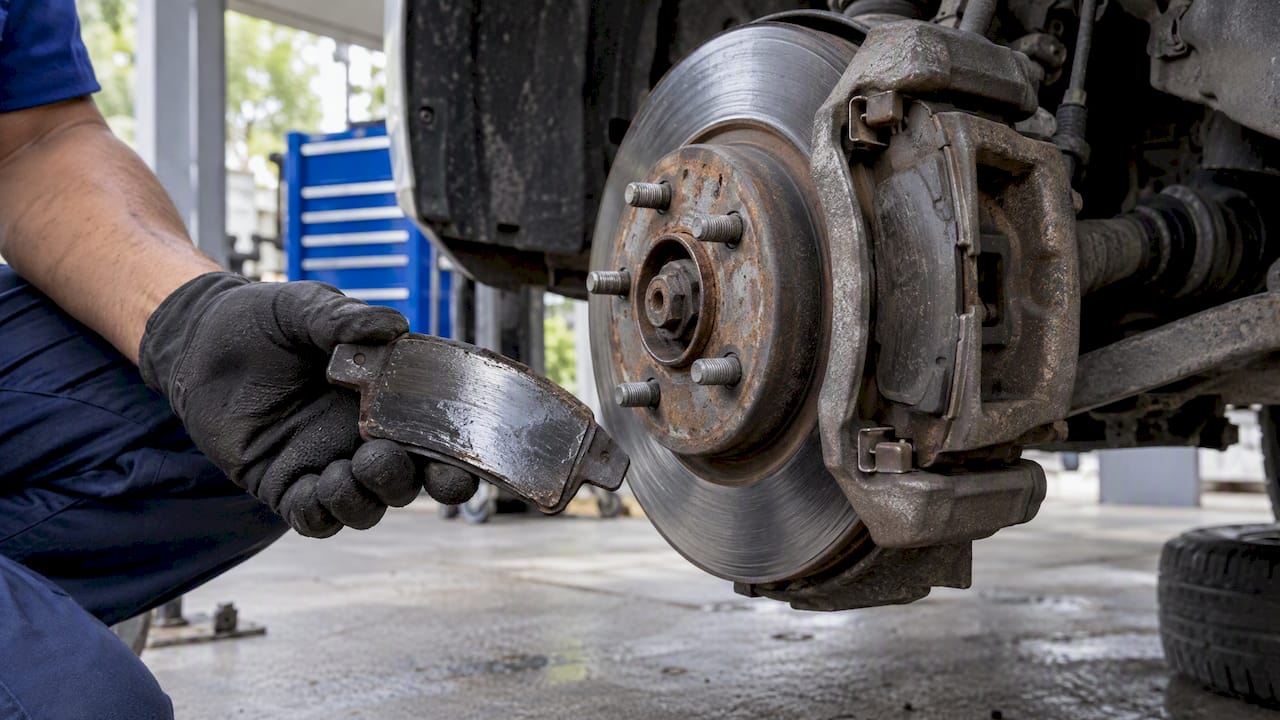
Scorched brake pads are pads that have been heated past what their friction material can tolerate. They give off a sharp burning smell, lose bite and often leave the rotor discoloured. Once a pad is truly scorched, it cannot be restored. Replace it, and inspect the rotor, caliper and brake fluid at the same time, because whatever overheated the pad has usually affected them too.
This guide explains how to recognize the damage, what causes it in Canadian driving conditions, what to do in the first minutes after you smell it, and how to avoid a second set of scorched pads.
TL;DR
- A sharp burning smell, a soft or spongy pedal, a pull to one side or blue-tinged rotors are the usual signs of overheated brakes.
- Scorching comes from heat that has nowhere to go: dragging calipers, long downhill runs, aggressive stop-and-go driving, a poor bedding-in routine or old fluid.
- If you smell it or see smoke, stop safely, let the brakes cool and have them inspected before driving far. Do not pour water on hot brakes.
- Replace pads and check rotors as a pair. In Canada a pad-only job commonly runs $175 to $340 per axle, and pads with rotors $350 to $700 per axle on mainstream vehicles.
- Our HydroAdaptive ceramic pads and corrosion-resistant rotors are engineered for stable friction in rain, snow and humidity.
Table of Contents
- What “scorched” actually means
- How to recognize scorched brake pads
- What causes pads to scorch
- Why Canadian conditions make it worse
- What to do right now if you suspect overheated brakes
- Can scorched pads be saved?
- What the repair costs in Canada
- Our perspective: heat is only half the story
- Replacing scorched pads with the right set
- Keeping new pads from scorching
- FAQ
- Sources
What “scorched” actually means
A brake pad turns the motion of your car into heat. The pad material and the rotor absorb that heat and release it into the air. Scorching happens when the heat arrives faster than it leaves, or when it never stops arriving because a brake is staying partly applied.
The pad surface then changes. Binders in the friction material cook out, the face turns hard, shiny and sometimes crumbly, and the pad no longer grips the way it did. Mechanics often call the shiny, hardened result “glazing”. The two terms overlap, but scorched suggests heat damage that goes deeper than the surface.
The damage rarely stays in the pad. Heat also reaches the rotor, the caliper seals and the fluid, which is why a scorched pad is a symptom to investigate, not just a part to swap.
How to recognize scorched brake pads
You can often tell before you remove a wheel. Look for a combination of these signs rather than one on its own.
| Sign | What you notice | What it can mean |
|---|---|---|
| Burning smell | Acrid, like hot carpet or chemicals, after a stop or a hill | Pads or a dragging brake running too hot |
| Soft or spongy pedal | Pedal travels further or feels less firm | Heat in the hydraulic system or fluid affected by heat |
| Pull to one side | Car drifts when you brake | One caliper gripping or releasing unevenly |
| Squeal or grinding | High pitch or rough scraping | Hardened pad face, or pad worn to the backing plate |
| Blue or dark patches on the rotor | Colour change on the rotor face | Rotor has seen very high temperatures |
| Shiny, hard pad face | Glassy surface, sometimes cracked or crumbling | Glazed or scorched friction material |
| One wheel much hotter than others | Noticeably hot hub after a normal drive | A sticking caliper or slide pin |
Two of these deserve extra attention. A change in pedal feel and a vehicle pulling to one side are warning signs that often appear well before total loss of braking, and drivers tend to dismiss them. If either shows up, book an inspection with a trained technician rather than waiting for it to get worse.
Squealing and grinding are also easy to misread. Many drivers assume they are ordinary wear noises, yet in a climate with road salt, freeze-thaw cycles and heavy city traffic they can point to heat damage already under way.
Pad inspection in the driveway
If you do your own maintenance, a basic look takes ten minutes once the car is fully cool and safely supported.
- Check the pad face for a glassy sheen, cracks, chipped corners or a burnt, blackened look.
- Compare the inner and outer pads on each caliper. A large difference in wear says the caliper is not moving freely.
- Check the rotor for blue or purple tint, deep grooves and a raised lip at the edge.
- Look at the caliper boots and the brake hose for cracks or seepage.
- Compare left and right sides. Brakes should wear in a similar way across an axle.
If you are not confident working under a vehicle, a technician can do the same check quickly during a tire swap.
What causes pads to scorch
A caliper that does not release
This is the most common hidden cause. A seized slide pin or a sticking piston keeps the pad pressed against the rotor even when your foot is off the pedal. The pad cooks slowly through ordinary driving. You may notice poorer fuel economy, a hot wheel and a faint burning smell after a drive. Overheating from dragging brakes is serious enough that it features in Transport Canada’s recall database: a snowmobile brake recall is one example of a vehicle where brakes could overheat under certain conditions.
Long, loaded descents
Driving down a long grade with your foot resting on the pedal turns kinetic energy into heat continuously. This is common on mountain routes in British Columbia and Alberta, especially with a trailer or a full load. Shifting to a lower gear so the engine shares the braking work keeps the pads from carrying all of it.
Aggressive stop-and-go driving
Hard braking repeated with little time to cool, whether in dense urban traffic or spirited driving, stacks heat faster than the system sheds it. Heavier modern vehicles make this harder. Dealer-network specialists point out that EVs and other heavy vehicles with instant torque put greater demands on brakes than older cars did, and that higher-quality components matter more as a result.
Poor bedding-in
New pads and rotors need to transfer a thin, even layer of friction material onto the rotor. Skipping this, or hammering new pads with hard stops before they are ready, can leave uneven deposits and overheat the new surface. The Transport Canada brake test standard shows how seriously engineers treat the process: its burnish procedure for light vehicles calls for 200 stops from 64.4 km/h, with the brakes allowed to cool between stops. That is a laboratory test, not a driveway routine, so follow the bedding instructions that come with your pads. The principle carries over: heat needs to be introduced gradually and given time to leave.

Old or contaminated brake fluid
Brake fluid absorbs moisture over time, and moisture lowers its boiling point. Fluid that boils under heavy braking creates vapour, and vapour compresses. That is the soft pedal you feel. A fluid flush is commonly recommended with brake work and typically costs $80 to $150.
The wrong pad for the job
Pad compounds are designed for particular temperature ranges. A pad built for light commuting will struggle with towing, and a track-oriented pad can feel dull and noisy when cold. Matching the compound to how you drive matters as much as the brand name. Our guide to choosing the right pads walks through the questions to ask.
Why Canadian conditions make it worse
Canadian brakes work in a harsher environment than most. Road salt and brine get thrown into the caliper area. Temperatures swing across zero, so moisture freezes and thaws in the same places repeatedly. Corrosion builds on rotor faces, pads stick to rusty surfaces after a night outside, and slide pins seize.
Corrosion can also be hard to see. Rotors can lose structural integrity from corrosion before the friction surface looks worn out. A standard thickness check may pass them even though they are not in good shape. The same lesson appears in a Transport Canada advisory on aircraft: de-icing fluids can catalyze oxidation in carbon brakes, causing damage that a surface inspection can miss. Aircraft are not cars, but the point holds: contaminants and chemistry can compromise brake parts in ways the surface does not show.
Prevention starts with keeping the corrosive material off. Road salt protection that works is worth reading for the wash and coating routine that limits salt damage on the rest of the vehicle. For brakes specifically, we cover the monthly routine in our road salt corrosion checks and the faster response in 7 same-day steps against brine corrosion.
What to do right now if you suspect overheated brakes
The steps below are general. Your owner’s manual and a licensed technician take priority for your specific vehicle.
- Ease off and pull over safely. Use your hazard lights, find a flat spot away from traffic and put the vehicle in park with the parking brake applied only if you are sure the rear brakes are not the hot ones. If in doubt, use park or a gear and chock a wheel.
- Keep your distance. Hot brakes can burn skin. Do not touch the wheel or rotor.
- Let everything cool. Give the brakes time to cool naturally. Dousing hot rotors with cold water can stress the metal.
- Look for smoke, fluid or a hot wheel. One wheel much hotter than the others points to a sticking caliper. Fluid around a wheel points to a leak.
- Do not keep driving if the pedal is soft, the car pulls hard or there is smoke. Arrange a tow. A shop can inspect the whole hydraulic path, not only the pads.
- Call 911 if you see flames. Move well away from the vehicle.
Do not treat a symptom that fades as a problem solved. A brake that overheated once because of a dragging caliper or contaminated fluid will usually do it again. Transport Canada’s recall notices show the same pattern in other settings: one Transport Canada recall describes brake fluid reaching a brake pressure switch and wire harness on certain trucks, which could cause a short circuit. The corrective action is inspection and repair of the component, not waiting to see if it comes back.
Can scorched pads be saved?
No. Once the friction material has been cooked, the pad cannot be restored by sanding or by gentle driving. A light surface glaze that has just started can sometimes be cleaned up when the rotor is also resurfaced, but a pad that has been burnt, cracked or crumbled needs replacing. Replacing only the pad on a heat-stressed rotor can pass the problem on to the new set.
Treat the repair as a set:
- Pads: replace both pads on the axle, never one side only.
- Rotors: replace them if they show blue marks, deep grooves, cracks, uneven thickness or judder. Our brake judder checks list five things to rule out before you decide.
- Calipers and hardware: free up or replace sticking slide pins and boots. If a piston is seized, replace the caliper.
- Fluid: flush it if it is old or dark, or if the pedal went soft.
- Bed in the new parts according to the instructions for the pads you install.
What the repair costs in Canada
Costs depend on your vehicle, your region and the shop. Figures published by a Canadian repair guide put a pad-only replacement at $175 to $340 per axle and a pad and rotor replacement at $350 to $700 per axle on mainstream vehicles, with complex or luxury vehicles above $1,200 per axle. Labour rates run $80 to $150 per hour, and a standard job takes 1.5 to 3 hours. Regional sources show the same spread: an Ontario shop guide lists $175 and up per axle, and a Calgary guide describes a typical job as pads, rotor resurfacing or replacement, a fluid check and caliper, hose and line inspections.
If your rotors are involved, see our breakdown of rotor replacement costs in Canada. Replacing rotors at the same time as scorched pads costs less than doing a second visit a few months later.
Our perspective: heat is only half the story
Most articles on scorched pads treat them as a heat problem. In the conditions our customers drive in, we see it as a heat and moisture problem together.
A conventional ceramic pad can be slow to clear water from the rotor face on a wet or humid day. The driver feels a delay and an inconsistent pedal, presses harder, and generates more heat than the stop needed. Add salt and corrosion on the rotor, and the friction surface the pad meets is no longer clean or consistent. That is the environment we engineered HydroAdaptive technology for. Our patented ceramic system is designed to clear moisture quickly and keep friction stable, so the pedal feels the same in rain, snow or humidity and the brakes are not pushed into extra work.

We pair that with rotors designed for corrosion resistance and with climate-adaptive calipers and lubricants, because a brake works as a system. A great pad on a seized caliper still scorches. Our approach is to treat the pad, rotor, caliper and lubricant as one ecosystem built for stable behaviour across a wide temperature band.
That said, no product removes the need for good habits. Use engine braking on long descents, check for dragging, keep your fluid fresh and bed in new parts properly.
— AAA
Replacing scorched pads with the right set
If you are ready to replace pads, match them to your vehicle and how you drive. We offer two pad lines and two rotor types, all engineered around HydroAdaptive ceramic technology:
- Type 03 Brake Pads and Type 07 Brake Pads, vehicle-specific pad sets.
- SC Type Rotors and GC Type Rotors, for rotors designed to resist corrosion.
- ClimateFlex™ Brake Calipers, for the caliper side of the system.
Many vehicles have a complete kit that pairs pads and rotors, which is the simplest way to avoid mismatched parts. You can browse every disc brake pad set by vehicle, or learn about high carbon rotors before you choose.
Keeping new pads from scorching
- Bed in properly. Follow the pad instructions. Avoid hard stops from speed until the surface is established.
- Use lower gears downhill. Let the engine carry part of the load.
- Leave space in traffic. Smooth, early braking spreads heat out.
- Wash the undercarriage in salt season. Salt and brine build-up speeds seizure of slide pins.
- Check for dragging after tire swaps. A hot wheel after a short drive is a flag.
- Replace brake fluid on the schedule in your manual.
- Have a technician inspect before winter. Transport Canada recommends a pre-winter check-up by a trained technician so that important items are not missed.
FAQ
Why did my brakes catch fire?
Brake fires usually trace back to extreme heat from a dragging or seized brake, leaking fluid that reaches hot parts, or an electrical fault near the brake system. A Transport Canada recall on certain trucks, for example, involved exhaust heat melting a rear wiring harness. If you see smoke or flames, move away from the vehicle and call 911.
How much does it usually cost to replace rotors?
On mainstream vehicles, a full pad and rotor replacement commonly runs $350 to $700 per axle in Canada, according to a published cost guide. Luxury or complex vehicles can exceed $1,200 per axle. Our rotor cost page explains what drives the difference.
Are brake pads supposed to look rusty?
A thin film of surface rust on the rotor after rain or a night outside is common and usually wears off in the first few stops. Heavy, flaking rust, rust on the pad edges or pads stuck to the rotor deserve an inspection. In salt-heavy regions, corrosion can weaken a rotor before the friction surface wears out.
How long does it take to burnish brakes?
It depends on the pad. Transport Canada’s lab test uses 200 controlled stops with cooling between them, but that is a test method. For your car, follow the bedding procedure that comes with your pads and avoid hard braking until it is complete.
Sources
- Preparing your vehicle for winter, Transport Canada
- Transport Canada recall 2022670, Polaris
- Transport Canada recall 2025336, International Motors
- Transport Canada recall 2023346, Hino
- Transport Canada brake test standard (TSD 105)
- Catalytic oxidation of aircraft carbon brakes, Transport Canada advisory
- Brake Job Cost in Canada, Preferred Mechanic
- How Much Does Brake Repair Cost in Ontario?, Master Mechanic
- Typical cost of a brake job in Calgary, My Calgary Mechanic
- Canadian Auto Dealer, ACE 2023 exhibitor interviews