

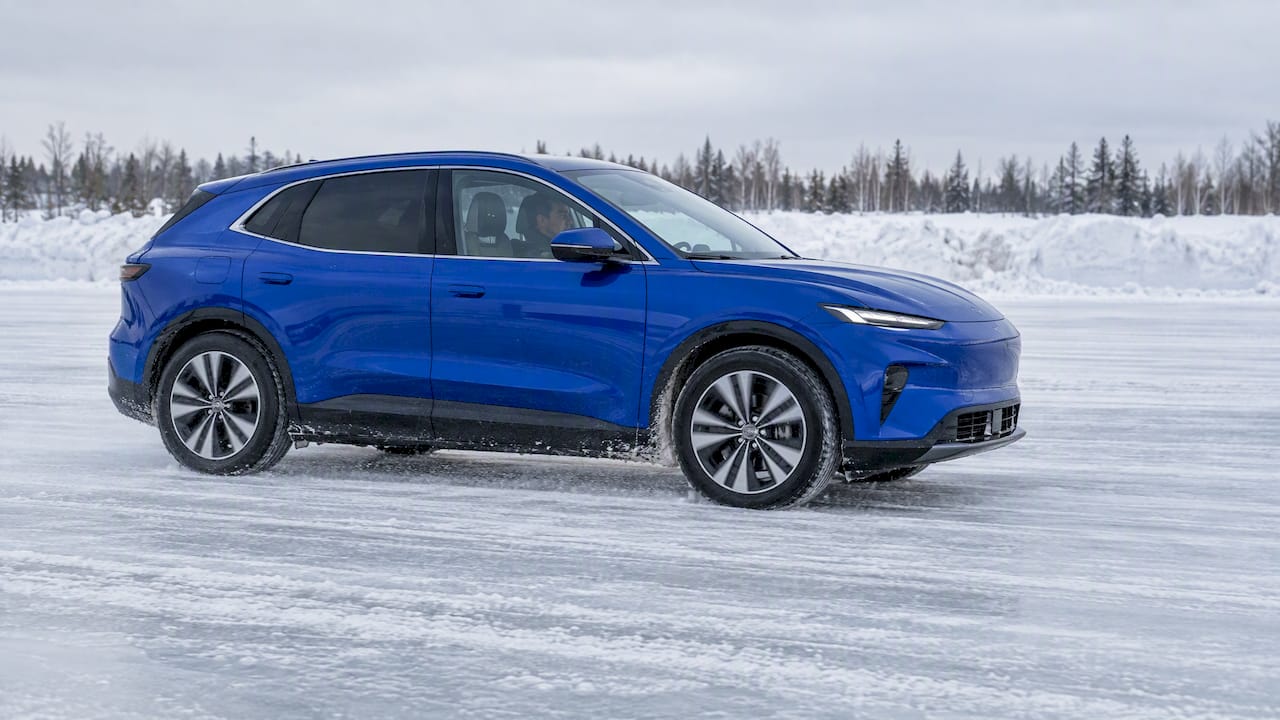
Regenerative braking works on ice, but it is not gentle by default. It slows the car through the drive wheels only, so on a slick surface strong regen can push those tyres past their grip, much as a hard downshift would. The practical answer is to lower your regen setting, lift off the accelerator early and smoothly, keep the friction brakes in good condition, and rely on winter tyres for the grip that makes any of it work.
This guide explains what is physically happening, what to change in your vehicle, and where the friction brake system fits in. It is written for Canadian drivers of electric and hybrid vehicles heading into the first freeze.
TL;DR
- Regen decelerates only the driven axle, so on ice it can cause the same wheel slip that a sudden lift off the throttle can.
- Lower the regen strength if your vehicle allows it, and smooth out your inputs. Turning it off entirely is not always possible or necessary.
- No braking technology changes how much grip the road offers. Transport Canada is clear that driver aids cannot override the laws of physics.
- Winter tyres on all four wheels, longer following distances and healthy friction brakes do more for your stopping than any setting.
- Hydraulic friction brakes still do the work when regen fades, so their condition matters in cold, wet, salty conditions.
Table of Contents
- What regen braking does differently on ice
- Should you turn regen off on ice?
- Cold batteries and why regen feels different
- What the official guidance says
- Tyres decide how much any braking system can do
- Technique: braking on ice in an EV or hybrid
- Why your friction brakes matter more in an EV than you think
- Our perspective: regen and friction brakes are one system
- Choosing parts for a winter-ready braking system
- A pre-winter routine for regen vehicles
- FAQ
- Sources
What regen braking does differently on ice
In a conventional car, the hydraulic brakes act on all four wheels and the force is split between front and rear by design. In an electric or hybrid vehicle, regenerative braking uses the electric motor as a generator. That motor drives either the front axle, the rear axle or both, depending on the model, so the regen force is applied only where the motor is.
On dry pavement that is invisible. On ice, the available grip is a small fraction of what you have in summer, and a strong, sudden deceleration at one axle can be enough to exceed it. The tyres slide, the wheels lose their ability to steer or stabilize the car, and the sensation is similar to engine braking on a slippery hill in a manual car.
Engineers know this problem well. An SAE paper on stability control for a hybrid with an electric rear axle starts from the point that pushing regen as far as possible on the rear axle of a low friction surface is a stability concern. Another SAE paper describes integrating regen with ABS during an ABS event, because the two systems have to cooperate when a wheel starts to lock.
Modern vehicles manage that handoff for you. Most reduce or blend out regen when sensors detect slip. But the software reacts after the slip begins, not before, and it cannot create grip that is not there.

Rear-drive, front-drive and all-wheel drive
The axle matters. Regen on a rear-drive vehicle can unsettle the back end, which is the less forgiving failure on a corner. Regen on a front-drive vehicle tends to push the nose wider, which also reduces steering. All-wheel-drive layouts spread the force and are usually calmer, but they are not immune. Check your owner’s manual for how your model handles regen on low-traction surfaces.

Should you turn regen off on ice?
Owner forums are divided on this, and the honest answer is that it depends on your vehicle and your road.
Many vehicles will not let you disable regen completely, and some only offer a choice between standard and low. Where a low or reduced setting exists, it is the sensible winter default on ungritted, icy or compacted-snow roads. The deceleration when you lift off is weaker and easier to predict, and you use the brake pedal when you actually want to slow down.
Where regen cannot be reduced, adapt your technique:
- Lift off the accelerator earlier than you normally would, and do it progressively.
- Avoid sudden lifts while turning. Finish steering inputs before you ease off.
- Brake in a straight line, and begin well before the junction or stop.
- On a long downhill, expect regen to be limited when the battery is full or cold, and be ready for the friction brakes to take over.
If a setting is ambiguous in your manual, ask your dealer before the first icy morning, not during it.
Cold batteries and why regen feels different
A cold battery accepts charge more slowly, so many vehicles limit regen on a cold start. You may notice that the car slows less when you lift off for the first few kilometres, then more strongly as the pack warms. That change in feel is a risk on its own: you can approach the first stop sign expecting a certain amount of deceleration and not get it, or get more of it a few minutes later on a patch of ice.
The habit to build is to treat the first part of a winter drive as a calibration. Test deceleration gently on a quiet stretch, away from traffic, before you depend on it. Then use the brake pedal for decisions that matter.
What the official guidance says
Transport Canada’s winter driving advice tells drivers to match their speed to road and weather conditions, to leave more distance between vehicles than usual, and to use winter tyres on all wheels in cold, snowy or icy conditions. None of that changes because your car is electric.
The department’s page on traction control explains that these systems use the same wheel speed sensors as ABS to prevent wheel spin. Electronic stability control has been mandatory on cars, SUVs, pickups and minivans from the 2012 model year, and is meant to help when you need to swerve. They assist, they do not replace judgment. The department also warns, in its trip planning guidance, that snow and ice can affect how driver assistance technologies perform, and they may not work properly in winter weather.
The lesson for regen is the same: it is an aid, and the surface sets the limit.
Tyres decide how much any braking system can do
A brake, whether it is regenerative or hydraulic, only converts your request into a force at the tyre contact patch. If that patch cannot grip, the force goes nowhere. This is why tyres come first.
Older SAE research on ABS, ice and temperature compared summer, all-season and winter tyres on a flooded frozen track and on snow-covered pavement, and the tyre type changed the friction values the tests recorded. Transport Canada has also published winter tire testing results on a vehicle tested with winter tyres on four wheels versus a mixed set, which shows why it is worth fitting a full set.
If you want a deeper look at how antilock systems behave on slippery surfaces, we cover it in Should You Trust ABS on Ice?. For why tyres and brakes work as a pair, read Tyres First, Performance Brakes Second for Snow.
Technique: braking on ice in an EV or hybrid
The questions readers raise most are what to do when the car starts to slide. Keep it simple.
- Look and plan further ahead. Stopping distances on ice are much longer. Transport Canada’s winter driving guidance advises extra distance and looking as far down the road as you can.
- Be smooth. Gentle pedal input, gentle steering, gentle lift. Anything abrupt can break traction.
- Brake before the corner. Slow down in a straight line, then steer.
- If ABS pulses, keep pressing. The pedal vibration is normal. Do not pump it.
- If you slide, ease off the accelerator slowly and look where you want to go. Do not stomp the brake.
For slush, which behaves differently from sheet ice, see our note on leaving 4 to 6 seconds when braking in slush. For long descents, what to do when winter brake fade hits on a downhill is worth reading before a mountain trip, and mountain winter braking in Canada covers the wider approach.
Why your friction brakes matter more in an EV than you think
Because regen does so much of the everyday slowing, an EV’s pads and rotors can go long periods with light use. That sounds like a benefit, and in wear terms it is. But light use has a cost in a Canadian winter. Rotors that rarely get hot enough to dry out collect moisture, road salt and surface corrosion. Calipers and slide pins can seize or drag when they are not exercised. Then, on the day regen is limited, whether because the pack is cold or full, or because the software has backed it off on ice, the hydraulic system has to deliver a firm, even stop right away.
A few things to check before winter:
- Pad and rotor condition. Look for uneven wear, heavy rust ridges and glazed surfaces.
- Caliper movement. Sticking slide pins cause uneven wear and drag. Our guide to caliper slide pin maintenance is a 15 minute job for confident DIYers.
- Pedal feel. A pedal that sinks or feels different in the cold deserves attention. See brake pedal travel in the cold.
- Snow and ice packed around the brakes. Our page on snow buildup in brakes explains what to do.
- Fluid and general inspection. Our five winter brake checks put these together in one list.
Salt is the other half of the story. Washing the underbody and wheels regularly during winter helps limit what it does to metal parts, and this winter car washing guide, written for UK salt roads, makes the case for washing more often than you might think. Canadian roads see plenty of salt too, so the principle carries over.
Our perspective: regen and friction brakes are one system
We design and sell friction components, so we see this topic from the hydraulic side. Here is what we would tell a driver coming from a gas car to an EV.
Regen is excellent for efficiency and for everyday slowing. It is not a substitute for a brake system that is ready to work in the worst moment. On ice, the car will blend or hand off to the friction brakes and the ABS, and that handoff is only as good as the hardware behind it. Pads that grab late when wet, rotors that are rusted or pitted, or calipers that stick all make the transition less clean.
That is the reason we developed our HydroAdaptive ceramic formulation. It is designed to clear moisture quickly and hold friction in rain, snow, humidity and cold, so the pedal feel is more consistent when conditions change from one block to the next. To be clear about its role: it supports predictable braking once the tyres have grip. It does not create grip on glare ice, and we would never ask you to treat it that way. Tyres first, then technique, then brakes that are ready.
In practice, we think of the braking setup as an ecosystem. The pad, the rotor, the caliper and the lubricants should all be chosen to work in the same temperature band, and the tyres complete the chain. Our rotors use corrosion-resistant coatings, our ClimateFlex calipers address the sticking and drag that winter brings, and the pads are matched to both.
— AAA
Choosing parts for a winter-ready braking system
If your inspection shows worn pads, rusted rotors or sticky calipers, replace them as a set. The right choice depends on your vehicle and driving, and our guide on choosing brake pads is the place to start. Fitment is vehicle-specific, so always confirm the part against your make, model and year before ordering.
Our range in brief:
| Component | What it does | Where to look |
|---|---|---|
| Type 03 pads | HydroAdaptive ceramic friction material | Type 03 Brake Pads |
| Type 07 pads | HydroAdaptive ceramic friction material, a different formulation | Type 07 Brake Pads |
| SC Type rotors | Rotor option matched to our pads | SC Type Rotors |
| GC Type rotors | Coated, corrosion-resistant rotors | GC Type Rotors |
| ClimateFlex calipers | Climate-adaptive calipers | ClimateFlex Brake Calipers |
If you want to know how the pad material is built, see our HydroAdaptive formulation page. We also publish vehicle-specific kits, including for hybrids such as the Toyota Prius C and the Toyota Mirai. Browse the full disc brake pad range to find yours.
If you are replacing rotors, vented versus solid rotors and directional rotors explain what to match.
A pre-winter routine for regen vehicles
- Set your regen level for the road: low for ice and compacted snow, as your vehicle allows.
- Fit winter tyres on all four wheels.
- Inspect and service the friction brakes, including slide pins.
- Do a gentle test stop at low speed in a safe, empty place after each big temperature swing.
- Wash off salt regularly.
- Leave extra distance and slow down before the hazard, not at it.
- Read the manual for how your model blends regen with ABS and stability control.
FAQ
Is it better to have regenerative braking on or off in winter?
If your vehicle lets you choose, a lower regen setting is usually easier to manage on ice because the deceleration is weaker and more predictable. Many vehicles will not let you switch regen off entirely. Whatever the setting, smooth inputs and winter tyres matter more.
What are the downsides of regenerative braking on slippery roads?
Regen acts only on the driven wheels, so strong deceleration can exceed grip at that axle. It can also feel different when the battery is cold or full. Your friction brakes and ABS remain the backup, so keep them in good condition.
What is the best braking technique on ice and snow?
Slow down early, in a straight line, with gentle and progressive pressure. Leave extra following distance, as Transport Canada advises. If ABS pulses under your foot, keep steady pressure and steer where you want to go.
Can better brake pads fix poor braking on ice?
No. Pads and rotors determine how reliably the hydraulic brakes build force, and moisture-resistant ceramic friction material helps consistency in wet and cold. But grip comes from the tyres and the road surface, so winter tyres remain the first upgrade.
Sources
- Transport Canada: Driving safely in winter
- Transport Canada: Planning your trip
- Transport Canada: Traction control
- Transport Canada: Electronic stability control
- Transport Canada: Results of winter tire testing on a multi-function activity vehicle
- SAE 2016-01-1649: Stability control for a hybrid with electric rear axle drive
- SAE 2020-01-0846: Integrated regenerative braking and ABS
- SAE 940724: Ice, ABS, and Temperature