

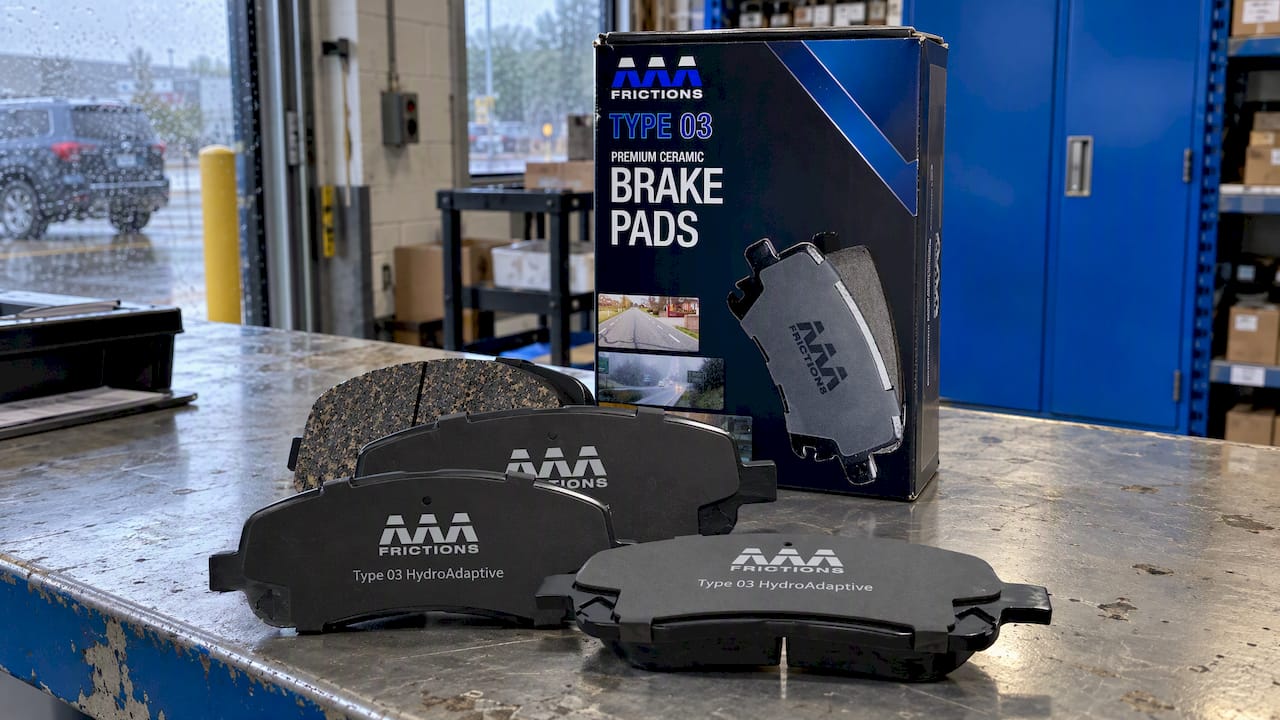
Weather adaptive brake pads are friction products designed to keep pedal feel and stopping behaviour steady when moisture, road salt and temperature swings change the conditions at the rotor. “Weather adaptive” is a design goal, not a regulated category, so the useful question is what a pad is built to do about rain, salt and cold. This guide explains the problems weather creates, the features that address them, and how to choose a set for your vehicle in Canada.
TL;DR
- “Weather adaptive” has no official definition in Canada. Judge a pad by its friction material, its pairing with the rotor and its fit for your vehicle.
- Moisture, road salt and cold attack the whole braking system, not only the pad. Rotor corrosion can cause pads to stick and braking to suffer.
- Ceramic-based pads are a common starting point for Canadian passenger vehicles. Heavy loads and towing can call for a different choice.
- Pads and rotors work best as a matched system, so replace them with that in mind and follow the bedding-in steps.
- Check pad wear, rotor surface and caliper movement before winter and after it.
Table of Contents
- What “weather adaptive” means for a brake pad
- What rain, road salt and cold do to your brakes
- Features that help braking stay consistent
- How our HydroAdaptive approach works
- Our perspective: consistency matters more than peak numbers
- How to choose pads for your vehicle and climate
- Fitment, installation and break-in
- Maintenance checks through the seasons
- Our weather-ready brake range
- FAQ
- Sources
What “weather adaptive” means for a brake pad
No standard says a pad is weather adaptive. Transport Canada’s Technical Standards Document No. 135, Revision 5, published on May 1, 2026, sets the requirements for service brake and parking brake systems on light vehicles. It includes a cold-effectiveness test. That tells you the baseline: a vehicle’s brakes must meet performance requirements in cold conditions, but the standard does not rate individual aftermarket pads as suited to rain or salt.
So when a brand says a pad is weather adaptive, it is describing engineering intent. In practice, that intent usually covers three things:
- Friction stability: the pad holds a similar friction level across a wide temperature band, from a freezing morning start to a warm afternoon.
- Moisture management: the pad material and surface design help clear water so the first stops in rain or after a car wash feel predictable.
- Corrosion tolerance: the pad works with a rotor and hardware that resist rust, so surface corrosion does not undermine the contact patch.
These are reasonable goals, and you can check whether a manufacturer has built its range around them. Ask what the material is, whether the rotor is designed to pair with the pad, and whether the pad is made for your exact vehicle.
What rain, road salt and cold do to your brakes
Brakes are exposed. The rotor faces spray, slush and salt every day, and the pads press against that surface whenever you slow down. Each kind of weather causes a different problem.
Rain and humidity
Water on the rotor face reduces friction briefly until the pads wipe it away. On a short wet commute, that gap can show up as a slightly delayed first bite. Humid air also lets a thin layer of surface rust form overnight on cast-iron rotors. A light layer normally clears after a few stops, but a vehicle that sits for long stretches can develop deeper corrosion.
Road salt
Salt is the harshest part of a Canadian winter for brakes. Academic research on corrosion stiction in automotive braking systems reports that rain, snow and chloride-containing environments can corrode cast-iron rotors, and that corrosion under static conditions can cause pad stiction, where the pad bonds to the rotor and impairs braking performance. This is why a vehicle parked for several days after a salty drive can feel rough or noisy on the first stops.
Salt also reaches calipers, slide pins and brake lines. If you want to reduce the damage across the whole vehicle, practical road salt protection for cars such as regular washing of the underbody and wheel wells helps the brake parts last longer too.

Snow and deep cold
Cold stiffens lubricants and rubber. A caliper that moves freely in summer can drag or hang in winter if its slide pins are dry or its boots are damaged. That drag wears pads unevenly and heats the rotor. Our guide on the five-minute pin check that cuts winter pad wear walks through what to look for.
One point deserves honesty: brakes do not create grip. Tyres do. If you are choosing between a brake upgrade and a set of winter tyres for snow, read why tyres come first and performance brakes second. Good pads let the tyres do their job without surprises.
Features that help braking stay consistent
Not every feature matters equally. These are the ones worth weighing.
Friction material
Ceramic-based pads are widely used in passenger vehicles because they tend to stay stable in cold, produce fine light-coloured dust and resist the effects of salt. Semi-metallic pads can handle higher heat and heavier duty, which suits some trucks and towing use. We compare both in detail in ceramic vs semi-metallic brake pads, and if you haul or tow, our page on heavy duty brake pads for Canadian drivers covers that case.
The rotor surface
A pad can only be as consistent as the surface it grips. A coated or corrosion-resistant rotor keeps the friction surface and the non-contact areas in better shape through a salty winter. A rusted, pitted rotor gives even a high-quality pad an uneven bed.
Caliper movement
A seized or sticky caliper undermines every other feature. Look for hardware, boots and lubricants made for temperature extremes, and replace worn slide hardware when you replace pads.
Pad and rotor as a matched system
Pads and rotors wear each other in. When both are developed together, the friction behaviour is more predictable than when you mix unrelated parts. This is the principle behind our range.
How our HydroAdaptive approach works
Our range is built around three parts that each address one weather problem: HydroAdaptive brake pads for moisture management and stable friction, GEOMET-coated rotors for protection against corrosion from moisture and road salt, and ClimateFlex calipers for smooth operation through winter cold and summer heat. The pads use HydroAdaptive ceramic technology, and we develop pads and rotors as a matched system. For that reason, we sell rotors only together with compatible pads. You can read more in our explanation of how HydroAdaptive technology improves braking.
Our two pad lines are Type 03 and Type 07, and our rotors come in SC Type and GC Type. Each is sold by vehicle, so you choose by your make, model, year and axle rather than guessing at a universal size.
Our perspective: consistency matters more than peak numbers
Most brake marketing leads with the highest temperature a pad can survive. Most Canadian driving never gets near that. Daily commuters, rideshare and delivery drivers, and anyone covering high mileage spend their time in repeated moderate stops, in wet slush, at minus 15 in the morning and plus 10 by afternoon.

For that driver, the quality that counts is repeatability: the pedal feels the same on the first stop of a cold day as on the tenth stop of a wet one. That is why we engineer for temperature band adaptability and moisture management first, then for heat capacity. It is also why we treat the rotor as part of the pad’s environment. A pad developed for stable friction needs a rotor that stays clean and protected from salt, otherwise the benefit fades after a winter or two.
We would rather tell you a heavier-duty or tyre-first answer fits your situation than sell you the wrong part. Brakes are a safety system, and trust comes from fit.
— AAA
How to choose pads for your vehicle and climate
Start with how you use the vehicle, then match the material and the parts to it.
| Your situation | What to prioritise | Where to look |
|---|---|---|
| Daily commuter, city and highway | Stable friction, low dust, corrosion-resistant rotors | Ceramic-based pads with matched rotors |
| Rideshare, delivery or high mileage | Wear life, consistent feel across thousands of stops | Ceramic-based pads, shorter inspection intervals |
| Larger SUV or truck, light loads | Correct vehicle-specific fitment, rotor condition | Pads and rotors specified for your model |
| Towing or heavy loads | Heat capacity and fade resistance | Heavy duty options |
| Salt-belt winters | Rotor coating, caliper hardware | Matched pad and rotor set, new hardware |
Three practical checks keep you from buying the wrong thing:
- Confirm the exact vehicle. Pads are specific to model year, trim and axle. Front and rear are different parts.
- Replace in axle sets. Pads on one side only create uneven braking.
- Judge the rotor. If it is deeply grooved, rusted through or below its minimum thickness (stamped on the rotor), replace it rather than fitting new pads on a poor surface.
If you want a broader view of how to evaluate options, our guide on how to choose the right brake pads for your vehicle goes step by step.
Fitment, installation and break-in
Good pads can still disappoint when they are installed carelessly. These steps apply to nearly every vehicle, but your vehicle’s service manual and the pad manufacturer’s instructions come first.
Before installation
Compare the new pads with the old ones side by side: shape, clip positions and wear indicator location should match. Clean the caliper bracket where the pad ears slide, and replace the clips if they are corroded or bent. Retract the piston slowly, and check the dust boot for tears.
During installation
Lubricate the slide pins and contact points with a brake-rated lubricant designed for temperature extremes, and keep it off the pad face and rotor surface. Torque the caliper and bracket bolts to the vehicle’s specification. Pump the brake pedal before moving the car so the pistons seat against the pads, and top up fluid only if the level requires it.
Break-in
New pads and rotors need to transfer a thin, even layer of friction material onto the rotor, known as bedding in. Most manufacturers describe a series of moderate stops from a modest speed, with cooling time in between and no hard stops or holding the pedal while stationary on hot brakes. Follow the specific procedure supplied with your pads. Expect slightly reduced bite for the first few dozen kilometres, and avoid heavy braking or towing in that period.
A note on older brake parts
If you are working on an older vehicle, be careful with old pads and dust. Health Canada notes that older brake pads may contain asbestos and advises checking with suppliers or considering a commercial brake service. If you do not know the age of the parts on a vehicle, have a licensed technician handle the job rather than blowing dust off the parts yourself.
Maintenance checks through the seasons
Brakes give warnings if you listen for them. Check these before winter, again in spring after the salt is gone, and any time something changes.
- Pad thickness: Transport Canada’s earlier light vehicle brake standard required a way to check lining wear, either an acoustic or optical warning or a visual means. Use whatever your vehicle provides, and ask a technician to measure when in doubt. Replace pads before they wear to the backing plate, since metal on metal damages rotors.
- Rotor surface: light orange rust that clears after a few stops is normal. Deep pitting, a raised lip at the edge or scoring is not.
- Calipers and slide pins: they should move freely. A vehicle that pulls to one side when braking, or a wheel that is much hotter than the others after a drive, points to a sticking caliper.
- Brake fluid and lines: fluid condition and rusted lines matter after a salty winter. Have a technician check them.
- Sound, feel and behaviour: grinding, squealing that does not go away, a soft or spongy pedal, vibration through the pedal or steering wheel, or a dash warning light all call for an inspection promptly. Do not wait for the next service.
High-mileage drivers should shorten these intervals. A delivery vehicle that makes hundreds of stops a day wears through pads far faster than a weekend car.
Our weather-ready brake range
If you are ready to replace your pads, our Type 03 and Type 07 HydroAdaptive pad lines are built for consistent braking in rain, humidity, snow and cold. Browse the Type 03 brake pads or the Type 07 brake pads, and pair them with our SC Type rotors or GC Type rotors for a matched system. Each page lets you select your vehicle so you get the right fitment.

If you see your own model on our site, such as the Type 03 front pads for the Ford Escape 2020-2025, start there. Otherwise, begin from the AAA Frictions homepage and enter your vehicle details.
FAQ
Are weather adaptive brake pads a recognised category?
No. It is a marketing and engineering description rather than a regulated class. Transport Canada sets brake system performance requirements, including a cold-effectiveness test, but it does not certify pads as weather adaptive. Look at the material, the rotor pairing and the vehicle fitment instead.
Do ceramic pads work better in Canadian winters?
Ceramic-based pads are a common choice for passenger vehicles because they tend to stay stable in the cold and resist salt. They are not the answer for every vehicle, since towing or heavy loads can call for a semi-metallic compound. See our comparison of ceramic and semi-metallic pads to decide.
Can I replace just the pads and keep my old rotors?
Sometimes, if the rotors are smooth, above minimum thickness and free of deep rust. If they are pitted, grooved or worn thin, fresh pads will not seat evenly. With our range, rotors are sold together with compatible pads, because we develop them as a matched system.
How long should new pads take to bed in?
Usually a series of moderate stops over the first stretch of driving, then normal use. The exact procedure differs by pad, so follow the instructions supplied with yours. Avoid hard stops, towing and holding the pedal on hot brakes during that period.
When should I get my brakes inspected?
Before winter, after the salting season ends, and straight away if you notice grinding, a pull to one side, a soft pedal or a warning light. Drivers who cover high mileage should check more often.
Sources
- Transport Canada, TSD No. 135, Revision 5 (May 1, 2026)
- Transport Canada, Light Vehicle Brake Systems (TSD 135, Revision 3)
- Corrosion Stiction in Automotive Braking Systems (PubMed Central, 2023)
- Health Canada, Asbestos and your health
- Road salt protection for cars