

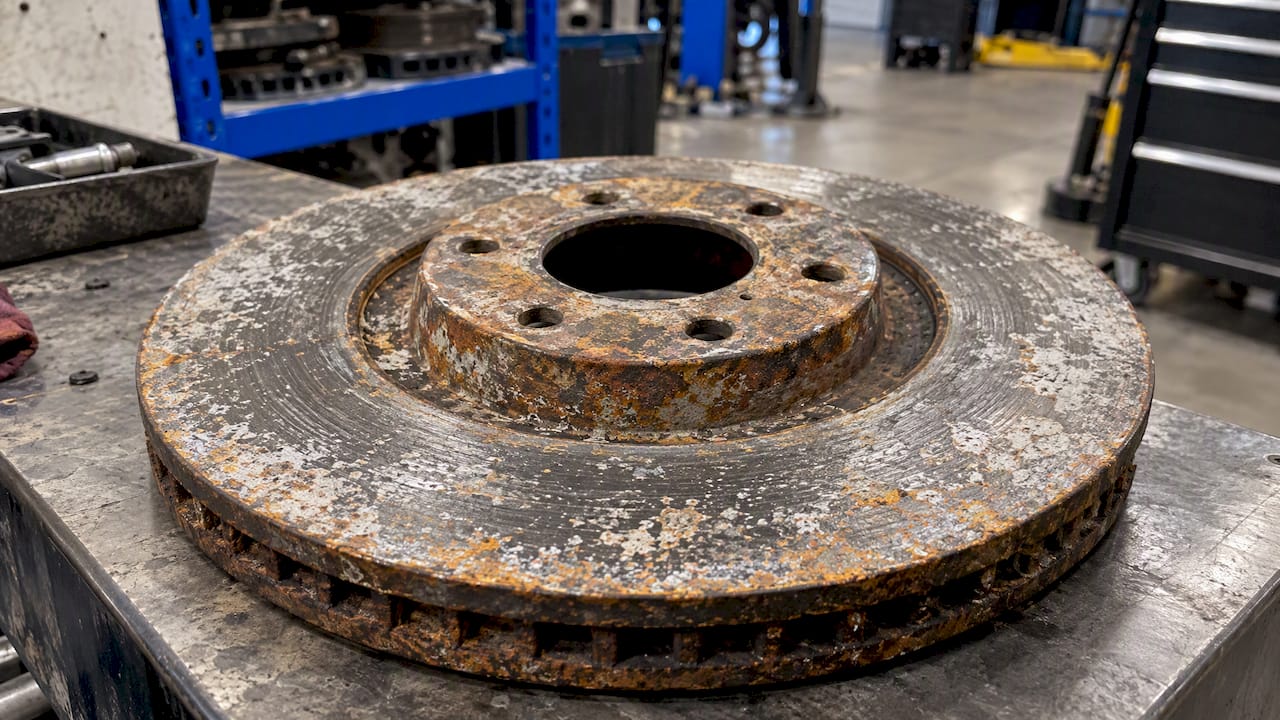
Yes, magnesium chloride corrodes brake rotors. Cast iron rusts quickly when chloride is present, and brine that dries on a rotor, hat, caliper bracket or fastener keeps attacking the metal long after the road has dried. The corrosion is usually cosmetic on the surface of a rotor that is driven regularly, because the pads wipe the friction face clean. It becomes a problem when pitting builds up, when rust spreads to the rotor hat and mounting areas, or when a car sits for days between drives. This guide explains how the damage happens, how to tell harmless rust from a real concern, and what you can do about it.
TL;DR
- Magnesium chloride is used on Canadian roads in smaller volumes than sodium chloride, but chloride of any kind speeds up rust on cast iron and steel.
- Rust on the swept friction face of a rotor often clears with normal driving. Deep pitting, heavy scale and rust on the hat, caliper brackets and slides are the real warning signs.
- Rinsing the underbody, driving regularly and checking brakes monthly in winter do more than any single product.
- Coated rotors, moisture-managing pads and calipers built for cold-to-heat cycling reduce what brine can do. They do not replace inspection.
Table of Contents
- What magnesium chloride is doing on Canadian roads
- How chloride attacks a brake rotor
- Magnesium chloride, aluminum and galvanic corrosion
- Surface rust or safety concern?
- How to clean brakes after brine exposure
- Reducing exposure: habits that work
- Perspective: why we build brakes as a weather system
- Choosing parts for brine-heavy roads
- What lab corrosion numbers mean for your car
- Spring checklist after the brine season
- FAQ
- Sources
What magnesium chloride is doing on Canadian roads
Road authorities use chloride salts to keep ice from bonding to pavement. Sodium chloride is the most common, but magnesium chloride is also applied, often as a liquid brine sprayed before a storm. Health Canada and Environment Canada’s assessment of road salts put magnesium chloride use at roughly 25,000 to 35,000 tonnes a year as of 2001, far less than sodium chloride. That figure is dated, and usage differs by province and municipality, so treat it as a sense of scale, not a current total.
The same assessment found that road salts, magnesium chloride included, can harm freshwater ecosystems, soil and vegetation. Brine is a problem for the environment as well as for your car, which is one reason crews apply it carefully and why Canada has a Code of Practice for road salt management. That code covers storage, road application and snow disposal. It does not apply to private or domestic use, so the protection of your own vehicle is up to you.
Why does brine matter more than dry salt? Liquid brine reaches every crevice at speed, clings to wet surfaces and stays active in damp air. Humidity changes how thick and sticky magnesium chloride is, and that affects how long it stays on a surface. The Washington State DOT’s laboratory assessment of corrosion best practices notes that results vary widely for this reason.
How chloride attacks a brake rotor
A rotor is mostly grey cast iron. Iron rusts with water and oxygen alone, but chloride changes the chemistry. In ferrous metals, chloride ions combine with iron ions to form iron chloride, which dissolves more easily than the hydroxide that forms in a benign environment. According to this engineering guide to corrosion, that is why corrosion runs faster in chloride-rich conditions that resemble a marine atmosphere. The protective layer never gets a chance to settle, so the attack continues.
On a rotor, this plays out in two very different places.
The friction face
The swept surface, where the pads grip, is cleaned every time you brake. The National Highway Traffic Safety Administration describes braking systems as self-cleaning in normal use, which stops build-up on rotor surfaces. The same document warns that extended parking in humid conditions can cause uneven corrosion on the braking surfaces, which may lead to pulsation. Brine speeds that process: a car parked after a salty drive can wake up with an orange film, and with an uneven film the pad contacts some areas more than others.
In practice that is flash rust. We cover it in detail in our guide to flash rust on rotors, and the short version is that a light film that disappears after a few stops is normal.
The hat, vanes and edges
The parts of the rotor that pads never touch are where brine does lasting damage. The hat (the centre section that sits against the wheel hub), the outer edge and the inside of ventilated vanes stay wet and salty because nothing wipes them. Rust here can swell and lift, which can make a wheel sit unevenly or a rotor seize on the hub. Our checklist for rotor hat rust in Canada shows five places to look.
Magnesium chloride, aluminum and galvanic corrosion
Rotors are not the only brake parts exposed. Research on magnesium chloride exposure of metals shows that the chloride can penetrate deep into the matrix of aluminum alloys, and some studies recorded a reduction in ultimate tensile strength of aluminum coupons after exposure. That matters because many modern calipers, wheels and brackets are aluminum.
Galvanic corrosion adds a second mechanism. It needs three things: different metals, electrical contact between them, and an electrolyte. Trade reporting on aluminum caliper corrosion points out that it happens most often where an aluminum caliper casting meets steel hardware, such as a banjo bolt or bleeder screw, with salty water acting as the electrolyte. A brake system has plenty of those junctions: steel slide pins in aluminum brackets, steel bolts in aluminum knuckles, steel rotors against aluminum hubs.

In plain terms, brine does not need to be magnesium chloride in particular. Any chloride solution in a joint between dissimilar metals will drive corrosion. Magnesium chloride is just one more source. If you want to go deeper on caliper-side problems, read our page on caliper corrosion in Ontario.
Surface rust or safety concern?
Most drivers see rust on a rotor in winter and wonder whether the car is safe. The useful distinction is where the rust is and how deep it goes.
| What you see | Usually means | What to do |
|---|---|---|
| Thin orange film on the whole face after parking | Flash rust | Drive normally and brake gently a few times; it should clear |
| Orange or brown on the hat or edge only | Cosmetic corrosion, not contact surface | Monitor; clean and protect at service |
| Dark, rough bands on the friction face | Pitting | Have it assessed; see below |
| Flaking scale, ridges, or a lip at the outer edge | Advanced corrosion or wear | Have a licensed technician measure thickness |
| Pulsation through the pedal after a long park | Uneven corrosion on the face | Clean-up stops; if it persists, inspect |
In Ontario, a published summary of the passenger-vehicle inspection standard says a rotor fails when corrosion covers more than 25% of the pad-contact surface, while light flash rust or scaling on the non-contact face generally passes. Other provinces set their own requirements, so confirm with a licensed inspection station. Heavy vehicles are held to a stricter standard: in commercial enforcement, severe rusting across the entire friction surface is treated as a defective brake and an out-of-service violation.
If you see pitting, read rotor pitting: is it safe, and what should you do. If you suspect heavy flaking, have a licensed mechanic verify the remaining thickness on a hoist. Thickness is measured against the minimum stamped on the rotor, a check we explain for technicians in minimum rotor thickness.
How to clean brakes after brine exposure
For ordinary surface film, the fix is driving. NHTSA’s service guidance says that ten to 15 moderate stops from about 56 to 64 km/h, with cooling time between stops, can clean the braking surfaces. The conditions matter:
- Pick a clear, quiet road where it is safe to brake repeatedly.
- Brake moderately, not to a hard stop, from the speed above.
- Let the brakes cool between stops by driving a short distance without braking.
- Repeat up to the number of stops above and see if the pedal feel evens out.
If pulsation or noise remains after this, the rust may have left uneven deposits or pitting, and the rotor needs inspection. Do not keep repeating hard stops to burn it off.
Reducing exposure: habits that work
Corrosion is a matter of time spent wet and salty. Shorten that time and you slow everything down.
Rinse the underbody
Brine dries into a film that reactivates with humidity. Rinsing the wheel wells, wheels and underbody in thaw periods removes it. A detailed guide to removing road salt from your car explains how checking rinse water quality helps, and our own steps for the same day are in 7 same-day steps to protect rotors from brine corrosion.

Do not leave the car sitting
A rotor that sits wet after a salty drive rusts unevenly. If the vehicle will be parked for a few days, see our stored-car brake rust steps. Driving a few kilometres with some gentle braking before you park lets the heat dry the rotors.
Consider a rust-proofing treatment for the underbody
Washington State DOT’s research tested corrosion inhibitors on equipment and found that spraying one product 19 times a year would cut corrosion from NaCl or MgCl2 deicers by at least 99% on that equipment. That was fleet equipment, not a passenger car’s brake system, and the lab results are best read as indicators, not as a guarantee. Never spray anything onto rotor faces or pads: oils and sprays on friction surfaces reduce braking. Treatments belong on the underbody and frame, not on brake contact areas. For wider road salt protection for cars, including what it does to brake systems and aluminum parts, it is worth understanding what each type of coating can and cannot do.
Monthly checks in winter
A five-minute look through the wheel spokes each month catches problems early. Our monthly road salt brake checklist walks you through it. Also watch for the signs of worn brake pads, since corroded rotors tend to wear pads unevenly.
Perspective: why we build brakes as a weather system
We design AAA Frictions parts around one idea: the weather does not attack one brake component at a time. Moisture changes pad friction, brine eats unprotected iron, and cold stiffens moving parts. So we treat the brake as an ecosystem and engineer each part for the challenge it faces.
Our HydroAdaptive ceramic pads are built for moisture management and stable friction, so pedal response stays predictable in rain and humidity. Our GEOMET-coated rotors are designed to protect against corrosion from moisture and road salt. Our ClimateFlex calipers are designed for smooth operation through winter cold and summer heat. Because rotors and pads work together, we develop them as a matched system, and we sell rotors only with compatible pads so the friction behaviour you get is the one we designed.
A coating does not make a rotor immune to neglect. A coated rotor on a car that sits in brine for weeks still needs rinsing and inspection. What the coating does is reduce what road salt can do on the surfaces it covers, so routine care goes further. That is how we think about reliability: the right parts, plus the habits above.
— AAA
Choosing parts for brine-heavy roads
If your rotors show pitting, heavy rust or a lip you can catch with a fingernail, replacement is usually the answer, and it is worth choosing the replacement for your conditions. Here is how our range maps to the problem.
- GC Type rotors are GEOMET-coated. They are our choice for drivers who face road salt and brine through the winter.
- SC Type rotors are part of our rotor range for drivers who want a rotor matched with our pads.
- Type 03 and Type 07 pads are HydroAdaptive ceramic pads. The Type 07 is also sold as HydroAdaptive+ in our kits.
- ClimateFlex calipers address the cold-to-heat cycling that stresses moving caliper parts.
Rotors are sold with compatible pads, so you get a pairing intended to work as designed. Pad and rotor replacement is best done together so a new pad is not bedded against a rotor surface that is already damaged.
Browse the GC Type rotors, the SC Type rotors, the Type 03 pads and the Type 07 pads, or start at aaafrictions.ca and select your vehicle to see the matching kit.

For a vehicle-specific example, our kits pair pads and GEOMET-coated rotors in one set, such as the front and rear kit for the Volkswagen Corrado. Enter your own vehicle on the site to see what fits.
What lab corrosion numbers mean for your car
You will find many laboratory figures online, such as corrosion rates measured in salt solutions on steel samples. Be careful using them. The WSDOT work shows that results for magnesium chloride are inconsistent because humidity changes its viscosity and how well it adheres. Cyclic tests, such as SAE J2334, tend to simulate real service humidity better than continuous spray tests, so they say more about what happens on a road.
For a driver, the takeaway is practical. A single “times more corrosive” claim from a lab does not tell you how fast your rotors will rust. Your climate, how often you drive, how often you rinse, and whether the car sits wet decide that. Inspect what you can see, and trust measured thickness more than headlines.
Spring checklist after the brine season
When the roads clear, do a proper review rather than assuming everything is fine.
- Look at both sides of each rotor through the wheel for dark bands, ridges or an edge lip.
- Check the hat and the area around the wheel studs for swollen rust.
- Check that caliper slides move freely, and that boots are intact and not cracked.
- Have a technician measure rotor thickness against the stamped minimum, particularly if the rotors have a coating, as covered in our guide to measuring rotor coating wear.
- Replace pads and rotors together if either shows heavy wear or corrosion.
FAQ
Will magnesium chloride rust brake rotors?
Yes. Chloride speeds up rust on cast iron and steel by keeping the corrosion reaction going. On the friction face, braking wipes much of it away. On the hat, edges and vanes, it can build up and cause lasting damage if the brine is not rinsed off.
Is magnesium chloride worse than road salt for brakes?
It depends on the conditions, and research findings differ mainly because humidity changes how magnesium chloride behaves. Both are chlorides and both corrode iron and steel. Your best approach is the same for either: rinse, drive regularly and inspect.
Does magnesium chloride damage aluminum brake parts?
It can. Research shows chloride can penetrate aluminum alloys, and galvanic corrosion can occur where aluminum meets steel hardware in the presence of salty water. Calipers, brackets and bleeder screws are common spots, so check them each season.
When is rotor rust a reason to replace the rotor?
Replace when corrosion has pitted the friction face deeply, when scale covers a large part of the swept area, or when the rotor is below its stamped minimum thickness. In Ontario, a published inspection summary puts the fail line at more than 25% of the pad-contact surface. Have a licensed technician confirm.
Can I clean rust off by braking?
For light surface film, yes. Ten to 15 moderate stops from about 56 to 64 km/h, with cooling between stops, can clean the surfaces. If pulsation or noise continues, the rotor needs inspection.
Sources
- Health Canada and Environment Canada, Priority Substances List Assessment Report for road salts
- Government of Canada, Code of practice for the environmental management of road salts
- NHTSA technical service bulletin on brake corrosion and pulsation
- Washington State DOT, Identification and Laboratory Assessment of Best Practices
- Corrosion of metals exposed to 25% magnesium chloride
- Engineer’s Guide to Corrosion: Causes, Protection and Control
- Aluminum Caliper Corrosion Alert
- Minor rust and the Ontario safety inspection
- Brake Safety Week: are your trucks and drivers prepared
- Road salt removal for cars
- Road salt protection for cars