

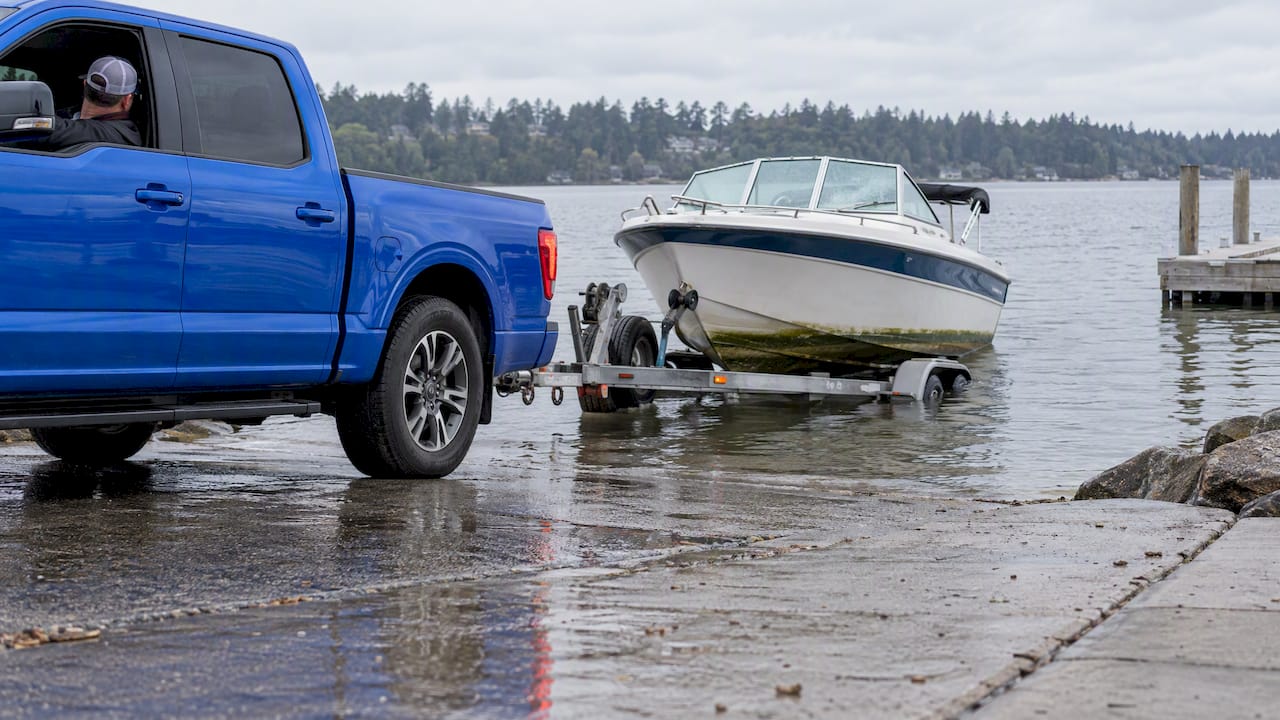
Wet brakes at a boat ramp are a real, manageable problem. Slippery concrete, algae and water on the rotors all cut your stopping and pulling grip at the moment you have the most weight behind you. The fix is a short routine: slow down, keep the tow vehicle off the slimy surface, let hot brakes cool before the trailer touches water, and test your brakes gently as you drive away. This guide walks through that routine, then covers the brake hardware that makes it easier.
TL;DR
- A wet, algae-covered ramp reduces tire grip, so brake early, brake gently and never rush the descent.
- Let trailer brakes cool before they go in the water, and disconnect the trailer’s electrical cable before immersing it.
- Once you are off the ramp, apply the brakes lightly a few times to clear moisture and confirm normal pedal feel.
- Check trailer brakes, hub lubrication and brake lights before every season, and make sure your tow vehicle’s pads and rotors are in good condition.
- If your tow vehicle’s brakes feel soft or noisy after ramp use, have them inspected before the next trip.
Table of Contents
- Why a wet ramp changes how your vehicle stops
- Before you leave home: the checks that matter
- Launching on a wet ramp, step by step
- Retrieving the boat: where most slips happen
- If the vehicle or trailer starts to slide
- After the ramp: clearing moisture from the brakes
- Our perspective on brakes for boat-ramp season
- Choosing pads and rotors for a tow vehicle
- Ready for your next launch
- FAQ
- Sources
Why a wet ramp changes how your vehicle stops
Two things happen at the ramp, and they are easy to confuse. The first is a loss of grip between your tires and the surface. The second is moisture on the braking components themselves. Both reduce how confidently the vehicle slows, and both are worse with a loaded trailer.
On the surface side, launch ramps are hazardous because of slippery conditions from water, oily residue and weeds. When tires lose contact with the surface, braking traction can be almost completely lost, according to NASA research on tire hydroplaning. A ramp is not a highway, but the principle holds: a film of water or slime between tire and surface leaves you with little to brake against.
Algae is the usual culprit. Sea Tow advises noting where algae begins on a ramp and keeping your vehicle off that part of the surface. Their guidance also describes a ramp made extremely slippery by low tide and a summer’s worth of algae growth. Ramps that are only exposed at certain water levels often have a green band you can see before you commit.
Weight makes it harder. A trailer pushing from behind increases the force your brakes and tires must manage on the way down, and increases the pulling force you need on the way up. One German source calculates that on a 12% grade, a 1.5-tonne boat and trailer need roughly 180 kg of pulling force, which a front-wheel-drive vehicle may struggle to deliver on slippery, algae-covered concrete. That is a calculation for one example, but it shows why drivetrain and tire grip matter as much as brakes.
Before you leave home: the checks that matter
Most wet-brake trouble at the ramp starts in the driveway. A few minutes of preparation prevents the situations that are hardest to recover from once you are on a slope.
Trailer brakes and the legal threshold
In Canada, a loaded trailer weighing more than 1500 kg (3300 lb) must have a trailer braking system, according to CanBoat. Requirements can differ by province, so confirm the rule with your provincial transportation authority. Whether or not your trailer crosses that line, working brakes make a large difference to control. Without them, or with poorly adjusted ones, a sudden stop can cause the trailer to jackknife.
Trailer brakes should be inspected at least once a year, and working them periodically during the off-season helps prevent problems from sitting unused. If your boat spends the winter in storage, run through this before the first launch of spring.
Hubs, lights and wheel chocks
Check that axle hubs are properly lubricated before towing, since hubs are what the cold water hits first. The BC RCMP also recommends confirming that trailer signal and brake lights work before you set out. Pack wheel chocks too: the Alberni-Clayoquot Regional District notes that chocks are useful when trailering or storing a boat.

Your tow vehicle’s brakes
The trailer is only half of the system. Your tow vehicle does most of the stopping, and worn pads or glazed rotors show up quickly under load. The BC RCMP points out that a boat’s added weight increases stopping distance, so leave extra space between you and the vehicle ahead on the drive to the ramp.
Before a season of towing, look at:
- Pad thickness: thin pads overheat sooner and fade sooner on long downhill grades.
- Rotor surface: rust, scoring or a visible lip at the edge means it is time to replace them.
- Pedal feel: a soft or spongy pedal, pulling to one side or new noises should be checked by a qualified technician before towing.
- Fluid and lines: have a technician confirm fluid condition and look for leaks or damaged hoses.
If you tow regularly, our guide to towing brake pads explains what to look for in a pad built for the extra load.
Launching on a wet ramp, step by step
The goal is to get the trailer to the water’s edge with the least braking drama. Work through the sequence below at a walking pace.
- Prepare in the staging area. Do the strap, plug and gear checks away from the ramp. Preparation time also lets trailer brakes cool before they enter the water, which matters because hot components meeting cold water is exactly what you want to avoid.
- Disconnect the trailer’s electrical cable. The ACRD suggests unplugging it from the vehicle before immersing it in cold water to prevent bulb damage or shorting. If you want a fuller rundown of pre-launch trailer checks, this is the moment to apply them.
- Engage four-wheel drive if you have it. Mercury Marine Canada recommends doing so before towing the boat to the ramp, so the system is already working when traction drops.
- Back down slowly and straight. Do not race down the ramp and brake suddenly. The Australian Boating College warns that cars have gone into the water because ramps were slippery or the boat was still secured. Light, early brake pressure gives you more control than a late hard stop.
- Secure the vehicle before you leave the seat. When the stern starts to float but the bow is still supported by the trailer, Mercury Marine says to shift into park and engage the emergency brake before walking back to the boat.
- Chock the right wheels. Sea Tow cautions that chocks work only against wheels that are not sitting on slippery areas like algae. A chock on slime can simply slide with the tire.
Try to keep the tow vehicle’s wheels out of the water entirely. The less of the braking system that gets wet, the less you have to recover afterwards.
Retrieving the boat: where most slips happen
Pulling a loaded trailer up an algae-covered slope is where traction runs out. A few habits help.
- Pick your line before you commit. Look for the cleaner, rougher part of the ramp and keep tires off the green band.
- Apply steady, moderate power. Avoid wheelspin. The Oregon State Marine Board notes that prolonged throttling during retrieval, known as power loading, can undermine the toe of a ramp and create holes that become hazards for the next boater.
- Use the drivetrain you have. A front-wheel-drive vehicle carries a heavy trailer’s pulling load on its steered wheels, which is the setup the earlier 180 kg example describes as the hardest on slippery concrete.
- Know the slow-spin trick, and its limits. One boating school suggests that slowly spinning tires on mud or slime may dry the surface and help the vehicle regain traction. Treat that as a last resort and keep the spin gentle.
At the top of the ramp, pull clear promptly and move to the staging area. Do your strapping and draining there, so the next boater is not waiting behind you.
If the vehicle or trailer starts to slide
Stay calm and avoid sudden inputs. A hard brake stab on a slimy surface can lock the wheels and worsen the slide. Ease off the throttle, keep the steering straight and apply smooth, progressive brake pressure. If you are descending, stopping and securing the vehicle with the parking brake in park is better than trying to correct a slide with more speed.
If a wheel is on algae and you need to hold position, move the chock to a wheel on cleaner concrete, as Sea Tow’s guidance implies. If the vehicle cannot hold the ramp at all, do not keep trying. Ask a second vehicle with better traction to assist, or call the marina or a towing service. After any slide, have a technician look over the brakes and trailer hitch components before the next outing.

After the ramp: clearing moisture from the brakes
When the trailer has been in the water, your tow vehicle’s brakes may be damp too, particularly the rear axle if you backed in deep. Water between pad and rotor temporarily lowers friction, so the first stops on the road can feel weaker than usual.
Our approach is simple. Once you are clear of the ramp and traffic, drive at low speed and apply the brakes lightly several times. This warms the components and helps clear the water film, and you should feel the pedal return to normal. We describe the method in more detail in how to restore wet brake pads’ grip and in our piece on wet brake fade in rain. If you have driven through deeper water than expected, our flood water and brakes guide lists what to inspect afterward.
Heat matters on the way home too. CanBoat explains that braking power can fade from heat buildup when you brake continuously downhill with a trailer. Use a lower gear to let the engine share the work, rather than riding the pedal. For cold-season launches, see our advice on winter brake fade on a downhill.
After a launch season, rinse the brake area with fresh water, especially if you launch in salt water, and dry the components with a short drive. Corrosion on rotors is what turns a damp morning into a rough, noisy pedal.
Our perspective on brakes for boat-ramp season
We build brake parts for the conditions drivers cannot control: rain, humidity, snow, freezing mornings and road salt. A boat ramp compresses all of that into one afternoon, with a heavy trailer added.
Our HydroAdaptive ceramic pads are designed for moisture management and stable friction, so the pedal feel you rely on is meant to stay consistent when the brakes are damp. Our GEOMET-coated rotors are designed to protect against corrosion from moisture and road salt, which matters for any vehicle that spends its season near water. Our ClimateFlex calipers are designed to operate smoothly through winter cold and summer heat, which covers both the spring launch and the autumn haul-out.
We develop rotors and pads as a matched system, and we sell rotors only with compatible pads. That is deliberate: a tow vehicle’s braking works best as an ecosystem, not as a collection of unrelated parts.
AAA
Choosing pads and rotors for a tow vehicle
If you tow a boat several times a season, think of your brakes as part of the towing equipment, not only as a commuter component. A few criteria help you decide.
| What to consider | Why it matters at the ramp |
|---|---|
| Moisture behaviour | Pads that manage water well help the first stops after the ramp feel consistent |
| Corrosion protection on rotors | Wet storage, salt and humidity attack bare iron, so coated rotors resist surface rust |
| Vehicle-specific fit | Larger vehicles and vans need the right size and pad compound for the load |
| Matched pads and rotors | A pair designed together helps keep friction behaviour predictable |
| Seasonal temperature range | Calipers and pads should work in cold spring launches and hot summer ones |
Our Type 03 brake pads and Type 07 brake pads are engineered with HydroAdaptive ceramic technology. Both pair with our GC Type rotors, which use a GEOMET coating. Fitment is vehicle-specific, so enter your vehicle details on the product page to see what suits it.
Ready for your next launch
If your tow vehicle’s brakes are due, we sell vehicle-specific brake pads, rotors and complete brake kits direct to drivers and mechanics across Canada. Every kit pairs rotors with compatible pads, so the parts are designed to work together.

Browse the full range at AAA Frictions, or go straight to the Type 03 brake pads if you tow with a larger van or truck.
FAQ
Can boat-ramp water damage my tow vehicle’s brakes?
Brief contact with water does not usually harm brakes, but it can temporarily reduce friction until the components dry. Repeated wetting without rinsing and drying can promote corrosion on rotors. Keep the vehicle’s wheels as far from the water as you can, and test the brakes gently after you leave the ramp.
Should I put the trailer in the water while the brakes are hot?
No. Give them time to cool in the staging area first. CanBoat notes that preparation time at the ramp allows trailer brakes to cool before they enter the water, which also reduces the stress on the hubs and components.
Do I need to unplug the trailer lights before launching?
Yes, in most cases. The ACRD recommends disconnecting the trailer’s electrical cable from the vehicle before the trailer goes into cold water, to prevent bulb damage or shorting. Reconnect it once the trailer has dried and check that the brake lights work.
How often should trailer brakes be inspected?
At least once a year, according to Power Boating Magazine, and working them periodically during the off-season helps prevent seizing from disuse. If your trailer carries more than 1500 kg loaded, it needs a braking system in Canada, so confirm your provincial rules as well.
What should I do if my brakes feel weak after the ramp?
Pull over safely once you are clear of the ramp and apply the brakes lightly at low speed several times to clear moisture. If the pedal stays soft, the vehicle pulls to one side or you hear new noises, stop towing and have a qualified technician inspect the system.
Sources
- Launch Ramp Safety, Power Boating Magazine
- Phenomena of Pneumatic Tire Hydroplaning, NASA
- Loading and Unloading at the Boat Ramp, Sea Tow
- Pulling force when slipping, ramp and the loaded trailer, Nammert
- Transportation and Trailering a Boat, CanBoat / NautiSavoir
- Boat Launching tips, Alberni-Clayoquot Regional District
- Proper towing of boats and trailers, RCMP in British Columbia
- Boating Basics: At the Ramp, Mercury Marine Canada
- Launching and Retrieving at Boat Ramps, Australian Boating College
- The Art of Boat Launching, Oregon State Marine Board
- Pre-launch trailer checks