

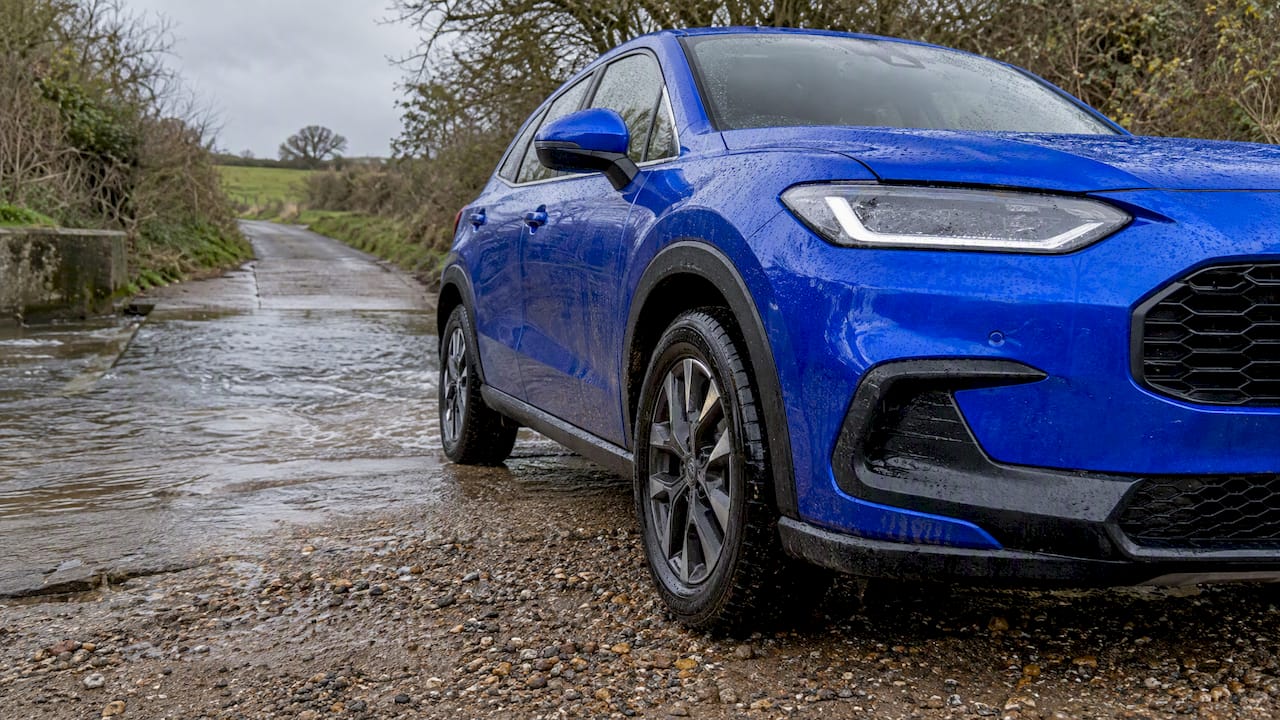
If you have just driven through deep water, slow down, test your brakes lightly, then dry them by driving slowly while pressing the pedal gently and repeatedly until the pedal feels normal and the car stops in a straight line. Wet brakes can stop the car later than usual or pull it to one side, so do this before you pick up speed. If the problem does not clear, or the pedal feels soft, pull over safely and have the car inspected.
TL;DR
- Water on the pads and rotors cuts friction for a short time. It usually clears with slow driving and light, repeated braking.
- Test first, at low speed, in a place where it is safe to do so. Confirm the car brakes evenly before you accelerate.
- Squeals, scraping or a brief grinding after water are often just surface moisture or a thin film of rust being wiped off. Noise that stays is a reason to inspect.
- A soft pedal, a pull to one side, a burning smell or brake fluid near a wheel means stop and get a professional check.
- If the vehicle was partly submerged, have it looked at by a garage even if the brakes seem fine.
Table of Contents
- What happens to your brakes in water
- How to dry wet brakes safely, step by step
- What the noises and feelings mean
- When to stop driving and have the brakes inspected
- Prevention: reduce the risk before you cross
- Our perspective: why brake parts should be built for weather
- Brake parts engineered for wet and changing weather
- FAQ
- Sources
What happens to your brakes in water
Disc brakes work by clamping pads against a spinning rotor. Friction between the two slows the car. Water changes that contact. A thin layer of it between pad and rotor acts as a lubricant, so the first few applications grip less than you expect.
How much depends on the depth and speed. Manitoba Public Insurance’s driver guidance says brakes may fail after a large puddle, and that after deep water they may pull to one side or may not work at all. Mazda Canada’s owner guidance gives the same warning in plain terms: wet brakes can lengthen stopping distance or make the vehicle pull to one side, which creates a serious accident risk.
That is why regulators test for it. Transport Canada’s brake standard includes a water-recovery test in which a vehicle is driven for two minutes at 8.05 km/h through a 152.4 mm water trough, then has its braking assessed. The same procedure checks recovery through five successive stops from 48.3 km/h. In other words, brakes are expected to lose some bite in water and to recover quickly. Your job is to help that recovery along safely.
Why the first stops feel wrong
The effect comes in stages. At first, water on the rotor face keeps the pad from gripping properly. As you press the pedal, the pad wipes the film away and heat starts to evaporate what is left. Within a few gentle applications, friction usually returns. If you are travelling fast when you need the brakes, you may not get those few applications.
Wet brakes are not the same as hydroplaning
Both happen in standing water, but they are different problems. Hydroplaning is when water builds up between the tires and the road and the tires lose contact and traction. Braking harder does not fix it. The same source notes that neither ABS nor stability control can override the physical limits of the vehicle, so the answer is slower speed and avoiding standing water. Wet brakes, by contrast, are about the friction surfaces inside the wheel. You can have one without the other, and a deep puddle can cause both.

How to dry wet brakes safely, step by step
The method is consistent across Canadian official and manufacturer guidance: slow down, test lightly, dry gradually. Here is how to put it into practice.
- Take your foot off the accelerator and increase your following distance. You need space because the first stops may be long ones.
- Check that it is safe to test. Make sure no one is close behind you. Do not test the brakes on a flooded section of road; get clear of the water first.
- Press the pedal lightly. Manitoba’s guidance is to test the brakes lightly after deep water. You are checking for a delay, a pull or a soft feel, not trying to stop hard.
- Dry them by driving slowly while braking lightly. Mazda Canada’s owner guidance says to drive slowly, release the accelerator and lightly apply the brakes several times until braking performance returns to normal. Road Safety at Work gives the same direction, slowing down and applying the brakes gently to help them dry.
- Confirm the car stops evenly. The same Road Safety at Work guidance says to make sure the brakes pull evenly on all wheels before you increase speed.
- Repeat until the pedal feels normal. If it does not, do not carry on at highway speed.
A few things to avoid. Do not ride the brake pedal for long distances with firm pressure. It heats the rotors unevenly and wears the pads. Do not brake hard to “clear” them at speed. And do not drive off at the same pace as before just because the pedal feels firm; test the stopping power first.
We cover the technique in more detail in our guides on drying brakes while driving and restoring grip to wet brake pads.
What the noises and feelings mean
After a crossing, your brakes can speak up. Most of it is harmless and short-lived. Some of it is not.
| What you notice | Common cause | What to do |
|---|---|---|
| Light squeal or scrape for the first few stops | Moisture or a thin rust film being wiped off the rotor | Keep driving gently. It should fade within a short drive |
| Grinding that continues after several stops | Worn pads, grit trapped in the assembly or a damaged rotor | Have the pads, rotors and hardware inspected |
| Weak first stop, then normal | Water film on pad and rotor | Dry as above and stay alert for the first stops |
| Car pulls to one side under braking | Uneven water effect, or a stuck caliper or contaminated pad | Dry and retest. If the pull stays, stop and get it checked |
| Soft or sinking pedal | Possible fluid or hydraulic problem | Do not keep driving. Arrange an inspection |
| Burning smell, one wheel very hot | Dragging brake | Pull over when safe and have it checked |
Why brakes squeal after water or rain
Rotors are bare metal on their friction faces, so a thin film of surface rust can appear quickly when they get wet. One diagnostic guide explains that the first brake applications can scrape or squeal as the pads wipe that rust away, and that the noise typically disappears within a short drive. The same guide’s point is worth remembering: if the sound does not fade after several stops, look at pad thickness, rotor condition and caliper hardware.
Driving through standing water can also push sand and grit into the brake assembly. A high-pitched squeal that persists after you have dried the brakes may be that grit caught between pad and rotor, and a garage can clear it without much trouble. For the wheel faces, a safe way to deal with brake dust once everything has cooled is to remove brake dust safely with a short dwell time rather than scrubbing hot components.
If you want to know when rain noise is harmless and when it is worth a closer look, our page on quiet brakes after rain goes through it.

A spongy pedal is a different category
Wet friction surfaces cause a weak bite. A pedal that feels spongy or sinks is more often a hydraulic matter: air in the lines, a leak or aged fluid. Brake fluid absorbs moisture over time, which lowers its boiling point, and that is why a pedal that goes soft after heavy use deserves a prompt check. If your pedal feel changes in the rain more generally, see our notes on pedal feel in rain and spongy brakes in rain.
When to stop driving and have the brakes inspected
Drying works for water on the friction surfaces. It does not fix damage. Pull over safely and arrange an inspection if you notice any of the following.
- The brakes do not recover after several gentle applications.
- The car pulls to one side and keeps pulling after the brakes are dry.
- The pedal is soft, travels further than usual or sinks.
- Grinding, scraping or squealing continues for more than a short drive.
- You see fluid near a wheel or the reservoir, or the brake warning light comes on.
- The water came up over the wheels, into the cabin or near the engine air intake.
That last point matters beyond brakes. Mazda Canada advises against driving on flooded roads because water can short-circuit electrical or electronic parts and can damage the engine or cause stalling. If the vehicle has been immersed, it advises consulting an authorized dealer. For significant floodwater, The AA in the UK recommends immediate garage attention to check the important parts of the vehicle, which is sensible advice anywhere.
What a mechanic should look at
A technician checking a car after a crossing should cover:
- Pads and rotors: thickness, glazing, scoring, uneven wear, grit between pad and rotor.
- Calipers and slides: free movement, no sticking, intact boots and hardware.
- Brake fluid: level, condition and any sign of leakage at lines, calipers or the master cylinder.
- Friction surfaces: free of fluid or lubricant. Transport Canada’s standard expects no visible brake fluid or lubricant on friction surfaces and no leakage at the master cylinder reservoir.
- Wheel bearings and electronics: where water came up high, ABS sensors and wiring are worth a look.
The same standard expects brake-lining wear to be shown by a warning device or visually checkable, so pad thickness is one of the easiest things to confirm.
Prevention: reduce the risk before you cross
The best way to handle wet brakes is to give them less water to deal with.
- Do not enter water you cannot judge. If you cannot see the road surface or its depth, turn around. Flooded roads can hide washouts and debris.
- Slow down before the water. Enter at a walking pace if you must cross, and keep a steady speed rather than braking in it.
- Check tires first. Worn tires make every wet stop worse. Our guide to weak brakes in rain starts with tires for that reason.
- Look after the parts that meet weather every day. Canadian drivers deal with road salt, slush and freezing mornings as well as heavy rain. Corrosion on rotors, glazed pads and sticky calipers all make wet-weather braking less predictable.
- After off-road or muddy driving, check the assembly. See our page on off-road mud braking.
For a longer treatment of this exact situation, we have written about flood water and brakes and what to do after you drive through it.
Our perspective: why brake parts should be built for weather
We build brake parts around a simple idea: weather is not an exception your brakes sometimes meet, it is the condition they work in. Rain, humidity, road salt and freezing mornings all act on the same few surfaces, the pad face, the rotor and the caliper.
That is why we treat the braking system as a matched set. Our HydroAdaptive pads are designed for moisture management and stable friction, so the first stops after water exposure are meant to feel more predictable. Our GEOMET-coated rotors are designed to resist corrosion from moisture and road salt, and our ClimateFlex calipers are designed for smooth operation in winter cold and summer heat.
We develop rotors and pads together, and we sell rotors only with compatible pads, because a rotor and a pad that were not designed to work as a pair can undermine each other’s performance. When you replace worn parts, we think that is the point where you can choose consistency over compromise.
AAA
Brake parts engineered for wet and changing weather
If you are already replacing worn pads or rotors, or a crossing has shown you how much your brakes depend on their condition, our range is built for exactly these conditions. Type 03 brake pads and Type 07 brake pads use our HydroAdaptive ceramic approach to moisture management and stable friction.

For rotors, choose SC Type rotors or GC Type rotors with GEOMET coating for protection against corrosion from moisture and road salt. Rotors come paired with compatible pads. You can browse vehicle-specific options on aaafrictions.ca, and read more on our blog.
FAQ
How long do wet brakes take to dry?
Usually a short stretch of slow driving with several light brake applications is enough. Mazda Canada’s guidance is to repeat this until braking performance returns to normal, so judge by how the pedal and the stopping feel rather than by a fixed time. If the brakes have not recovered, stop driving and have them checked.
Can driving through water cause brake failure?
Water can sharply reduce braking for a short time. Manitoba Public Insurance says brakes may fail after a large puddle and may not work at all after deep water. In most cases the effect is temporary and clears as the brakes dry, but it is the reason to test them at low speed before carrying on.
Why do my brakes squeal after driving through water?
Moisture and a thin film of surface rust on the rotor are the usual causes, and the pads clear it in the first stops. Grit pushed into the assembly can also squeal. If the noise continues beyond a short drive or turns into grinding, have the pads, rotors and calipers inspected.
Should I have my brakes checked after a water crossing?
Yes, if the brakes do not return to normal, the car pulls to one side, the pedal feels soft, or the water was deep enough to reach the wheels, cabin or engine bay. After significant floodwater, a garage check of the important vehicle systems is the safe choice.
Sources
- Manitoba Driver’s Handbook: Wet Brakes
- Mazda Canada, 2024 CX-5 Driving Tips
- Transport Canada, Hydraulic and Electric Brake Systems
- Square One, Hydroplaning prevention and recovery
- Road Safety at Work, Driving for the Conditions
- The AA, How to drive through floodwater and heavy rain
- Brake noise from moisture or rust
- How to remove brake dust safely