

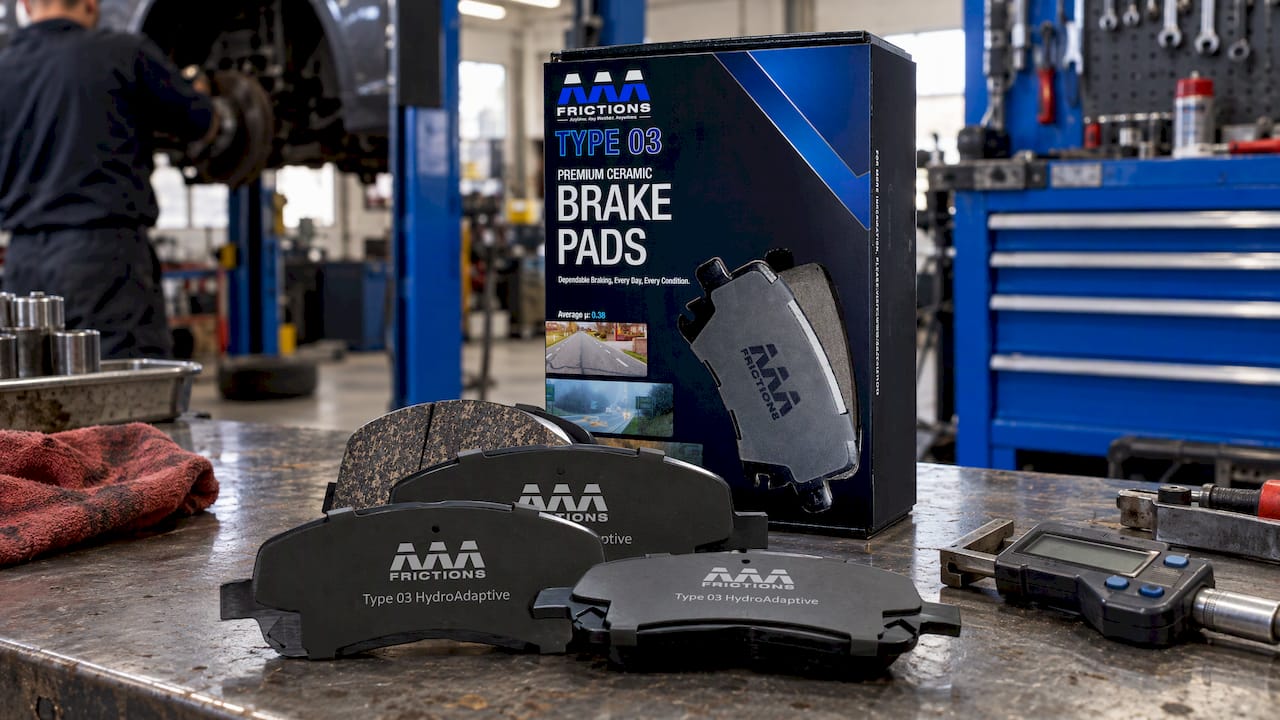
Ceramic brake pads have no fixed lifespan, but the real-world range is wide: Driving.ca reports that brake pads in general can last anywhere from 25,000 km to 150,000 km, depending mostly on how much of your driving is stop-and-go and how much is steady highway. Where your pads land in that range depends on your route, your vehicle’s weight, the condition of your calipers and rotors, and how well the whole brake system copes with moisture and road salt. This guide shows you what drives that number, how to check your own pads, and how to set up your brakes so the pads wear evenly and last.
TL;DR
- Expect a very wide range, roughly 25,000 km to 150,000 km for brake pads, with city stop-and-go at the short end and open highway at the long end.
- Pads wear only when you press the pedal, so a mileage schedule is unreliable. Inspect your brakes twice a year, more often if you drive for work.
- Sticking caliper sliders, corroded rotors, extra weight and aggressive braking shorten pad life more than the pad material does.
- Replace pads before they reach the wear limit. Grinding means the metal backing plate is already touching the rotor.
- Pads, rotors and calipers last longest when they are designed to work together in rain, salt and cold. That is how we build our range.
Table of Contents
- What “lifespan” really means for a ceramic pad
- Kilometres you can realistically expect
- What shortens or extends pad life
- How to tell when ceramic pads are worn
- Build a twice-a-year routine
- Why the pad and rotor should be a matched pair
- A worked example: finding your own number
- Replacing your pads: where to start
- FAQ
- Sources
What “lifespan” really means for a ceramic pad
A ceramic pad is a friction material made from ceramic fibres and fillers bonded onto a steel backing plate. Its lifespan is the distance it travels before the friction material wears down to the minimum thickness. Unlike tyres, which wear a little with every kilometre, brake pads only wear when you apply the brakes. That is why two drivers with the same car and the same odometer reading can need pads 60,000 km apart.
Brian Turner of Driving.ca makes this point directly: because pads wear only when the pedal is pressed, and because driving conditions and driver skill vary so much, no fixed distance or time interval can be set. His answer is to inspect twice a year instead of waiting for a mileage figure.
So when you see a single number for ceramic pad life, treat it as a midpoint of a wide spread. The useful question is not “how long do they last?” but “what will make mine last longer, and how will I know when they are done?”

Kilometres you can realistically expect
The Driving.ca range of 25,000 km to 150,000 km is the best published Canadian guide for brake pads as a category. Here is how that range maps onto the way most Canadians drive.
| Driving pattern | Where in the range you are likely to land | Why |
|---|---|---|
| Dense city commuting, frequent stop-and-go | Toward the shorter end | Many brake applications per kilometre, each one removing a little material |
| Mixed suburban and highway | Middle of the range | Fewer hard stops, long stretches with light braking |
| Mostly highway, steady speeds | Toward the longer end | Very few brake applications per kilometre |
| Rideshare, delivery, courier, taxi | Shorter end, often with checks more frequent than twice a year | Constant stop/start use, which Driving.ca says calls for more frequent inspection |
| Heavy vehicles, loaded trucks and SUVs | Shorter end | More mass to slow on every stop |
This table describes tendencies, not guarantees. The only way to know your own figure is to measure it: note the odometer reading when you fit new pads and again when you replace them, and you will have your personal lifespan for the next set.
What about the “five years” question?
Some drivers ask whether pads can last five years. Time on its own does not wear a pad out, so a low-kilometre car can run a set for many years. But age still matters in two ways. The friction surface can glaze and the backing plate can corrode if the car sits in humid or salted conditions, and the calipers that press the pads can seize up from lack of movement. For a low-use vehicle, use thickness and condition as your trigger, not the calendar: have the pads measured at each seasonal changeover.
What shortens or extends pad life
Pad material matters, but it is one of several factors. In our experience of what controls wear on a vehicle, these are the ones to look at first.
Your driving pattern
Stop-and-go traffic is the hardest thing you can ask of a pad. Every stop converts motion into heat through friction, and every stop removes a thin layer of the pad. Anticipating traffic, lifting off the throttle early and braking gently over a longer distance spreads the work out and keeps both pad and rotor temperatures down.
Weight you carry
Driving.ca advises removing unnecessary weight from the vehicle. Roof boxes left on all winter, tools in the trunk and a full cargo area all add mass your brakes must stop. Drivers of larger vehicles feel this most, so for them the weight audit is the cheapest pad-life improvement available.
Caliper condition
The caliper is the clamp that presses the pads against the rotor. Its sliders, the pins it moves on, need to travel freely. When they corrode or dry out, the caliper can drag, so one pad stays lightly pressed against the rotor even when you are off the brake. Driving.ca recommends cleaning and lubricating corroded or sticking sliders. A dragging caliper is one of the most common reasons one pad on a car is far thinner than the others.
This is where weather comes into the lifespan question. Cold mornings, slush and road salt are hard on the moving parts around the pad. Our ClimateFlex calipers are designed for smooth operation through winter cold and summer heat, because a caliper that moves freely lets the pad wear evenly.
Rotor surface
A pad runs against the rotor, so a rough, pitted or rusted rotor sands the pad away faster than a clean one. In Canada, salt is the main cause. Rotors with surface corrosion produce an uneven friction surface, and the pad pays for it. Our GEOMET-coated rotors are built to resist corrosion from moisture and road salt, which helps keep the surface the pad works against in good condition.
Moisture and temperature
Rain, humidity, snow melt and freezing mornings all change how a pad behaves in the first few seconds of braking. Pads that hold a stable friction level through those changes need less pedal pressure and fewer corrective stops. Our HydroAdaptive pads are engineered around moisture management and stable friction. For more on how heat and cold affect pad behaviour, see our guide to the brake pad temperature range.
How to tell when ceramic pads are worn
Do not wait for a noise. Check in this order.
- Look at the pad thickness. On many cars you can see the pad through the wheel spokes with a torch. The friction material is the layer between the metal backing plate and the rotor. Many technicians treat 3 mm as the lowest acceptable thickness and prefer replacement before that, since new pads typically start around 8 to 12 mm.
- Compare the pads on each wheel. A pad that is much thinner than its neighbour points to a sticking caliper or slider, which should be fixed when the pads are replaced.
- Listen for the wear indicator. Pads carry a small metal tang that squeals against the rotor when the pad is getting low. Treat it as a prompt to book the replacement, not as something to ignore for another month.
- Never drive on grinding. When the wear material is gone and the metal backing plate meets the rotor, the loud scraping or grinding means braking efficiency has dropped to an unsafe level. Driving.ca advises getting to a service facility, preferably by tow truck.
- Feel the pedal. A longer pedal travel, a pull to one side, or vibration under braking are all reasons to have the brakes inspected the same week.
New pads can also make noise that is not a sign of wear at all. Our article on new brakes that squeak explains how to tell harmless bedding-in noise from a real fault.
Build a twice-a-year routine
Because pad wear cannot be predicted by mileage, a fixed schedule is the wrong tool. A better one is tied to the seasons. Book a brake check when you change to winter tyres and again when you change back. At each check:
- Measure the pad thickness on every wheel, inside and outside pad.
- Look at the rotor faces for rust ridges, deep scoring or a lip at the edge.
- Check that the caliper sliders move freely and are lubricated.
- Check the brake fluid level and the condition of the rubber boots and hoses.
If you drive for a living, Driving.ca says to inspect more often than twice a year because stop/start use wears pads fast. For rideshare and delivery drivers, a monthly thickness check takes minutes and prevents an unplanned day off the road.
Wheels that stay clean are also easier to inspect. Brake dust hides pad edges and rotor condition, so it helps to know how to remove brake dust safely before you look at the pads.
Why the pad and rotor should be a matched pair
A new pad wears in against the rotor surface it meets. If the rotor is corroded, grooved or made of a material that does not suit the pad, the pad wears unevenly and may never reach its potential life. That is why we develop our rotors and pads as a matched system, and why we only sell rotors together with compatible pads. The result we engineer for is consistent friction and even wear, so that the pad’s lifespan is set by your driving and not by a mismatch underneath it.
If you are deciding between friction materials, our comparison of ceramic and semi-metallic pads goes through the trade-offs for everyday driving, and our guide on choosing brake pads for your car shows how to match a pad to your vehicle and use. If your winters are severe, read what Canadian drivers should expect from ceramic pads in snow and why tyres come first for snow traction.
A worked example: finding your own number
Say you drive a mid-size SUV 20,000 km a year, mostly commuting in town. You fit new pads at 60,000 km on the odometer. At your October tyre swap, at 68,000 km, you measure 7 mm of material left on the front pads, from a starting thickness of 10 mm. You used 3 mm in 8,000 km, or about 0.375 mm per 1,000 km.

If you replace at 3 mm, you have 4 mm of useable material left, which at that rate is about 10,700 km more. So you would plan the next replacement at around 78,000 km, and you would re-measure at the spring swap to confirm. This arithmetic works for any vehicle and takes two measurements. It also reveals problems: if the rate suddenly doubles, something has changed, usually a sticking caliper, a heavier load or a change in route.
The figures in this example are illustrative, not a prediction for any particular pad.
Our view on pad lifespan
We do not think a pad should be judged on one number. A pad lasts as long as the system around it lets it. A seized slider, a salt-pitted rotor or a friction surface that changes character every time it rains will all consume a pad faster than the kilometres alone would suggest.
That is why we engineer the three parts that carry the weather load as one system. HydroAdaptive pads manage moisture and keep friction stable. GEOMET-coated rotors protect against corrosion from moisture and road salt. ClimateFlex calipers are designed to move smoothly through winter cold and summer heat. Each part addresses a different way that weather attacks braking, and together they aim at predictable response and even wear season after season.
For Canadian drivers, that means thinking about the brakes as an ecosystem. If you are replacing pads, consider the rotor and caliper at the same time, so the new pad meets a surface and a clamp that will let it wear as intended.
AAA
Replacing your pads: where to start
When your inspection says it is time, choose pads for your exact vehicle. Our Type 03 brake pads and Type 07 brake pads use HydroAdaptive ceramic technology and are listed by vehicle, so you can find the set for your make, model and year. If the rotors also need replacing, our SC Type rotors and GC Type rotors are developed to work with our pads. DIY installers and mechanics can order directly from the store at aaafrictions.ca.

FAQ
How many kilometres do ceramic brake pads last?
Brake pads can last anywhere from 25,000 km to 150,000 km, depending on how much of your driving is stop-and-go and how much is highway. Heavier vehicles and frequent braking pull the figure down. Measure your pads at each seasonal check to find your own rate.
Can brake pads last five years?
They can, if the vehicle covers few kilometres, because pads wear with braking and not with time. Even so, inspect them at least twice a year, since corrosion and sticking calipers can develop on a car that is driven rarely. Replace on thickness and condition, not on age.
How often should I have my brakes inspected?
Driving.ca recommends twice a year, and more often for commercial stop/start use such as delivery or rideshare. Pairing the check with your seasonal tyre change makes it easy to remember.
What is the first sign my ceramic pads are wearing out?
The built-in wear indicator tang usually gives the first warning, a squeal when the pad is low. A visual check of pad thickness will catch the problem earlier. A grinding sound means the metal backing plate is already touching the rotor and the car needs service immediately.
Sources
- How Long Do Brake Pads Last? | Driving.ca
- What’s the Difference Between Ceramic & Metallic Brake Pads? | Bridgestone
- When to Replace Brake Pads: Complete 2026 Guide | Car Matcher
- Remove Brake Dust Safely | Diamondbrite