

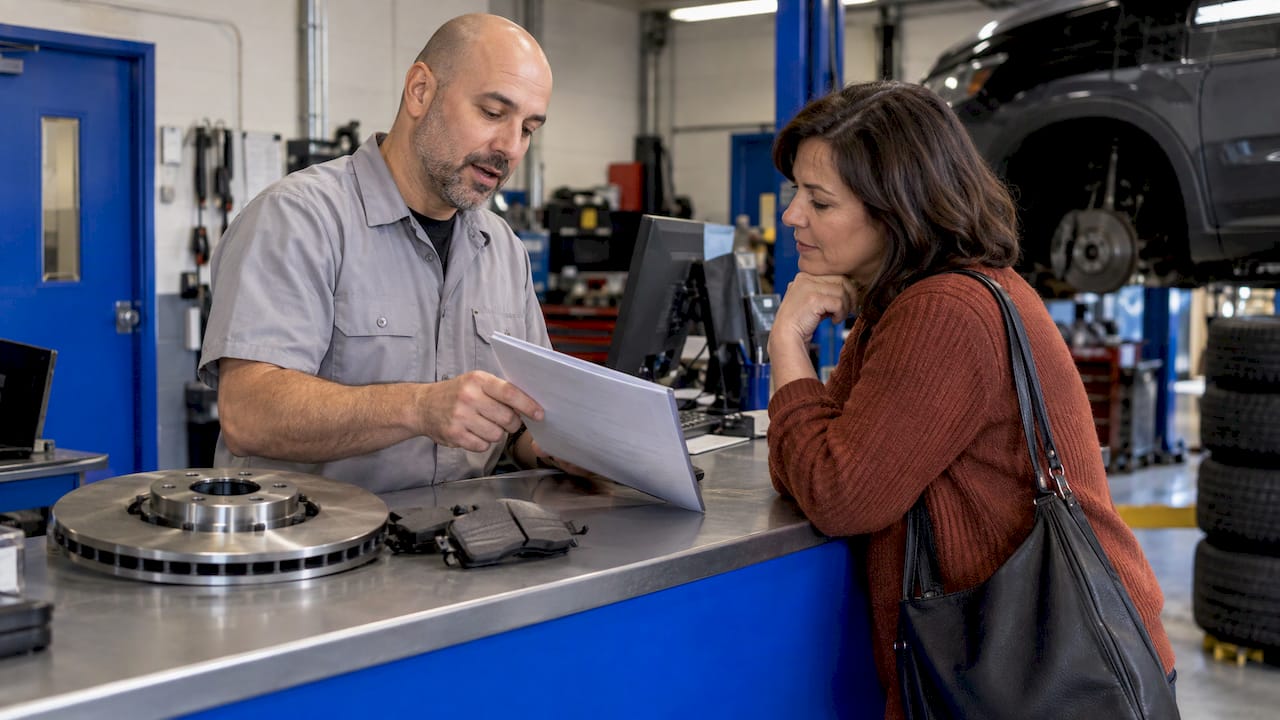
A pad-and-rotor upgrade on a mainstream Canadian car usually lands between $325 and $595 per axle at a shop, parts and labour included, and the number climbs with vehicle size, parts quality and rust. The cheapest brake job is rarely the cheapest over five winters. Salt, slush and temperature swings are what shorten brake life here, so we recommend buying a matched pad and rotor set built for those conditions, such as our HydroAdaptive ceramic pad and GEOMET-coated rotor kits, and paying for installation once.
TL;DR
- Expect roughly $325–$595 per axle for pads and rotors on a car, $370–$685 on an SUV or truck, and $435–$805 on a luxury or European vehicle, installed.
- Labour is the swing factor. Shops bill a published book time multiplied by their hourly rate, so quotes differ more on labour than on parts.
- Rust and seized hardware are the most common reasons a quote grows, which is why corrosion-resistant rotors matter for the next job.
- A matched pad and rotor set is the simplest way to keep cost predictable. Our rotors are only sold with compatible pads for that reason.
- Drum-to-disc conversions and big brake kits are separate budgets, covered below.
Table of Contents
- What a brake upgrade costs per axle in Canada
- Where the money goes: parts, labour and tax
- What pushes a quote up
- Why Canadian weather changes the real cost
- Buying a matched set instead of mixing parts
- A worked example
- Other upgrades with their own budgets
- A budget checklist before you order
- Our perspective
- Choose the set for your vehicle
- FAQ
- Sources
What a brake upgrade costs per axle in Canada
An axle is one end of the car: the front pair of wheels or the rear pair. Brake work is quoted per axle, so a full job on all four wheels is roughly double.

RepairPrice.ca’s 2026 data for pads plus rotors per axle puts cars and sedans at $325–$595, with a fair price near $460. SUVs and trucks run $370–$685 (fair price $530), and luxury or European vehicles $435–$805 (fair price $620). Those ranges assume shop labour of $95–$130 an hour plus parts, and dealerships charge about 30% more. City ranges shift a little: $315–$585 in Montréal and $345–$625 in Toronto.
Other Canadian price guides land in the same territory. One guide puts pads and rotors at $350–$600 per axle on a mainstream car, with pads alone at $150–$340. Another estimates pads with rotors at $300–$750 per axle, before tax.
| Vehicle type | Pads + rotors per axle, installed (2026) |
|---|---|
| Car or sedan | $325–$595 |
| SUV or truck | $370–$685 |
| Luxury or European | $435–$805 |
Treat these as planning ranges. Your own quote depends on your vehicle, your province’s tax and your shop’s labour rate.
Where the money goes: parts, labour and tax
A quote has three lines, and each behaves differently.
Parts
Pads and rotors are the core. Parts quality sets the price: original-equipment parts, premium aftermarket parts and economy parts sit at very different levels. Larger vehicles, trucks and performance cars use bigger, costlier rotors and pads, so a half-tonne pickup costs more to stop than a compact.
Extras add up: hardware kits, wear sensors and caliper brackets. Calipers, which clamp the pads against the rotor, are a larger item. Published Canadian ranges for caliper replacement run from $150 to $500 per caliper, and $200–$500 in another national estimate.
Labour
Labour is billed by the book, not the clock. An industry labour guide publishes a flat time for the job on your vehicle, and the shop multiplies it by its hourly rate. A technician who finishes early still bills the book time, which is why two independent quotes for identical parts can differ by $100 or more.
Some newer vehicles have an electronic parking brake. These need a model-specific service mode to retract the rear calipers, and that can add book time. If you are installing parts yourself, you avoid the labour line, but you take on the work and the tools it needs.
Tax and add-ons
Quotes are often shown before tax, so add GST or HST, and PST or QST where your province charges it. Brake fluid is a common add-on: Canadian guides put a fluid flush at $80–$150. Fluid absorbs moisture over time, so a flush with new pads is a sensible pairing.
What pushes a quote up
Four things move a brake quote more than anything else:
- Vehicle weight and size. Heavier vehicles need larger components and often more labour.
- Parts grade. Original-equipment, premium and economy parts are priced at different levels.
- Labour rate. Dealers charge more than independents, and rates vary by city and rural area.
- Rust. Rust and seized hardware add labour time, and that is where Canadian drivers meet surprises.
The fourth is the one weather controls. Salt sits in the caliper slides, bolts and rotor hat, and a technician who has to fight each fastener bills for it. A rotor at or below the manufacturer’s minimum thickness must be replaced even if the pads wore out first, so pads-only jobs are not always possible.
Why Canadian weather changes the real cost
The cost of an upgrade is not only the invoice. It is the invoice divided by how long the parts last and how clean the next job is.
Salt brine, slush and sudden temperature swings attack rotors and calipers. Pads typically last 40,000 to 100,000 km depending on city stops, hills, towing and braking style, and a winter of stop-and-go commuting sits at the harder end of that range. Rideshare, delivery and other high-mileage drivers cycle through brakes faster than the average, so a longer-lasting setup pays back sooner for them.
Three choices shape that outcome.
Pad material. Ceramic and semi-metallic pads are priced differently and behave differently. Our guide to ceramic vs semi-metallic brake pads explains the trade-offs for everyday driving.
Rotor protection. An uncoated rotor starts to rust on the first wet day. Our GEOMET-coated rotors are designed to resist corrosion from moisture and road salt, which supports cleaner rotor faces and cleaner removal at the next job. For the cost side, see our breakdown of rotor replacement cost per axle in Canada.
Caliper movement. A caliper that sticks in the cold wears one pad faster than the other. Our ClimateFlex calipers are engineered for smooth operation through winter cold and summer heat.
Salt also reaches the rest of the car. If you want to protect paint and underbody alongside the brakes, there is a practical rundown of road salt protection for cars, and our own monthly checks to protect brakes from road salt corrosion cover the brake side.
Buying a matched set instead of mixing parts
A brake is a system. The pad’s friction material and the rotor’s surface work together, and mixing unrelated parts makes the result less predictable. Our rotors and pads are developed as a matched system, and rotors are only sold with compatible pads. That keeps the buying decision simple: you pick the vehicle, and the set fits together.
Our range covers the common needs:
- Type 03 and Type 07 pads, both HydroAdaptive ceramic designs for moisture management and stable friction. See Type 03 and Type 07.
- SC Type and GC Type rotors. The GC Type rotors carry GEOMET coating against corrosion, and the SC Type rotors are the other option in the range.
- Complete front kits for specific vehicles, such as the Ford Mustang 2005-2010 kit.
If you want an idea of how performance parts behave in winter, read why tyres come first and performance brakes second. Our guide to ceramic pads in snow covers what to expect on cold roads.
A worked example
Take a mid-size SUV with worn front pads and rotors, in a city with $110 per hour labour.
- At a shop, the fair price for an SUV front axle is about $530, according to the 2026 range above, before any caliper or fluid work.
- Add a brake fluid flush at $80–$150 and the front-axle total sits around $610–$680.
- Add tax at your province’s rate.
- If the slide pins have seized from salt, expect extra labour or hardware.
Now compare the next job. A coated rotor and a pad built for wet and cold conditions are designed to keep the next removal simpler, so the labour line is less likely to grow. That is where the upgrade earns its cost, in the second and third service rather than the first.
Other upgrades with their own budgets
Drum-to-disc conversion
Some older vehicles have drum brakes at the rear. One 2026 guide puts a bolt-on drum-to-disc kit at $400–$1,200 per axle plus $300–$600 per axle in professional labour, against $200–$400 per axle to replace worn drum parts. It also lists a proportioning valve ($50–$150), parking brake cables ($40–$100) and possibly a master cylinder upgrade ($100–$250). The conversion makes the most sense if you plan to keep the vehicle for years. Check that the kit lists your exact vehicle.

Whole-car replacement
A pad-and-rotor job on all four corners is quoted at $700–$1,400 for the whole car at Canadian shops, with luxury vehicles above that. Doing both axles together saves a second visit and keeps front and rear wear in step.
A budget checklist before you order
- Confirm the year, make, model and trim, and whether the car has front and rear discs or rear drums.
- Measure or inspect the rotor thickness against the stamped minimum. Our guide to measuring rotor coating wear walks through it.
- Decide whether to do one axle or both.
- Add fluid, hardware and tax to your budget.
- If the car has been parked, check for rust first. Our notes on stored-car brake rust show how quickly it forms.
- Plan a winter check routine, using our five winter brake checks.
Our perspective
We design brake parts around one fact: in Canada, the weather decides how long brakes last and how hard they are to service. A pad and rotor that cost a little less on day one can cost more by the third winter, when salt has set into every fastener.
That is why we build pads, rotors and calipers as a matched system. HydroAdaptive pads manage moisture for stable friction, GEOMET-coated rotors protect against corrosion from moisture and road salt, and ClimateFlex calipers are engineered to move smoothly in cold and heat.
When you budget a brake upgrade, we suggest looking at the whole cycle: the price of the set, the labour it takes, and how the parts are designed to hold up. For daily commuters, larger vehicles and high-mileage drivers, consistent braking across seasons is the result we engineer for.
AAA
Choose the set for your vehicle
If you are ready to upgrade, pick the pad and rotor set that matches your vehicle, and check the fit on the product page. Complete front kits are listed for vehicles such as the Subaru BRZ 2013-2015 and the Honda BR-V 2018-2021, and the pads and rotors are also available separately.

Browse the full range at aaafrictions.ca to find the parts built for rain, humidity, snow and cold.
FAQ
How much does it cost to replace a full brake system?
For pads and rotors on all four wheels, Canadian shops quote about $700 to $1,400 for a whole car. Calipers add roughly $150 to $500 each, and a fluid flush adds $80 to $150. Luxury and European vehicles sit above those ranges.
Is it worth converting drum brakes to disc brakes?
It can be, if you plan to keep the vehicle for years. The conversion costs two to three times as much upfront as replacing worn drum parts, but disc brakes often need less maintenance over a long ownership period. Choose a kit listed for your exact vehicle.
How often do I need new pads in Canadian conditions?
Pads commonly last between 40,000 and 100,000 km, depending on city stops, hills, towing and driving style. Salt, slush and stop-and-go winter driving push toward the shorter end. Inspect pads and rotor thickness at each tyre change.
Should I replace pads and rotors together?
In most cases yes. A rotor at or below its minimum thickness has to be replaced, and a matched set keeps the friction surfaces working together. Replacing both axles at once also keeps wear even front to rear.
Sources
- RepairPrice.ca: brake pads and rotors per axle cost
- Brake job cost in Canada: prices and rules
- How much does brake repair cost in Canada?
- Drum to disc brake conversion: what to know
- Road salt protection for cars