

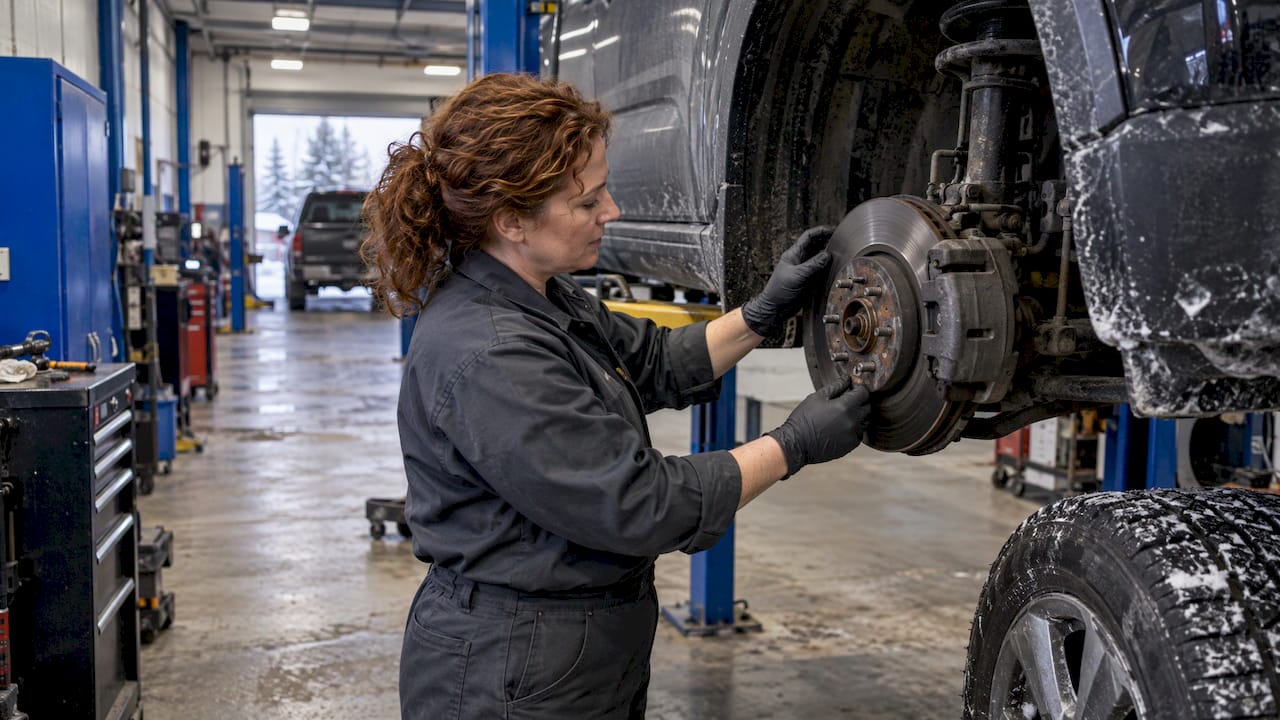
The best rotors for a Canadian snow belt are corrosion-resistant rotors, paired with pads designed to work with them. Road salt, slush and repeated freeze-thaw cycles attack unprotected cast iron from the first week of winter. A GEOMET-coated rotor, matched to a HydroAdaptive ceramic pad, is built to keep the braking surface and the hidden edges in better shape through the season. Our GC Type rotors are made for exactly this job, and this guide explains why, and how to choose and look after them.
TL;DR
- Canada spreads more than 5 million tonnes of road salt every winter, and salt corrosion reaches brake components directly.
- Corrosion hurts rotors in two places: the swept face you can see and the edges and underside you usually cannot.
- GEOMET is a zinc and aluminum flake coating accepted for protection against road salt and humidity, which is why we use it on our GC Type rotors.
- Rotors and pads work as a system. We only sell our rotors with compatible pads so the friction behaviour stays predictable.
- A short monthly check, plus a rinse after salty drives, keeps small rust problems from becoming vibration and uneven wear.
Table of Contents
- Why the snow belt is hard on rotors
- What coated rotors do differently
- Why the pad matters as much as the rotor
- Choosing rotors for your vehicle
- Our view on snow belt braking
- A winter routine that protects your rotors
- When rotors need inspection or replacement
- Get the matched set for your vehicle
- FAQ
- Sources
Why the snow belt is hard on rotors
A brake rotor is a heavy disc of bare iron that sits in the spray zone behind your wheel. Every puddle, slush bank and salted off-ramp throws water straight at it. In winter that water carries salt.
The scale is large. According to Environment and Climate Change Canada, about 5 million tonnes of road salts are spread on Canadian roads each year. Natural Resources Canada puts the figure at about 4.75 million tonnes of sodium chloride and 0.1 million tonnes of calcium chloride annually. The Sustainable Technologies Evaluation Program notes that salt corrosion affects motor vehicles, especially brake linings, frames and bumpers.
New Brunswick gives a local picture. The province’s winter driving guidance says roughly 150,000 tonnes of salt and 300,000 tonnes of sand go on its roads each year, and that salt becomes impractical below minus 10 degrees Celsius. That detail matters for drivers: in the deepest cold, crews lean more on sand, and the salt exposure comes in the milder swings around freezing, when slush stays wet and sticks to metal.

What salt and moisture do to the rotor surface
On a rotor that is not protected, salty water starts surface rust within hours. Most of that rust wipes off at the first few stops, which is why you may hear a grinding rasp on a cold morning. The problem is what happens where the pad does not sweep.
The outer edge, the inner edge and the hat area of the rotor are never cleaned by the pad. Rust there can creep inward, and over a winter it can leave pitting on the friction surface. Pitting changes how the pad contacts the rotor. Drivers feel it as pulsing through the pedal or a shake in the steering wheel, and often assume the rotor is warped when the surface is simply uneven from corrosion.
Freeze-thaw cycles keep the damage going
Many snow belt regions swing above and below zero repeatedly. Each thaw lets salty water seep into seams and crevices, and each freeze locks it there. The cycle pushes moisture into places that stay damp long after the road has dried, including the back side of the rotor where airflow is poor.

This is why a quick look at the visible face through the wheel spokes does not tell you the whole story. A rotor can look acceptable from the outside while the inboard side is already flaking.
What coated rotors do differently
A coating gives salt and water something to attack other than the iron. The question for a snow belt driver is which coating, and where it is applied.
GEOMET is a water-based coating containing metal oxides and metallic zinc and aluminum flakes. According to the GEOMET technical document, it averages seven microns thick without topcoat and nine microns with topcoat, and it is accepted worldwide as corrosion protection against road salt, humidity, solvents and other corrosive elements. That thin layer is the reason a coated rotor can keep its edges and non-swept areas protected without changing how the rotor fits or looks.
A coating on the swept friction face is a different matter. The pad wears that area clean within the first stops, which is expected. The protection that counts over a winter is on the edges, the hat and the underside, the places where rust begins and spreads under the friction surface.
If you want the full comparison of coating chemistries, our guide to rotor coating types covers zinc, GEOMET and E-coat side by side.
Our GC Type and SC Type rotors
We offer two rotor lines, and the choice is about how much coating coverage you want for the roads you drive:
- GC Type rotors: GEOMET-coated rotors, our choice for drivers who see salt, brine and slush through a full winter.
- SC Type rotors: semi-coated rotors, suited to drivers who want engineered corrosion protection on a vehicle-specific kit.
Both are developed as part of a matched system with our pads. Rotors and pads are designed together for optimal performance, and we only sell rotors with compatible pads.
Why the pad matters as much as the rotor
A rotor does not brake alone. The pad lays friction material onto the disc, and the two surfaces work as a pair. If the pad chemistry and the rotor surface do not suit each other, you get noise, uneven wear or dust that holds moisture against the metal.
Our Type 03 and Type 07 brake pads use HydroAdaptive ceramic technology, built around moisture management and stable friction in rain, humidity, snow and cold. Paired with a coated rotor, the aim is a consistent pedal feel from a damp commute to a freezing morning start.
If you are comparing materials, our explainer on ceramic versus semi-metallic pads goes through the differences, and our piece on winter brake dust and rotor pitting shows how pad choice affects what builds up on the disc.
Choosing rotors for your vehicle
Start with the vehicle, not the rotor. Brake parts are specific to year, model, axle and trim, and a fit that is almost right is not right. Our kits are vehicle-specific for that reason.
Then work through four questions:
- How much salt do you drive through? Daily commuters on treated highways, rideshare and delivery drivers, and anyone near the coast see the most exposure. For these routes, GC Type GEOMET-coated rotors are the stronger match.
- How hard is your vehicle on its brakes? Larger vehicles such as full-size trucks carry more weight and build more heat. Pair them with a kit built for the vehicle and replace pads and rotors together.
- How many kilometres do you cover? High-mileage drivers go through winter salt more times, and benefit most from protection that keeps working at the edges.
- Do you want a complete front or rear kit? A kit keeps pad and rotor matched from the first stop, which supports predictable braking.
You can see how this looks in practice in our kits, such as the front and rear kit for the GMC Sierra 3500 with GEOMET-coated rotors or the front kit for the Nissan Rogue with semi-coated rotors.
Our view on snow belt braking
We build brake parts around one idea: braking should feel the same on a dry July afternoon and a salted January morning.
Most winter brake trouble starts quietly. Salt sits on the hidden edges of a rotor, moisture works under the friction surface, and by spring the driver feels a pulse in the pedal. That is why we pair a coating that targets road salt with pads designed to manage moisture.
We develop rotors and pads as a matched system, and that is also why we sell rotors only with compatible pads. A well-protected rotor with the wrong pad still gives you uneven behaviour. A matched set gives a stable friction profile across the temperature band your vehicle sees in a Canadian year.
Our ClimateFlex calipers complete the picture, built for smooth operation through winter cold and summer heat, because the caliper is where pad and rotor meet the rest of the system.
AAA
A winter routine that protects your rotors
Protection starts with the right parts, and it lasts longer with a little attention. None of this takes special tools.
- Rinse after salty drives. Washing the underside and wheel wells removes the brine before it dries into a crust. Our same-day steps for brine corrosion lay out what to do the day you get home from a heavy salt run.
- Run a monthly check. Look at the rotor edges, the inner face if you can see it, and the caliper hardware. Our monthly road salt corrosion checks give a simple list.
- Know your brine. Magnesium chloride behaves differently from sodium chloride on metal. We explain the difference in magnesium chloride and rotor corrosion.
- Do not let a parked vehicle sit. Rust can set in on a stationary car within days, covered in our guide to stored vehicle brake rust.
- Watch the calipers. Seized slides lead to uneven pad wear and heat. Read more on caliper corrosion.
Salt does not stop at the brakes. After a week of slush, the cabin carpets and mats carry it too, and a guide to cleaning salt and slush from your interior is worth keeping handy while you are doing the exterior rinse.
When rotors need inspection or replacement
Watch for signs that go beyond normal surface rust:
- A pulse or shake through the pedal or steering wheel under braking
- Grinding or squealing that does not clear after the first few stops
- Flaking or peeling on the rotor, or deep grooves in the friction face
- A soft pedal, a warning light or a burning smell
- Heavy rust across the area the pad touches
The law supports taking these seriously. Transport Canada’s 2026 light vehicle brake standard requires service brakes to remain intact and functional, without component fracture or detachment. Every rotor also has a stamped minimum thickness. Once wear or corrosion takes it to that limit, it must be replaced rather than resurfaced. Our guide to measuring rotor coating wear against the stamped minimum walks through how to read it.
When you replace rotors, replace the pads at the same time. A fresh rotor with worn pads, or the reverse, gives uneven contact and shortens the life of both. A full kit keeps that simple. If your brakes show any of the signs above, have them inspected by a licensed technician before you drive further.
Get the matched set for your vehicle
If your rotors are due, we make the choice straightforward: pick your vehicle, then choose a kit that pairs HydroAdaptive ceramic pads with SC Type or GC Type rotors. For salted roads and long winters, start with the GC Type GEOMET-coated rotors.

Browse the GC Type rotors or see everything on aaafrictions.ca.
FAQ
What are snow belt brake rotors?
The term describes rotors chosen for regions with heavy snowfall and heavy road salt use. In practice that means rotors with corrosion protection on the edges and non-swept areas, matched to pads that cope with moisture. Our GC Type GEOMET-coated rotors are built for that use.
Is surface rust on a rotor normal in winter?
Light rust on the swept face often wipes off after a few stops. Rust on the edges, flaking, deep pitting or vibration under braking is different, and you should have the brakes inspected by a licensed technician.
Should I replace rotors and pads together?
Yes, that is the best way to keep contact even and braking predictable. Our rotors are sold with compatible pads for this reason, because rotors and pads are developed as a matched system.
How often should I check my brakes in winter?
A quick monthly look at the rotors and calipers catches most corrosion early. After a heavy salt week, rinse the underside and wheel wells, then check again. Our blog archive has more seasonal guides.
Sources
- Road salts code implementation, Environment and Climate Change Canada
- Salt damage, Natural Resources Canada
- Winter Salt Management, Sustainable Technologies Evaluation Program
- Winter driving safety, Government of New Brunswick
- GEOMET technical document, Green Metafin
- Light vehicle brake systems standard, Transport Canada (2026)