

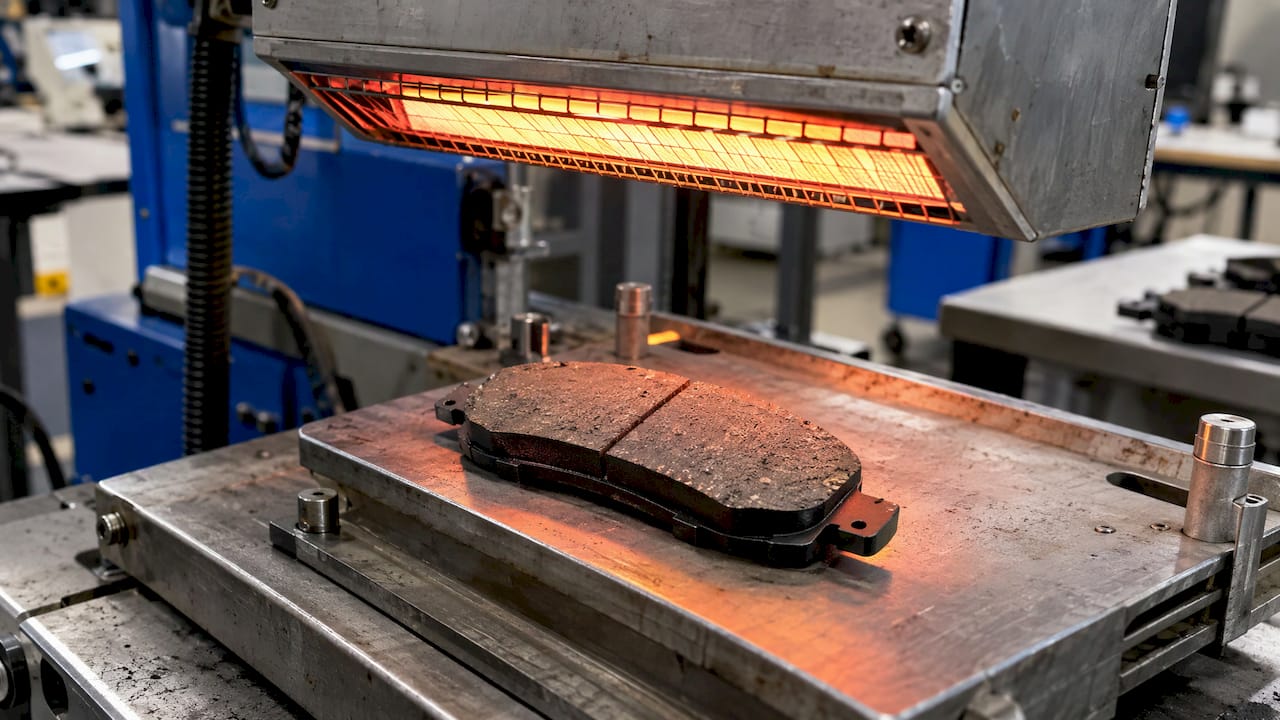
Scorching is a factory heat treatment, not a pad type. The surface of the friction material is heated until the resin near the face carbonizes, and the main benefits are a shorter bedding-in period and less risk of fade on a new pad. For a Canadian driver, the practical question is what to do with that knowledge: choose pads and rotors that are engineered to work together, then bed them in properly so they perform in rain, slush and cold. That is how we approach brakes at AAA Frictions.
TL;DR
- Scorching heats the pad surface to carbonize a few millimetres of resin, mainly to shorten run-in and reduce early fade.
- It is a treatment, not a material: a scorched pad can be ceramic, semi-metallic or organic.
- Research links it to faster pad-to-disc matching, a higher friction coefficient at braking onset and better fade resistance.
- A pad that has been treated still needs a proper bedding-in routine, and in Canadian weather the pad, rotor and hardware matter as a set.
- Blue or dark gold rotors mean the brakes have overheated and need a full inspection.
Table of Contents
- What “scorched” actually means
- The benefits of scorched brake pads
- Why weather changes what you need from a new pad
- How to bed in new pads, step by step
- When “scorched” means overheated
- Choosing pads for how you drive
- Matched pads and rotors for Canadian roads
- FAQ
- Sources
What “scorched” actually means
The word sounds like damage, but in brake manufacturing it describes something deliberate. A 2020 peer-reviewed study defines scorching as heating the pad surface to several hundred degrees so the resin carbonizes a few millimetres into the friction material. The same study notes that this is generally done to shorten the run-in of a new pad, and that it can be carried out with a hotplate or with infrared radiation.

Industrial heating suppliers describe the same step. A TRUMPF press release from 2023 describes short-time heating at around 700°C that carbonizes a surface depth of about 1 to 2 mm. The heat is applied in seconds and only to the face that will meet the rotor, so the rest of the pad is unchanged.
Two things are easy to confuse with it:
- A pad overheated on the road. This is uncontrolled heat from hard or prolonged braking. It can glaze the surface and leave the pad and rotor discoloured.
- Burnishing or bedding-in. This is the break-in procedure a driver performs after fitting new pads. A technical article from National Oil and Lube News distinguishes scorching from post-curing and burnishing, and notes that friction suppliers and vehicle manufacturers recommend a burnish break-in procedure.
Scorching also says nothing about what the pad is made of. It describes how the surface was treated. If you are comparing ceramic, semi-metallic (sometimes called sintered or metallic) and organic pads, that is a question about the compound. Scorching can be applied to a pad of any of those types.
The benefits of scorched brake pads
The benefits come from what the heat does to the surface layer. A 2018 conference study on scorching OEM brake pads found that scorching makes a few millimetres of the friction surface porous. That helps the pad and the disc match faster in the first braking condition.
Shorter bedding-in
A new pad has a surface that has not yet conformed to the rotor. The resin binder near the face is the part that resists that conformity. Once it has been carbonized, the face is more willing to contact the disc, so the pad reaches a stable contact pattern sooner. The 2020 study gives shorter bedding as the manufacturing purpose of the treatment.
Less risk of early fade
Fade is the loss of braking force when the friction surface gets hot. Fresh resin can outgas, which means it releases gases as it heats for the first time, and that can interrupt contact between pad and rotor. The 2020 study says scorching is intended to prevent possible initial fade. The 2018 study reports improved fade resistance. The trade publication adds that treating the surface removes uncured bonding agents near the face, which can stabilize friction and shorten break-in.
Higher friction at the start of a stop
The 2018 research reports that scorching can raise surface roughness and the friction coefficient at braking onset. In plain terms, a treated pad can bite more readily at the beginning of a stop, which is when a new set otherwise feels vague.
What the evidence does and does not tell you
The research was done on specific friction materials under controlled test conditions. The 2020 study used one copper-free friction material against grey cast iron, and it found that the level of scorching changed both friction behaviour and airborne particle emissions. So treat the benefits as a description of what the treatment is for, not a promise that every scorched pad performs the same on every vehicle. The result depends on the compound, the rotor it meets and how you bed it in.
Why weather changes what you need from a new pad
Bedding-in speed matters most to Canadian drivers in the first weeks after a pad change, and that often lands right when conditions turn. Rain, road spray, slush and salt all change what the pad face meets. Water on the rotor reduces friction at the contact surface until the film clears. Cold weather means components may not reach a good working temperature on a short trip, which can leave a pad face smooth and shiny (glazed) instead of grippy.
That is why we think about brakes as a system rather than a single part:
- The pad has to manage moisture and keep friction stable. Our HydroAdaptive pads are built around that job.
- The rotor has to survive moisture and road salt. Our GEOMET-coated rotors are designed to protect against corrosion from both.
- The caliper has to move freely in winter cold and summer heat. Our ClimateFlex calipers are designed for that.
If you want the detail on these conditions, our guides on restoring wet pad grip, stopping glazing in winter and HydroAdaptive pads and winter brake dust go further into each one.
How to bed in new pads, step by step
Whether or not a pad has been scorched at the factory, a burnish procedure is what the industry recommends. The exact routine differs by pad and vehicle, so follow the instructions that come with your pads first. The general pattern is the same for most drivers:
- Fit the pads and rotors as a matched set. Pads bed best against a clean, correctly prepared rotor. Mixing old rotors with new pads leaves the pad face matching a worn surface. Our rotors are sold only with compatible pads for this reason, because we develop them as a matched system.
- Check the hardware. Clips, shims and slide pins should be clean and move freely. A sticking pin leaves a pad dragging and heating unevenly, which defeats the point of a good bed-in. Our five-minute pin check shows what to look for.
- Start with gentle stops. Make a series of moderate stops from about 50 km/h, with enough gap between them for the brakes to cool slightly. Do not hold the pedal down once you have stopped.
- Build up gradually. Add a few firmer stops from higher speed, still without locking the wheels or triggering the ABS (anti-lock braking system).
- Let the system cool. Drive for a few minutes without heavy braking so the pads and rotors cool evenly. Do not park with the brakes very hot and the pedal pressed.
- Avoid emergency stops for the first stretch. Give the new set a few days of normal use before testing it hard.
If you are bedding in during wet weather, our rain brake bedding guide covers how the routine changes when the roads are wet. Tires come first on snow and ice, and our note on tires first, performance brakes second explains why.
When “scorched” means overheated
A treated pad face is a manufacturing step. A discoloured rotor or a burnt smell after driving is something else, and it needs attention.
ALLDATA’s Canadian DIY guide says that rotors that are blue or dark gold indicate the brakes overheated and need a complete inspection. The same guide says pads should be replaced when the friction material is as thin as the metal backing or thinner.
Signs that call for an inspection:
- Blue or dark gold discolouration on the rotor face.
- A burning smell after normal driving, or smoke from a wheel.
- A pedal that feels spongy, or a car that pulls to one side when braking.
- A pad that is down to the thickness of its backing plate.
- Noise that is new. If the cause is not obvious, this overview of why brakes squeal and what fixes it lists the usual causes.
If any of these show up, have the brakes inspected before you drive further. Heavy vehicles, rideshare and delivery drivers and anyone who brakes hard on long descents should check more often, because they put more heat through the system.
Choosing pads for how you drive
The right set depends on your vehicle and your use. Keep these points in mind when you choose.
| Your driving | What matters most | What to look for |
|---|---|---|
| Daily commuting, stop-and-go | Quiet, consistent pedal feel | Stable friction from the first stop, low dust |
| High mileage (rideshare, delivery) | Long, even wear | A matched pad and rotor set, free-moving calipers |
| Larger vehicles and SUVs | Heat handling | Pads and rotors sized for the vehicle |
| Wet, salty winters | Corrosion and moisture control | Coated rotors, pads that clear water fast |
A pad is only as good as the parts around it. Matching pads, rotors and hardware is the most reliable way to get predictable braking through a Canadian winter, and a quick look at winter brake maintenance before the first snowfall helps everything else.
Our perspective
We build brakes around one question: what does the weather do to the contact between pad and rotor, and how do we keep that contact predictable? Scorching is one way manufacturers shorten the early life of a pad. It is useful because the first weeks are when a driver feels the most uncertainty.
Our answer is to treat the whole braking system as one design. HydroAdaptive pads manage moisture so friction stays stable in rain and humidity. GEOMET-coated rotors protect against corrosion from moisture and road salt. ClimateFlex calipers are designed for smooth operation through winter cold and summer heat. We develop rotors and pads as a matched system, and we sell rotors only with compatible pads so the engineering works as intended.
For drivers in changing Canadian weather, that matters more than any single treatment. A consistent pedal feel on a wet commute and on a freezing morning is what we engineer for.
AAA
Matched pads and rotors for Canadian roads
If you are replacing pads, our Type 03 brake pads and Type 07 brake pads are vehicle-specific and built with HydroAdaptive ceramic technology for rain, humidity, snow and cold. For rotors, choose between our SC Type rotors and GC Type rotors, each sold with compatible pads.

Select your vehicle on the product pages to see the pads and rotors that fit it, or start from aaafrictions.ca.
FAQ
Are scorched brake pads better than regular pads?
Scorching is a surface treatment, so it is not a pad type that can be ranked against ceramic or semi-metallic. Research links it to faster bedding-in, higher friction at the start of braking and better fade resistance. The overall result still depends on the compound, the rotor and how you bed the pads in.
Is a scorched pad the same as a burnt or overheated pad?
No. Scorching is a controlled heat treatment applied to the pad face in the factory. An overheated pad has been heated in use and may show glazing, a burning smell or blue or dark gold rotors. If you see those signs, get a full brake inspection.
Do I still need to bed in pads that have been scorched?
Yes. Friction suppliers and vehicle manufacturers recommend a burnish break-in procedure, and scorching is a separate manufacturing step. Follow the instructions supplied with your pads, then use gentle, gradually firmer stops and let the brakes cool.
Are scorched pads the same as sintered pads?
No. Sintered pads are defined by their metallic material and how it is made. Scorching describes a surface treatment that can be applied to pads of different materials.
Sources
- A Study of the Effect of Brake Pad Scorching on Tribology and Airborne Particle Emissions (2020)
- Surface modification of OEM brake pad by scorching process (2018)
- Improving Brake Performance: It Starts With a Good Cocktail (2017)
- Improved vehicle safety with brake pad scorching (2023)
- Guide to Brake Inspection, ALLDATA DIY