

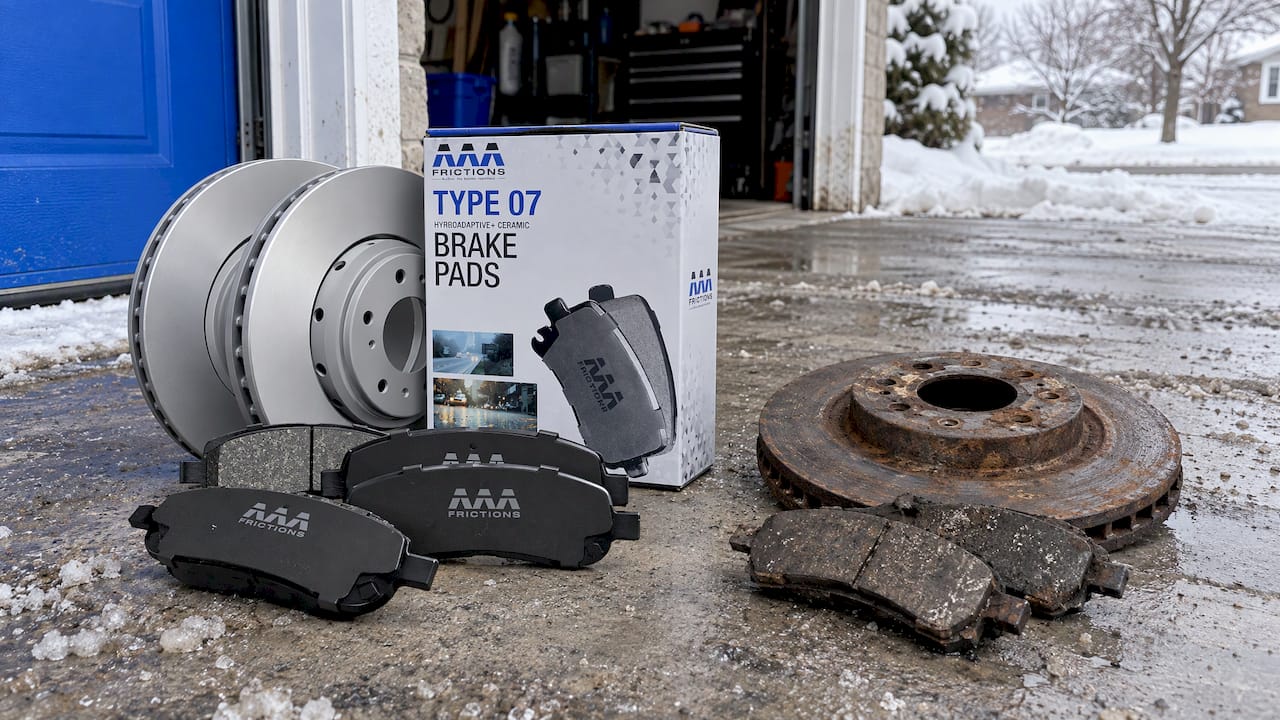
A brake rotor can last roughly 48,000 to 100,000 km in Canadian conditions, but a winter of road salt, slush and freeze-thaw cycles pulls a rotor toward the short end of that range. Heat from braking sets how fast the surface wears. Salt and moisture decide how much usable metal is left to wear. The rotors that last longest through winter are the ones protected against corrosion, matched to their pads and checked on a schedule. That is how we build ours: GEOMET-coated rotors, sold only with compatible pads.
TL;DR
- Rotor life in Canada typically falls between 48,000 and 100,000 km, shorter in stop-and-go city driving and longer on the highway.
- Road salt speeds up rusting of exposed brake metal. A thin film of morning rust is normal, but pitting, deep grooves and ridges are not.
- A rotor must stay above the minimum thickness set by its manufacturer. Wear plus machining can never take it below that number.
- Inspect brakes twice a year, ideally when the wheels come off for the seasonal tire swap, and rinse the underside after heavy salt periods.
- Corrosion-resistant rotors and pads developed as a matched set give winter wear less to work with.
Table of Contents
- How long rotors last, and why the number moves so much
- What winter does to a rotor
- Harmless rust or a real problem?
- How to measure the end of a rotor’s life
- A winter routine that protects rotor life
- Choosing rotors that suit a Canadian winter
- Replace now or wait?
- Our approach to winter braking
- Fit a matched set before the first salt
- FAQ
- Sources
How long rotors last, and why the number moves so much
The published range for Canadian driving is wide for a reason. One source puts city driving at 32,000 to 48,000 km and highway driving at 69,000 to 100,000 km or more. The same source says higher-quality rotors can reach 160,000 km. Treat every figure as a range, because your own result depends on a handful of factors:
| Factor | Shortens rotor life | Extends rotor life |
|---|---|---|
| Braking style | Hard, late stops | Smooth, steady braking |
| Route | Hills, stop signs, stop-and-go traffic | Highway driving |
| Vehicle | Heavier vehicles, larger SUVs and trucks | Lighter vehicles |
| Road conditions | Wet, salted winter roads | Dry roads, rinsed undercarriage |
| Rotor quality | Lower-grade material | Premium rotors |
| Maintenance | Worn pads left in place | Timely pad replacement |
If you drive a larger vehicle, or you drive for a living (rideshare, delivery, long commutes), you hit several left-hand cells at once. Every stop puts heat into the rotor face, and a vehicle with more mass has more energy to shed each time. High-mileage drivers also cycle through that heat far more often than the average owner, so calendar age matters less than how many stops the rotor has absorbed and what the winter did to its surface.
What winter does to a rotor
A rotor is bare iron on its braking surface, and it sits behind the wheel, close to the road spray. Winter attacks it in three ways.
Freeze-thaw cycles
Toyota Canada explains that water and snow can freeze inside the brakes overnight, causing grinding and squealing until the ice melts as the brakes heat up. Repeated freezing and thawing adds wear and tear over the season.
Salt and moisture
The same Toyota Canada guidance notes that road salt speeds up rusting of exposed metal, brakes included. Rotors, calipers and brake lines are not painted or sealed like the body, so brine finds its way into tight spots and stays there. That includes the rotor hat (the centre section that bolts to the hub), the outer edge and the cooling vanes. When rust settles into those areas it reduces the usable contact area and can leave ridges that affect how the pad meets the rotor.
If you want to see how the newer de-icing brines behave, our page on magnesium chloride and rotor corrosion covers what Canadian drivers should know.

Calipers that stick
Rotor life is not only about the rotor. Brian Turner, writing in Driving.ca, describes how salt, moisture and stop-and-start heat rust caliper sliders and pins. That can cause dragging brakes, accelerated wear and, in the worst case, seized wheels. A caliper that drags keeps one pad pressed on the rotor and heats it continuously, so a sticky caliper quietly shortens rotor life. This is why we pair our rotors and pads with ClimateFlex calipers, which are designed for smooth operation through winter cold and summer heat.
Harmless rust or a real problem?
Most drivers see it the first cold morning after a wet night: a rough, grumbling first few stops. Toyota Canada says a vehicle parked outside overnight collects moisture on the rotor surface, and the roughness is just surface rust being scrubbed off. Driving.ca calls it flash rust that wears away within a few minutes of driving. None of this means the rotor is failing.
The warning signs are different. Look and listen for:
- A grinding or growling sound. Toyota Canada says this means the pads are fully worn and grinding into the rotor, which is dangerous. Have it looked at straight away.
- Deep scoring, flaking patches or a visibly thinned rotor. Rust that has settled into the thickness, edges or grooves no longer scrubs off with normal braking.
- A pulsing pedal or a shaking steering wheel. This points to uneven thickness or a rotor that is not running true.
- Blue or purple patches. These are heat marks on the braking surface.
- Cracks near the hub or around drilled holes.
- A spongy pedal, constant rubbing or a burning smell after a drive.
The dividing line is condition and measurement, not colour. A thin film is surface rust. Pitting, heavy scaling or a surface that no longer makes full pad contact is wear. Whenever a rotor looks borderline, ask whoever inspects your brakes for the actual measurements rather than a verdict alone.
How to measure the end of a rotor’s life
A rotor does not wear out at a mileage. It wears out at a thickness. Every rotor has a minimum thickness set by its manufacturer, normally stamped or cast on the hat or edge. British Columbia’s official vehicle inspection standard says a brake disc’s original thickness may not be reduced by any combination of wear and machining below that manufacturer’s minimum. The same standard lists these out-of-service conditions:
- a groove worn deeper than 2.3 mm (3/32 in.);
- lateral run-out (side-to-side wobble) above 0.125 mm on discs of 380 mm diameter or less;
- a disc cracked through to the hub;
- bonded pad linings worn to 1.6 mm (1/16 in.) or less at the thinnest point;
- metal-to-metal contact.
Those are inspection limits for commercial and regulated vehicles in BC, but they are a clear reference for what “worn out” means in millimetres. A proper measurement uses a rotor micrometer on both faces, with the wheel off, not a tape measure or a glance.
A practical point for winter: salt-pitted rotors lose thickness unevenly, so the reading in the cleanest spot flatters the rotor. Measure at several points around the face, and compare the thinnest reading with the stamped minimum.
Our page on measuring rotor coating wear using Ontario’s stamped minimum walks through how that stamped figure applies to a coated rotor.
A winter routine that protects rotor life
You cannot stop heat, but you can limit how long salt sits on the metal. Here is the routine we recommend.
- Rinse the underside. Toyota Canada suggests a car wash with under-spray every couple of weeks in winter to lengthen brake life. For a thorough job after a heavy salt period, a road salt protection routine for cars helps keep brine from lingering on metal. Avoid aiming a high-pressure jet straight at calipers or hoses.
- Keep driving. A car that sits for weeks builds surface rust more easily than one used daily. If a vehicle must be stored, our guide to stored-car brake rust sets out the steps for the first days.
- Brake gently for the first few stops on a cold, damp morning to clear the film.
- Inspect twice a year. Driving.ca advises two inspections a year for the average vehicle driven under 30,000 km annually, ideally when the wheels are off for the seasonal tire changeover. If you cover far more than that, inspect more often.
- Keep braking surfaces clean. Never put oil, grease or rust-prevention spray on a rotor face or pad.
- Let everything cool before touching rotors. Hot rotors burn, so check them only once the wheels are cool.
- Check calipers and lines at the same time. Sliders, pins and brake lines rust too, and a line can corrode under a coating that still looks intact.
For a month-by-month version, see our monthly checks to protect brakes from road salt corrosion and the seven same-day steps against brine corrosion. If you are doing the work yourself, our five winter brake checks list gives you a bench-ready order of operations.
Choosing rotors that suit a Canadian winter
If you are replacing rotors, winter is the main thing to buy for. Plain bare iron will rust the first time the brine touches it. A coating that resists moisture and salt gives the surface a better chance of staying smooth between pad changes, and a smooth surface keeps the pad in full contact.
Our two rotor lines are built around that idea:
- GC Type Rotors carry a GEOMET coating, which protects against corrosion from moisture and road salt.
- SC Type Rotors are our carbon-based rotors, engineered for consistent braking across moisture, cold and temperature swings.
Pads matter as much as rotors. Our Type 03 and Type 07 pads use HydroAdaptive ceramic technology, designed to manage moisture and keep friction stable in rain, humidity, snow and cold. We develop rotors and pads as a matched system, which is why rotors are only sold with compatible pads. A rotor and pad designed to work together wear in together, and that is the combination we stand behind for winter.
If you live in a heavy lake-effect or snow-belt region, our guide to snow belt brake rotors goes further. For steep, cold routes, see mountain winter braking in Canada. And on snow, tires come first: our note on tires first, performance brakes second explains the order.
Replace now or wait?
A rotor close to its minimum thickness is not worth another pad cycle in a salted climate. Salt keeps working on it, and it has less metal to give. The cost logic is simple. Fresh pads on a worn, rusted rotor wear unevenly and may need replacing early, and grinding that reaches the rotor can turn a pad job into a pad-and-rotor job. If the rotor is near its limit when the pads come off, replace both together, and choose a pair designed to work as one.
For mechanics and DIY owners the same rule applies: measure first, record the number, and decide from the stamped minimum, not from how the rotor looks after a wash.
Our approach to winter braking
Weather decides how long braking parts last more than most drivers expect. Cold, moisture and road salt each attack a different component, so we address them separately: HydroAdaptive pads for moisture management and stable friction, GEOMET-coated rotors for corrosion protection, and ClimateFlex calipers for smooth operation through winter cold and summer heat.
We develop rotors and pads as a matched system, and we sell rotors only with compatible pads. That is deliberate. A rotor and pad designed together wear in together, and the result is the predictable pedal feel a daily commuter or a delivery driver depends on every winter morning.
Our view is simple: rotor lifespan in winter is not luck. It comes from corrosion resistance, a matched set and a regular check against the stamped minimum.
AAA
Fit a matched set before the first salt
We build brake parts so your braking stays consistent when the weather changes. If your rotors are near their minimum or heavily pitted, pair GEOMET-coated GC Type Rotors with Type 03 pads or Type 07 pads. If you drive a Mitsubishi RVR, a front brake kit with Type 07 pads and GC Type rotors is already put together for it.

Browse the full range at aaafrictions.ca and match parts to your vehicle.
FAQ
How often should I inspect my rotors in winter?
Twice a year for a vehicle driven under 30,000 km annually, and the easiest time is the seasonal tire changeover when the wheels are already off. Drivers who cover more distance, such as rideshare and delivery drivers, should look more often, particularly after heavy salt periods.
Is rust on my rotors after an overnight park a problem?
A thin film of surface rust on the braking surface is normal after moisture sits on it overnight, and it usually wears off within a few stops. Pitting, flaking, deep grooves or ridges are different and call for a measurement.
Can a rotor be resurfaced if it has rusted?
Only if it stays above its manufacturer’s minimum thickness afterwards. The BC inspection standard says wear and machining combined may not take a disc below that minimum. A rotor stamped with a minimum and already close to it should be replaced.
What does a grinding noise mean?
Grinding or growling usually means the pads are fully worn and the backing plate is cutting into the rotor, which Toyota Canada describes as dangerous. Stop driving it hard and have the brakes inspected right away.
Sources
- How Long Do Brake Rotors Last? (North York Chrysler)
- Cold Stop: How to keep your brakes working this winter (Toyota Canada)
- Troubleshooter: Why brakes must be in top shape for cold weather driving (Driving.ca)
- Section 3 – Brake System, vehicle inspection standard (BC Publications)