

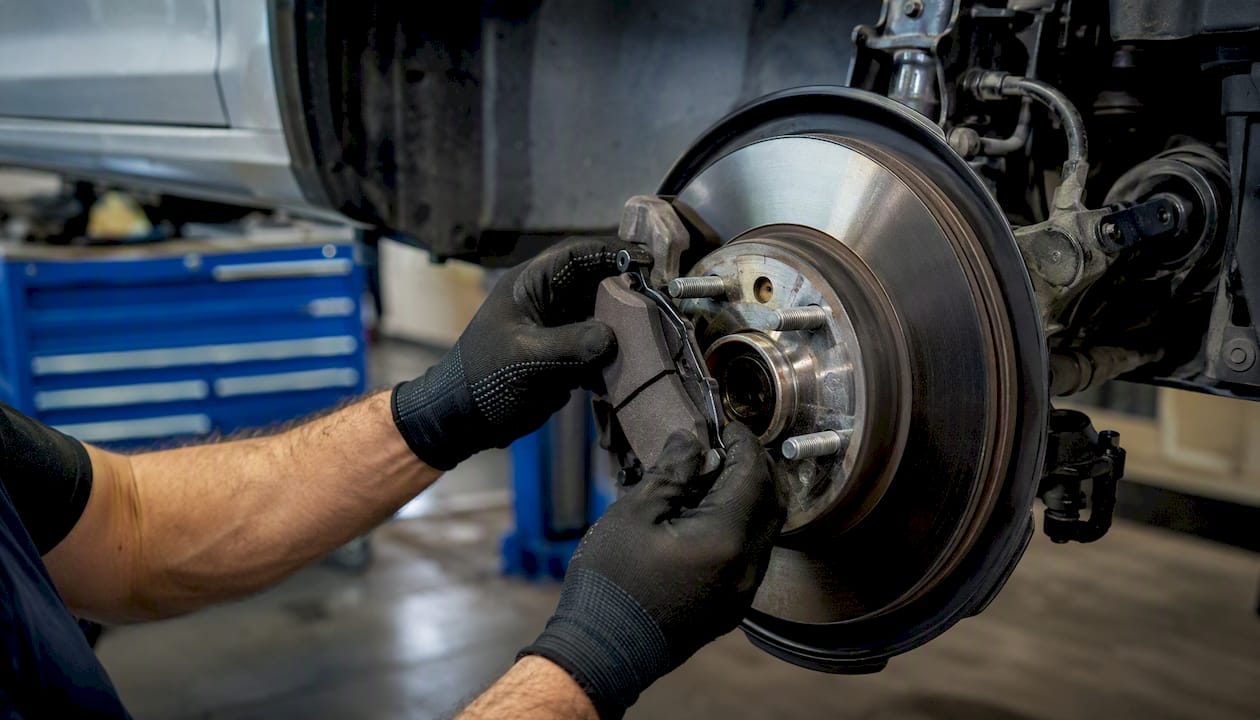
Brake pad friction is the coefficient of friction, or mu, generated at the pad-to-rotor interface, and it is what converts your vehicle’s kinetic energy into stopping force. That number is not fixed. It shifts with temperature, sliding speed, rotor condition, and the specific chemistry baked into the pad.
Most passenger vehicle pads operate in a mu range of roughly 0.2 to 0.6, depending on formulation and operating temperature. The SAE J866 system translates that range into a two-letter friction code, with letters corresponding to fixed bands. An “F” rating covers mu 0.35 to 0.45, a “G” covers 0.45 to 0.55, and an “H” covers 0.55 to 0.65, according to SAE friction code guidance.
Three variables drive most of the behavior you need to understand before specifying or troubleshooting a pad:
- Temperature: mu often rises through a moderate heat band, then falls off sharply once the pad overheats.
- Sliding velocity: higher speeds can raise or lower mu depending on the formulation, since velocity changes how the contact film behaves.
- Rotational speed (RPM): in several tested compounds, mu drops steeply as RPM climbs, independent of temperature.
Pro Tip: A friction code alone won’t tell you how a pad behaves under load. Ask for the full mu-versus-temperature curve, not just the two-letter rating, before you commit to a formulation.
Key Takeaways
Brake pad friction depends on formulation chemistry, transfer layer stability, and how mu shifts with temperature, speed, and rotor condition, not on the SAE code alone.
| Point | Details |
|---|---|
| Mu is not fixed | Coefficient of friction shifts with temperature, sliding speed, and RPM, sometimes by more than half. |
| Transfer layer governs steady-state mu | Proper bedding-in and clean rotor prep matter more than the raw pad compound. |
| Match friction band to use case | FF suits daily driving, GG suits towing and performance, HH suits severe duty. |
| Request full curves, not just codes | A two-letter SAE rating hides fade valleys, recovery behavior, and batch variance. |
| Moisture management affects consistency | Aaafrictions’ HydroAdaptive ceramic formulation targets stable mu in rain, snow, and humidity. |
Table of Contents
- What Determines Brake Pad Friction at the Contact Surface
- Which Brake Pad Materials Produce the Best Friction Performance
- How Temperature and Speed Change the Friction Coefficient
- Fade, Wear, Noise, and the Other Tradeoffs You Can’t Avoid
- How SAE J866 and Dynamometer Testing Measure Friction
- Why Your Brakes Might Feel Inconsistent or Grabby
- What Recent Lab Research Reveals About Friction Stability
- Matching Friction Bands to How You Actually Drive
- Brake Pads Engineered for Consistent Friction in Any Weather
- Frequently Asked Questions
- Sources
What Determines Brake Pad Friction at the Contact Surface
The steady-state coefficient of friction is governed mostly by a thin layer of transferred material sitting between the pad and the rotor, not by the raw compound alone. Engineers call this the transfer layer, or third-body layer, and it forms during the first several hundred stops a pad makes on a rotor.
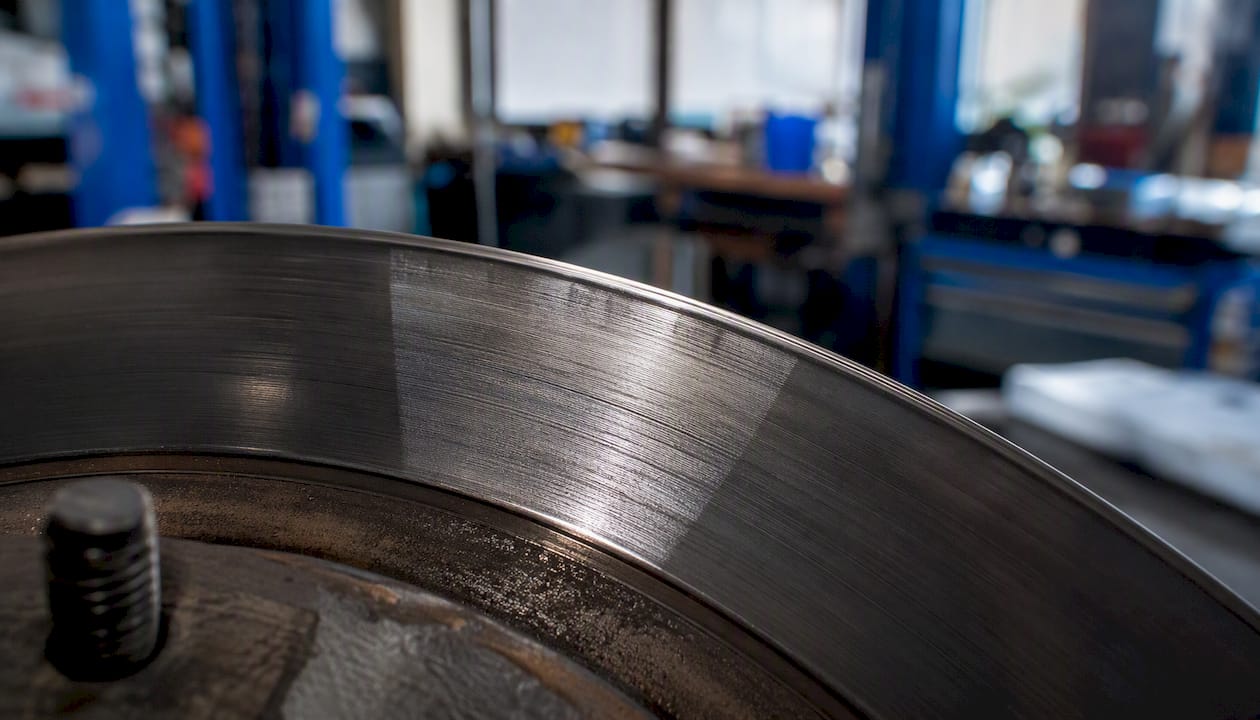
At the microscopic level, contact between pad and rotor happens at high points, called asperities, rather than across the full surface. Braking force comes from a mix of adhesion between those high points and abrasive plowing as harder particles in the pad cut into the rotor surface. Both actions generate heat, and that heat has to go somewhere. Some of it conducts into the rotor, some into the pad material and backing plate, and the rest radiates or convects away.
As pads cycle through repeated stops, debris, oxidized metal, and transferred pad material build up on the rotor face into a stable, grey-toned layer. Once that layer establishes itself, it becomes the actual sliding surface, and it is what keeps mu consistent stop after stop. New pads installed on an old, dirty, or previously glazed rotor often underperform initially precisely because that transfer layer has not formed correctly yet. The rotor surface is fighting the new pad’s chemistry instead of working with it.
- Adhesion and abrasion at asperity contacts generate the base friction force.
- Heat generated at the interface conducts into the pad, backing plate, and rotor simultaneously.
- The transfer layer, once stabilized, governs mu more than the raw pad compound does.
- Bedding-in cycles are what allow that layer to form uniformly across the rotor face.
Pro Tip: Resurface or replace glazed rotors before installing new pads, and follow the manufacturer’s bedding-in procedure exactly. Skipping that step is the single most common reason a new pad set feels inconsistent during the first week of driving.
Which Brake Pad Materials Produce the Best Friction Performance
Organic (NAO) pads, semi-metallic pads, ceramic pads, and sintered pads each deliver a distinct friction profile, and no single family wins on every metric. NAO compounds tend to run quieter and gentler on rotors but fade sooner under sustained heat. Semi-metallic pads hold up better at high temperature and deliver strong bite, at the cost of more rotor wear and noise. Ceramic formulations aim for a stable, moderate mu with low dust and low noise, and sintered pads, common in motorcycles and some heavy-duty applications, resist fade aggressively but generate more rotor wear at low temperatures.
What separates these families is not one ingredient but a formulation of more than a dozen material classes, each contributing something specific to how the pad behaves. A comprehensive review of friction materials breaks that formulation down into a handful of functional roles:
- Binders hold the compound together mechanically and determine how the pad behaves as it heats up; phenolic resins are common, and their thermal breakdown point sets an upper limit on pad performance.
- Reinforcing fibers (steel, aramid, or ceramic fibers, depending on the family) transfer load through the pad and maintain structural integrity at high temperature.
- Abrasives like zirconium silicate or aluminum oxide provide initial bite and help condition the rotor surface, but too much abrasive accelerates rotor wear.
- Solid lubricants and friction modifiers, including graphite and various sulfides, stabilize mu across a temperature range and prevent it from spiking or collapsing too fast.
- Fillers control noise, manage thermal conductivity, and adjust density without significantly altering the friction coefficient itself.
Some modern formulations combine more than 30 distinct ingredients in a single compound, which is why two pads with an identical SAE friction code can still feel and wear differently on the road.
Regulatory pressure has also reshaped this landscape. Copper historically improved thermal conductivity and stability, but environmental regulations have pushed manufacturers toward low-copper and copper-free formulations, which forces engineers to find that same thermal stability through fiber and filler chemistry instead. The tradeoff is real: ceramic and low-metallic compounds that meet these standards need more sophisticated binder and lubricant systems to match the fade resistance that copper used to provide cheaply. For a side-by-side look at how ceramic and semi-metallic formulations compare on noise, dust, and heat tolerance, the tradeoffs become clearer once you’re weighing a specific vehicle and driving style.
How Temperature and Speed Change the Friction Coefficient
Mu is not a constant. It moves through distinct phases as a pad heats up, and understanding that curve is the difference between specifying a pad correctly and getting surprised by fade on a mountain descent.
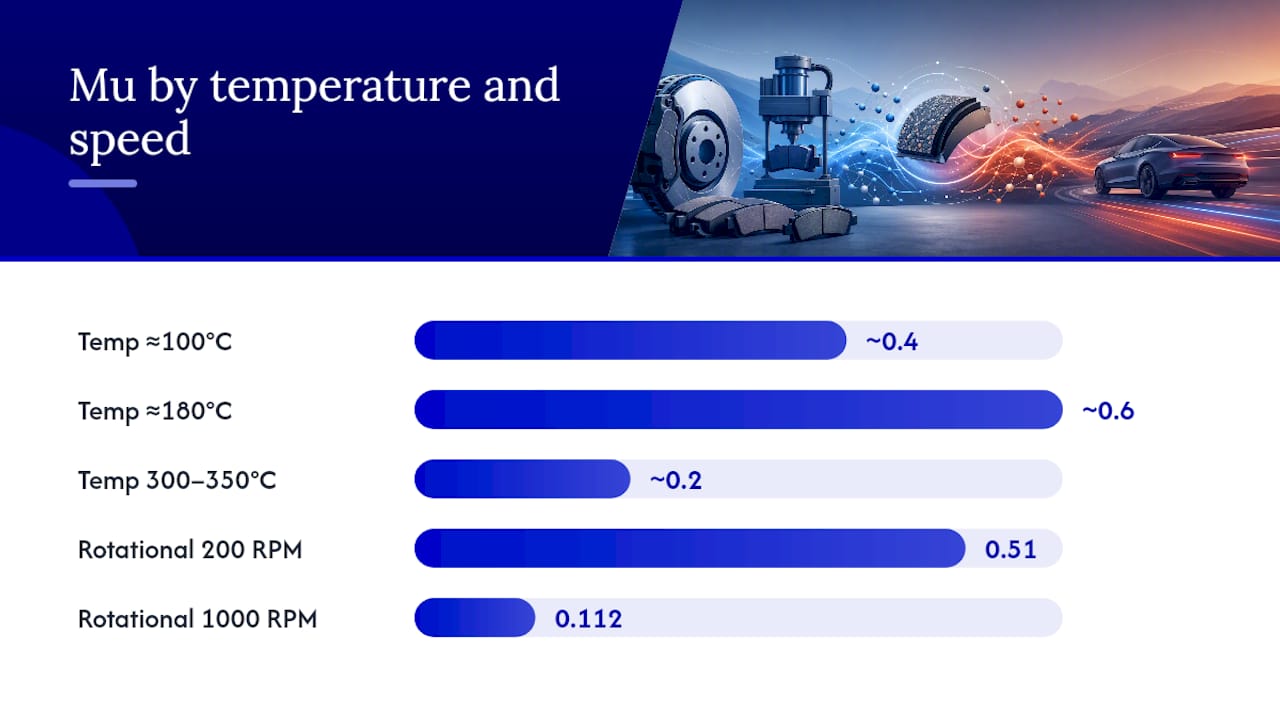
In one laboratory study of a traditional friction compound, mu climbed from roughly 0.4 to 0.6 as temperature rose from about 100°C to 180°C, then declined toward approximately 0.2 as temperature pushed past 300°C to 350°C. That rise happens because moderate heat activates certain friction modifiers and helps the transfer layer bond more effectively. The subsequent drop, known as fade, happens because binders begin to soften and off-gas, and the tribo-film at the interface breaks down faster than it can reform.
Speed matters just as much as heat, and sometimes in the opposite direction. Tests on automotive brake pad compounds found a steep inverse relationship between rotational speed and friction: one formulation measured COF at 0.51 at 200 RPM, dropping to just 0.112 at 1000 RPM, a decline of roughly 78%. That same body of testing found sliding velocity could push COF the other way in certain materials, rising from 0.637 to 0.775 as velocity increased from 0.4 to 0.8 meters per second. The direction of the effect depends heavily on the specific compound, which is exactly why generic friction claims without test data are unreliable.
- Mid-range heat (roughly 100 to 200°C) typically increases mu as the transfer layer stabilizes.
- Extreme heat (300°C and above) typically reduces mu as binders degrade and fade sets in.
- Rising RPM can sharply reduce mu independent of temperature, in some compounds by more than three-quarters.
- Sliding velocity effects vary by formulation and can move mu in either direction.
Pro Tip: If you’re designing or requesting a dynamometer test cycle, don’t stop at a single hot stop. Build in a fade sequence (repeated high-energy stops), a cooling recovery period, and a high-RPM segment. A pad that looks great at one operating point can fall apart at another.
Fade, Wear, Noise, and the Other Tradeoffs You Can’t Avoid
Every friction formulation is a balancing act between initial bite, fade resistance, wear rate, noise, and environmental impact, and pushing one variable in your favor usually costs you somewhere else. There is no pad that maximizes all five simultaneously.
High-mu compounds deliver strong initial bite and shorter stopping distances, but they typically wear rotors faster and generate more noise as the abrasive content increases. Low-dust ceramic formulations solve the noise and cleanliness problem that many daily drivers care about most, often at the cost of slightly lower peak mu compared to aggressive semi-metallic options. Copper historically solved thermal stability problems cheaply, but its environmental and regulatory costs have pushed the industry toward alternative fiber and lubricant systems that require more engineering to match copper’s old performance.
- Daily commuting favors moderate mu, low noise, and rotor-friendly compounds over maximum bite.
- Towing and mountain driving demand higher fade resistance, even if it means accepting more rotor wear.
- Severe-duty and performance applications justify higher-mu compounds, provided the rotor and cooling system are matched to handle the added heat and wear.
- Environmental regulations increasingly restrict copper content, pushing formulations toward fiber and ceramic-based thermal management instead.
Matching the friction band to the actual use case, not the highest number on the spec sheet, is what prevents premature rotor wear and unnecessary noise complaints down the line.
How SAE J866 and Dynamometer Testing Measure Friction
The SAE J866 code is a two-letter shorthand, where the first letter reports cold friction (measured roughly between 200°F and 400°F) and the second reports hot friction (measured roughly between 300°F and 650°F), with each letter corresponding to a fixed mu band such as F for 0.35 to 0.45 or G for 0.45 to 0.55. That code is useful shorthand, but it is a snapshot, not a full performance picture.
Dynamometer testing is how manufacturers actually generate that code and the fuller data behind it. A typical procedure cycles the pad through controlled speed, load, and temperature profiles, recording mu continuously rather than at just two points. For replacement parts sold in many markets, ECE R90 testing adds another layer of validation, confirming that a replacement pad’s performance stays within a defined tolerance of the original equipment part.
Reading a friction curve takes some practice. You are looking for the peak mu value, how deep any fade valley drops during sustained heat, how quickly mu recovers once temperature falls, and how consistent that pattern stays across repeated cycles. A pad that fades badly once but recovers cleanly is a very different product from one that fades and stays degraded.
A friction code tells you two data points. A dynamometer curve tells you the whole story, including how a pad behaves in the fade valley and whether it recovers once it cools. If a supplier can’t produce that curve, that itself is information.
Before specifying a pad for a fleet, a performance build, or a severe-duty application, request the raw mu-versus-temperature curve, repeatability data across multiple test cycles, wear mass-loss figures, and batch-to-batch variance. A single friction code cannot substitute for any of that.
Why Your Brakes Might Feel Inconsistent or Grabby
Most friction complaints trace back to one of four causes: a stuck caliper slide pin, a glazed pad or rotor surface, an incomplete or damaged transfer layer, or surface contamination from oil, brake fluid, or road grime. Each produces a distinct symptom, and each has a specific fix.
- Rubbing or dragging pads usually point to a seized caliper slide pin or a collapsed rubber boot restricting normal pad retraction.
- Glazing, a shiny, hardened surface on the pad or rotor, comes from repeated overheating without adequate cooldown, and it flattens the friction surface until mu drops noticeably.
- Touchy or grabby braking often signals an uneven or incomplete transfer layer, frequently from a rushed or skipped bedding-in process.
- Contaminated surfaces from oil leaks or fluid contact require full cleaning or replacement, since contamination cannot be bedded out.
A quick garage check should cover pad thickness, visible glazing or contamination, caliper slide movement, and rotor surface condition before assuming the pads themselves are defective. Light glazing can sometimes be corrected with a proper re-bedding cycle; heavier glazing or a warped rotor usually calls for resurfacing or replacement. Whatever the fix, always follow the pad manufacturer’s specific bedding-in procedure afterward to rebuild a clean, even transfer layer.
What Recent Lab Research Reveals About Friction Stability
Recent testing continues to quantify just how sensitive mu is to conditions most drivers never think about. The temperature study cited earlier didn’t just observe the rise-then-fall pattern in mu, it built a predictive model around that curve with low residual error, giving engineers a mathematical tool for anticipating fade before it happens on a dyno.
Separate testing on sliding velocity and rotational speed confirmed that these effects are not minor footnotes. The 78% drop in COF between 200 and 1000 RPM observed in one semi-metallic formulation is large enough to change real-world stopping distance at highway speeds, not just a lab curiosity.
On the materials side, engineered ceramic fillers and advanced lubricant systems are increasingly designed specifically to flatten these swings, keeping mu closer to a stable band across a wider window of temperature, humidity, and speed rather than letting it spike and crash. The tradeoff is formulation complexity: stabilizing mu across more variables generally means a longer, more expensive development cycle before a compound reaches production.
Matching Friction Bands to How You Actually Drive
If you’re driving a typical daily commuter, an FF-rated pad usually delivers the balance of quiet operation, moderate rotor wear, and adequate stopping power you actually need. Step up to a GG rating for towing, spirited driving, or performance applications where fade resistance matters more than noise. Reserve HH-rated compounds for severe-duty or track use, and pair them with a rotor built to handle the added heat and wear.
Whatever band you land on, the pad is only half the equation. Moisture management at the interface matters just as much as the compound itself, which is the specific problem Aaafrictions’ HydroAdaptive ceramic formulation was engineered to solve, keeping mu consistent when rain, snow, or humidity would otherwise disrupt the transfer layer.
Brake Pads Engineered for Consistent Friction in Any Weather
Everything in this guide points to the same conclusion: friction stability depends on formulation quality and how well a pad manages moisture at the contact surface, not just its SAE letter rating. That is the exact gap Aaafrictions built its HydroAdaptive ceramic technology to close, clearing moisture rapidly at the pad-rotor interface so mu stays consistent whether you’re braking on a dry highway or a rain-soaked exit ramp.

Aaafrictions pairs that formulation with corrosion-resistant rotors and climate-adaptive calipers, so the whole system, not just the pad, holds its friction characteristics through seasonal swings. If you drive through real winters, humid summers, or unpredictable rain, that consistency shows up as a pedal that feels the same in March as it does in July. Vehicle owners can search by make and model to find a matched pad-and-rotor kit, or review the full HydroAdaptive engineering breakdown before choosing a friction band for their driving conditions.
Frequently Asked Questions
What is a good coefficient of friction for brake pads?
Most passenger vehicle pads perform well in the 0.35 to 0.55 range, corresponding to SAE codes like FF or GG. Higher isn’t automatically better since it often trades off against rotor wear and noise.
Why does brake pad friction drop at high temperatures?
Extreme heat softens binders and disrupts the tribo-film at the contact surface, a process known as fade. One study measured mu falling from about 0.6 near 180°C to roughly 0.2 by 300 to 350°C.
Do ceramic brake pads have lower friction than semi-metallic pads?
Ceramic compounds often run a slightly lower peak mu than aggressive semi-metallic formulations, but they typically hold that mu more consistently across temperature swings, with less noise and dust.
How long does it take for brake pad friction to stabilize on new pads?
Stabilization depends on the bedding-in procedure and rotor condition, but most pads need several dozen controlled stops before the transfer layer forms evenly across the rotor face.
Can humidity affect brake pad friction?
Yes. Moisture at the pad-rotor interface can interfere with transfer layer consistency, which is the specific issue wet-weather focused formulations are designed to manage.
Sources
- Temperature Influence on Brake Pad Friction Coefficient Modelisation – PMC
- Effect of sliding velocity, load, and RPM on wear and friction in automotive brake pads | Discover Applied Sciences | Springer Nature Link
- Advances in brake friction materials: A comprehensive review of ingredients, processing methods, and performance characteristics
- Brake pad friction ratings decoded: What the FF, GG, and HH codes actually mean | BaiyunBrake