

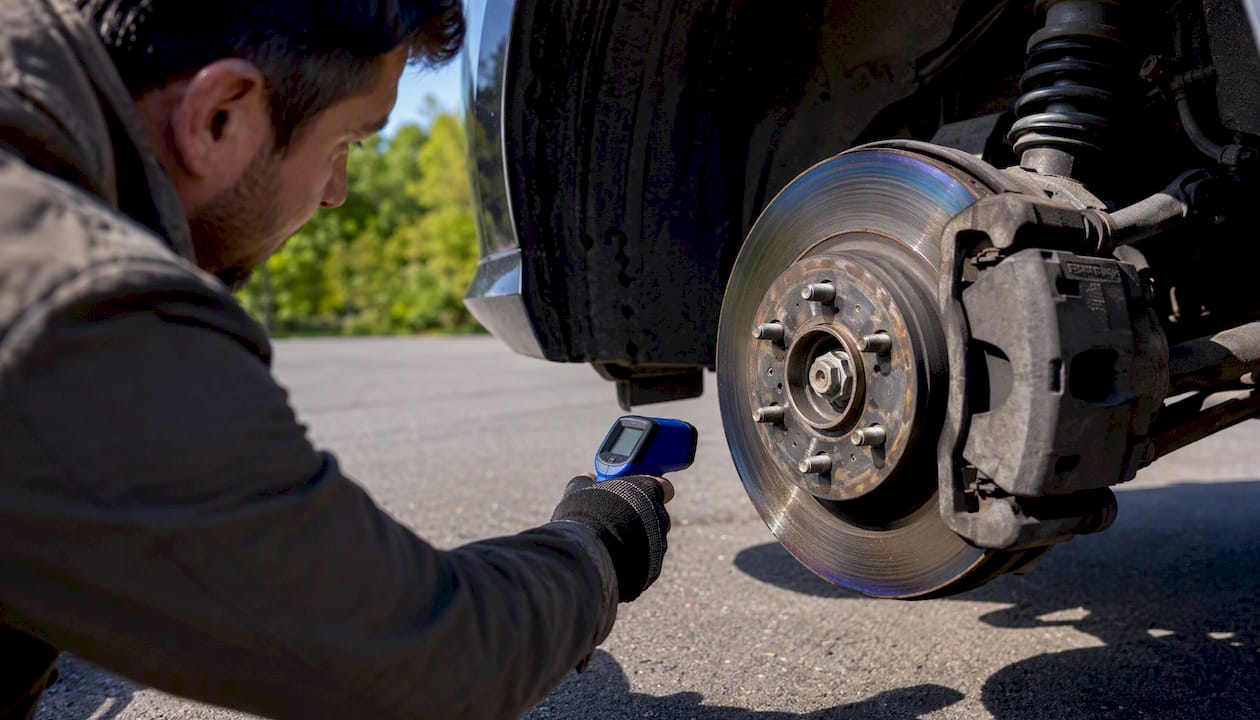
Most street brake pads and rotors run between 100°F and 300°F (38–149°C) during normal driving, climb to 300–500°F (149–260°C) under towing or mountain descents, and can exceed 800°F (427°C) on a race track. The rule that matters more than any single number: keep rotor surface temperatures below the point where your specific pad compound starts losing friction, and never install a pad whose designed heat window sits above what your driving will actually produce.
That second half of the rule trips up more drivers than overheating itself. A track-focused pad that needs to reach 500°F before hitting peak friction will feel weak and grabby on a commute that never gets the rotor past 250°F. Heat range isn’t just a ceiling to avoid. It’s a window you need to hit.
A few numbers ground the rest of this guide:
- Typical street rotor surface temps run 100–300°F under normal conditions, rising with harder or repeated braking.
- Track rotor core temperatures commonly reach 450–600°C (840–1,110°F), with surface spikes near 800°C.
- Standard DOT 3 brake fluid boils at roughly 205°C (401°F), a ceiling that matters as much as pad temperature does.
Pro Tip: If you tow, live in the mountains, or track your car occasionally, think in terms of two numbers, not one: the lowest temperature your pad needs to bite well, and the highest temperature your driving will actually generate. The gap between them is your margin of safety.
Key Takeaways
Brake pad performance depends on matching a compound’s designed heat window to the temperatures your specific driving actually produces, not the other way around.
| Point | Details |
|---|---|
| Know your range | Street driving runs 100–300°F, towing and mountain descents push 300–500°F, and track use can exceed 800°F. |
| Watch for fade signals | A soft pedal, burning smell, or reduced stopping power means pull over and let the system cool before continuing. |
| Match material to use | Organic and ceramic pads suit daily driving; semi-metallic handles towing better; race compounds need extreme heat to work at all. |
| Measure before guessing | An infrared pyrometer taken right after a drive gives a reliable read on whether your rotor temps match your pad’s rated window. |
| Choose weather-stable friction | Aaafrictions’ HydroAdaptive pads maintain consistent friction across temperature and moisture swings rather than only in dry, ideal conditions. |
Table of Contents
- Optimal Brake Pad Temperature Ranges by Driving Situation
- What Happens When Brakes Get Too Hot
- How Pad and Rotor Materials Respond to Heat
- How to Measure Brake Temperatures Accurately
- Warning Signs Your Brakes Are Overheating
- Preventing Overheating Through Technique and Maintenance
- Inspecting for Heat Damage and Knowing When to Replace
- A Brake Maker’s View on Matching Pads to Real Driving Conditions
- How HydroAdaptive Technology Handles Temperature Swings
- Sources
Optimal Brake Pad Temperature Ranges by Driving Situation
Street driving, mountain descents, and track days put wildly different thermal loads on a brake system, and the pad that’s perfect for one can be a liability in another.
Around town, brakes barely get warm. Stop-and-go traffic in a sedan or crossover typically keeps rotor surfaces in the 100–300°F range, occasionally spiking higher during hard stops or repeated red-light braking. Standard organic and ceramic pads are engineered specifically for this window, which is why they feel confident and quiet in daily use.
Towing a trailer or descending a long mountain grade changes the picture fast. Continuous braking against a loaded vehicle’s momentum, without engine braking to help, can push rotor temperatures into the 400–600°F range within a few miles. This is where standard street pads start to show strain, and where drivers first notice a softer pedal or a faint burning smell.
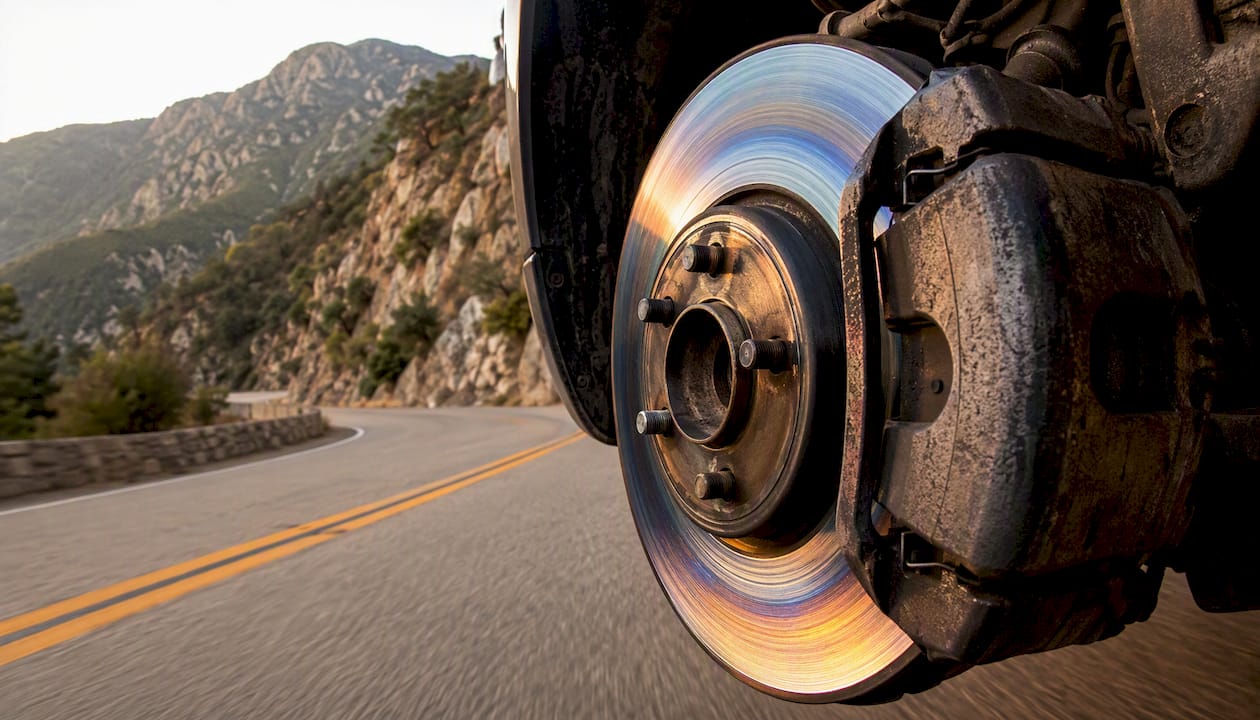
Track and autocross use is a different category entirely. Repeated hard stops from high speed, with minimal cooling time between corners, routinely drive rotor core temperatures to 450–600°C (840–1,110°F), with brief surface peaks near 800°C. At that point, street-oriented pads have long since faded.
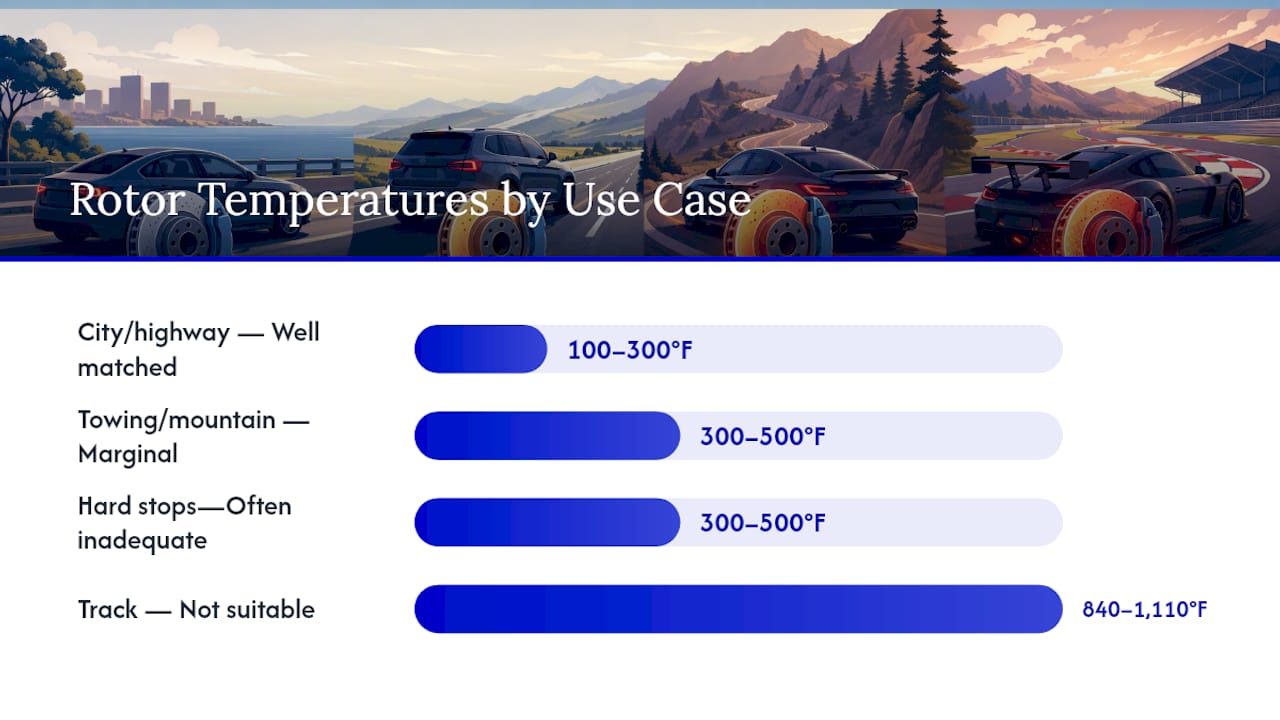
| Use Case | Typical Rotor Surface Temp | Standard Street Pad Suitability |
|---|---|---|
| Normal city/highway driving | 100–300°F (38–149°C) | Well matched |
| Towing or mountain descents | 300–500°F (149–260°C) | Marginal; upgrade recommended |
| Repeated hard stops, spirited driving | 300–500°F (149–260°C) | Often inadequate |
| Track or competition | 840–1,110°F (450–600°C) | Not suitable |
Motorcycles and light trucks shift these numbers somewhat. A motorcycle’s smaller rotor mass heats and cools faster, so temperature swings are sharper even if peak values land in a similar range to a passenger car. Heavy-duty trucks and vehicles hauling significant loads run warmer baselines across the board, which is exactly why factory-spec pads for those platforms are usually formulated with a higher minimum operating temperature than a compact car’s pads.
What Happens When Brakes Get Too Hot
“Too hot” isn’t a single number. It’s the point where a specific system component stops doing its job, and there are three separate failure modes worth knowing apart.
Pad fade happens when friction material exceeds its designed heat ceiling and the coefficient of friction drops sharply. Research on mixed-lining pad compounds found friction climbing from about 0.4 to 0.6 between 100–180°C, then falling to roughly 0.2 near 300°C. That drop is exactly what a driver feels as a suddenly long, soft pedal with no bite.
Fluid boil is a separate, more dangerous failure. Once brake fluid reaches its boiling point, it turns to vapor, and vapor compresses instead of transmitting pressure. Pedal travel increases until the pedal goes nearly to the floor with little stopping power left. Standard DOT 3 fluid boils around 205°C (401°F), which is well within reach during a sustained mountain descent with worn or moisture-contaminated fluid.
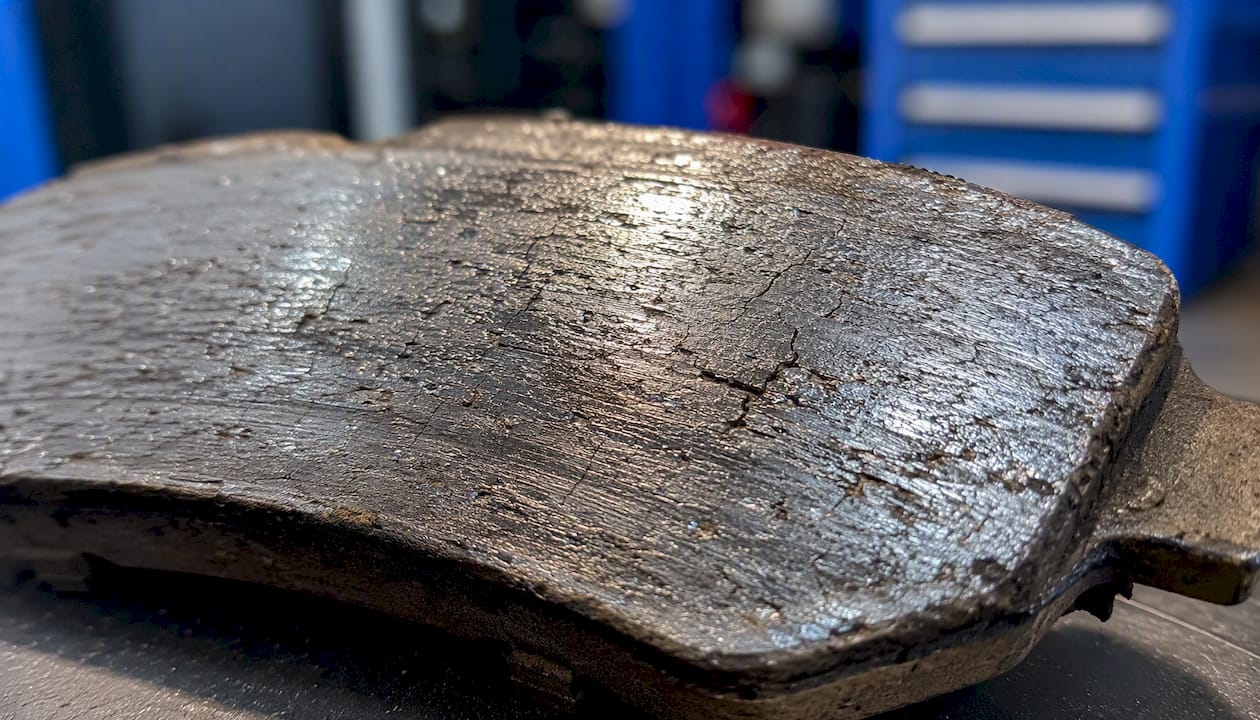
Glazing and green fade come from a different mechanism. Overheated pad material can release gas from resins in the friction compound, and that gas forms a thin film between pad and rotor that momentarily kills grip, a phenomenon sometimes called green fade. Repeated exposure to this cycle without proper bedding leaves a hardened, shiny glaze on the pad surface that never grips as well again.
Rotor damage follows its own timeline. Sustained heat beyond a rotor’s design limit causes warping, hot spots, and visible bluing on the metal surface. According to motorsport technical documentation, street pads commonly begin breaking down around 300–350°C (570–660°F), a useful marker for where “warm” becomes “too hot” for daily-driver components.
If you ever feel the pedal sink toward the floor or catch a burning smell that won’t go away, pull over immediately and let everything cool before continuing. Hot rotors and calipers can exceed temperatures that cause burns on contact, so treat an overheated brake system the same way you’d treat any hot engine component.
How Pad and Rotor Materials Respond to Heat
Friction material isn’t a fixed number. It’s a curve, and understanding that curve explains almost everything about why pad selection matters more than most drivers assume.
Every friction compound has a friction coefficient that changes with temperature. In the study cited above, friction rose steadily up to a peak around 180°C before collapsing at higher temperatures. That peak location, not just the peak value, is what separates one pad compound from another. Organic and ceramic pads are formulated to peak in the low-to-moderate range that matches everyday driving. Semi-metallic pads generally handle a wider band with better fade resistance under moderate heat. Race compounds are built to peak far higher, sometimes not reaching their best friction until well into the 500°F-plus range.
Thermal conductivity plays a quieter but equally important role. Materials with lower conductivity in the pad push more heat into the rotor rather than absorbing it themselves, which raises rotor bulk temperature and changes wear behavior over the component’s life, according to modeling research on pad and disc thermal partitioning. This is part of why a mismatched pad and rotor pairing can wear unevenly even when each part looks fine individually, and it’s the logic behind buying matched pad and rotor kits rather than mixing components from different sources.
| Pad Material Class | Typical Effective Heat Window | Best Suited For |
|---|---|---|
| Organic | Light mode, friction surface ≤200°C | City driving, light-duty passenger cars |
| Ceramic | Medium mode, up to ≈450°C | Daily driving through moderate performance use |
| Semi-metallic | Medium to heavy, >450°C tolerance | Towing, mountain driving, mixed use |
| Race compound | Heavy mode, often requiring 500°F+ to peak | Track and competition only |
This is precisely why a race pad on a commuter car is a downgrade, not an upgrade. If the compound never reaches its minimum effective temperature during normal driving, it delivers weak initial bite and can actually lengthen stopping distances in everyday traffic. Choosing between ceramic and semi-metallic formulations comes down to matching the pad’s real operating window to the heat your driving actually generates, not to whichever compound sounds more aggressive on the box.
How to Measure Brake Temperatures Accurately
You don’t need a data-logging rig to get a useful reading. Three tools cover nearly every situation a street driver or weekend track enthusiast will encounter.
An infrared pyrometer is the fastest and most practical option. Point it at the rotor surface immediately after a drive and it gives an instant readout, though it only measures surface temperature at the exact spot aimed, which can miss hot spots elsewhere on the disc.
Thermocouples give more consistent, continuous data because they’re mounted directly against the caliper or rotor and wired to a readout or logger. They’re the standard for track telemetry setups but require more installation effort than a handheld pyrometer.
Temperature-indicating paint or heat strips are the low-cost option. Applied to the rotor before a drive, they permanently change color at specific temperature thresholds, giving you a record of peak heat reached, useful for confirming whether a given pad and rotor pairing actually stayed within its design range during real driving.
Here’s a simple sequence for getting a meaningful reading:
- Drive the route or perform the braking sequence you want to evaluate.
- Pull over to a safe location immediately afterward, since rotors cool quickly once the vehicle stops moving.
- Approach the wheel carefully. Hot rotors and calipers can cause burns, so avoid direct contact.
- Aim the pyrometer at the rotor’s outer friction surface, taking readings at a few points around the disc.
- Record the highest reading, not the average, since peak temperature is what determines fade risk.
- Compare that number against your pad’s rated operating window.
If readings regularly approach the lower failure thresholds discussed earlier, roughly 300°F for standard street pads under sustained stress, that’s your signal to consider a higher-temperature pad compound or a cooling upgrade before the next heavy-use drive.
Warning Signs Your Brakes Are Overheating
Overheating rarely arrives without warning. The signs are physical and unmistakable once you know what to look for.
- A sharp burning smell, often described as hot resin or scorched material, coming from a wheel area.
- A brake pedal that feels longer or softer than usual, sometimes sinking closer to the floor.
- Visible smoke or haze rising from a wheel well.
- A grinding or squealing noise that wasn’t present before the drive.
- Vibration through the pedal or steering wheel under braking.
- Noticeably reduced stopping power compared to normal.
If any of these appear, ease off the brakes immediately rather than continuing to press harder, since additional heat only worsens fade. Find a safe place to pull over and stop using the brakes for at least 15 to 20 minutes to let the system cool naturally. Avoid pouring water on hot rotors, since rapid temperature change can crack them. If you see actual smoke combined with a burning rubber or electrical smell, treat it as a potential fire risk, move away from the vehicle, and call for assistance rather than attempting to inspect hot components yourself.
Preventing Overheating Through Technique and Maintenance
Most overheating incidents are preventable with driving habits that cost nothing to adopt.
On long descents, downshift and use engine braking to carry part of the load instead of riding the brake pedal continuously. Pulse braking, firm application followed by release, allows the system brief cooling windows that continuous light pressure never provides. When towing, increase following distance and begin braking earlier than you would unloaded, since a heavier vehicle needs more time and distance to shed speed safely.
Maintenance habits matter just as much as technique:
- Bed in new pads following the manufacturer’s staged braking procedure, which lets the compound reach operating temperature gradually and avoids green fade from the outset.
- Check brake fluid condition annually, since moisture contamination lowers the effective boiling point well below the fresh-fluid spec.
- Inspect pad thickness and rotor surface condition at every oil change or tire rotation.
- Match pad and rotor selection to your actual driving profile rather than to marketing claims about ultimate stopping power.
Pro Tip: Bedding isn’t optional theater. A pad that’s rushed into service without a proper bed-in cycle is more prone to uneven transfer layer buildup, which shows up later as pulsation or reduced bite exactly when you need it most.
Inspecting for Heat Damage and Knowing When to Replace
Heat damage leaves visible evidence, and catching it early is far cheaper than discovering it during an emergency stop.
Check pads for a glassy, shiny surface, which indicates glazing from excessive heat exposure. Uneven wear across the pad face, cracks in the friction material, or a pad thickness below roughly 3 millimeters all call for replacement regardless of remaining mileage estimates.
Rotors tell their own story. Blue or straw-colored discoloration on the braking surface indicates the metal exceeded its safe temperature range at some point. Hot spots, visible as darker rings or patches, often accompany pedal pulsation and signal uneven heat distribution during hard braking. Measure rotor thickness against the minimum spec stamped on the rotor itself. Any measurement below that number means immediate replacement, since a rotor that thin can crack under hard braking.
If you feel a pulsing brake pedal, hear consistent grinding, or notice a burning smell returning after the system has cooled and rested, that’s a signal to have a shop inspect the full system rather than waiting for the next scheduled service. Heat-damaged components rarely improve on their own, and continuing to drive on glazed pads or warped rotors compounds the wear rate on everything downstream, including calipers and wheel bearings.
A Brake Maker’s View on Matching Pads to Real Driving Conditions
The biggest mistake we see isn’t drivers ignoring temperature. It’s drivers matching pad choice to a fantasy version of their driving instead of the real thing. A commuter who buys an aggressive high-heat compound because it sounds tougher usually ends up with a colder pedal and worse bite than a properly matched ceramic pad would have delivered from day one. The heat window has to match the drive, not the driver’s aspirations.
Weather adds a variable that pure temperature charts don’t capture. A pad that performs beautifully at 200°F on a dry summer day can behave unpredictably the moment rain or road spray hits a hot rotor, because moisture displacement matters just as much as thermal stability. That’s the gap HydroAdaptive technology is built to close, keeping friction consistent whether the pad is warming up on a dry highway or clearing water on a wet mountain grade. Matching heat range to driving style is step one. Matching that same pad’s behavior across weather conditions is what actually determines whether it performs when you need it.
How HydroAdaptive Technology Handles Temperature Swings
Every pad on the market has a heat window. Fewer are engineered to stay consistent across the temperature and weather swings that real driving actually throws at them, which is exactly the gap Aaafrictions built its ceramic formulation to close.

Aaafrictions’ HydroAdaptive pads are engineered with a few specific goals in mind:
- Consistent friction output whether the rotor is warm and dry or wet from rain, snow melt, or humidity.
- Rapid moisture clearing at the pad surface, so temperature swings don’t compound with water displacement problems.
- Corrosion-resistant rotor coatings that hold up under repeated heat cycling without degrading.
- A friction profile designed for the realistic street and towing heat windows most drivers actually encounter, rather than a race-only extreme.
If you tow regularly, drive through variable weather, or simply want a pad matched to real-world heat ranges instead of a compound built for the track, browse matched brake pad and rotor kits built around this approach. Start by checking which kit fits your vehicle and driving profile, and get a pad whose heat window actually lines up with the roads you drive.
Sources
- Temperature Influence on Brake Pad Friction Coefficient Modelisation – PMC
- Materials journal: numerical simulation and material selection for brake pads (MDPI)
- DBA technical bulletin: Motorsport important information
- 5 Ways Temperature Helps Racing Experts Choose the Right Brake Pad – Hawk Performance
- Understanding Heat Ranges for Optimal Brake Pad Performance – XP Motorsports Inc.
One Response