

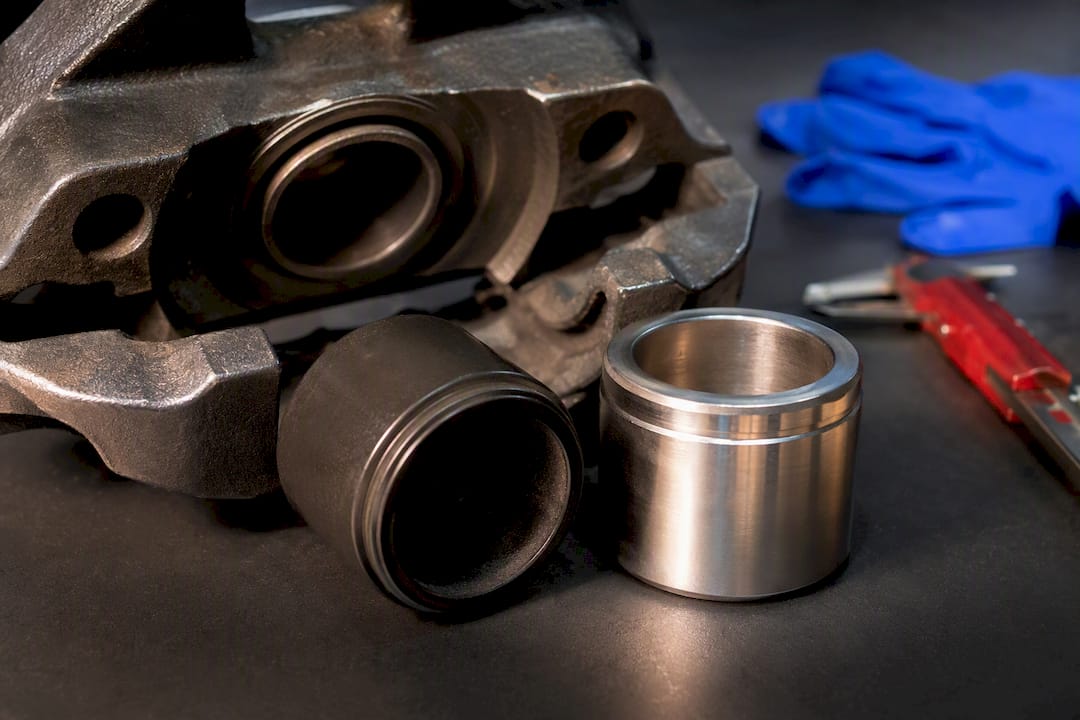
Phenolic pistons win for routine, corrosion-prone driving because they insulate heat and shrug off rust, though they can absorb moisture and swell over time. Steel pistons win for towing, sustained mountain descents, or track use because they hold their shape under heat and load, at the cost of transferring more heat into your brake fluid. When either type shows binding, pitting, or a torn dust boot, replace it during the caliper rebuild rather than reusing it.
TL;DR:
- Phenolic pistons are ideal for daily driving in salted climates due to their corrosion resistance and lightweight properties, but they can swell with moisture over time.
- Steel pistons are better suited for high-heat conditions like towing or mountain descents because they maintain shape, but they transfer more heat to the brake fluid and are prone to rust.
- Regular inspection of dust boots and brake fluid helps catch swelling or corrosion early before they cause binding or leaking issues.
- Switching piston materials should be matched to your driving environment, with phenolic preferred for city driving and steel for high-temperature or heavy-duty use.
- Replacing pistons during caliper rebuild is suggested if they show signs of binding, pitting, or damage, as once a phenolic piston seizes, it is likely to recur without system fixes.
Table of Contents
- Phenolic vs Steel Pistons: A Side-by-Side Comparison
- How Piston Material Changes Brake Feel and Heat Flow
- Why Phenolic Pistons Swell and Steel Pistons Corrode
- Which Piston Material Fits Your Driving Situation
- How to Inspect and Replace a Caliper Piston Safely
- Why a Full Kit Sometimes Beats a Piston Swap
- When a Weather-Adaptive Brake Kit Makes More Sense Than a Piston Swap
- Sources
Phenolic vs Steel Pistons: A Side-by-Side Comparison
Before deciding which material fits your caliper, it helps to see how the two stack up on the properties that actually affect braking performance.
| Property | Phenolic | Steel |
|---|---|---|
| Weight | Lighter, reduces unsprung mass | Heavier |
| Heat transfer to fluid | Low, insulates fluid from rotor heat | Higher, conducts heat into fluid |
| Corrosion resistance | Immune to rust | Prone to pitting and corrosion |
| Durability at high temperature | Can degrade internally with heat and moisture | Stable, holds dimensional tolerance |
| Common failure mode | Swelling and taper from absorbed moisture | Rust pitting and seal wear |
| OE history | Standard in many calipers since the 1970s | Long-standing use, especially in heavy-duty and older designs |
A few practical takeaways come out of that table:
- Phenolic’s weight and insulation advantages matter most in daily commuting, where heat cycles are moderate and moisture exposure is the bigger long-term threat.
- Steel earns its keep when brake heat is sustained and repeated, since it won’t taper or bind the way a moisture-saturated phenolic piston can.
- Corrosion resistance in phenolic is a genuine edge in salted-road climates, but it’s not a free pass. It just trades one failure mode for another.
- If a phenolic piston has already seized once, the odds favor doing it again unless the moisture source (torn boot, contaminated fluid) gets fixed first.
- Cost and availability tend to favor phenolic for OE-spec replacements, since that’s what many calipers were designed around from the factory.
How Piston Material Changes Brake Feel and Heat Flow
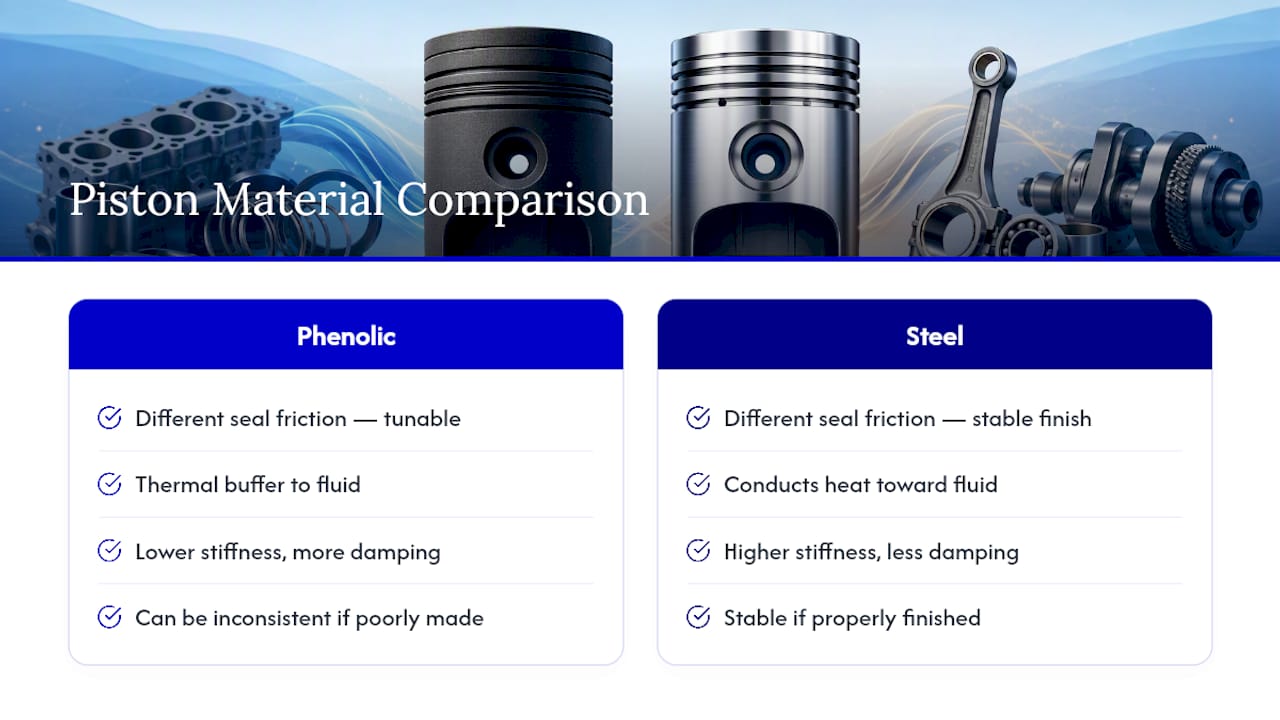
The piston material inside your caliper affects more than corrosion resistance. It shapes how the pedal feels under your foot. Tribology testing using modified JASO C448 bench methods has shown that phenolic pistons generate different friction forces against caliper seals than steel, and that surface finish on the piston can be engineered to tune that feel. A poorly molded or improperly cured phenolic piston skips that tuning benefit and can behave inconsistently from the first mile.
Steel’s advantage shows up in thermal flow. In single-cylinder engine testing, alloy steel components reduced friction losses and energy transfer to coolant compared to aluminum, a finding that maps onto brake systems too: steel conducts more heat toward the fluid, while phenolic acts more like a thermal buffer between rotor and fluid. That buffer matters directly for vapor lock risk, since fluid that stays cooler resists boiling under hard, repeated stops.
Material choice also affects stiffness and damping, which influences how sensitive a corner is to brake judder under load. None of this happens in isolation. Caliper design, pad chemistry, and rotor cooling all interact with piston material to produce the pedal feel you actually experience. If you’re chasing a specific pedal character, it’s worth reading how brake pad friction and mu behavior factor into the equation, and how thermal-management caliper designs handle heat before it ever reaches the piston.
Pro Tip: If your pedal feels different after a piston swap, don’t assume the new part is defective. Bed in the pads and seals for 200 to 300 miles before judging the feel, since fresh seals and a new piston surface both need a break-in period to settle.
Why Phenolic Pistons Swell and Steel Pistons Corrode
Phenolic pistons are hygroscopic, meaning they absorb moisture from brake fluid over time. That absorption isn’t uniform. The open end of the piston tends to swell more than the closed end, creating a subtle taper that causes binding inside the bore. You won’t see this from the outside. It typically surfaces as a dragging brake, uneven pad wear, or a caliper that won’t retract properly, and it’s often only confirmed once the piston comes out.
Steel pistons fail differently. Moisture and road salt attack the exposed surface directly, causing pitting and rust rather than internal swelling. Once corrosion roughens the surface, it tears at the seal every time the piston moves, leading to fluid leaks and eventual seizure from the outside in.
A practical inspection routine catches both problems early:
- Check the dust boot for tears, cracks, or displacement. A compromised boot is the main entry point for moisture in both piston types.
- Inspect brake fluid color and clarity. Dark, cloudy fluid signals moisture contamination and should trigger a flush.
- Feel for uneven caliper retraction or a piston that resists pushing back squarely. Resistance on one side hints at taper.
- Visually scan steel pistons for surface pitting or rust streaks near the boot.
- When in doubt, don’t force a suspect phenolic piston back into the bore. Pushing it can crack a taper-weakened piston.
Pro Tip: There’s no reliable non-destructive test for internal phenolic degradation. If the piston has high mileage or unknown history, replace it during the rebuild instead of reusing it and hoping.
Which Piston Material Fits Your Driving Situation
The right piston depends less on brand preference and more on how and where you drive.
- Salted-climate commuters generally do best sticking with phenolic, since corrosion resistance outweighs the marginal heat penalty of everyday stop-and-go driving.
- Light-duty towing or hauling pushes toward steel, since sustained brake heat during descents with a loaded trailer is exactly the scenario where dimensional stability under heat pays off.
- Mountainous, frequent-descent driving favors steel for the same reason. Repeated hard braking generates heat loads that stress a phenolic piston’s tolerance more than city driving ever will.
- Track or performance use almost always calls for steel, since aftermarket practice commonly upgrades phenolic to steel specifically to eliminate swelling risk under sustained high heat.
- OE-spec replacements should generally stay phenolic unless the vehicle has a documented history of repeat seizure, since some calipers were engineered around phenolic’s specific thermal and weight properties.
If you switch to steel, plan on slightly more frequent fluid changes to offset the extra heat reaching the fluid. And before buying either type, confirm the replacement piston matches your caliper’s seal kit. Not every bore is machined to accept both materials interchangeably.
How to Inspect and Replace a Caliper Piston Safely
Start with the basics before you ever pull a piston: check dust boot condition, fluid level, and look for visible scoring or corrosion on the exposed piston face. Any of these can tell you which failure mode you’re dealing with before you open the caliper.
- Retract the piston slowly and watch for uneven movement, drag, or resistance on one side, which points to swelling or taper.
- If retraction feels off or the piston looks discolored, have a shop measure the bore and piston diameter rather than forcing it back manually.
- When replacing, match the new piston to the correct seal kit for your caliper model. Don’t mix piston materials without confirming the caliper was designed for both.
- Torque caliper bolts to spec and bleed the system fully after reassembly, since trapped air will mimic a pedal problem that has nothing to do with the piston.
Pro Tip: A caliper piston hone or a partner in brake-dust removal, like this safe brake-dust removal method, helps prevent abrasive buildup that accelerates seal wear regardless of which piston material you choose.
Why a Full Kit Sometimes Beats a Piston Swap
Swapping a piston fixes a specific failure. It doesn’t address the moisture management that caused the failure in the first place. That’s the gap AAA Frictions built its HydroAdaptive technology to close, clearing moisture from the friction interface so braking stays consistent through rain, snow, and humidity rather than only after a seized piston finally gets attention.
Our honest read: if you’re chasing one seized or corroded piston, replace it. If you’ve replaced pistons more than once on the same vehicle, the problem likely lives in the system, not the part. Look at how the HydroAdaptive formulation approaches moisture at the pad and rotor level before you spend another afternoon under the car.
— AAA
When a Weather-Adaptive Brake Kit Makes More Sense Than a Piston Swap
A piston swap solves one part failure. It doesn’t stop moisture from finding its way back into the system next winter. If you’re dealing with recurring corrosion, inconsistent bite in wet weather, or brakes that feel different every time the temperature drops, that’s a system pattern, not a piston problem.

Some manufacturers build full brake kits around HydroAdaptive ceramic technology specifically for that pattern. Instead of chasing one worn piston at a time, a kit pairs corrosion-resistant rotors with pads engineered to clear moisture fast, so pedal feel stays consistent across rain, snow, and humidity rather than degrading the moment conditions change. This isn’t the only fix for a single bad piston, but for drivers who keep running into the same weather-related braking issues, it addresses the actual cause instead of the latest symptom. Browse available brake kits for your vehicle and see what a system-level upgrade looks like for your specific make and model.
Sources
- Phenolic brake piston repair guidance — Alldata
- Effect of phenolic brake piston tribology on brake pedal feel — SAE
- Experimental comparison of aluminium and steel pistons — Oxford research repository
- Phenolic pistons are a one-and-done component — Vehicle Service Pros
- Disc brake caliper piston: terminology and upgrade guidance — PartsAdvisory