

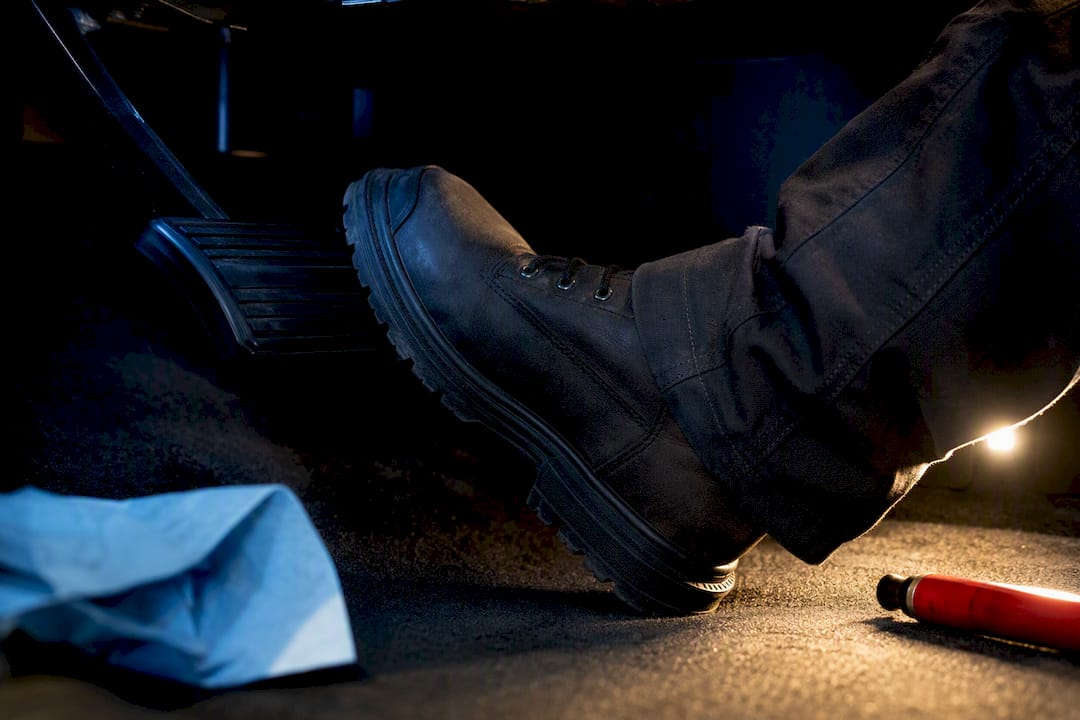
A healthy brake pedal feels firm from the first inch of travel, holds steady under pressure, and delivers stopping force that matches how hard you press. Spongy means air or contaminated fluid in the hydraulic system. A pedal that sinks toward the floor points to a fluid leak or a master cylinder that’s bypassing internally. A hard, high-effort pedal usually means a failed brake booster. Pulsation almost always traces back to warped or uneven rotors.
TL;DR:
- Air in the brake lines causes a spongy pedal that compresses under pressure, often resulting from system opening or leaks.
- Moisture-contaminated fluid lowers brake boiling points and can cause intermittent sponginess during hard braking.
- A sinking pedal usually indicates fluid leaks or a master cylinder bypass, requiring immediate diagnosis to prevent safety risks.
- Warped rotors lead to pulsating brake pedals, especially at higher speeds, highlighting the importance of rotor maintenance.
- Regular brake fluid replacement every two to three years helps prevent moisture buildup and maintains pedal feel consistency.
Table of Contents
- Brake Pedal Feel Explained: What a Healthy Baseline Looks Like
- What Different Sensations Are Telling You
- Why Pedal Feel Changes: the Common Root Causes
- How to Diagnose a Soft or Unusual Brake Pedal Yourself
- Fixing It: What Each Repair Actually Buys You
- Keeping Pedal Feel Consistent Over Time
- When Weather Is Part of the Problem
- Treat Your Pedal Like an Early-Warning System
- Where Weather-Ready Parts Fit In
- Sources
Brake Pedal Feel Explained: What a Healthy Baseline Looks Like
A properly functioning pedal engages within the first inch or two of travel, builds resistance smoothly, and stops the car in proportion to how hard you push. Engineers who study this describe pedal feel as a function of firmness, travel distance, and predictability. That’s not a minor design detail. It’s a driver’s real interface with the entire braking system, tied directly to both safety and comfort.
You can check your own baseline with a couple of simple tests:
- Engine-off test: With the car off, pump the pedal three to five times to bleed off vacuum reserve, then hold steady pressure. It should stay firm and not sink under held pressure.
- Consistency check: The pedal should feel the same on your third stop of the day as it did on your first.
- ABS distinction: A pulsing pedal during hard braking on slippery surfaces is your anti-lock system working correctly. That’s normal. Pulsation during routine, moderate braking on dry pavement is not.
What Different Sensations Are Telling You
Each abnormal feel maps to a fairly specific subsystem, which is why paying attention to how the pedal feels wrong matters as much as noticing that it does.
- Spongy or soft: The pedal compresses without a firm stopping point, usually caused by air trapped in the lines or brake fluid that has absorbed moisture and turned partly to vapor under heat.
- Low pedal or sinking to the floor: This signals a bigger fluid loss somewhere in the system, or an internal master cylinder seal that’s letting fluid bypass instead of building pressure.
- Abnormally hard, high-effort pedal: Almost always a brake booster or vacuum problem, though a seized caliper or mechanical obstruction can produce the same symptom.
- Pulsating or vibrating pedal: Rotor thickness variation, warping, or runout, since uneven rotor surfaces create a rhythmic pulse you feel through the pedal with every rotation.
A pedal that changes character over the course of one drive, going from firm to soft as brakes heat up, is a different clue than one that’s been soft since you started the car. Keep that timing in mind as you work through causes.
Why Pedal Feel Changes: the Common Root Causes
Most complaints trace back to a short list of culprits, and knowing which one you’re dealing with changes both the fix and the urgency.
Air in the lines gets in whenever the hydraulic system is opened, during a pad or caliper job, a fluid top-off gone wrong, or a slow leak nobody caught. Air compresses; fluid doesn’t. That’s why even a small air pocket produces a mushy pedal.
Moisture-contaminated fluid is a slower, quieter version of the same problem. Brake fluid is hygroscopic, meaning it absorbs water from the air over time. That water lowers the fluid’s boiling point, and under hard or sustained braking, it can flash to vapor, which compresses just like trapped air and produces intermittent sponginess.
Leaks commonly show up at wheel cylinders, caliper seals, brake lines, or the master cylinder itself. Check for wetness or fluid staining near any of those points, plus a reservoir level that keeps dropping without explanation.
- Rubber brake hoses expand slightly under pressure, which softens pedal feel over time as hoses age; stainless braided lines resist that expansion and sharpen pedal response.
- Master cylinder internal bypass shows up as a pedal that firms briefly after bleeding, then goes soft again within days.
- Booster failure typically causes a hard pedal along with a hissing sound when you press it.
- Warped rotors cause pulsation that gets worse under braking from higher speeds.
Fix costs vary widely by cause. A straightforward brake bleed to remove trapped air runs around $50, while a full master cylinder replacement can land anywhere from $300 to $800 or more depending on the vehicle. That gap alone is a good reason to diagnose before you assume the worst or dismiss a real problem as minor.
How to Diagnose a Soft or Unusual Brake Pedal Yourself
Run these checks in order before you decide whether this is a driveway fix or a shop visit.
- Engine-off pump test. Shut the engine off, pump the pedal several times, then hold firm pressure for 30 to 60 seconds. A pedal that stays firm suggests the booster is fine; one that slowly sinks under held pressure points toward air, a leak, or master cylinder bypass.
- Check the reservoir. Look at fluid level and color through the translucent reservoir. Fluid that’s dark brown or black has likely absorbed moisture and contaminants and needs replacing.
- Inspect around each wheel. Look for wet spots, fluid trails, or staining near calipers and wheel cylinders, and listen for hissing near the booster with the engine running.
- Road-test with attention. Note whether the pedal is soft from the first press, sinks gradually while stopped at a light, or only softens after several hard stops.
- Decide on urgency. A pedal that sinks to the floor, or one that suddenly goes hard with a hiss, means stop driving and call a tow rather than risk it.
Pro Tip: If the pedal firms up right after a bleed but goes soft again within a day or two, don’t bleed it a second time. That pattern almost always means the master cylinder is bypassing internally, and no amount of bleeding fixes a bad seal.
Fixing It: What Each Repair Actually Buys You
Not every soft pedal needs a new master cylinder, and not every spongy feel goes away with a quick bleed. Matching the fix to the actual cause saves money and prevents repeat trips.
- Bleeding removes trapped air and restores a solid, non-compressible fluid column. It’s the right call when the softness is new and hasn’t recurred before.
- Full fluid flush replaces old, moisture-laden fluid system-wide, using a pressure bleeder to push fresh fluid through every line and caliper. This addresses sponginess tied to heat and humidity rather than a one-time air pocket.
- Hose, pad, or rotor replacement restores consistent feel when aging rubber, worn friction material, or warped rotor surfaces are the source. These are moderate-priority repairs, important but rarely an immediate safety emergency unless pads are metal-on-metal.
- Master cylinder replacement is a higher-priority job, since internal bypass will keep returning even after a fresh bleed.
- Booster repair ranges from a simple vacuum line fix, which restores lost assist quickly and cheaply, to a full booster swap when the diaphragm itself has failed.
Any pedal that sinks to the floor, feels hard with a hissing sound, or has changed suddenly rather than gradually deserves immediate professional attention rather than a wait-and-see approach.
Keeping Pedal Feel Consistent Over Time
Most pedal problems are preventable with a maintenance rhythm that’s easy to ignore until something goes wrong.
- Flush and replace brake fluid every two to three years, since that’s roughly how long it takes moisture absorption to meaningfully affect boiling point.
- Inspect rubber hoses, seals, and fittings during routine service rather than waiting for a leak to announce itself.
- Expect a firmer, more responsive pedal over the first few hundred miles after new pads or rotors as they bed in against each other.
- Pay extra attention heading into winter, since cold temperatures and road moisture both tend to expose marginal seals and hoses that were fine in summer.
When Weather Is Part of the Problem
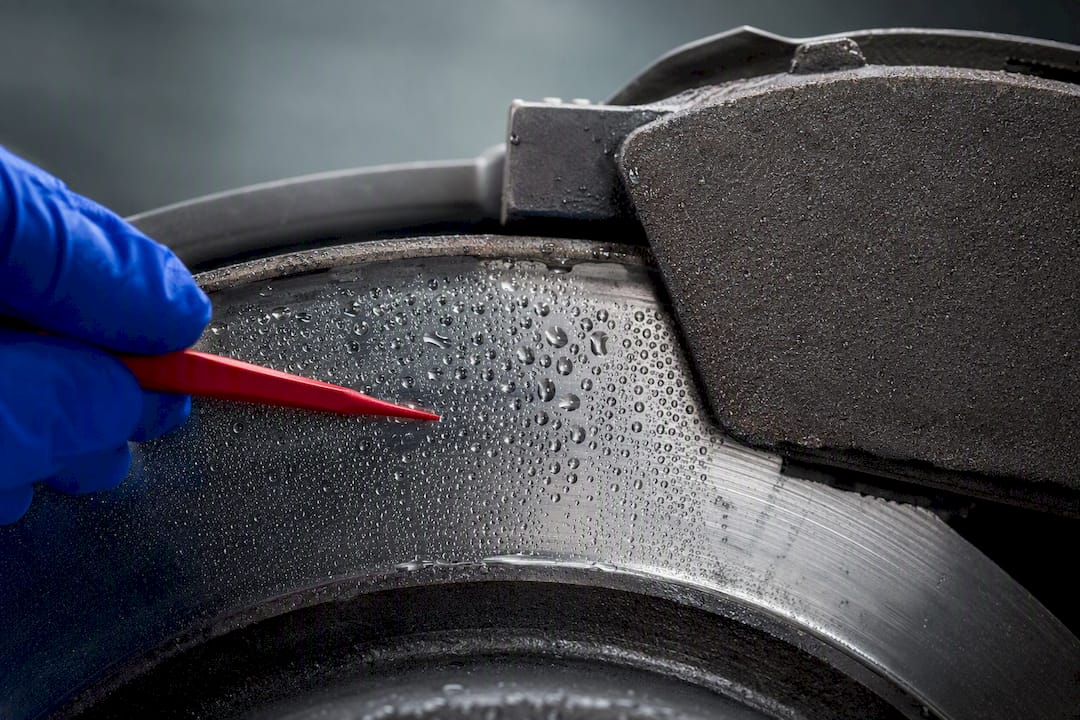
Some pedal softness isn’t about worn parts at all. It’s about how moisture interacts with heat and friction material in the moment you brake. That’s one approach to addressing moisture at the pad and rotor interface to keep bite more consistent in rain, snow, or high humidity. It’s not a fix for leaks, air in the lines, or a failing master cylinder, those still need direct repair. It’s worth considering when your pedal feels fine on dry days but softens or hesitates specifically in wet or cold conditions, which points to a weather-related friction issue rather than a hydraulic fault.
Treat Your Pedal Like an Early-Warning System
Pedal feel rarely lies. A gradual change over weeks is your car telling you something is wearing out, long before it becomes a roadside emergency. Skipping a fluid flush or ignoring a slowly softening pedal is how a $50 bleed job turns into an $800 repair. Pay attention early, and act on what you feel.
— AAA
Where Weather-Ready Parts Fit In
Diagnosing a soft or inconsistent pedal comes first. But once you’ve ruled out leaks, air, and master cylinder problems, and the softness still shows up mainly in wet or cold weather, that’s when a parts upgrade makes more sense than another repair. Some manufacturers build pads, rotors, and full kits with ceramic technology specifically for scenarios involving wet or cold conditions, aiming to keep bite consistent through rain, snow, and humidity rather than just replacing worn friction material with more of the same.

If your symptoms line up with weather-related inconsistency rather than a hydraulic fault, browse the HydroAdaptive product lineup to see kits matched to your vehicle, or read why AAA Frictions built the technology this way in the first place. Either page will help you decide whether a parts upgrade is the right next step for your driving conditions.
Sources
- 8 common reasons why your brakes feel spongy when pressed (With fixes and repair costs) | The Motor Guy
- Why do my brakes feel spongy? | KBB