

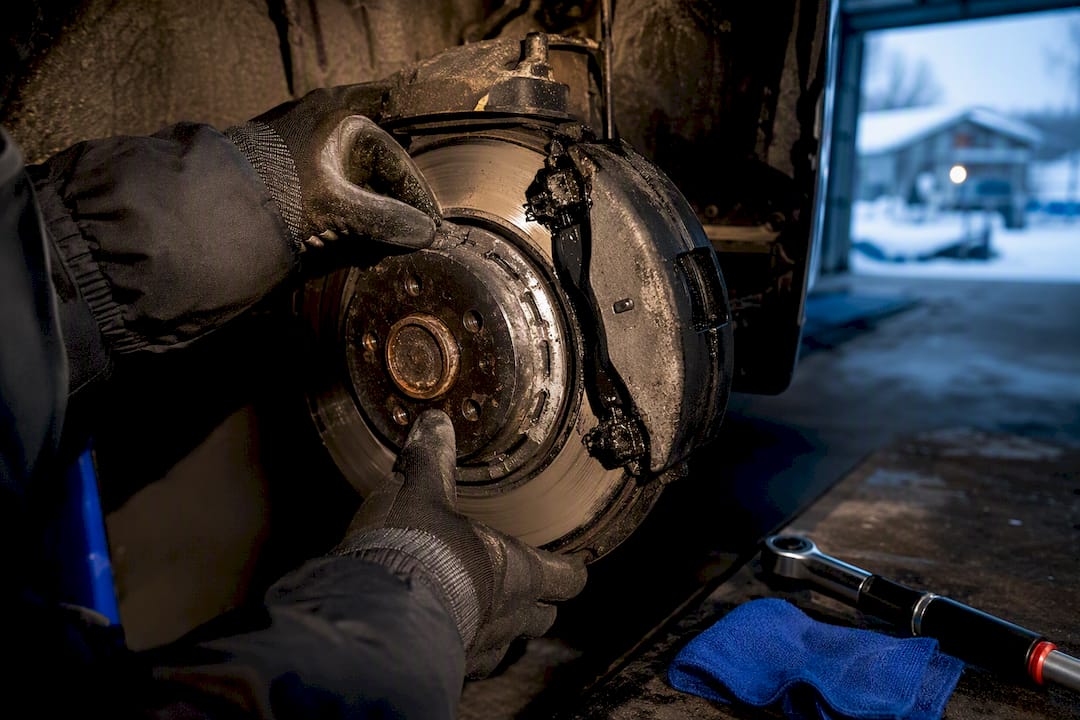
Most drivers don’t need a full brake overhaul before winter, but every driver needs a mechanical inspection first. Fix seized slide pins, corroded rotors, and moisture-laden fluid before you spend a dollar on new pads. Once the mechanicals check out, climate-focused pad and rotor systems built for consistent cold-start bite outperform aggressive high-temp performance pads, which need to heat the average winter commute usually never generates such heat.
TL;DR:
- Mechanical inspection should prioritize fixing seized slide pins, rusted rotors, cracked caliper boots, and old, moisture-laden brake fluid before considering new pads.
- Climate-adaptive brake pads and rotors with corrosion-resistant finishes outperform high-temp performance pads that require heat to deliver optimal cold-start bite.
- Matching pad chemistry and rotor surface treatment to your driving habits and road salt exposure ensures better winter brake performance and system longevity.
- Proper bedding-in of new pads and rotors is essential to achieve consistent bite and prevent uneven wear, especially in cold conditions.
- Regular pre-winter brake maintenance checks on pad thickness, rotor surface, caliper function, and fluid quality prevent failures that a simple pad swap cannot fix.
Table of Contents
- What Winter Brake Upgrades Actually Change
- How Do You Choose Winter-Ready Pads and Rotors?
- What Should a Pre-Winter Brake Inspection Cover?
- How Long Does It Take to Bed In New Winter Brakes?
- How Do Climate-Adaptive Brake Systems Work?
- Which Brake Symptoms Signal Trouble Before Winter Hits?
- How Do Ice, Snow, and Salt Change Stopping Distance?
- Why Does Brake Fluid Need to Be Cold-Weather Rated?
- Does Cold Weather Affect ABS and Electronic Brake Systems?
- How Do Winter Tires Work With Your Braking System?
- An Editorial Take on Winter Brake Priorities
- Where to Find Winter-Ready Pads and Rotors
- Sources
- FAQ
What Winter Brake Upgrades Actually Change
Cold weather doesn’t just make roads slippery. It changes how the brake system itself behaves, sometimes for the worse, before your tires ever lose grip.
Pad friction is temperature-dependent. Many performance-oriented pads are formulated to reach peak stopping power only after they hit high temperatures, which means a short cold start, drop the kids off, sit at a light commute may never get them into their effective range. If your daily drive includes only short trips, a track-bred pad compound can leave you with less bite exactly when black ice makes you need more of it.
Rotors face a different enemy: corrosion. Road salt combined with freeze-thaw cycles accelerates rust on exposed rotor surfaces, and Canada’s own cold-season weather guidance flags these conditions as a recognized hazard to vehicle systems, not just to roads. Semi-coated rotors and GEOMET-style finishes resist that surface rust, which keeps pad contact even instead of pitted.
Mechanical hardware takes the hit nobody thinks about until it fails:
- Slide pins seize when old grease thickens or crystallizes in sub-zero temperatures, leaving one side of the caliper doing all the work.
- Caliper boots crack from repeated freeze-thaw flexing, letting in moisture and grit that speeds up internal corrosion.
- Stiff or partially seized calipers cause uneven pad wear and a pull to one side under braking.
- Old brake fluid absorbs moisture over time, and that moisture affects pedal feel and lowers the fluid’s resistance to boiling and internal corrosion.
None of these are pad or rotor problems. They’re maintenance problems that make new parts underperform if you skip them.
How Do You Choose Winter-Ready Pads and Rotors?
Pad and rotor selection for winter comes down to four practical decisions, not brand loyalty.
- Match the pad chemistry to your driving pattern. OEM-like and ceramic compounds generally deliver more predictable cold-bite than aggressive semi-metallic performance pads, which are engineered for sustained heat rather than a cold garage start. Climate-adaptive formulations split the difference by targeting consistent friction across a wider temperature band, which matters more for winter driving than peak dry-pavement grip.
- Choose rotor surface treatment based on your road salt exposure. Full-face rotors with a semi-coated or GEOMET finish resist the surface rust that shows up after a rotor sits overnight in slush. Drilled rotors carry a real cracking risk in freeze-thaw climates, and slotted designs need a manufacturer that documents cold-weather testing before you trust them for a Canadian winter.
- Confirm fitment and electronic compatibility before you buy. Vehicles with ABS or ADAS features are calibrated around specific friction and rotor characteristics, so check manufacturer fitment tools and any documented ADAS compatibility rather than assuming a universal fit.
- Read the warranty and dust/corrosion claims carefully. A pad or rotor that lists corrosion resistance and dust control as tested claims, not marketing copy, gives you something to hold the manufacturer to later.
A word of caution worth repeating: aggressive high-temp performance pads sold for spirited driving can genuinely underperform on a short winter commute. If your car rarely gets driven hard or far, that’s the wrong pad for January, no matter how well it rated in a summer track review. For deeper background on friction coefficients and how they shift with temperature, this friction and mu behavior guide breaks down the mechanics.
What Should a Pre-Winter Brake Inspection Cover?
A proper inspection catches the problems that make new pads and rotors pointless. Whether you’re doing this yourself or handing a list to a shop, the sequence matters.
- Check pad thickness on all four corners, not just the ones that squeal.
- Inspect rotor surfaces for scoring, rust ridges, or uneven wear patterns.
- Test caliper boots for cracks and confirm slide pins move freely under hand pressure.
- Check that all mounting hardware, clips, and shims are present and not corroded to the point of seizing.
- Inspect brake hoses for cracking or bulging, especially near the caliper connection.
- Check the master cylinder fluid level and look for any ABS or brake warning lights on startup.
Slide pins deserve special attention because they’re the most common cold-weather failure point that has nothing to do with pad or rotor quality. Standard petroleum-based greases can stiffen or crystallize in sub-zero temperatures, so mechanics increasingly favor cryo-stable silicone lubricants that stay pliable through freeze-thaw cycles, paired with OEM-specified hardware rather than generic replacements.
Pro Tip: If a caliper slide pin won’t move freely by hand after cleaning and fresh grease, don’t force it back into service. A pin that’s corroded into its bore usually means the caliper needs rebuilding or replacing, not just relubricating, because forcing it will cause uneven pad wear within weeks.
Corrosion mitigation extends beyond the caliper. Semi-coated rotor finishes and basic rust-inhibiting practices, along with protective coatings like those covered in this road salt protection guide, reduce how fast winter road chemicals eat into exposed metal. And caliper corrosion in salt-heavy regions is common enough that it deserves its own inspection line every fall, not just when a symptom shows up.
The dividing line between clean and replace is straightforward: if a caliper slides freely after cleaning and fresh lubricant, service it. If it’s seized solid or the boot has failed and let moisture in, replace it. Trying to save a corroded caliper usually costs more in comebacks than the part itself.
How Long Does It Take to Bed In New Winter Brakes?
Bedding in new pads and rotors isn’t optional, and skipping it undermines the whole upgrade. The process builds an even transfer layer of pad material onto the rotor surface, which is what gives you consistent, predictable bite instead of a pedal that varies stop to stop.
- Perform a series of moderate stops from around 50 km/h down to near 20 km/h, allowing the brakes to cool between each one without coming to a complete stop.
- Avoid hard, sudden stops or holding the brake pedal down at a standstill immediately after installation, since that can glaze the fresh pad surface unevenly.
- Complete eight to ten of these graduated stops before you rely on the brakes for emergency-level stopping power.
- Check pedal feel and watch for any ABS warning lights during a short test drive in a safe, low-traffic area.
Expect the parts and labor timeline to depend heavily on what you’re replacing. Pads alone are usually a same-day job. A full pad-and-rotor kit takes longer if rotors need machining assessment or if your vehicle requires ADAS recalibration after caliper work. Cost scales with the scope: pads cost less than rotors, and a matched kit costs more than either alone but avoids the mismatched wear that comes from pairing new pads with old, glazed rotor surfaces.
How Do Climate-Adaptive Brake Systems Work?
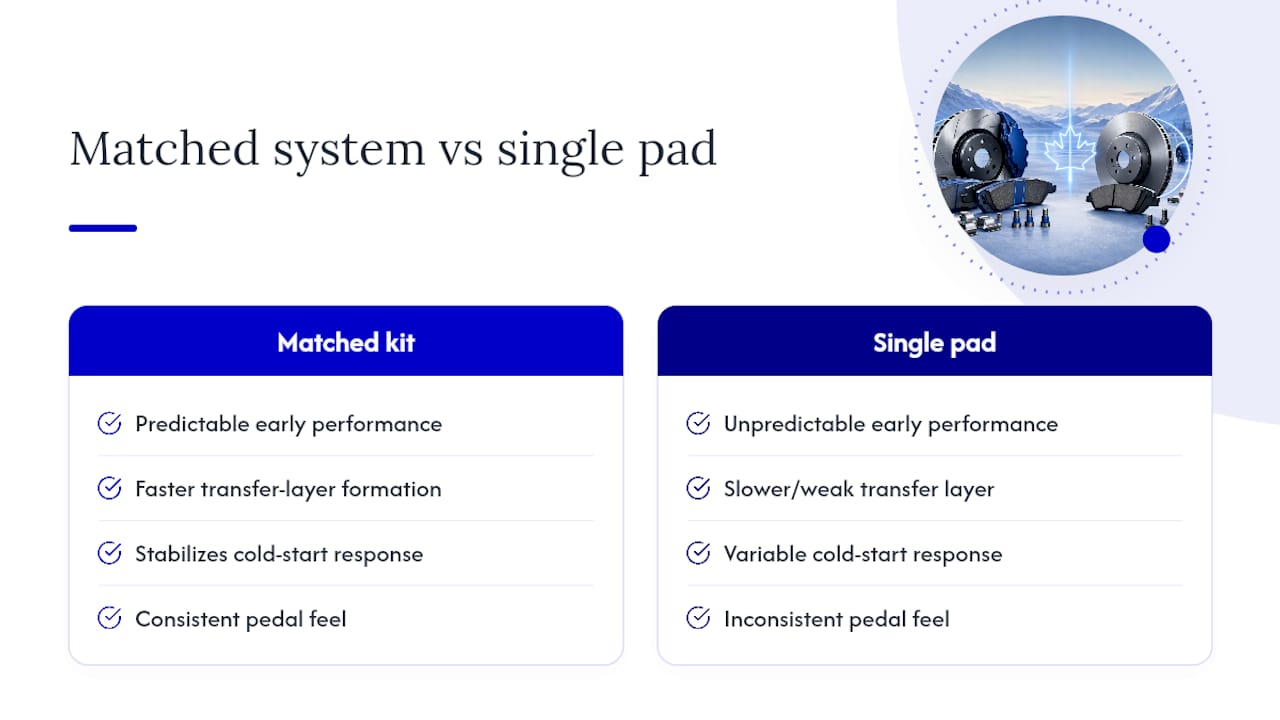
A system approach means the pad chemistry, rotor surface, and mechanical hardware are engineered to work together rather than being sourced as separate, unrelated parts. That matters because pairing pad chemistry and rotor surface preparation promotes faster transfer layer formation and more predictable early performance, which shortens the unpredictable window right after installation.
AAA Frictions builds its Type 07 HydroAdaptive+ pads and SC Type semi-coated rotors around this idea, describing the pairing as a matched system intended to stabilize cold-start response and maintain consistent pedal feel through winter conditions. ClimateFlex calipers are part of that same claim, engineered with cold-tolerant seal materials meant to keep moving parts from stiffening in freezing temperatures. These are the company’s own stated claims about its product line, not independently verified test results, and they’re worth stating plainly as such.
A system approach makes the most sense for drivers with frequent short cold starts, heavy freeze-thaw exposure, or a vehicle equipped with ADAS features that expect consistent brake characteristics from one stop to the next. A single upgraded pad on old, corroded rotors rarely delivers the same result as a matched set.
If your winter driving is mostly short trips through a salted city grid, that’s the exact scenario a matched kit is built to address.
Which Brake Symptoms Signal Trouble Before Winter Hits?
Three symptoms show up disproportionately once temperatures drop, and each one points to a different underlying issue.
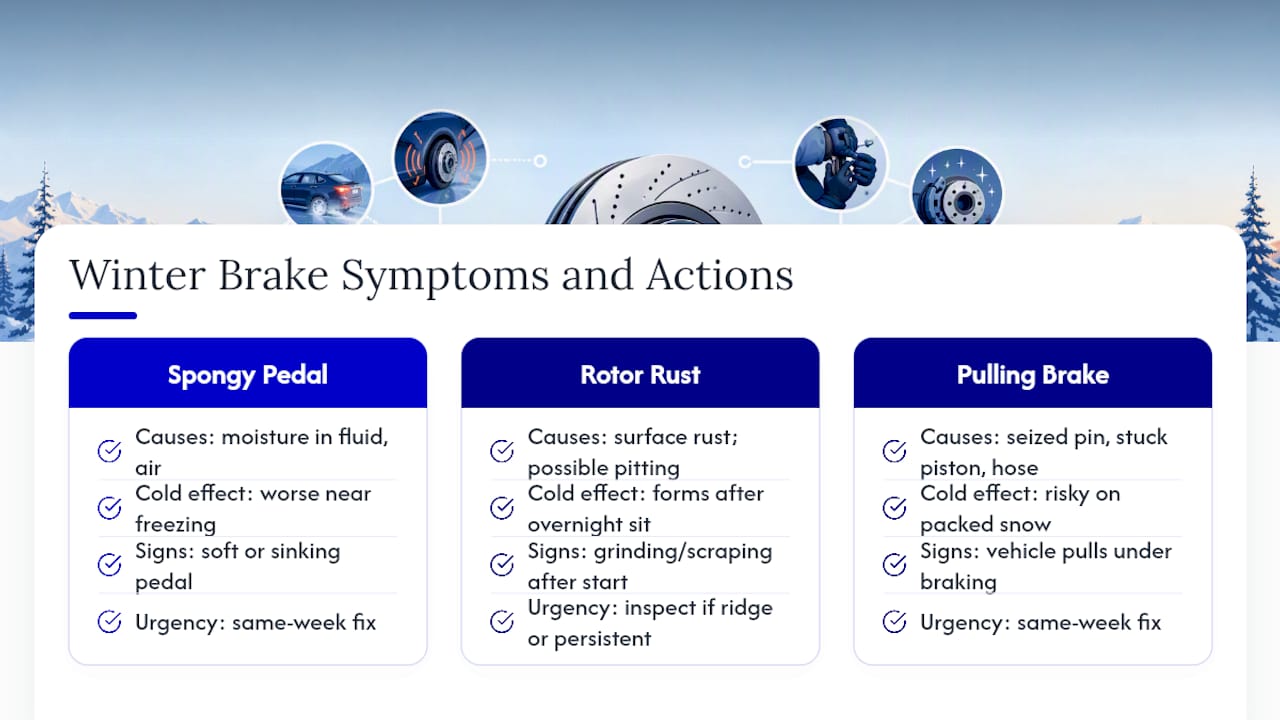
A spongy or sinking pedal almost always traces back to moisture in the brake fluid or air trapped in the lines. Cold temperatures make this worse because moisture-laden fluid behaves less predictably as it approaches freezing, softening the firm pedal feel you rely on for quick stops.
Rotor rust appears as a light surface haze after a car sits overnight, and that’s normal. It’s a problem when you hear a grinding or scraping noise for more than a few hundred meters into your drive, or when you see a visible ridge of rust building up at the rotor’s edge that pads haven’t been wiping clean. Persistent rust ridges usually mean the rotor surface is pitted underneath.
A pull to one side under braking almost always means uneven caliper function, not tire issues, unless you’ve also got mismatched tire pressure. A seized slide pin, a sticking caliper piston, or a collapsed brake hose restricting fluid flow to just one wheel are the usual suspects. This is a bigger deal in winter because a pull during an emergency stop on packed snow can send the vehicle into a slide that a straight stop wouldn’t have caused. If you notice a pull or a persistent pedal issue, treat it as a same-week fix, not a spring project. For pedal-specific diagnostics, this cold-weather pedal travel checklist walks through the most common causes step by step.
How Do Ice, Snow, and Salt Change Stopping Distance?
Friction between tire and road drops sharply on ice and packed snow, and no brake upgrade changes that physics. What upgraded brakes control is the variable you actually have influence over: how consistently the system responds once the tire has whatever grip it has.
Salt-slush mixtures create a secondary problem beyond the obvious slip risk. Salt brine accelerates rotor corrosion faster than plain snow does, and Canada’s cold-season hazard guidance specifically calls out freeze-thaw exposure as a driver of vehicle system wear, brake components included. A rotor that develops surface pitting from salt exposure won’t grip a fresh pad evenly, which shows up as pulsation or reduced initial bite exactly when road conditions already demand more from the system.
Wet, cold pavement also changes how quickly a pad “wakes up.” A pad glazed by rust particles or contaminated by road grime takes a fraction of a second longer to reach full friction, and at highway speed that fraction adds real distance to a stop. This is why corrosion-resistant rotor finishes aren’t just a cosmetic upgrade. They protect the one surface that determines how fast your pad material can do its job once you press the pedal. Combine that with reduced tire grip on packed snow, and every inefficiency in the brake system gets amplified rather than absorbed.
Why Does Brake Fluid Need to Be Cold-Weather Rated?
Brake fluid is hygroscopic, meaning it absorbs moisture from the air over time even in a sealed system. That absorbed water changes two things that matter directly in winter: pedal feel and the fluid’s resistance to problems at temperature extremes.
As fluid accumulates moisture, it affects pedal feel and reduces the fluid’s protective properties against freezing-related issues, which is exactly the spongy-pedal complaint many drivers notice more in January than in July. The fix isn’t a specialty winter fluid marketed with cold-weather branding. It’s routine fluid replacement on the interval your manufacturer specifies, using the DOT-rated fluid your vehicle calls for, since moisture content, not the base fluid type, is what drives most cold-weather fluid problems.
If you haven’t flushed your brake fluid in two to three years, that’s a more urgent pre-winter task than swapping pads. Old, moisture-saturated fluid undermines even the best pad and rotor upgrade, because the pedal feel it produces stays inconsistent no matter what’s clamping down at the wheel.
Does Cold Weather Affect ABS and Electronic Brake Systems?
ABS sensors and modules are built to operate across a wide temperature range, but extreme cold introduces failure points that don’t show up in warmer months. Wheel speed sensors can develop condensation or ice buildup around the sensor ring, which sometimes triggers a false ABS warning light even when the physical brake components are fine.
Electronic brake distribution systems rely on consistent input from all four corners to modulate pressure correctly. A caliper that’s dragging slightly from a stiff slide pin, or a rotor with uneven surface wear, feeds inconsistent data into that system, and on a vehicle with ADAS features layered on top of ABS, that inconsistency can affect more than just braking. If an ABS light comes on after cold starts specifically, don’t dismiss it as a winter quirk. Have the sensor and wiring connections checked before assuming it’s purely a temperature glitch, since a genuine mechanical issue behind that inconsistent data won’t resolve itself once spring arrives.
How Do Winter Tires Work With Your Braking System?
Winter tires and brake performance aren’t separate systems. They’re two halves of the same stopping equation, and upgrading one without addressing the other leaves real performance on the table.
Winter tire compounds stay pliable in cold temperatures, which is what actually generates grip on cold pavement and light snow. All-season tires stiffen below roughly 7°C, and once that happens, no brake upgrade can compensate for the lost contact patch. This is the piece drivers most often get backward: they’ll invest in premium pads while running summer-worn all-seasons through a Canadian winter, and wonder why stopping distance hasn’t improved.
The synergy works both ways. Better tire grip means your brake system can actually use its full stopping potential instead of triggering ABS intervention on nearly every hard stop. And a brake system with even, corrosion-free rotors and freely moving calipers delivers consistent pressure to all four contact patches, which matters more once winter tires are giving you real grip to work with. Neither upgrade replaces the other. Pair climate-adaptive brake components with a proper winter tire set, and you get compounding safety benefits instead of just isolated gains at either end of the system.
An Editorial Take on Winter Brake Priorities
The instinct to buy new pads before winter is understandable, but it’s often the wrong first move. Mechanical faults, seized pins, cracked boots, saturated fluid, quietly erase whatever benefit a new pad compound might offer. Fix those first.
After that, resist the pull toward aggressive performance pads marketed for grip. They need to heat, but your commute may never generate. Climate-focused pad and rotor combinations built for consistent cold-start response serve most winter drivers better. Build a habit of checking slide pins, rotor surfaces, and fluid condition every fall, and call a shop the moment you notice a pull, a spongy pedal, or a rust ridge that won’t clean up on its own.
— AAA
Where to Find Winter-Ready Pads and Rotors
Once your mechanical inspection is done and you’ve decided a pad and rotor upgrade makes sense, the next question is fitment, not just friction rating. One approach to winter brake upgrades is matching pad chemistry to rotor surface to ensure two separately purchased parts behave well together.

The Type 07 HydroAdaptive+ pads are paired with SC Type semi-coated rotors specifically to stabilize cold-start bite and resist the salt-driven corrosion covered earlier in this guide. If your vehicle sees frequent short cold starts or heavy road salt exposure, that pairing addresses both failure points at once instead of solving one and leaving the other unresolved. For drivers who want a different friction profile, the Type 03 pads remain available as an alternative line, and GC Type GEOMET-coated rotors offer another corrosion-resistant option depending on your vehicle.
Check your vehicle’s fitment on the product pages before ordering, since pads and rotors work best as a matched set rather than mixed with older, worn components. From there, order directly through the Aaafrictions site or bring the part numbers to a local installer to get your winter brake upgrade done before the first hard freeze.
Sources
- Cold-season weather hazards — Government of Canada
- Type 07 Brake Pads + ClimateFlex™ Calipers Kit – AAA Frictions
FAQ
Are Brake Upgrades Worth It Before Winter?
Mechanical repairs, fixing seized slide pins, cracked boots, or old fluid, deliver the biggest safety return, and climate-adaptive pad and rotor upgrades are worth it if your vehicle sees frequent cold starts or heavy road salt exposure. A pad swap alone rarely fixes a problem rooted in worn hardware.
What Is the 30/30/30 Rule for Brakes?
Definitions of this rule vary across sources and shops, so treat it as informal guidance rather than a manufacturer standard, and rely on your vehicle’s actual pad thickness and rotor inspection results instead of a general rule of thumb.
Is PowerStop or Brembo Better for Winter Driving?
Brand comparisons matter less in winter than pad chemistry: aggressive performance-oriented pads from any brand often need several hundred degrees of heat to reach full bite, which many short winter commutes never generate. A climate-focused pad formulation designed for consistent cold bite, like Aaafrictions Type 07 HydroAdaptive+ pads, tends to serve daily winter driving better than a track-oriented compound regardless of brand.
At What Temperature Will Brake Fluid Freeze?
Fresh, properly rated DOT brake fluid has a very low freezing point and isn’t the typical winter failure risk. The real concern is moisture absorbed into old fluid over time, which degrades pedal feel and the fluid’s protective properties well before outright freezing becomes an issue, making regular fluid flushes more important than cold-rated marketing claims.
How Often Should I Inspect My Brakes for Winter?
Check pad thickness, rotor condition, caliper boots, and fluid clarity every fall before temperatures drop consistently below freezing, and again mid-winter if you drive through heavy salt or slush regularly.