

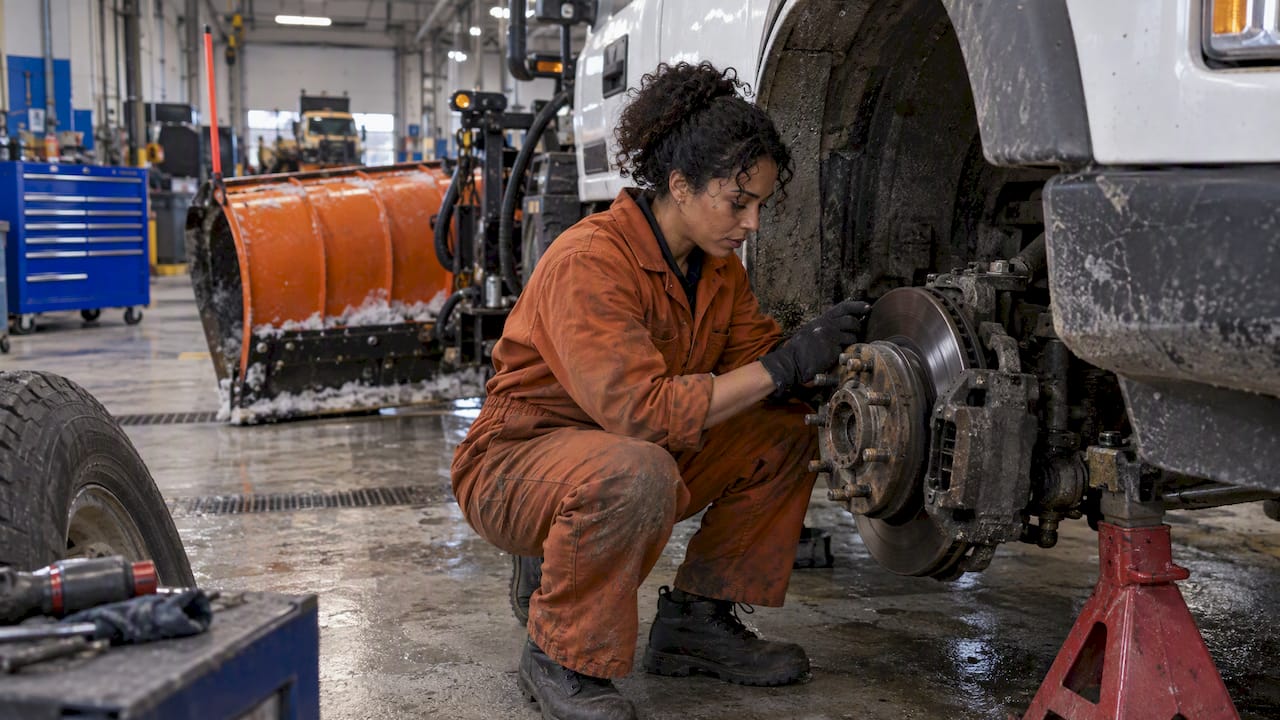
A plow truck asks more of its brakes than almost any other vehicle on the road. It carries extra weight on the front axle, works in slush and salt brine, and stops and starts constantly in cold air. The best way to keep snow plow truck brakes dependable is a matched set of pads and rotors, calipers that keep moving in the cold, and a short inspection routine before and during the season. This guide covers what winter does to each part, what to check, how to drive the brakes you have, and where our range fits.
TL;DR
- Winter attacks plow-truck brakes through moisture, road salt, temperature swings and added front-end load. Pads, rotors and calipers each face a different problem.
- Corrosion, sticking calipers and glazed or wet pads are the usual causes of pulling, grabbing and uneven wear. Catch them before the first storm.
- Stopping distances on ice can be many times longer than on dry pavement, so space and smooth inputs matter as much as hardware.
- A matched pad and rotor set, such as our HydroAdaptive pads with GEOMET-coated rotors, is designed for steady braking through wet and freezing conditions.
- Inspect before winter and again mid-season. Anything leaking, grinding or pulling needs a qualified technician before the truck goes back to work.
Table of Contents
- What winter does to a plow truck’s brakes
- Which brake parts matter most on a plow truck
- A winter brake inspection routine for plow trucks
- Brake warning signs: what they mean and what to do
- Braking technique when you are plowing
- Protecting brake hardware from salt
- Our perspective: a matched system beats mixed parts
- Choosing brake parts for your plow truck
- Ready to replace your pads and rotors?
- FAQ
- Sources
What winter does to a plow truck’s brakes
Four things work against the brakes at once: water, cold, salt and load.
Water and slush. Wet pads and rotors do not grip the way dry ones do, and a thin film of water between them can delay the first bite of the pedal. Slush thrown up by the wheels keeps surfaces damp through a whole shift.
Cold. Rubber seals stiffen, grease thickens and metal parts contract. Moving parts such as caliper slides and slack adjusters respond more slowly, which can show up as uneven pad wear or a pedal that feels different from the one you had in September.
Road salt. Salt brine speeds up rust on rotor faces, hats, caliper hardware and brake lines. Corrosion is a known maintenance cost for winter road fleets, and research on plow fleets notes that specifying corrosion-resistant materials and protective coatings is one of the ways to fight it, starting when equipment is chosen.
Load. A plow and mount sit ahead of the front axle. That adds weight the front brakes must stop, and angling the blade or pushing a windrow shifts how the truck behaves under braking.
Why stopping distance grows on snow and ice
The brakes are only half of the stopping equation. The other half is traction. Early braking tests on bare pavement, snow and ice found that stopping distances on glare ice were about ten times those on dry concrete for passenger cars and straight trucks, and about six times for the heavy tractor-trailer that was tested. Those tests are old and the tyres and ABS systems have changed, but the principle holds: ice multiplies your distance.
That is why we always say tyres come first and brakes second. Our guide on tyres first, performance brakes second for snow explains how to think about that order. Good brakes make sure you use all the traction the tyres have, and no more is available from any pad.

Which brake parts matter most on a plow truck
A plow truck’s brake system works as an ecosystem. When one part falls behind, the others carry the load and wear faster. Here is how we rank the parts by winter risk.
Brake pads
Pads are the part that meets moisture first. Pads that absorb or hold water, or that glaze after repeated light dragging, give you a pedal that feels inconsistent. Our HydroAdaptive ceramic pads are designed to manage moisture and keep friction stable in rain, humidity, snow and cold. For heavy pickups and SUVs we offer Type 03 brake pads and Type 07 brake pads, with fitments listed by vehicle.
Rotors
Rotors take the salt. Surface rust forms overnight on bare cast iron, and a pitted friction face wears pads unevenly and can cause vibration. Our SC Type rotors and GC Type rotors are built around GEOMET-coated surfaces designed to protect against corrosion from moisture and road salt.
Calipers and hardware
A caliper that does not release fully drags the pad, overheats the rotor and wears the pad on one side. Cold and corrosion are the usual causes. Our ClimateFlex calipers are designed for smooth operation through winter cold and summer heat, and fresh slide pins and lubricant are worth fitting any time you service the pads.
Brake lines, fluid and, on air-brake trucks, the air system
Moisture in the system is a winter problem for hydraulic and air brakes alike. On air-brake trucks, fleet guidance for Canadian winters is to use an air dryer sized for the job and confirm it works before winter so moisture stays out of the lines and valves. Hydraulic systems depend on clean fluid and sound lines.
A winter brake inspection routine for plow trucks
Do this before the first snowfall, then repeat a shortened version every few weeks. Our article on five winter brake checks goes deeper on the basics.
- Measure pad thickness on both sides of every caliper. A big difference between the inner and outer pad, or between left and right, points to a sticking slide or caliper.
- Look at the rotor faces. Check for deep scoring, pitting, a raised rust lip at the edge and blue heat marks. Uneven wear patterns call for replacement, not just a cleanup.
- Move the caliper slide pins by hand. They should slide freely. Clean and re-lubricate them with brake-rated lubricant.
- Inspect hoses, lines and fittings. Look for cracking, rubbing, weeping and heavy rust.
- Check fluid level and condition. A low reservoir is a leak until proven otherwise.
- Spin each wheel with the truck raised and check for drag.
- Test the parking brake. It should hold on a grade and release completely.
We covered the pad side of this in more detail in a five-minute pin check that cuts winter pad wear.
Daily checks that regulators already expect
Commercial operators in Canada work under provincial inspection rules. Ontario’s truck handbook, for example, describes tests for air-brake trucks such as air build-up rate and air-loss rate with the pedal fully applied. It also classes noticeable hydraulic leaks, or a reservoir under a quarter full, as major defects that need immediate attention. Other provinces set their own standards, so check your provincial transport ministry for the rules that cover your truck’s weight class and use.
If you plow with a light-duty pickup for personal or small-business use, those commercial tests may not apply to you, but they make a useful template for a quick walk-around before every shift.
Brake warning signs: what they mean and what to do
Winter hides small problems until they get loud. These are the signs we would not drive past.
| Sign | Common causes | What to do |
|---|---|---|
| Truck pulls to one side under braking | Sticking caliper or slide pins, uneven pad wear, contaminated pad, a tyre pressure or tread difference | Inspect calipers and tyres before the next shift |
| Grinding or metal-on-metal noise | Pads worn to the backing plate, debris, rust lip on the rotor | Stop driving it hard and have it inspected now |
| Grabbing or lock-up on first application | Surface rust or moisture film on cold rotors, glazed pads, ABS not engaging correctly | Check rotors and pads; have ABS faults diagnosed if a light is on |
| Soft or sinking pedal | Air in the lines, fluid leak, failing master cylinder | Do not drive. Have a technician inspect the hydraulic system |
| Vibration through the pedal or wheel | Warped or unevenly worn rotors, seized slide, loose hardware | Measure rotor thickness and runout; replace as a set if needed |
| Brake or ABS warning light | Low fluid, sensor fault, system fault | Have it diagnosed; a low fluid level calls for a leak check |
A mechanic will read these signs in combination. Grabbing plus pulling, for example, often points to a caliper that is not releasing. Squealing plus uneven pad wear tells you to look at the slides. If the pedal ever feels soft or goes to the floor, treat it as a stop-and-tow situation, not something to nurse back to the yard.
Braking technique when you are plowing
Hardware helps, but technique is what keeps a loaded truck out of the ditch. Ontario’s winter driving guidance is clear: steer gently, because hard braking, quick acceleration and sudden gear changes can cause a skid. If you do skid, it says to release the brakes and steer in the direction you want to go. It also advises leaving extra distance, since slippery roads take longer to stop on.
A few habits that fit plow work:
- Brake early and lightly, then release. Progressive pressure uses the traction available instead of overwhelming it.
- Lift off before the turn. Do not brake hard mid-corner with the blade angled, as the plow load can tug the front end toward the windrow.
- Keep the blade raised in transit. Carrying it low adds drag and weight to the steering axle on the road.
- Dry the brakes when it is safe. After driving through deep slush, a light, brief application at low speed with open road behind you can help clear moisture from pads and rotors. Never do this in traffic or on a slippery surface.
- Watch hills. Cold air does little to take away brake heat on long grades. Trucking guidance notes that brake heat buildup remains a concern when descending in winter. Use a lower gear and engine braking instead of riding the pedal.
If you drive mountain routes, see our pieces on mountain winter braking in Canada and what to do when winter brake fade hits on a downhill.
Protecting brake hardware from salt
Salt does its damage slowly, then all at once in spring. A few habits stretch component life:
- Rinse the undercarriage, wheel wells and brake areas with fresh water after salty shifts, particularly when the truck will sit overnight.
- Dry the truck in a heated bay when you can, or drive it a short distance to warm the rotors.
- Keep wheels clean. A protective finish on the wheel faces makes brake dust and brine easier to wash off. For wheel care, this guide to protecting alloy wheels with ceramic coatings covers the principle.
- Replace hardware clips and slide pins with each pad change. They are inexpensive and they are the first things to seize.
- Choose rotors with a corrosion-resistant coating from the start.
Our perspective: a matched system beats mixed parts
We build brakes around a simple idea: weather is a design input, not an afterthought. A plow truck meets every kind of weather in a single shift, so it is the clearest test of that idea.
Our rotors and pads are developed as a matched system. The HydroAdaptive ceramic pads are designed to manage moisture and hold a stable friction profile. The GEOMET-coated rotors are designed to resist corrosion from moisture and road salt. That is why we only sell rotors with compatible pads: the rotor surface and the pad compound are intended to work together, and mixing them undercuts the result we engineer for.
The third part is the caliper. ClimateFlex calipers are designed to keep moving smoothly through winter cold and summer heat, so the pad releases cleanly after each stop. When all three parts are doing their job, you get consistent pedal feel and predictable braking when conditions change quickly, which is what a plow operator needs at five in the morning.
We would rather you spend your time on technique and a good inspection routine than wondering how the pedal will feel on a cold start.
AAA
Choosing brake parts for your plow truck
Start with your exact vehicle, because pad shape, rotor size and hardware differ by model and year. Then weigh these points.
- Weight class and duty cycle. Heavier trucks and long shifts generate more heat and wear. Rideshare, delivery and high-mileage drivers face a similar pattern of constant stop-and-go.
- Salt exposure. If your truck lives in salted conditions most of the winter, corrosion protection on the rotor is a priority, and so is refreshing slide hardware.
- Pad and rotor pairing. Replace both together with parts designed to work as a set. New pads on worn, pitted rotors wear unevenly.
- Caliper condition. If a caliper is sticking or leaking, service or replace it at the same time so you do not wear new pads unevenly.
For heavy-duty pickups and large SUVs commonly used for plowing, our fitments include the Chevrolet Silverado 2500 HD 2001-2010 front Type 07 pads. For tractor units, we list Type 07 pads for the Freightliner Cascadia 2008-2024, available as front pads or as a front and rear set. Always confirm fitment for your exact model on the product page.
Ready to replace your pads and rotors?
If your inspection shows worn pads or salt-pitted rotors, we can help you rebuild the front end around parts designed for Canadian winters. Our front brake kits pair HydroAdaptive pads with semi-coated rotors for popular heavy-duty SUVs, such as the Chevrolet Suburban 2500 kit for 2000-2013 and the GMC Yukon XL 2500 kit for 2000-2013.

Browse the full range at AAA Frictions and select your vehicle to see matched pads and rotors. Anytime. Any weather. Anywhere.
FAQ
Do plow trucks need special brakes?
The brake system is usually the one the truck was built with, but plowing raises the demands on it. The blade adds front-axle load, and stop-and-go work in salt and slush speeds up wear and corrosion. Pads, rotors and calipers that are designed for moisture, salt and cold are a sensible fit, and you should always match parts to your exact vehicle.
Why do my brakes grab or lock up in the snow?
Grabbing usually starts with moisture or a thin layer of rust on cold rotors, a glazed pad, or a caliper that is not releasing. It can also be a traction issue, where the tyre simply lets go on ice. Check the pads, rotors and caliper slides, and have any ABS warning light diagnosed by a technician.
How often should I inspect the brakes on a plow truck?
Do a full inspection before winter and a shorter check every few weeks while the truck is working. Commercial operators should also follow their province’s daily inspection requirements. Check your provincial transport ministry for the rules that apply to your truck.
Should I replace pads and rotors together?
In most cases, yes. New pads on pitted or unevenly worn rotors wear unevenly and can cause vibration. Our rotors are only sold with compatible pads because the two are developed to work as a pair.
How do I stop safely on an icy road while plowing?
Brake early and gently, keep the wheels straight when you can, and leave extra following distance. If the truck starts to skid, release the brakes and steer where you want to go. Official winter driving guidance in Ontario gives the same advice.
Sources
- Braking and Traction Tests on Ice, Snow, and on Bare Pavement (Highway Research Board)
- Corrosion report, Western Transportation Institute
- Prepping Your Brakes for Another Canadian Winter, Truck News
- Daily inspection test, Ontario MTO Truck Handbook
- Winter driving, Ontario.ca
- How to protect alloy wheels with ceramic coatings