

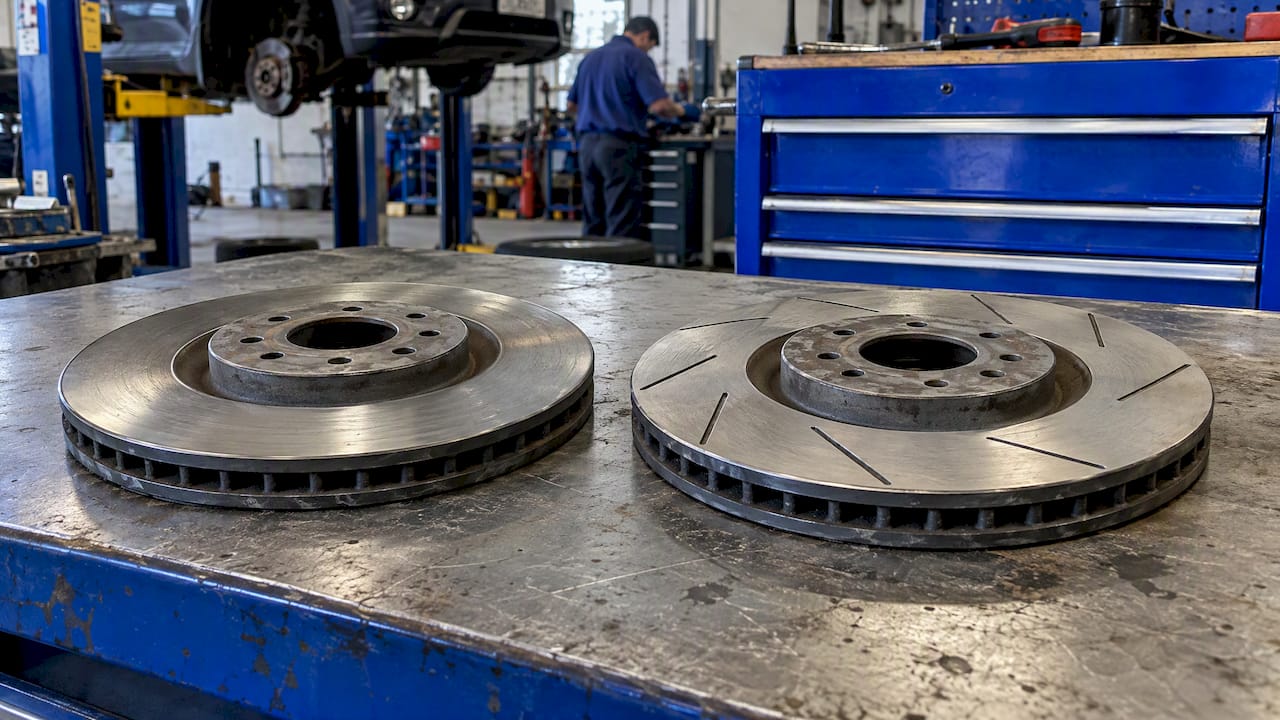
For most daily drivers, plain or blank rotors are the easiest, quietest and longest-lasting choice. Slotted rotors earn their keep when your braking duty includes frequent high-heat stops, such as towing or spirited driving, where sustaining friction under repeated hard braking matters more than a smooth, quiet ride. A single cold stop depends far more on tires, pads and your ABS calibration than on rotor face design, and the evidence below explains why.
TL;DR:
- One 2022 simulation found a slotted design’s heat transfer coefficient was 87.2% higher and peak temperature 39.56% lower than its vented comparison, but geometry matters.
- Repeated hard stops during towing, steep descents, or track use can justify engineered slots, but the pattern must match the vehicle and pad compound.
- Slot edges generally accelerate pad wear, while poorly matched slot profiles can add noise; for commuting, pair standard ceramic pads with coated blank rotors.
- Check rotor thickness against the manufacturer’s minimum, measure runout, and reject rotors with cracks reaching cooling vents or deep grooves, even if they look sound.
Table of Contents
- 1. Pros and cons of blank versus slotted rotors
- 2. How slotting changes heat transfer and fade resistance
- 3. Wear, cracking, noise and lifecycle costs
- 4. Matching rotor style to how you actually drive
- 5. Fitment rules, thickness checks and inspection notes
- 6. How AAA Frictions’ HydroAdaptive systems interact with rotor choice
- 7. Editorial rules of thumb for making the call
- 8. Matched brake kits built around your actual driving
- FAQ
- Sources
1. Pros and cons of blank versus slotted rotors
Blank rotors keep things simple. A flat, uninterrupted braking surface means fewer stress risers, generally quieter operation and a more even pad contact pattern over the rotor’s life. Many coated blank designs also offer straightforward corrosion protection, which matters for vehicles that sit outside through wet seasons or spend long stretches parked between drives.
Slotted rotors cut shallow channels across the braking surface to vent gases and shed debris from between the pad and rotor. That venting can help reduce glazing, a film that forms on the pad surface during repeated hard stops and reduces friction. For certain geometries, slots also lower peak surface temperature compared with a plain vented rotor of similar design, according to comparative heat dissipation research.
That benefit comes with trade-offs that are easy to overlook when a slotted rotor is chosen mainly for its appearance.
- Slot edges can act like tiny machining tools, which tends to increase pad wear compared with a smooth face.
- Poorly matched slot count, profile or direction can create noise rather than reduce it.
- An optimised slot pattern improves fade resistance, but a generic one may not, according to SAE slot-optimization research.
- Slotted designs rarely change anything about a single, cold stop from normal speed, where tire grip and pad bite do the work.
Choosing rotors by looks alone, rather than by duty cycle, is one of the more common ways drivers end up with higher noise, faster pad wear and no real performance gain. A coated blank rotor often delivers the better outcome for routine driving, while a slotted design pays off only when the use case calls for it.
2. How slotting changes heat transfer and fade resistance
Brake fade happens when repeated hard stops push temperatures high enough that the pad’s friction material loses grip. Rotor design affects how quickly heat builds and how fast it leaves the system, and the research on slotting is more specific than the marketing around it usually suggests.
A 2022 SAE simulation study found that a slotted disc design produced an 87.2% higher heat-transfer coefficient and a 39.56% lower maximum temperature than a vented design tested under the same conditions, according to the comparative numerical study on brake disc heat dissipation. That is a meaningful thermal advantage, but it describes one slotted geometry against one vented geometry, not slotted rotors in general.

Separate SAE work on slot optimization reinforces that the benefit depends on getting the details right. Testing summarized in the 2018 slot-optimization paper showed that slotting can improve a friction material’s fade properties, but a suboptimal slot count, profile or direction can raise noise and wear instead of helping. A partner analysis on rotor heat dissipation makes a similar point: keeping rotor temperatures controlled matters more for preventing warping and fade than the surface pattern alone.
Before assuming slots will help your specific vehicle, a few variables are worth checking:
- Whether the rotor’s internal vane design already handles your typical heat load without slots.
- Rotor mass and thickness, since a heavier rotor absorbs more heat before temperature spikes.
- Pad compound, because some ceramic and semi-metallic formulas respond differently to slotted surfaces.
- Your actual braking pattern: short city stops behave nothing like sustained mountain descents.
The practical takeaway is narrow but useful: slotted rotors make sense for sustained high-heat duty only when the slot geometry is engineered for your pad compound and vehicle, not as a generic upgrade.
3. Wear, cracking, noise and lifecycle costs
Slotted rotors tend to wear pads faster than blank ones, since every pass over a slot edge removes a small amount of friction material. On softer pad compounds, this can also contribute to metal pickup, where small particles transfer unevenly across the rotor face. Noise is the other common complaint, and it is almost always tied to the slot pattern rather than the rotor itself. Our guide to slotted rotor noise covers the common causes and how to tell normal operating sound from a sign of trouble.

Cracking is mostly associated with drilled rotors, where holes create concentrated stress points. A well-engineered slot profile is designed to avoid that kind of stress concentration, which is part of why the SAE optimization work treats slot count, direction and profile as a package rather than a single variable.
A few signs mean a rotor has reached the end of its service life regardless of surface style:
- Deep grooves or scoring that catch a fingernail across the braking surface.
- Visible pitting or flaking, especially after extended flash rust exposure.
- Measurable runout, where the rotor wobbles slightly as it spins.
- Any crack that extends toward the cooling vents, or thickness approaching the OEM minimum.
Pro Tip: Check pad-rotor compatibility before buying either part separately. A generic slotted rotor paired with a pad it was never tested against can wear faster and run noisier than a plain rotor matched correctly to the same pad.
4. Matching rotor style to how you actually drive
Daily commuting rarely generates the heat that makes slotting worthwhile. Blank or coated blank rotors fit this use case best because they stay quiet, resist corrosion from sitting overnight and wear predictably alongside standard ceramic pads.
Towing, steep descents and sustained highway braking change the equation. Repeated hard stops without much cooling time between them are exactly where glazing and fade become real risks, and a slotted or heavily ventilated rotor engineered for that duty can help maintain consistent pedal feel.
Track driving and spirited road use sit at the far end of the spectrum. Purpose-built ventilated and slotted rotors, matched to a pad formulated for sustained high temperatures, are standard in that setting, along with more frequent inspection and shorter replacement intervals.
A simple way to decide which way to go:
- Identify your primary use: commuting, towing, mountain driving or track.
- Check whether your stops are isolated or repeated in quick succession.
- Match the pad compound to the rotor surface style, not the other way around.
- If in doubt, default to a quality coated blank rotor and upgrade only if symptoms of fade appear.
5. Fitment rules, thickness checks and inspection notes
Replacement rotors have to meet OEM specifications for your vehicle, and that includes staying above the minimum thickness the manufacturer sets. Transport Canada’s Technical Standards Document No. 135, Revision 5 sets out the testing and performance requirements that brake systems are built against, and provincial inspection practices rely on similar measurement standards when evaluating a rotor’s condition.
Provincial inspection rules call for measuring rotor thickness directly and rejecting rotors with cracks that extend to the cooling vents or excessive grooving, regardless of whether the rotor is blank or slotted. A rotor that passes a visual check can still fail on thickness, so a caliper or micrometer measurement matters more than appearance.
Beyond thickness, a few checks protect both safety and warranty:
- Measure runout with a dial indicator before assuming a vibration is pad related.
- Confirm directional rotors are installed with correct vane lean, since reversed fitment reduces cooling airflow.
- Bed in new pads and rotors gradually rather than braking hard immediately after installation.
- Record thickness and runout measurements at each rotor inspection, especially for vehicles nearing OEM minimum specs.
6. How AAA Frictions’ HydroAdaptive systems interact with rotor choice
Rotor surface style is only half the equation. Pad chemistry determines how consistently a rotor performs, which is where our HydroAdaptive ceramic technology comes in. It is engineered to clear moisture rapidly from the pad-rotor interface, maintaining reliable friction in rain, snow or humidity rather than letting water interrupt contact the way it can with standard ceramic pads.
That moisture management works alongside the rotor surface, not against it. We offer SC Type Rotors with a semi-coated design suited to commuters who want corrosion resistance and predictable wear with HydroAdaptive pads. We offer GC Type Rotors built for higher-performance duty, pairing with Type 07 pads for drivers who face heavier braking loads or towing.
A few practical pairings worth knowing:
- Commuters and daily drivers: Type 03 Brake Pads with SC Type Rotors for quiet, corrosion-resistant performance.
- Heavier use, towing or hilly terrain: Type 07 Brake Pads with GC Type Rotors for sustained braking performance.
- Wet-climate drivers of any use case: HydroAdaptive pads paired with either rotor line for consistent pedal feel in rain or snow.
7. Editorial rules of thumb for making the call
Default to plain or coated blank rotors for daily use. They are quieter, cheaper to live with and wear predictably against most ceramic pads. Reach for slotted rotors only when your driving genuinely includes repeated high-heat events, and only when the slot pattern is matched to your pad compound rather than picked for looks.
Installation quality, pad chemistry and regular inspection do more for braking consistency than rotor face styling ever will. A well-fitted blank rotor with the right pad beats a mismatched slotted one in almost every daily scenario.
— AAA
8. Matched brake kits built around your actual driving
We build our pad and rotor kits around the way people actually drive rather than around rotor aesthetics. Our HydroAdaptive pads pair with SC Type Rotors for commuters who want quiet, corrosion-resistant stopping power through wet seasons, and with GC Type Rotors for drivers facing towing, hills or heavier daily loads.

- Check your vehicle’s fitment page before ordering to confirm the correct pad and rotor combination.
- Choose SC Type Rotors with Type 03 pads for routine commuting and highway driving.
- Choose GC Type Rotors with Type 07 pads if your braking duty includes sustained or repeated hard stops.
Browse our complete brake kit options to find the pairing that matches your primary use case.
FAQ
What are the disadvantages of slotted rotors?
Slotted rotors tend to wear pads faster than blank rotors because the slot edges remove friction material with every rotation. They can also produce more noise if the slot count, profile or direction isn’t optimised for the pad compound, according to SAE slot-optimization findings.
Are slotted rotors good for daily driving?
Slotted rotors aren’t necessary for most daily driving, since routine commuting rarely generates the sustained heat they’re designed to manage. Blank or coated blank rotors usually offer quieter operation and lower maintenance costs for typical commuting and highway use.
Do slotted rotors cool better?
Some slotted geometries do show measurable cooling advantages in testing. One SAE simulation found a slotted design achieved a notably higher heat-transfer coefficient and a significantly lower peak temperature (https://saemobilus.sae.org/papers/comparative-numerical-study-heat-dissipation-behaviour-conventional-disc-brake-designs-high-performance-requirements-2022-28-0422) than a vented design tested under the same conditions, though results are specific to the geometries modelled.
Do slotted rotors stop faster?
Slotted rotors don’t meaningfully shorten stopping distance on a single, cold stop, since that distance depends mainly on tires, pads and ABS calibration. Their real benefit shows up during repeated high-heat stops, where they can help sustain friction and resist glazing better than some blank designs.
Sources
- Comparative numerical study on heat dissipation behaviour of conventional disc brake designs for high-performance requirements (2022-28-0422)
- Technical Standards Document No. 135, Revision 5 (Transport Canada)