

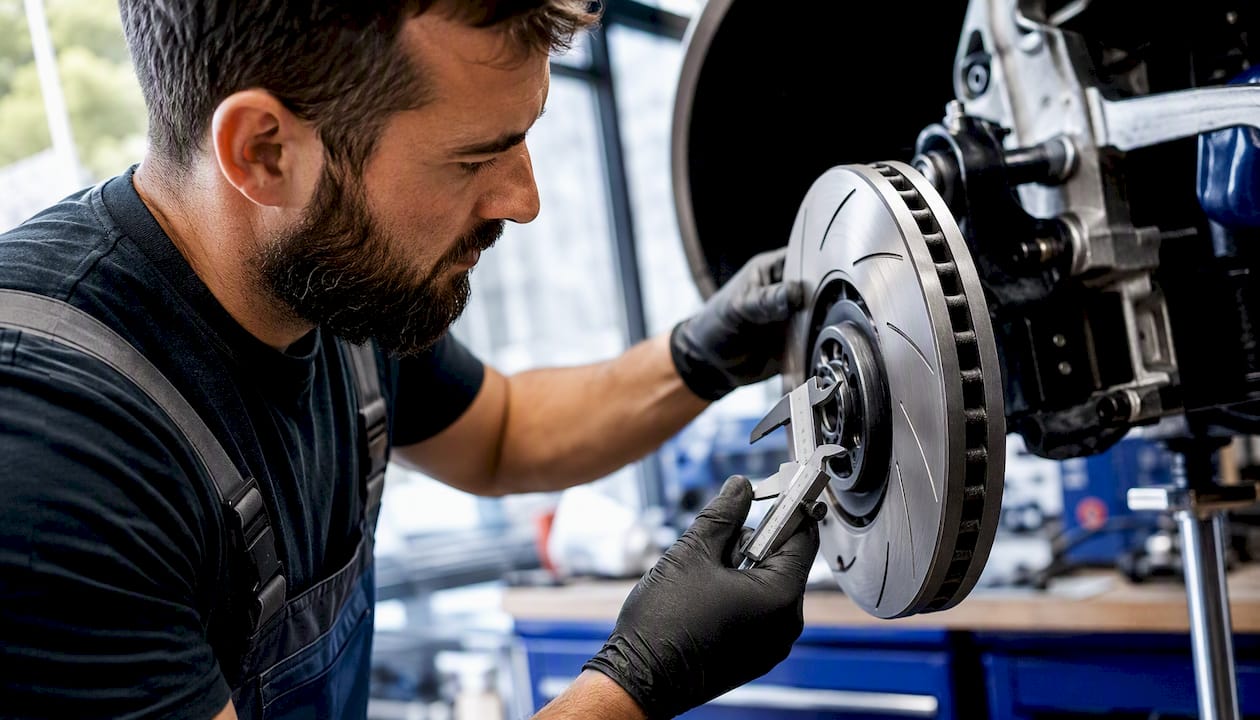
Some noise from slotted rotors is normal. A light ticking or whirring sound, particularly at highway speeds or during gentle braking, is a direct result of how slots are engineered to work. That said, not every noise deserves a shrug. Knowing the difference between an expected acoustic signature and a warning sign is what keeps your braking system safe and your repair bill reasonable.
Normal slotted rotors noise includes:
- A faint ticking or rhythmic whirring at speed or during light brake application
- A brief scraping sound on the first stop of the day, especially after overnight moisture or light surface rust
- Slightly more cabin sound than blank rotors, particularly with semi-metallic pads
Noise that signals a problem:
- Persistent metal-on-metal grinding that does not clear after a few stops
- Pulsing or vibration through the brake pedal combined with noise
- A new, worsening click or scrape that changes with brake pressure
Your immediate next step: before booking a shop visit, do a quick visual check of your pads and rotor surface. If pads are thin, the rotor face is deeply scored, or you see uneven rust patterns, that narrows the diagnosis fast and saves you from guessing.
Key Takeaways
Slotted rotors produce some noise by design, but the cause, severity, and fix depend on pad compound, rotor condition, and installation quality.
| Point | Details |
|---|---|
| Normal vs. abnormal noise | Light ticking or whirring is expected; grinding, pulsing, or worsening noise requires inspection. |
| First diagnostic step | Check pad thickness and rotor face visually before replacing any parts. |
| Resurfacing vs. replacement | Never resurface a rotor below its stamped minimum thickness or showing heat cracks. |
| Pad pairing matters | Ceramic pads produce lower NVH on slotted rotors than semi-metallic compounds in daily driving. |
| Aaafrictions recommendation | Type 07 HydroAdaptive ceramic pads with GC rotors are matched for quieter, weather-adaptive performance across Canadian conditions. |
Table of Contents
- Why slotted rotors sound louder than blank rotors
- How to tell whether the noise is from the rotor, the pads, or other hardware
- Practical fixes, timing, and rough Canada-relevant cost guidance
- Replace or resurface slotted rotors: inspection signs and safety limits
- What Aaafrictions engineers know about slot design and HydroAdaptive technology
- Are slotted rotors a poor choice for daily driving?
- Our perspective on slotted rotor noise
- Quieter, weather-adaptive braking from Aaafrictions
- Sources
Why slotted rotors sound louder than blank rotors
The noise difference between slotted and blank rotors is not a defect. It is physics. According to engineering analysis of slotted rotor design, slots allow compressed gases and air to escape from the pad-rotor interface, and the pad edge scrapes slightly each time it crosses a slot. That scraping produces the characteristic ticking you hear under braking. Slot geometry matters here: shallow, swept slots with a radiused edge generate less aggressive scraping than deep, sharp-edged slots, which is why rotor quality varies so noticeably between budget and engineered options.
Beyond slot geometry, brake NVH research confirms that rotor material, mass, surface finish, and cooling fin design all affect how well a rotor absorbs vibration. A rotor with higher carbon content and a refined microstructure damps vibration internally. Lower-damping aftermarket rotors can exhibit higher noise levels even when their geometry is identical to OEM spec. This is why two visually similar slotted rotors can sound completely different on the same vehicle.
Several practical factors also raise noise levels in real-world driving:
- Pad transfer and glazing: When brake pads overheat or are not properly bedded in, they deposit an uneven layer of friction material on the rotor face. That uneven transfer film creates a rough surface the pad drags across, amplifying noise at every slot crossing.
- Pad compound: Semi-metallic pads are harder and more aggressive against rotor surfaces than ceramic compounds. Paired with slotted rotors, they produce more audible friction signatures, particularly in cold Canadian mornings when the metal is stiff.
- Runout and hot spots: Rotor runout (lateral wobble) and disc thickness variation (DTV) create cyclical contact pressure changes that the pad reads as vibration and noise. Even small runout values, measured in thousandths of an inch, can produce a noticeable pulsing hum.
- Road debris and rust: A small stone lodged between the pad and rotor, or a patch of surface rust after a rainy night, can produce a scraping sound that mimics a worn-pad warning. In many cases, a few firm stops clear it entirely.
- Loose hardware: Worn anti-rattle clips, missing shims, or a loose caliper bracket allow the pad to vibrate freely. That vibration couples with the rotor’s own resonance frequency and amplifies the audible output significantly.
Pro Tip: If your slotted rotor noise appeared suddenly after wet weather, drive normally for 3–5 stops before diagnosing anything. Surface rust on a rotor face clears quickly, and the sound usually disappears with it.
| Noise cause | Likely sound | Fixable without shop? |
|---|---|---|
| Gas/air escape at slots | Light ticking under braking | Yes — normal operation |
| Pad glazing or transfer film | Scraping or squealing | Often — bed-in or pad swap |
| Surface rust after moisture | Brief scraping on first stops | Yes — clears with driving |
| Debris lodged in brakes | Persistent scraping | Often — visual inspection |
| Loose hardware or worn shims | Rattling or vibrating hum | Sometimes — hardware replacement |
| Rotor runout or DTV | Pulsing hum or vibration | Shop required |
How to tell whether the noise is from the rotor, the pads, or other hardware
Scraping and grinding noises during braking can come from worn pads, rotor surface damage, debris, or caliper and hardware problems. Most of these are identifiable with a systematic check before you spend money on parts. Work through this sequence:
-
Visual pad inspection through the wheel spokes. Look at the pad thickness visible through the caliper. If the friction material is less than 3 mm thick, worn pads are almost certainly contributing to the noise. Thin pads also risk metal-to-metal contact, which produces a harsh grinding rather than a ticking.
-
Rotor face inspection. Look at the rotor surface for deep grooves, a pronounced lip at the outer edge, heat discoloration (blue or purple patches), or visible cracks. Light surface rust is normal after overnight moisture. Deep scoring or a thick rust lip suggests the rotor face is compromised.
-
Wheel spin check (vehicle safely on level ground, engine off). Spin the wheel by hand and listen for a consistent rubbing or dragging sound. A steady drag that does not clear suggests a caliper not fully releasing or a pad sitting too close to the rotor.
-
Brake-free spin test. If you can safely lift the vehicle on jack stands, spin the wheel with the brake not applied. Any persistent scraping or grinding at this point points to a bearing, caliper, or debris issue rather than the rotor slots themselves.
-
Listening test: engine off vs. driving. Some noises only appear under braking load. A noise that occurs only when you press the pedal and disappears when you release it is almost always pad or rotor contact. A noise that continues regardless of pedal input is more likely a bearing or loose hardware.
-
Caliper pin movement check. With the wheel off, push the caliper pins by hand (wearing gloves). They should slide smoothly. Stiff or seized pins cause uneven pad contact and sustained noise even on a rotor in good condition.
Interpreting what you find: pad transfer shows as a shiny, uneven coating on the rotor face. Rotor edge noise is usually a consistent tick tied to wheel rotation speed. Wheel bearing noise tends to change with steering input, not brake pressure. Caliper pin issues produce a dragging sensation alongside the noise.
Safety note: never work under a vehicle supported only by a floor jack. Use rated jack stands on solid frame points. If you are not comfortable with any of these steps, a licensed mechanic can complete a full brake inspection in under an hour at most Canadian shops.
Practical fixes, timing, and rough Canada-relevant cost guidance
Start with the lowest-cost interventions and work up only if the noise persists.
Driver-level actions (no shop required):
- Bed-in procedure: If you recently installed new pads or rotors, a proper break-in sequence is the single most effective fix for early-life noise. The standard procedure involves a series of moderate stops from 50–60 km/h, allowing the rotor to cool between each, to deposit an even transfer film. Skipping this step is one of the most common reasons new brake setups squeak or tick excessively.
- Debris clearing: Drive normally and apply firm, progressive braking several times. Most lodged debris clears within a few stops.
- Hardware lubrication: Apply a thin layer of brake-specific lubricant (such as Permatex Ceramic Extreme or equivalent) to caliper pin bores and the back of the pad shims. Never apply lubricant to the rotor face or pad friction surface.
Shop-level fixes and typical Canadian cost ranges:
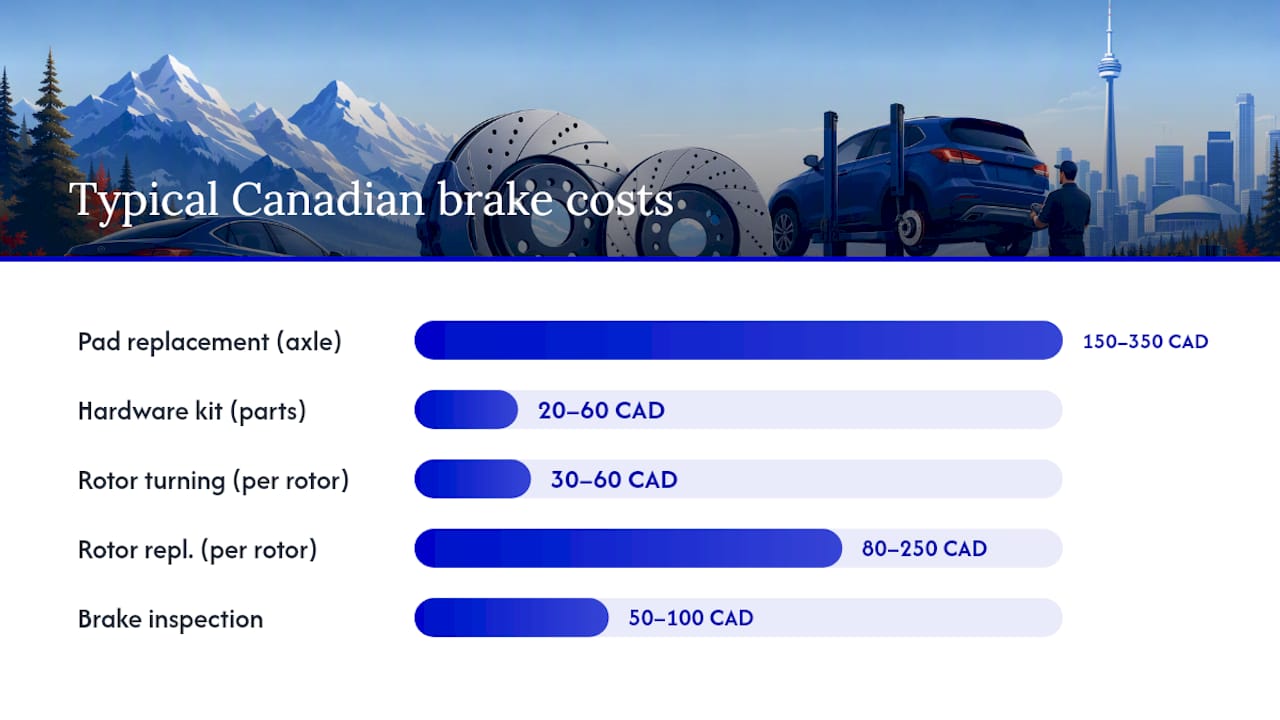
- Pad replacement: $150–$350 CAD per axle for parts and labor at most Canadian shops, depending on vehicle and pad compound
- Hardware kit (shims, anti-rattle clips): $20–$60 CAD in parts; often bundled with a pad job
- Rotor resurfacing (turning): $30–$60 CAD per rotor at a machine shop, where thickness allows
- Rotor replacement: $80–$250 CAD per rotor for quality aftermarket units; labor adds $80–$150 CAD per axle
- Full brake inspection: $50–$100 CAD at most Canadian shops, often waived if you proceed with repairs
O’Reilly’s brake guidance notes that rotor life on passenger vehicles typically ranges from roughly 30,000 to 70,000 miles (approximately 48,000–113,000 km) depending on driving style, load, and maintenance. Heavy towing or frequent mountain driving in British Columbia or Quebec shortens that range considerably.
When a temporary fix is acceptable: light ticking from slots on a rotor with adequate thickness and no scoring is safe to monitor. When it is not: metal-on-metal grinding, pedal pulsation, or a rotor below minimum thickness are immediate safety concerns. Do not defer those repairs.
Replace or resurface slotted rotors: inspection signs and safety limits
The decision between resurfacing and replacement comes down to three factors: remaining thickness, surface condition, and whether the underlying NVH problem is geometry-related or material-related.
Minimum thickness: every rotor has a minimum thickness specification stamped or cast into the hat or edge of the rotor. This value represents the point at which the rotor no longer has enough thermal mass to safely absorb braking energy. Operating below that spec risks brake fade, cracking, and structural failure under hard stops. Measure with a micrometer at multiple points around the rotor face, not just one spot.
Visual signs that rule out resurfacing:
| Condition | Resurfacing viable? | Action |
|---|---|---|
| Light surface rust, no scoring | Yes | Turn rotor; re-bed pads |
| Shallow grooves, adequate thickness | Yes | Turn rotor; inspect pads |
| Deep scoring at slot edges | No | Replace rotor |
| Heat cracks (radial lines from slots) | No | Replace immediately |
| Pronounced outer lip | Marginal | Replace if near min. thickness |
| Below minimum thickness | No | Replace immediately |
Runout and DTV: rotor runout beyond roughly 0.05 mm (0.002 inches) typically produces pedal pulsation and cyclic noise that resurfacing alone cannot fix if the hub face is also out of true. A dial indicator check at the shop confirms this. If runout is hub-related, turning the rotor only delays the problem.
Safety callout: if your rotor is at or below the stamped minimum thickness, or if you see radial heat cracks radiating from the slot edges, replacement is not optional. A cracked or undersized rotor can fail under hard braking, and no noise reduction strategy is worth that risk.
What Aaafrictions engineers know about slot design and HydroAdaptive technology
Slots serve four engineering functions: they vent compressed gas from the pad-rotor interface, clean the pad face by scraping away glazed or contaminated material, provide a thermal escape path for heat, and maintain a consistent friction footprint across the pad surface. The trade-off, as AutoZone’s rotor comparison confirms, is that slotted rotors tend to be noisier than blank rotors and accelerate pad wear slightly. How much noisier depends heavily on slot geometry and rotor metallurgy.
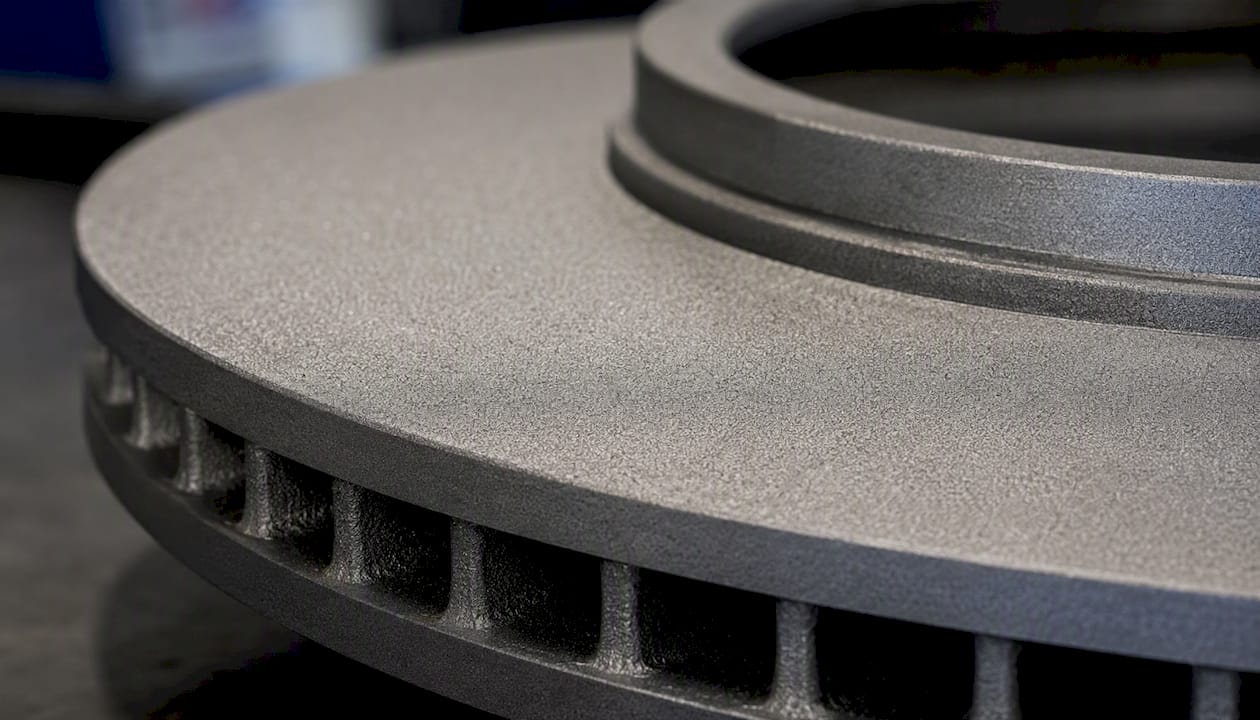
Aaafrictions GC rotors use a GEOMET-coated finish that resists corrosion at the rotor hat, vane, and non-swept areas. That corrosion resistance matters for noise: a corroded rotor hat or vane can introduce micro-vibrations that the pad reads as noise even when the swept face is clean. The GC coating keeps those secondary surfaces stable, reducing one common but overlooked NVH contributor.
The HydroAdaptive formulation addresses a noise source specific to Canadian driving conditions: water films. When a rotor surface carries a thin water layer, pad bite becomes momentarily inconsistent, producing a brief squeal or chirp on the first brake application. HydroAdaptive ceramic compounds are engineered to clear moisture rapidly and maintain consistent friction, which reduces that intermittent noise signature without sacrificing stopping power in rain, slush, or humidity.
Pad pairing guidance for slotted rotors:
| Pad compound | Noise tendency with slots | Best application |
|---|---|---|
| Ceramic (HydroAdaptive) | Low to moderate | Daily driving, wet climates, urban commuting |
| Semi-metallic | Moderate to high | Towing, performance, track use |
| Organic | Low | Light-duty, low-heat applications |
Ceramic compounds produce less dust and generate lower NVH signatures than semi-metallic pads on slotted surfaces. For most Canadian drivers, particularly those in Ontario, Quebec, or British Columbia where wet seasons are long, a ceramic pad paired with a properly finished slotted rotor is the quieter and more consistent choice. You can explore how ceramic and semi-metallic compounds compare in more detail to match the right compound to your driving profile.
Pro Tip: After installing new slotted rotors, complete the full bed-in sequence before driving in heavy rain or snow. An uneven transfer film on a wet rotor amplifies noise significantly during the first few hundred kilometers. A proper break-in under dry conditions first gives the friction material time to seat evenly.
Are slotted rotors a poor choice for daily driving?
Not for most drivers, but the answer depends on what you prioritize. AutoZone’s comparison of rotor types notes that slotted rotors can be noisier than blank rotors and that the trade-off involves pad wear, heat handling, and acoustic comfort.
Slotted rotor advantages:
- Consistent pad cleaning reduces glazing, which is a real benefit on vehicles that sit overnight or see stop-and-go urban traffic
- Better thermal performance under sustained load, making them preferable for towing or mountain driving
- More resistant to cracking than drilled rotors under repeated heat cycles
- Maintain braking performance longer in wet conditions by channeling water away from the pad contact zone
Slotted rotor trade-offs:
- Slightly faster pad wear than blank rotors, because the slot edges abrade the pad face
- Audible ticking or whirring that some drivers find intrusive, particularly with semi-metallic pads
- More brake dust in some configurations, depending on pad compound
Recommendation by driving profile:
- Urban commuting in Canadian cities (Toronto, Montreal, Vancouver): Slotted rotors work well paired with ceramic pads. The pad-cleaning benefit helps in stop-and-go traffic, and ceramic compounds keep noise low.
- Towing or heavy loads: Slotted rotors are the better choice over blank rotors. The thermal and pad-cleaning advantages outweigh the noise trade-off under sustained load.
- Highway-only, low-stress driving: Blank rotors are quieter and may suit drivers who prioritize cabin comfort over performance margin. Slotted rotors are not wrong here, just noisier than necessary.
- Performance or track driving: Slotted rotors are appropriate. Pair with semi-metallic pads and accept the higher noise signature as part of the performance profile.
For a deeper look at how slotted and drilled designs compare across driving scenarios, Aaafrictions has a dedicated drilled vs. slotted rotor guide that covers the engineering trade-offs in practical terms.
Our perspective on slotted rotor noise
The most common mistake we see drivers make is treating all brake noise as an emergency. It is not. A light ticking from slotted rotors on a vehicle with good pad thickness and a clean rotor face is an acoustic trade-off, not a safety issue. The engineering that produces that sound is the same engineering that keeps your pads clean, your rotor thermally stable, and your stopping distance consistent under load.
What we would push back on is the opposite mistake: dismissing noise because “slotted rotors are supposed to sound like that.” That framing is accurate for ticking. It is not accurate for grinding, pulsing, or a noise that has changed character over the past few weeks. Those are the sounds that deserve immediate attention, and the diagnostic checklist in this article gives you a structured way to tell the difference before spending money on parts you may not need.
The NVH picture is almost always multi-factor. Brake NVH research confirms that rotor surface finish, pad compound, caliper hardware, and wheel-end runout commonly combine to create an audible symptom. Swapping one component without checking the others often moves the noise rather than eliminating it. A systematic check, starting with pad thickness and rotor condition, resolves most cases without unnecessary part replacement.
We also want to be direct about one thing: rotor quality matters more than most buyers realize. Two slotted rotors with identical dimensions can behave very differently based on carbon content, microstructure, and surface finish. That is not marketing language. It is the reason we engineer our GC rotors and HydroAdaptive pads as a matched system rather than selling components in isolation. For more on brake squeaking and pad-rotor pairing, our educational library covers the diagnostic side in detail.
Quieter, weather-adaptive braking from Aaafrictions
Noise from slotted rotors is often a pairing problem, not a rotor problem. The right pad compound matched to the right rotor finish resolves most of the audible friction signatures that drive Canadian drivers to the shop unnecessarily.

Aaafrictions Type 07 HydroAdaptive ceramic pads paired with GC GEOMET-coated rotors are engineered specifically for the wet, cold, and variable conditions across Canada’s driving seasons. The ceramic formulation keeps NVH low while the GC coating prevents the corrosion-driven micro-vibration that blank or poorly finished rotors develop after a single wet season. If you need a complete system, the Type 07 Brake Pads + GC Rotors Kit is the matched starting point. For vehicle-specific fitment, use the parts match tool to confirm compatibility before ordering.
Sources
- Drilled vs Slotted Rotors: The Ultimate Engineering Guide | AME Motorsport
- Why Are My Brakes Grinding and Making Noise? | O’Reilly Auto Parts
- What Causes a Scraping Noise When Braking? – AutoZone