

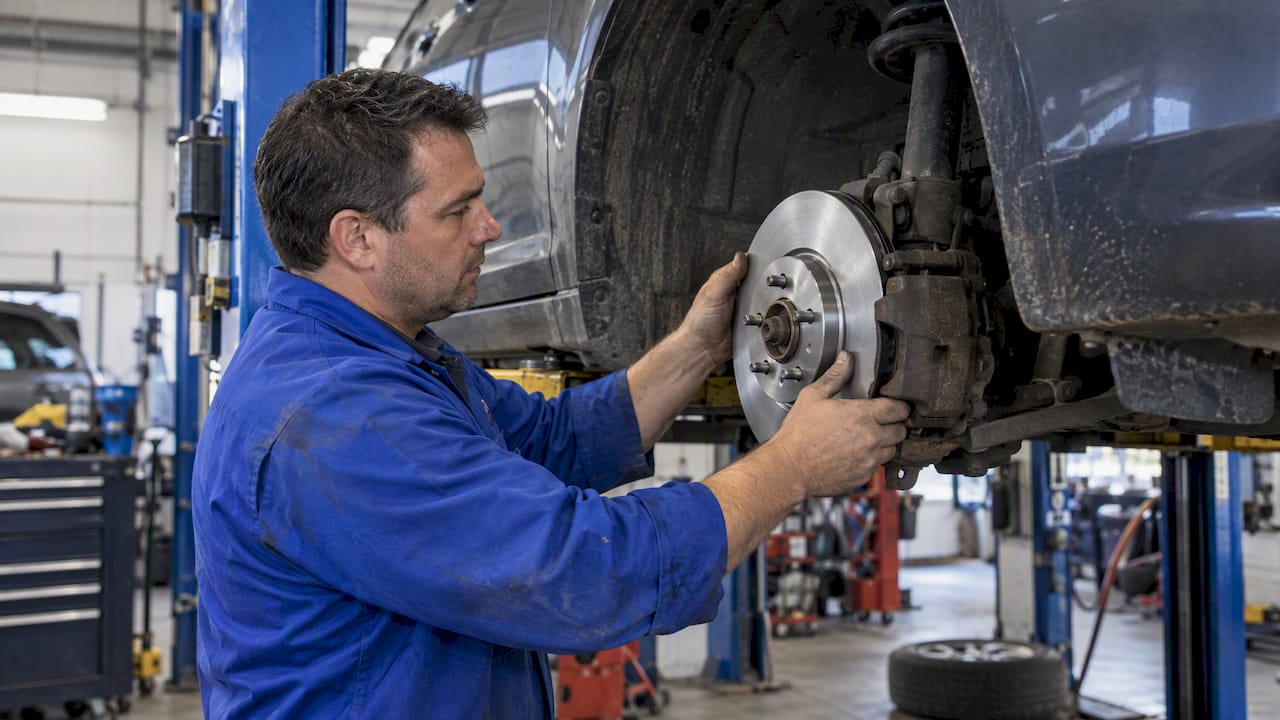
Expect to pay $200 to $400 per axle for pads only, or $350 to $700 per axle when rotors need replacing too, at an independent shop. A full set of four corners typically lands between $700 and $1,400, with dealers often charging more. Before you approve any job, ask for an itemised quote and a rotor thickness reading so you know exactly what you are paying for.
TL;DR:
- Dealers may charge $500 to $1,000 or more per axle for pads and rotors, while premium European vehicles and EVs can exceed typical ranges.
- Replace rotors when thickness reaches the stamped minimum, runout exceeds inspection limits, or cracks, deep grooves, or unmachinable hot spots appear.
- Ask for an itemized quote listing part brands, labor, and fees, plus documented thickness and runout readings; get another opinion if the shop refuses.
- Caliper service or replacement can add $250 to $600 per corner when hardware is seized, so request a demonstration before approving the work.
- Midrange or OEM equivalent parts can avoid repeat replacements, while mobile mechanics may quote lower flat rates for common vehicles.
Table of Contents
- Cost breakdown: what a typical Canadian bill looks like
- What affects price: parts choices, labour model and common add-ons
- When rotors actually need replacing: measurement thresholds and inspection checklist
- How to evaluate a shop quote: an itemised checklist and the red flags to watch for
- Practical cost-saving options that keep safety first
- Publisher perspective: why we emphasize measured replacement and weather-adaptive parts
- Where to look for rotors, pads, and kits built for Canadian conditions
- FAQ
- Sources
Cost breakdown: what a typical Canadian bill looks like
The price swings a lot depending on where you take your vehicle and what shape your current rotors are in. At an independent shop, pads alone usually run $200 to $400 per axle, while pads paired with new rotors move into the $350 to $700 range per axle, based on GTA pricing data from 2026. Dealers tend to charge more for the same work.
- Independent shop, pads only: $200 to $400 per axle
- Independent shop, pads and rotors: $350 to $700 per axle
- Dealer, pads and rotors: $500 to $1,000 or more per axle
- All four corners at an independent shop: $700 to $1,400 total
$700 to $1,400 is the typical range for replacing pads and rotors on all four corners at an independent GTA shop in 2026, compared with noticeably higher totals at dealerships for the same scope of work.
Vehicle type matters as much as shop choice. Premium European models and EVs with larger, more complex rotor designs push costs toward the upper end of these bands or beyond, since the parts themselves cost more and sometimes require specialized handling. Parts typically make up a sizeable chunk of the bill, with labour filling in the rest, which is why a shop quoting a flat number without breaking out parts and hours deserves a second look.
What affects price: parts choices, labour model and common add-ons
Three things drive most of the variation you will see between quotes: the parts tier chosen, the labour model the shop uses, and whether extra repairs get added along the way.
Economy rotors cost less upfront but tend to wear and corrode faster, especially on roads treated with winter salt. OEM-equivalent and premium coated rotors cost more initially but resist flash rust better on Canadian roads, which matters once a vehicle sits through a wet week or a salted commute. A winter-ready rotor buying guide can help you compare tiers before you commit to a quote.
Labour pricing also varies by model. Shops typically bill by the hour, while mobile mechanics often quote flat rates that can undercut traditional shop labour, according to GTA-based pricing research. Watch for these common add-ons:
- Caliper service or replacement: $250 to $600 per corner when hardware is seized
- Brake fluid bleed: often bundled, sometimes billed separately
- Hub cleaning and disposal fees: small but legitimate line items
Winter salt accelerates corrosion on calipers and slide pins, which is one reason seized hardware shows up more often in Canadian climates than in drier regions, and why labour hours sometimes run longer than expected.
Pro Tip: Ask whether a quoted caliper service is preventative or because the part has actually seized. A seized caliper should be visible or demonstrable, not assumed.
When rotors actually need replacing: measurement thresholds and inspection checklist
Rotors should be replaced based on measurement, not guesswork. A proper inspection checks two things:
- Rotor thickness, compared against the minimum stamped on the rotor itself
- Lateral run-out, which flags warping that causes pedal pulsation or steering wheel shake
Periodic Motor Vehicle Inspection standards call for internal brake components to be measured and the results recorded, with replacement parts meeting OEM or industry specifications under the National Safety Code Standard 11. Vehicle inspection guidance also sets lateral run-out thresholds that technicians use to flag a rotor for replacement.
Ask your technician for the actual thickness and run-out readings, ideally from a micrometre or dial gauge, rather than a verbal “they’re worn out.” Visible cracks that extend to the cooling vents, deep circumferential grooves, and hot spots that cannot be machined flat are all legitimate reasons to replace rather than resurface.

Machining rotors used to be common practice, but modern rotors are manufactured thinner than older designs, leaving little material to remove before hitting the minimum thickness. That is one reason full replacement has become the more practical option in most shops today, per GTA labour cost research.
How to evaluate a shop quote: an itemised checklist and the red flags to watch for
A trustworthy quote breaks the job into parts you can check individually, rather than one lump figure that only gets explained once your car is on the hoist.
- Part brand and cost for pads and rotors, listed separately
- Labour hours or a flat labour charge, stated up front
- Disposal or environmental fees, itemised rather than buried
- Any required caliper work, explained with a reason
Quality shops will itemise parts and brand names and give you an estimated labour time, according to guidance on transparent brake repair quoting. Ask to see the actual rotor thickness measurement, photos of damaged parts, or a demonstration of a seized caliper before agreeing to extra charges.
Pro Tip: If a shop cites a seized part as the reason for an add-on cost, ask to see it. A technician should be able to show you the corrosion or resistance directly.
Treat a vague single-line estimate, an unexplained surcharge, or a refusal to share measurements as reasons to get a second opinion. When comparing two quotes, normalize them by parts quality, labour model, included hardware, and warranty terms rather than the bottom-line number alone.
Practical cost-saving options that keep safety first
You have a few legitimate ways to lower the bill without cutting corners on safety.
- Supply your own parts. Shops will still charge labour and check fitment, so confirm compatibility and photograph the parts before drop-off, based on GTA labour pricing practices.
- Consider a mobile mechanic. Lower overhead often means flat, competitive quotes for common vehicles, particularly in urban areas like the GTA.
- Choose mid-tier or OEM-equivalent parts. The cheapest imported pads and rotors often wear out faster, pushing your total cost higher over time rather than lower.
Paying more upfront tends to make sense when calipers are seized, when the vehicle is a premium model, or when rotor design is complex, as with EVs that rely on regenerative braking alongside friction brakes.
Publisher perspective: why we emphasize measured replacement and weather-adaptive parts
We recommend measured replacement over guesswork and favour mid-tier, weather-adaptive parts because they reduce repeat visits in Canadian climates. Get your measurements documented, confirm fitment before installation, and treat those two habits as the foundation of a fair brake job.
— AAA
Where to look for rotors, pads, and kits built for Canadian conditions
Our HydroAdaptive ceramic technology is built to clear moisture quickly and hold consistent friction through rain, snow, and humidity, which matters once winter salt and slush become part of your daily drive.

If you’re budgeting a rotor job and want parts suited to Canadian weather, a few pages are worth a look:
- Type 03 Brake Pads for everyday ceramic performance
- Type 07 Brake Pads for our HydroAdaptive+ formulation
- SC Type Rotors for semi-coated corrosion resistance
- GC Type Rotors for GEOMET-coated protection
Check vehicle-specific fitment on each product page, and read more about the engineering behind the HydroAdaptive technology before you order.
FAQ
How much should a rotor job cost?
A full pad-and-rotor job on one axle typically costs $350 to $700 at an independent shop, with dealers often charging more for the same work. All four corners usually total $700 to $1,400 at a shop.
What is the lifespan of a rotor?
Rotor lifespan depends on driving conditions, pad material, and climate exposure rather than a fixed mileage number. In Canada, winter salt and moisture can shorten rotor life through corrosion, which is why coated rotors are often chosen for roads treated with brine.
How much for 4 brake rotors?
Replacing rotors on all four corners, along with pads, typically runs $700 to $1,400 at an independent shop in the GTA, with dealer pricing often exceeding that range. Vehicle type and parts tier both push the total up or down within that band.
Why are rotors so expensive now?
Modern rotors are manufactured thinner than older designs, which limits how much can be resurfaced before a rotor hits its minimum thickness, making replacement the more common outcome. Material costs, coating technology, and vehicle-specific designs, especially on EVs and premium models, also add to the price compared to older, simpler rotor designs.
What should I ask for before approving a quote?
Request an itemised breakdown showing part brand, cost, labour hours, and any disposal fees, along with the actual rotor thickness and run-out measurements. A shop following proper inspection practice should be able to provide these readings without hesitation.
Sources
- How Much Does a Brake Job Cost in Ontario? (2026 Real Prices)
- I Have the Pads and Rotors. What Does It Cost to Install? | Cars With Fares (GTA, 2026)
- NationalSafetyCodeStandard11
- Launchautoservice