

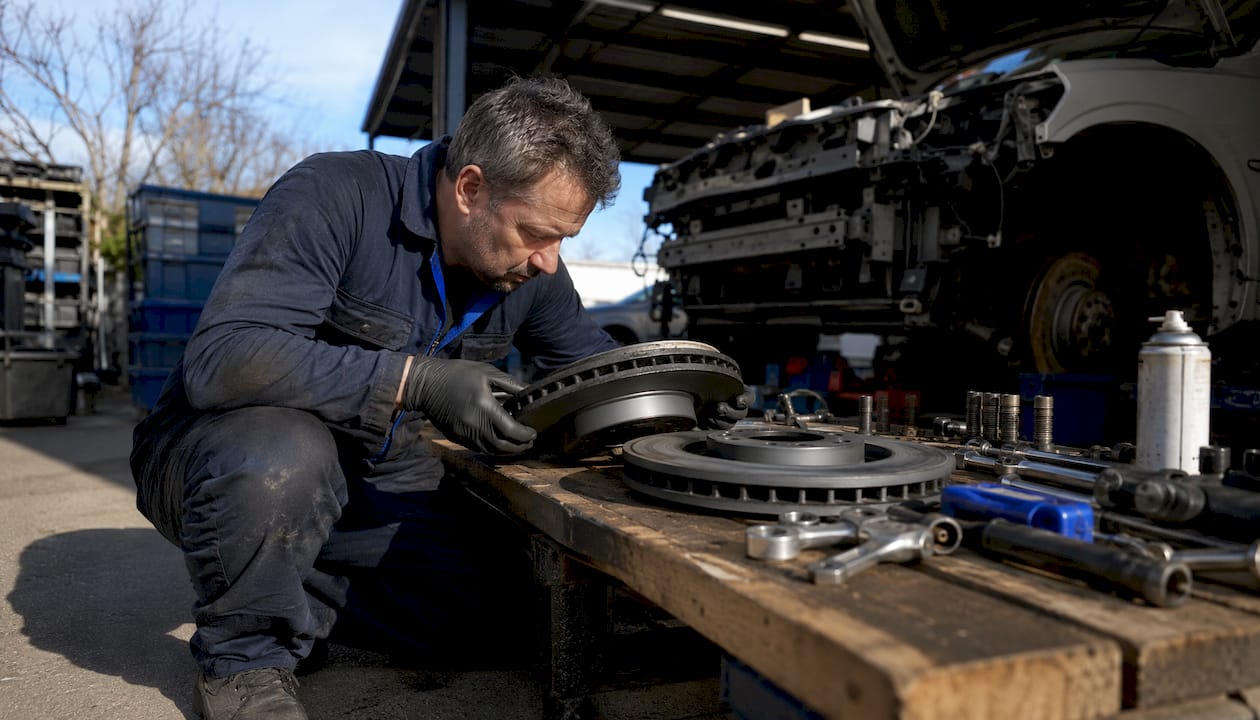
For most Canadian daily drivers, a coated rotor is the better pick. British Columbia’s wet winters, coastal humidity, and salted highways accelerate corrosion faster than almost any other driving environment in the country. A plain-face coated rotor paired with quality pads hits the right balance between corrosion protection, service life, and upfront cost. The per-rotor price difference is often in the $22–$34 range, and the functional payoff over a full ownership cycle can be significant. For drivers in drier interior climates or short-term ownership situations, plain uncoated rotors remain a cost-effective option worth considering.
Table of Contents
- What are plain (uncoated) rotors, and how do they behave?
- How do coated rotors work, and which coating types matter?
- How do coated and plain rotors compare head to head?
- What do coated rotors cost, and how long do they last in Canada?
- Which rotor should you choose for your driving situation?
- How to install, bed in, and maintain your rotors properly
- Aaafrictions GC coated rotors and the Type 07 kit for Canadian conditions
- Key Takeaways
- Why coated rotors are the practical choice, not the premium one
- Aaafrictions makes the choice straightforward
- Useful sources for specs, coatings, and local fitment in Canada
What are plain (uncoated) rotors, and how do they behave?
Plain rotors are cast iron discs with no protective surface treatment. They are the standard OEM replacement form found on most vehicles and represent the lowest upfront cost in the brake rotor category.
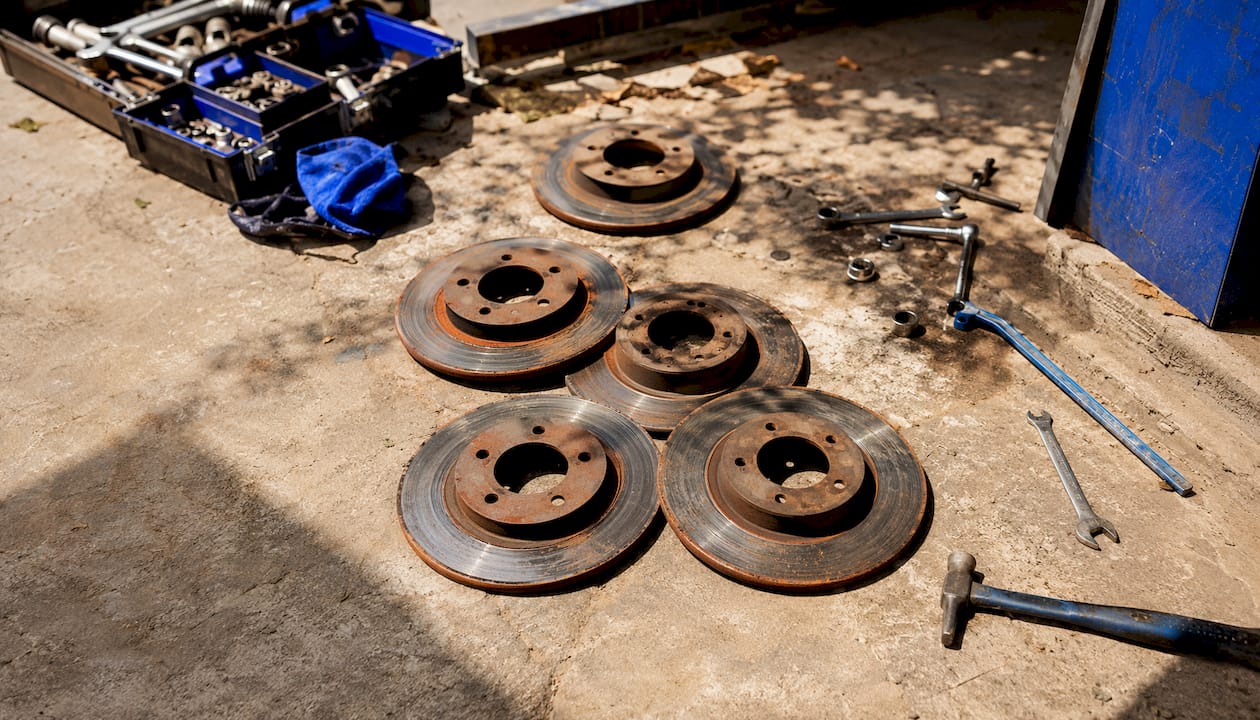
The problem with bare cast iron is straightforward: it rusts. Surface oxidation begins within hours of exposure to moisture, and while light surface rust on the swept friction area clears quickly during normal braking, the areas that pads never touch are a different story. The hat (the center mounting section), the outer and inner edges, and the internal cooling vanes all remain permanently exposed. Over time, rust builds up in those vanes, restricting airflow and reducing the rotor’s ability to shed heat during repeated braking cycles.
Practical characteristics of plain uncoated rotors:
- Surface rust on the hat and edges appears quickly in wet or humid conditions
- Internal vane corrosion can restrict convective cooling over time
- Rotor-to-hub seizing is a real risk after several winters of salt exposure, making removal difficult and increasing labor costs
- Lower upfront cost per rotor compared to coated equivalents (the typical difference is $22–$34 per rotor)
- Require more frequent visual inspection and occasional cleaning to stay presentable
Pro Tip: Rust on the hat and edges is not purely cosmetic. Once corrosion bridges the gap between the rotor hat and the wheel hub, technicians sometimes need to cut the rotor off during a future service. That extra labor can cost more than the price difference between coated and plain rotors in the first place.
How do coated rotors work, and which coating types matter?
Coated rotors apply a protective layer to every surface except the pad-swept friction zone, or in some cases across the entire rotor face with a sacrificial coating designed to wear away during bedding-in. The goal is to protect the hat, edges, and internal cooling vanes from the corrosion that plain rotors cannot resist.
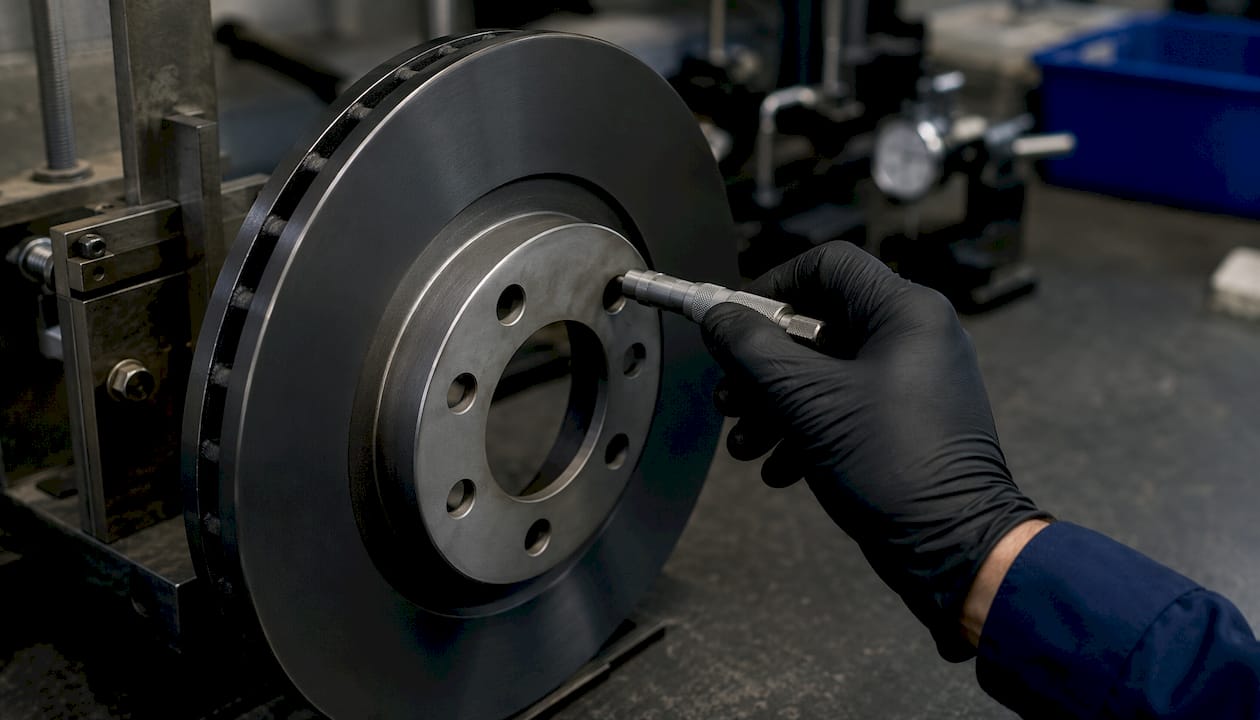
GEOMET is the coating standard most frequently specified by OEMs and referenced in aftermarket quality tiers. It chemically bonds to the rotor surface rather than sitting on top as a paint layer, and GEOMET-coated rotors are tested for extended salt-spray resistance in OEM contexts. Some product literature cites 480-hour salt-spray benchmarks for GEOMET-type coatings, a meaningful gap over bare cast iron. Critically, GEOMET also protects internal cooling vanes, which preserves convective airflow and reduces thermal hotspots that can accelerate warping under repeated heavy braking.
Zinc and zinc-aluminum electroplated coatings are the most common entry-level option. They provide solid corrosion resistance and a clean silver appearance, though they tend to be thinner than GEOMET and may not bond as durably in high-salt environments over a long ownership horizon.
Polymer-based coatings vary widely by manufacturer. Some are essentially a painted finish applied for aesthetics and light protection; others are engineered for durability. Quality varies more in this category than in GEOMET or electroplated options.
One concern drivers often raise: if the friction surface is coated, will braking feel slippery at first? The answer is no, by design. The coating on the pad-contact area is engineered to wear away quickly during the bedding-in procedure, leaving a clean metal surface for pad transfer. Follow the manufacturer’s break-in steps and the friction profile stabilizes predictably.
How do coated and plain rotors compare head to head?
| Category | Plain (Uncoated) Rotors | Coated Rotors |
|---|---|---|
| Corrosion resistance | Low — rust begins within hours on exposed surfaces | High — GEOMET and zinc coatings resist salt and moisture significantly longer |
| Upfront cost | Lower per rotor | Modest premium; per-rotor difference often in the $22–$34 range |
| Expected service life / warranty | Shorter in salt-belt climates; vane corrosion accelerates wear | Longer in wet/salted conditions; coating preserves vane geometry |
| Thermal performance | Adequate when vanes are clean; degrades as rust accumulates | Sustained — protected vanes maintain convective cooling over time |
| Brake feel, noise, and pad wear | Can develop uneven engagement as rust builds; vibration risk increases | More consistent pad engagement; quieter initial feel after bedding-in |
| Maintenance needs | More frequent inspection and cleaning required | Reduced cleaning burden; less risk of seized hardware |
| Aesthetics | Raw metal; surface rust visible through open wheels | Clean, uniform finish; retains appearance longer |
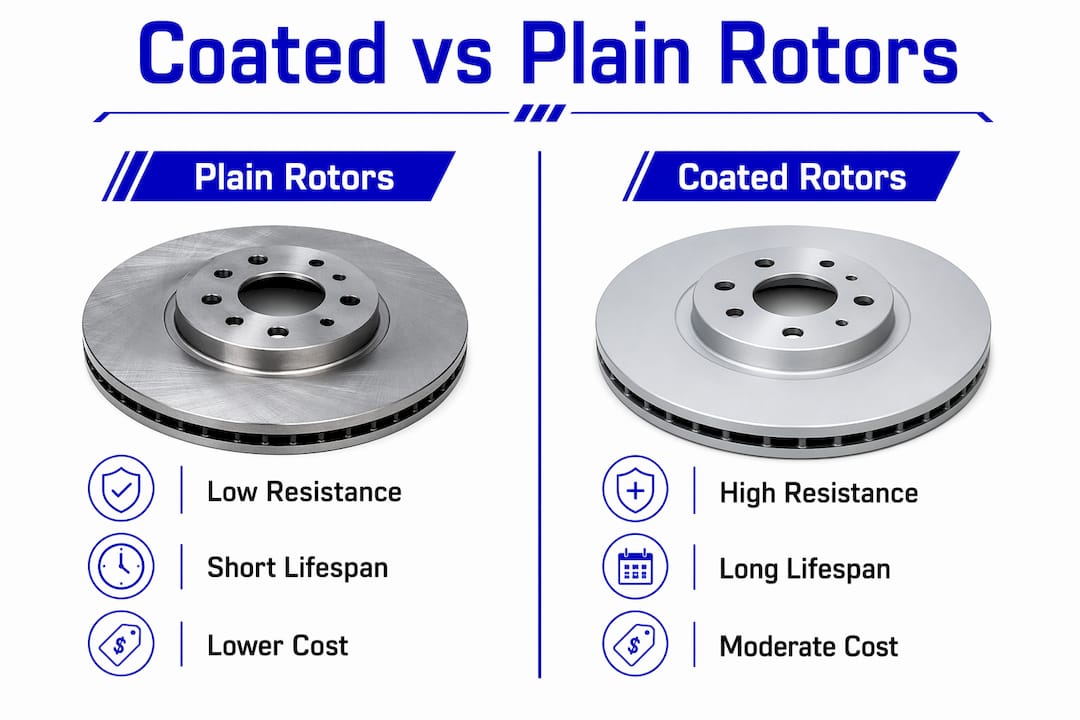
Best for plain rotors: Dry-climate drivers, short-term vehicle ownership (under two years), or budget-constrained buyers who commit to regular inspection and cleaning.
Best for coated rotors: Daily drivers in British Columbia’s Lower Mainland, Vancouver Island, or any salt-belt route; vehicles kept for three or more years; drivers who want lower maintenance overhead.
One caveat on drilled and slotted rotors: These are a separate category from plain vs. coated. Drilled rotors can develop stress cracks under repeated heavy braking, and slotted rotors accelerate pad wear. For most street-driven Canadian vehicles, a plain-face coated rotor outperforms both in everyday conditions. Reserve drilled or slotted options for dedicated track use or tow vehicles with specific thermal demands.
What do coated rotors cost, and how long do they last in Canada?
The per-rotor price gap between coated and uncoated units is often modest, typically in the $22–$34 per-rotor range for comparable quality tiers. On a full axle set, that translates to a manageable upcharge that most drivers recover through reduced labor costs alone, particularly by avoiding the seized-hub removal scenarios that plain rotors invite after two or three BC winters.
Under Canadian winter use with regular salt exposure, plain rotors in the Lower Mainland or along Highway 1 corridors can show functional vane corrosion within two to three years. Coated rotors, particularly GEOMET-type, tend to preserve their geometry and airflow characteristics significantly longer under the same conditions. In drier interior BC climates like the Okanagan, the gap narrows and plain rotors can serve a full service interval without major corrosion issues.
Key cost drivers to factor into your decision:
- Whether the kit includes hardware (caliper bolts, shims, anti-seize) or requires separate purchase
- Pad pairing quality — mismatched pads and rotors accelerate wear on both components
- OEM vs. aftermarket sourcing and whether the coating type is specified or generic
- Labor cost avoidance from not dealing with seized rotors at the next service interval
A warranty that covers the coating specifically, not just the rotor body, is a meaningful signal of manufacturer confidence. Check whether the warranty language addresses corrosion protection or only structural defects.
Which rotor should you choose for your driving situation?
Daily commuter in Metro Vancouver or on Vancouver Island: Coated rotors are the clear choice. Salt, rain, and humidity are present most of the year. The corrosion protection pays for itself well before the next rotor change.
Weekend performance driver: A plain-face coated rotor still makes sense here. Drilled or slotted rotors are often marketed to this segment, but for street driving, the thermal and noise benefits of a quality coated flat rotor outweigh the visual appeal of a slotted design.
Short-term ownership (selling within 18 months): Plain rotors are defensible if the vehicle is garaged and you live in a drier area. The cost savings are real over a short horizon.
Garage-kept city driver in Kelowna or Kamloops: Plain rotors can work, but even interior BC sees winter road treatment. A coated rotor is still the lower-maintenance choice if you plan to keep the vehicle past two years.
How to install, bed in, and maintain your rotors properly
Bedding-in procedure
- Install rotors and pads according to torque specs for your vehicle (wheel bolts and caliper hardware both).
- Drive at moderate speed (roughly 50 km/h) and apply firm, steady brake pressure to slow the vehicle without coming to a full stop. Repeat 6–8 times with cooling intervals between each application.
- Allow rotors to cool completely before driving normally. Avoid hard stops for the first 300–500 km.
- The coating on the friction surface will wear away during this process. Light smoke or smell is normal. Uneven pad transfer from skipping this step causes vibration that is difficult to correct without resurfacing.
Installation checklist
- Clean the hub face thoroughly before mounting the rotor. Rust or debris on the hub creates runout that feels like a warped rotor.
- Torque wheel fasteners to spec in a star pattern.
- Apply a thin layer of anti-seize to the hub-to-hat contact area (not the friction surface) to prevent future seizing.
- Inspect and replace caliper slide pins and hardware if they show corrosion or stiffness.
When to replace your rotors
Watch for these symptoms, and check your brake system if any appear:
- Pulsation or vibration through the pedal or steering wheel under braking
- Thickness below the manufacturer’s minimum specification (typically stamped on the rotor hat or listed in your service manual)
- Deep grooves or scoring visible on the friction surface
- Visible cracking on the hat or friction face
- Lateral runout exceeding 0.05 mm (measured with a dial indicator at the friction surface)
Pro Tip: Measure rotor thickness at multiple points around the circumference, not just one spot. Thickness variation, not just overall thinness, is what causes pedal pulsation. A rotor can be above minimum thickness and still need replacement if the variation across the surface exceeds spec.
Aaafrictions GC coated rotors and the Type 07 kit for Canadian conditions
For drivers who want a market-ready solution built specifically for wet and cold climates, Aaafrictions’ GC Coated Rotors use GEOMET-type coating to protect the hat, edges, and internal vanes against the corrosion patterns common in BC’s salt-belt driving environment. The coating chemically bonds to the rotor surface rather than sitting as a paint layer, preserving vane geometry and convective cooling performance over the full service life.
The Type 07 Brake Pads + GC Rotors Kit pairs those rotors with Aaafrictions’ HydroAdaptive ceramic pads, which are engineered to maintain consistent friction in rain, snow, and humidity. The HydroAdaptive formulation clears moisture from the friction interface rapidly, which matters most in the first few brake applications after driving through standing water or wet snow. The kit is sold as a vehicle-specific set that includes hardware, reducing the risk of mismatched components and simplifying installation.
Pro Tip: Aaafrictions sells rotors only as part of a complete pad-and-rotor kit. That approach ensures the friction profile of the pad and the thermal characteristics of the rotor are matched from the start, which is one of the most common sources of premature wear when drivers mix components from different manufacturers.
Key Takeaways
For most British Columbia drivers, a coated rotor is the better long-term investment because salt exposure and wet conditions accelerate corrosion on plain cast iron faster than the modest price premium can justify skipping protection.
| Point | Details |
|---|---|
| Coated rotors win in BC conditions | Salt, rain, and humidity make corrosion protection a functional need, not a cosmetic upgrade. |
| GEOMET coating is the quality benchmark | GEOMET-type coatings bond chemically and protect vanes, preserving thermal performance over time. |
| Price gap is modest | Per-rotor cost differences are often in the $22–$34 range, recoverable through reduced labor at future services. |
| Bedding-in is non-negotiable | Skipping the break-in procedure causes uneven pad transfer and vibration that is hard to correct without resurfacing. |
| Aaafrictions Type 07 + GC kit | Pairs HydroAdaptive ceramic pads with GEOMET-coated rotors in a vehicle-specific kit built for Canadian wet-climate driving. |
Why coated rotors are the practical choice, not the premium one
The framing around coated rotors as a “premium upgrade” has always struck us as slightly off. In a climate like British Columbia’s, where road salt is applied from October through March and coastal moisture is present year-round, a plain uncoated rotor is not the economical baseline. It is the option that defers cost rather than avoiding it. The seized hubs, the corroded vanes, the vibration from uneven pad engagement — those are not hypothetical failure modes. They are the predictable outcome of putting bare cast iron through several wet winters without protection.
What we find most useful to communicate is this: the decision between coated and plain is not really about performance at peak braking. Both types stop the car. The difference shows up in the third year, when one rotor still has clean vanes and a hub that comes off without a torch, and the other has become a labor problem. For drivers who keep their vehicles and drive them through real Canadian winters, that distinction is worth the modest upfront difference.
Aaafrictions makes the choice straightforward
Choosing between coated and plain rotors gets simpler when the product is already matched to your vehicle and your climate. Aaafrictions builds vehicle-specific brake kits that pair HydroAdaptive ceramic pads with GEOMET-coated GC rotors, including all necessary hardware. You get corrosion-resistant rotors, moisture-clearing pad technology, and matched components in a single order.

That matters for BC drivers because the kit removes the guesswork from component matching. Mismatched pads and rotors are one of the most common causes of premature wear and noise complaints after a DIY install. With Aaafrictions, the friction profile and rotor thermal characteristics are engineered together. Use the fitment lookup tool to find the right kit for your vehicle, or visit the Aaafrictions landing page to browse available options and confirm availability for your make and model.
Useful sources for specs, coatings, and local fitment in Canada
When verifying rotor specs, coating standards, or warranty terms before purchasing, these are the most reliable places to check:
- Coating specification pages: Look for salt-spray test hours (GEOMET benchmarks are documented in manufacturer literature) and whether the warranty covers corrosion protection specifically or only structural defects.
- Aaafrictions product and technology pages: The GC Brake Rotors page and Our Technology page detail coating type, HydroAdaptive specifications, and kit contents.
- Fitment lookup: Use Aaafrictions’ search tool to confirm vehicle-specific compatibility before ordering.
- Local certified installers: BCAA-affiliated shops and certified brake specialists across the Lower Mainland and Vancouver Island can verify minimum thickness specs and inspect for hub corrosion before installation.
- Vehicle service manual: Always cross-reference minimum rotor thickness and torque specifications from your OEM service documentation, as these vary by make, model, and year.
- Maintenance resources: A thorough car maintenance checklist can help you track inspection intervals and catch early corrosion before it becomes a labor problem.
Recommended
- Type 07 Brake Pads + GC Rotors Kit – AAA Frictions
- Type 03 Brake Pads with Type SC Rotors Kit – AAA Frictions
- Type 07 Brake Pads with Type SC Rotors Kit – AAA Frictions
- Front and Rear Brake Kit for Honda CR-V 2002-2004, Type 07 HydroAdaptive+ Ceramic Disc Brake Pad and Rotor Set with GC Type GEOMET Coated Rotors