

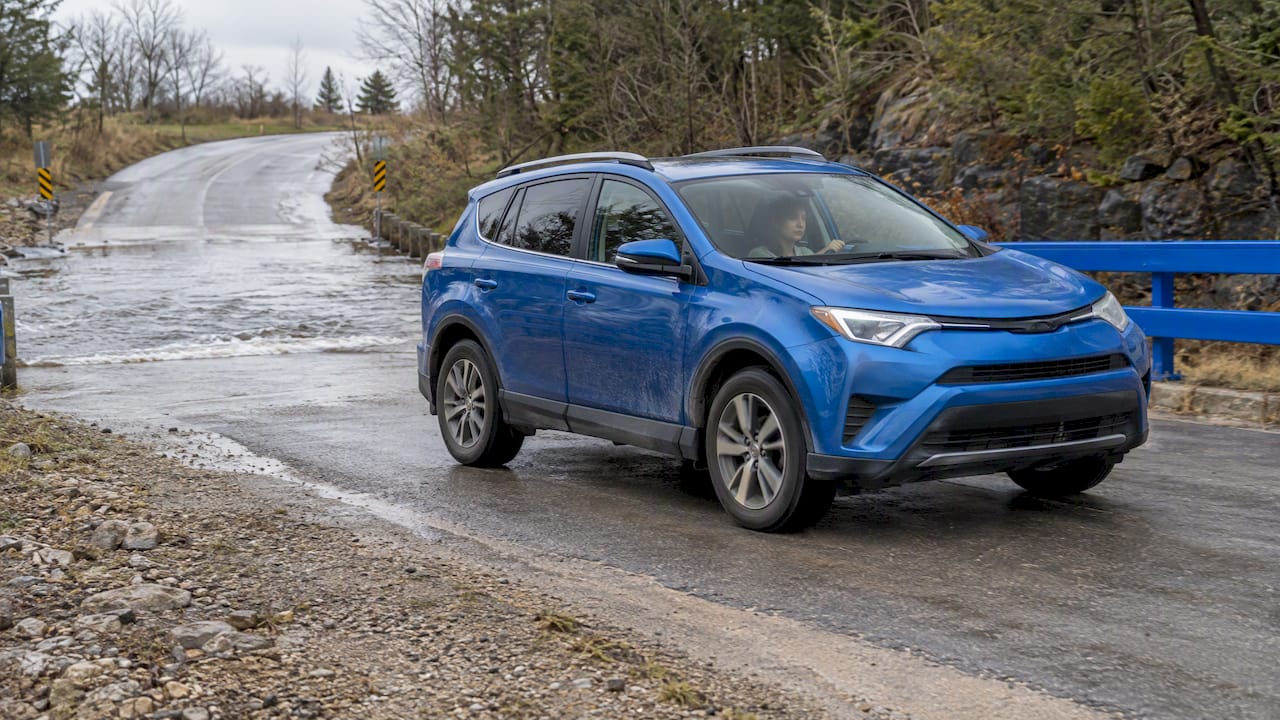
Driving through flood water leaves your brakes wet, and wet brakes stop less reliably. The car may take longer to slow down or pull to one side. The fix for a short, shallow splash is simple: once it is safe, drive slowly and press the brake pedal lightly several times until the pedal feels normal and the car stops straight. If the water was deep, if the brakes still feel wrong, or if the vehicle sat in flood water, the right move is a professional inspection, not more driving.
Below, we explain what water does to a braking system, how to test and dry your brakes step by step, which warning signs matter, and when to stop and call a tow truck.
TL;DR
- Wet brakes can increase stopping distance or make the vehicle pull to one side, so test them as soon as you are through the water and it is safe to do so.
- Drive slowly, ease off the accelerator, and apply the brakes lightly several times until they feel normal. Check for traffic behind you first.
- Vibration, scraping, grinding, pulling, or a soft pedal after the brakes have dried mean the system needs inspection.
- If the vehicle was immersed, do not start it. Have it towed to a qualified mechanic.
- Brake parts that handle moisture well reduce the problem in everyday rain, but no pad replaces an inspection after a flood.
Table of Contents
- What flood water does to your brakes
- How to test and dry your brakes after driving through water
- Shallow water still counts
- Warning signs that mean an inspection
- When to stop driving and get a professional
- Our perspective: wet-weather braking is a design problem
- Brake parts engineered for wet conditions
- What to keep in your routine
- FAQ
- Sources
What flood water does to your brakes
Brakes work through friction. A pad clamps a rotor, and the grip between those two surfaces turns motion into heat. Put a film of water between them and that grip drops until the surfaces wipe themselves clean.
The effect is documented by manufacturers and regulators. Mazda’s Canadian owner’s manual warns that wet brakes can lengthen stopping distance or cause the vehicle to pull to one side, and that this could lead to a serious accident. Manitoba Public Insurance’s Driver’s Handbook goes further: after a large puddle, brakes may pull to one side or not work at all, which is why it tells drivers to test them lightly after deep water.
Three things are happening at once:
- A water film on the friction surface. The pad glides over the rotor instead of gripping it, so the first few applications feel weak or delayed.
- Uneven wetting. One wheel may clear faster than another. That is what makes the car pull sideways when you brake.
- Contamination. Flood water is rarely clean. It carries grit, road salt and mud into the calipers, around the pads and onto the rotor surface, where it can scour friction material and start corrosion.
The AA lists reduced or absent braking, electrical damage and aquaplaning as the possible consequences of driving into flood water. Brakes are only one item on that list, which is a good reason not to treat “the pedal feels fine again” as a clean bill of health.
Why a brake pedal can feel different after water
You may notice a longer pedal, a delay before the car responds, or a pedal that feels softer than usual. Most of the time this is moisture on the friction surfaces, and it fades as the brakes warm up. A pedal that stays soft after the brakes have dried is a different matter. If that is what you are feeling, read our guide on odd brake pedal feel in rain and have the system checked.
How to test and dry your brakes after driving through water
The method is the same across the manufacturers and road-safety bodies we looked at: slow down and use the brakes lightly until they work properly again. Here is the sequence.
- Get through the water slowly. Do not stop in the middle of it, and keep your speed low and steady.
- Check behind you. Before you test, make sure no one is following closely. A brake test on a busy road is only safe when traffic allows.
- Ease off the accelerator. Let the vehicle slow on its own at a low speed.
- Apply the brakes lightly, several times. Mazda describes driving slowly and lightly applying the brakes several times until braking performance returns to normal. Manitoba Public Insurance gives the same advice: slow speed, light pressure.
- Confirm the car stops straight. Road Safety at Work, a British Columbia road-safety programme, says to confirm that the brakes pull evenly on all wheels before you accelerate again.
- Avoid high speed until it is sorted. A Nissan owner’s manual specifically recommends avoiding high speed while the brakes recover.
A light, even press is the point. Do not ride the brake hard for kilometres, and do not stab the pedal at speed to “burn off” the water. Gentle friction warms the surfaces and pushes the water film out, and it keeps you in control. For a driver-focused walkthrough, see our page on how to dry brakes while driving.
The same logic applies to a firm pedal and a quick response. A soft brake pedal check is worth running through if the pedal feels lower or spongier than it did before you entered the water, because a pedal that does not firm up as the brakes dry points to a fault, not moisture.
What a good result looks like
In Ontario, drivers are advised to test their brakes when it is safe after passing through a flooded stretch. According to this regional guidance, the vehicle should stop straight and the pedal should feel firm. If the car pulls or the pedal remains soft after drying, stop driving and have it repaired.
A simple pass or fail:
| What you notice | What it usually means | What to do |
|---|---|---|
| Weak first stop, normal after a few light applications | Moisture on pads and rotors, now cleared | Continue at moderate speed |
| Car pulls to one side, then evens out | One side dried faster than the other | Keep testing gently, then monitor |
| Still pulling after several minutes | A brake or related fault | Stop driving, book an inspection |
| Soft or sinking pedal that does not recover | Possible hydraulic or contamination problem | Stop driving, arrange a tow if needed |
| Grinding, scraping or vibration | Grit, damaged friction material or rotor issue | Have it inspected promptly |
Shallow water still counts
You do not need a flooded underpass to affect your brakes. Road Safety at Work’s driving-for-the-conditions guidance treats even shallow water as potentially hazardous, because hidden road defects and hydroplaning can compound reduced brake effectiveness. A deep pothole under a sheet of standing water can do more damage than the water itself.
This is also why stopping distance in wet weather deserves its own planning. Water on the road reduces tyre grip before your brakes even come into it. Our guide to stopping distance in rain explains how much extra room to leave, and if you notice braking feels thin in ordinary rain, our page on brakes slipping in rain lists the checks to run.
Warning signs that mean an inspection
A drying brake should improve within a short distance of gentle use. These signs should not be ignored.
- Vibration, scraping or grinding when braking. A trade publication for brake technicians, Motor’s BrakeShop, advises drivers to watch for these symptoms after driving through water.
- Pulling that does not go away. Even braking should return once the pads and rotors are dry.
- A soft pedal after the brakes have dried. This can point to a problem beyond surface moisture.
- Warning lights. Brake, ABS or stability-control lights after water exposure suggest sensor or electrical trouble.
- A delayed return of the pedal or odd noises from a wheel. Water can affect wheel bearings, fluids, wiring, sensors and control modules, as Durham regional guidance notes.
That same source adds an important point: corrosion may develop after visible moisture has dried. A car that seems fine on the drive home can show rusted rotor faces, seized hardware or stiff calipers days or weeks later. If you drove through serious water, a brake inspection a few days afterwards is sensible, even when nothing felt wrong.
The effect on the pedal when brakes grab or fade
Sometimes the problem is the opposite of weak braking. Brakes that grab suddenly as they dry, or fade as heat builds in wet conditions, are both common after water exposure. We cover the causes in our guides on brakes that grab when wet and brake fade in rain.
When to stop driving and get a professional
There is a line between wet brakes and a flood-damaged vehicle. Wet brakes dry. A flood-damaged vehicle needs a mechanic.
Do not start a vehicle that has been immersed. Quebec’s auto insurance board, the SAAQ, says to never try to start a road vehicle immersed in flood water and to have it towed or transported, since flooding can make it function improperly and create road-safety risks. CAA-Quebec gives the same advice: avoid engine start-up after submersion and have the vehicle towed to a trusted mechanic.
Do not trust normal-looking behaviour. The SAAQ also warns that flooding can damage electronic components, including parts associated with airbags, drivetrain control and vehicle self-diagnostics. A vehicle that appears to run normally is not proven safe.
Get the park brake and related parts checked. Manitoba Public Insurance says emergency-brake cables, axles and electronic components should be dried and checked by a qualified professional as soon as possible after flood exposure.
Do not wait on significant exposure. The AA says significant flood water exposure warrants immediate garage attention so that the vehicle’s important parts can be checked. CAA-Quebec adds that water can compromise whether a vehicle is safe to drive, and that corrosion and mould create longer-term problems.
Tell the technician exactly what happened: how deep the water was, how long the vehicle was in it, and whether it was fresh or salty. That detail shapes what they inspect. Pads and rotors that sat in dirty or salty water are often replaced rather than cleaned, and a mechanic will also look at the fluid, the lines, the calipers and the wheel bearings.

Our perspective: wet-weather braking is a design problem
Most advice about flood water and brakes is about what the driver does afterwards, and that advice is right. Drying brakes gently, checking for pulling and calling a mechanic when something is off are the habits that keep people safe. We would never suggest a product replaces them.
What we focus on is the other side of the problem: how brake components behave in the everyday wet conditions that precede and follow a flood. Standard ceramic pads can show delayed braking and inconsistent pedal feel in wet or humid climates. That is the specific problem our HydroAdaptive ceramic technology was developed to address. It is engineered to clear moisture rapidly and maintain friction, so the stop you get in rain, snow or humidity is closer to the stop you get on a dry day.

The pad is only one part of the braking ecosystem. Rotor surface treatment, corrosion resistance and caliper and lubricant behaviour in cold and damp conditions all affect how quickly a brake returns to a stable, clean stop. That is why we build pads, rotors and calipers to work together instead of treating any one of them in isolation.
If you want the technical background on how moisture affects the pad surface, our article on water on brake pads explains it in detail.
— AAA
Brake parts engineered for wet conditions
If you have just been through a flood event and a mechanic has told you the pads or rotors need replacing, or if you simply drive in a region with unpredictable weather, this is where our range fits. We offer vehicle-specific brake parts built around HydroAdaptive technology:
- Type 03 brake pads and Type 07 brake pads, HydroAdaptive ceramic pads for consistent braking in rain, humidity and cold.
- SC Type rotors and GC Type rotors, designed for corrosion resistance.
- Complete front and rear brake kits, as well as Climateflex calipers, for owners who want the whole system to work together.
Our products are sold direct online, matched to your vehicle. Browse the range and confirm fitment for your make and model at aaafrictions.ca.

What to keep in your routine
Some habits are worth building before the next heavy rain or spring melt:
- Know your route. Avoid low underpasses and unfamiliar flooded roads. If you cannot see the road surface, do not enter.
- Test after every deep puddle. A light brake check takes seconds and costs nothing.
- Keep a longer gap. Water lengthens stopping distances, so add following distance before you need it.
- Inspect after the event. Check for rust on rotors, stiff calipers and unusual noises in the days after a flood exposure.
- Replace worn parts. Pads that are already thin or rotors that are already scored have less margin when conditions turn wet.
FAQ
How does water get into a brake system?
Water reaches the friction parts directly: it splashes onto the pads, rotors and calipers as you drive through it. In deeper flooding it can also work into other parts of the system and carry grit and salt with it. That is why a vehicle that was submerged needs a professional inspection, not just a drying drive.
What should you do after driving through water?
When it is safe, drive slowly and apply the brakes lightly several times until they feel normal and the car stops straight. Keep your speed down until they do. If the pedal stays soft, the car pulls, or you hear grinding, stop driving and have the brakes inspected.
How long do brakes take to dry?
For a short splash, usually a short stretch of gentle braking is enough, which is why manufacturers say to repeat light applications until performance returns to normal rather than giving a set distance. If the brakes have not recovered after a reasonable drive, treat that as a fault and not as moisture.
Can I drive normally if the brakes feel fine after a flood?
Only if the water was shallow and brief. After deep or prolonged exposure, normal feel does not prove the car is safe, because floods can damage electronics and start corrosion that appears later. Book an inspection and tell the mechanic how deep the water was.
Do HydroAdaptive pads make a flood inspection unnecessary?
No. Our pads are designed to clear moisture quickly and keep friction consistent in wet weather, but they do not protect the rest of the vehicle from flood damage. If your vehicle has been in flood water, have it checked by a qualified mechanic regardless of which pads are fitted.
Sources
- Mazda Canada digital owner’s manual, wet brakes
- Manitoba Driver’s Handbook, wet brakes
- Manitoba Public Insurance, flood waters and vehicles
- The AA, how to drive through flood water and heavy rain
- Road Safety at Work, driving for the conditions
- Nissan LEAF owner’s manual, wet brakes
- Floodwater vehicle check, Durham
- Motor, BrakeShop October 2014
- SAAQ, flood-damaged road vehicles
- CAA-Quebec, what to do if your vehicle has been flooded