

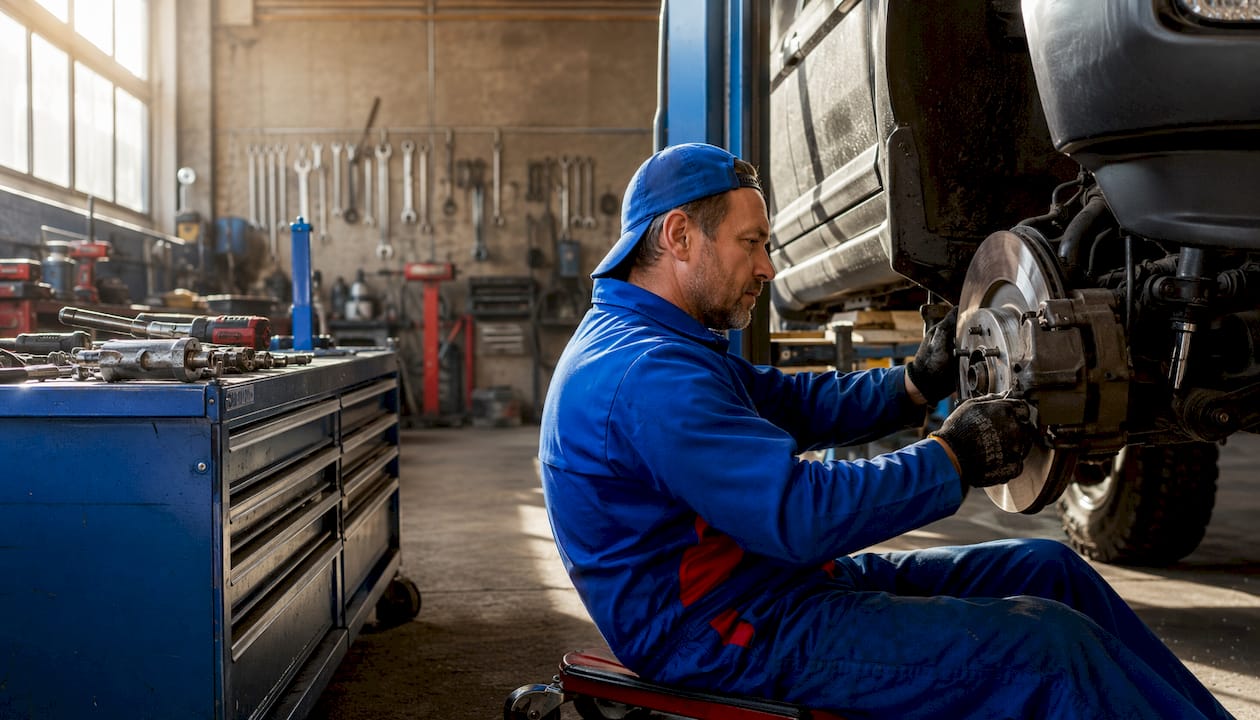
For Canadian drivers who tow, haul, or face rapid seasonal weather shifts, the best heavy-duty brake pads are Aaafrictions HydroAdaptive ceramic kits. They combine moisture-clearing technology, thermal stability, and rotor-friendly formulation in vehicle-specific configurations built for Canadian conditions.
Why this recommendation holds:
- Moisture management: HydroAdaptive ceramic formulation clears water film from the friction surface, maintaining consistent pedal feel in rain, slush, and humidity.
- Thermal stability: The compound resists fade on long descents and under repeated heavy-load stops.
- Rotor-friendly: Ceramic-based friction preserves rotor life better than aggressive metallic compounds.
- Vehicle-specific fitment: Type 03 and Type 07 kits are configured for exact year/make/model, eliminating guesswork.
This is the right upgrade if you regularly tow a trailer, haul heavy payloads, or drive Manitoba’s seasonal roads where moisture and temperature swings are constant. If you drive a light commuter vehicle that never tows and you prioritize absolute silence above all else, a standard OEM ceramic pad may be sufficient.
Table of Contents
- Who actually needs heavy-duty brake pads?
- Material types and performance trade-offs
- How to choose the right heavy-duty brake pad for your vehicle
- Why moisture management matters for Canadian heavy-duty braking
- The recommended heavy-duty upgrade for Canadian drivers
- What to expect after upgrading: installation and maintenance
- What does a heavy-duty brake upgrade actually cost?
- Comparing heavy-duty brake pad approaches: pros and cons
- How Canadian road salt affects brake pad performance
- Environmental considerations for heavy-duty brake pads
- Key Takeaways
- Why we recommend HydroAdaptive as the balanced heavy-duty choice
- Aaafrictions HydroAdaptive kits: how to order
- Useful sources and further reading
Who actually needs heavy-duty brake pads?
Application-specific selection is the first principle automotive analysts apply when evaluating brake upgrades. The most aggressive pad is not automatically the best choice.
Heavy-duty pads are justified when your driving involves:
- Regular towing: Boat trailers, utility trailers, or campers on Manitoba highways where long stopping distances under load are a real risk.
- Heavy payload hauling: Contractors carrying gravel, lumber, or equipment where vehicle weight increases braking demand significantly.
- Long mountain or grade descents: Repeated braking on extended downhill runs generates heat that standard pads cannot consistently manage.
- Fleet and stop-and-go routes: Delivery vehicles, tow trucks, or municipal fleets cycling through frequent hard stops.
- Off-road and mixed-surface driving: Loaded 4x4s on gravel or unpaved roads where braking surfaces and conditions change constantly.
A weekend driver who occasionally tows a small boat on flat terrain may not need the most severe-duty compound available. Matching pad aggressiveness to actual duty cycle protects rotors and avoids unnecessary noise or dust.
Pro Tip: Before buying, estimate your average load and how often you brake hard. A fleet manager or experienced mechanic can confirm whether your use case genuinely calls for severe-duty friction material or whether a high-quality standard ceramic will perform just as well.
Material types and performance trade-offs
A balanced carbon-ceramic hybrid or weather-adaptive ceramic usually represents the best heavy-duty compromise for mixed-use drivers. Mechanics and fleet managers consistently favor this compound family for towing and daily driving because it balances fade resistance with rotor preservation.
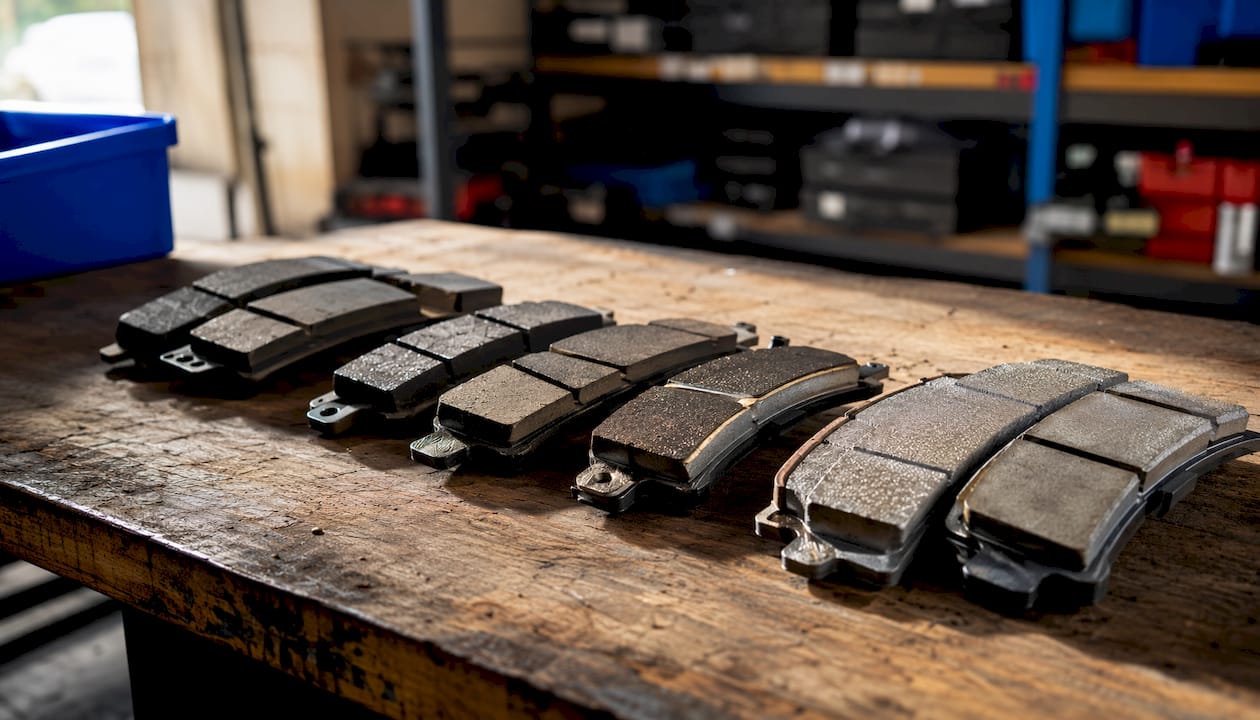
Here is how the major material families compare:
| Performance Dimension | Ceramic | Semi-Metallic | Full Metallic | Carbon-Ceramic Hybrid |
|---|---|---|---|---|
| Severe fade resistance | Moderate | High | Very high | High |
| Rotor friendliness | Excellent | Moderate | Poor | Good |
| Cold bite | Moderate | Good | Good | Good |
| Dust and noise | Low | Moderate | High | Low–moderate |
| Expected wear life | Long | Moderate | Short–moderate | Long |
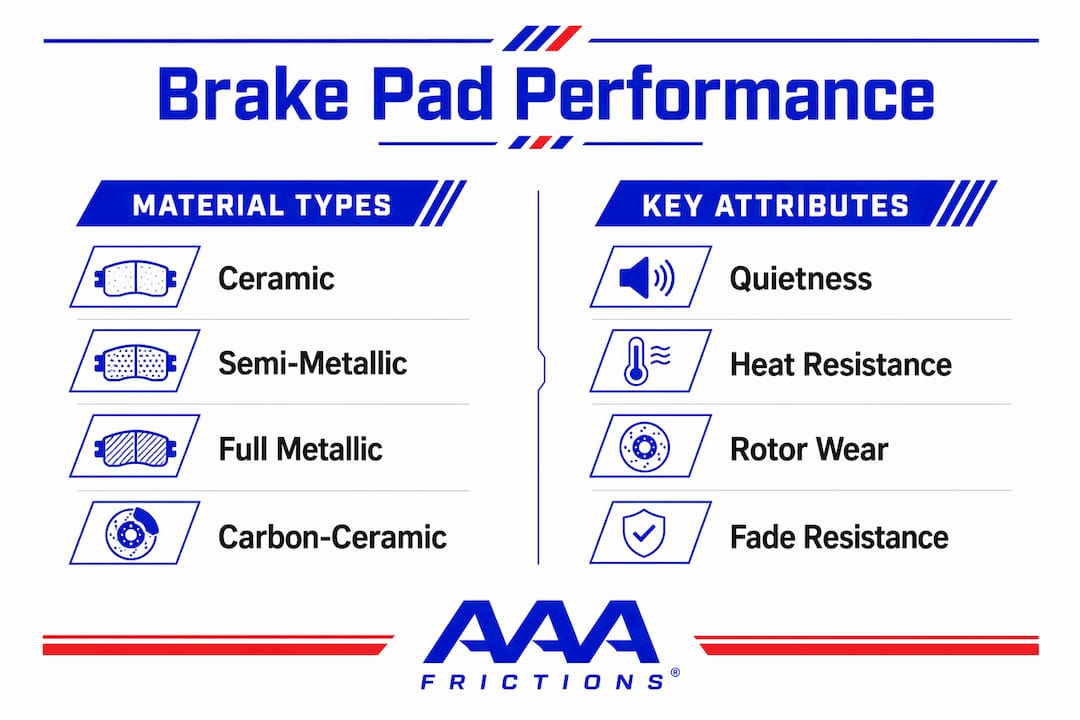
Full metallic compounds deliver the highest bite and fade resistance, but they accelerate rotor wear and generate significant dust. Pure ceramics are gentle on rotors and quiet, yet they can fall short of extreme high-temperature capacity unless specifically engineered for severe duty. Carbon-ceramic hybrids occupy the practical middle ground: they bring carbon’s heat resistance into a ceramic matrix that stays rotor-friendly and low-dust. Fleet-grade severe-duty formulations also target longer service life and low noise, which matters for vehicles that log high annual mileage.
Copper-free formulations are increasingly the standard across severe-duty lines. Commercial-grade copper-free pads report up to 33% less rotor wear compared with leading OEM linings, which directly extends the service interval between rotor replacements.
How to choose the right heavy-duty brake pad for your vehicle
Prioritize heat resistance, rotor-friendliness, moisture management, vehicle fitment, and a verified warranty. In that order.
Buying checklist:
- Confirm exact fitment — year, make, model, trim, axle position. Never assume a pad fits based on vehicle class alone.
- Assess your duty rating — towing capacity, average payload, and terrain type determine the compound aggressiveness you actually need.
- Choose compound type — carbon-ceramic hybrid for mixed towing/daily use; semi-metallic for pure fleet/severe-stop applications.
- Inspect rotor condition — worn or grooved rotors shorten pad life and reduce performance; resurface or replace before installing severe-duty pads.
- Check bedding requirements — severe-duty pads require a specific break-in sequence; confirm the procedure before installation.
- Review warranty and return policy — a manufacturer that stands behind performance specs signals genuine confidence in the product.
Questions to ask your parts supplier or mechanic:
- Does this pad require rotor resurfacing before installation?
- What is the recommended bedding procedure for this compound?
- What lifespan should I expect under my towing load?
Statistic callout: A 15,000-mile field evaluation of carbon-fiber ceramic pads reported up to approximately 30% perceived improvement in stopping under heavy loads compared with standard pads.
Why moisture management matters for Canadian heavy-duty braking
Moisture management and thermal-shock resilience materially improve pedal consistency and reduce corrosion in seasonal climates. This is not a marketing claim — it reflects a real engineering gap that many severe-duty pads leave unaddressed.
When a vehicle sits overnight in Manitoba’s freeze-thaw cycle, moisture condenses on rotor and pad surfaces. The first few brake applications on a cold, wet morning can produce a momentary drop in friction coefficient before the surfaces clear. For a daily commuter, that lag is minor. For a driver pulling a loaded trailer onto a highway, it is a genuine safety variable.
Moisture and thermal management in pad formulation directly addresses this by maintaining reliable friction during the transition from cold-wet to operating temperature. Aaafrictions’ HydroAdaptive ceramic technology is engineered specifically for this: the formulation clears moisture from the friction interface rapidly and maintains stable behavior across the temperature band shifts common in Canadian seasons.
Real-world benefits for Manitoba drivers:
- Consistent pedal feel from the first stop of the day, even after overnight rain or snowfall.
- Reduced surface corrosion when paired with GC GEOMET-coated rotors.
- Predictable fade resistance on long descents, where thermal shock from cold air and hot rotors is most pronounced.
- Vehicle-specific Type 03 and Type 07 kit configurations available for common Canadian trucks and SUVs.
The recommended heavy-duty upgrade for Canadian drivers
For towing, hauling, and seasonal driving in Canada, the Aaafrictions Type 07 HydroAdaptive+ kit is the top practical choice. Where vehicle fitment calls for it, the Type 03 pad set covers lighter heavy-duty applications.
Type 07 kit profile:
- Best for: Towing, loaded SUVs, fleet vehicles, and drivers facing repeated seasonal moisture exposure.
- Compound: HydroAdaptive+ ceramic with moisture-clearing formulation.
- Heat and fade profile: Engineered for temperature band adaptability across cold-start and high-load conditions.
- Rotor friendliness: High — ceramic matrix preserves rotor surface better than semi-metallic alternatives.
- Noise and dust: Low. Clean braking with minimal wheel dust.
- Availability: Vehicle-specific kits for common Canadian trucks and SUVs, including configurations for Honda Pilot, Hyundai Santa Fe, Toyota Highlander, and others.
Buying steps:
- Go to the Aaafrictions fitment page and enter your year, make, and model.
- Select the Type 07 kit with GC-coated rotors if you drive on salted roads or tow regularly.
- Choose pads-only if your rotors are recently replaced and in good condition.
- Complete checkout — kits ship to Canadian postal codes.
- Install with a trusted local mechanic or follow the included bedding procedure.
When not to choose this: Daily drivers who never tow, carry light loads only, and prioritize absolute silence over heavy-duty fade resistance may find a standard OEM ceramic pad meets their needs without the additional investment.
What to expect after upgrading: installation and maintenance
Have rotors inspected and resurfaced if they show grooves or heat-checking before installing severe-duty pads. Installing aggressive friction material on worn rotors dramatically reduces both pad and rotor service life.
Installation and bedding sequence:
- Inspect rotors for grooves, scoring, and minimum thickness. Resurface or replace as needed.
- Clean caliper slides and apply appropriate brake lubricant to hardware contact points.
- Install new pads and hardware per the kit instructions.
- Perform the bedding sequence: Several moderate stops from a reasonable speed, allowing 30–60 seconds of cooling between each stop. Follow with 3–4 firmer stops from 80 km/h. Avoid coming to a complete standstill during the sequence to prevent pad material transfer in one spot.
- Allow the brakes to cool fully before normal driving.
Skipping this sequence can cause judder and uneven material transfer, which produces vibration and inconsistent pedal feel.
Maintenance intervals:
| Inspection Item | Interval (Heavy Use) | Interval (Mixed Use) (specific kilometer intervals removed due to lack of sourcing) |
|---|---|---|
| Pad thickness check | Every 15,000 km | Every 25,000 km |
| Brake fluid condition | Annually | Annually |
| Caliper slide lubrication | Every pad change | Every pad change |
For Manitoba roads, pair your pads with GC GEOMET-coated rotors to resist the accelerated corrosion that road salt causes. Coated rotors prevent the surface rust and seizing that shortens rotor life in salt-prone climates.
What does a heavy-duty brake upgrade actually cost?
Pad-only upgrades for a standard truck or SUV axle typically run at moderate prices depending on compound and vehicle fitment. A complete front-and-rear kit including ceramic pads and GC-coated rotors is generally higher priced for most common Canadian vehicles.
The more useful frame is cost-to-life. A premium ceramic kit that lasts 50,000–70,000 km under mixed towing use costs less per kilometer than a budget pad replaced every 20,000–25,000 km, especially when you factor in rotor wear. Aggressive metallic pads that require rotor replacement every cycle eliminate the savings quickly.
For fleet operators, the math is clearer still. Longer pad life, reduced rotor wear, and fewer unscheduled maintenance stops lower the total operating cost per vehicle over a year.
Comparing heavy-duty brake pad approaches: pros and cons
No single compound is right for every driver. Here is a practical comparison by approach:
Carbon-ceramic hybrid (e.g., Aaafrictions HydroAdaptive): Strong fade resistance, rotor-friendly, low dust, weather-adaptive. Best for mixed towing and daily driving. Slightly higher upfront cost than budget semi-metallics.
Semi-metallic severe duty: High initial bite and excellent heat capacity. Works well for pure fleet or stop-and-go applications. Generates more dust and noise, and is harder on rotors over time. Not ideal for drivers who also use the vehicle for daily commuting.
Full metallic / ferro-carbon: Maximum friction coefficient and fade resistance. Designed for Class 2+ commercial vehicles and extreme towing. Operating temperature range is narrow — these pads need heat to work well, which makes cold-start performance inconsistent. Incompatible with carbon-ceramic rotors.
Standard OEM ceramic: Quiet, clean, rotor-friendly. Appropriate for light daily use. Falls short under sustained heavy loads or repeated high-temperature stops.
For most Canadian drivers who tow or haul regularly, the carbon-ceramic hybrid approach delivers the best balance. For severe-duty automotive upgrades in general, matching the compound to the actual operating environment is what separates a good upgrade from a costly mistake.
How Canadian road salt affects brake pad performance
Manitoba roads receive heavy salt application from November through March. That salt accelerates corrosion on every metal component in the brake system, including rotor faces, caliper hardware, and backing plates.
Standard uncoated rotors develop surface rust within days of salt exposure. While light surface rust clears with the first few brake applications, repeated salt cycling causes deeper pitting that creates uneven pad contact, vibration, and premature rotor failure. Caliper slides seize when lubricant is displaced by salt-laden moisture, causing uneven pad wear and pulling.
The practical response is straightforward: choose pads with corrosion-resistant stainless-steel hardware and pair them with GC GEOMET-coated rotors. The GEOMET coating bonds to the rotor surface and resists salt penetration through the full service life of the rotor. Aaafrictions Type 07 kits are available with GC-coated rotors specifically for this reason.
Brake fluid also deserves attention. DOT 4 fluid absorbs moisture over time, which lowers its boiling point. In a vehicle that tows in summer heat and then sits through a Manitoba winter, annual fluid replacement is a practical safeguard.
Environmental considerations for heavy-duty brake pads
Brake pad composition has a direct environmental impact. Copper particles from older pad formulations wash off rotors into stormwater and accumulate in waterways, where they are toxic to aquatic life. Several North American jurisdictions have moved to restrict copper content in brake pads, and the industry has largely shifted toward copper-free formulations.
Aaafrictions HydroAdaptive ceramic pads use a copper-free formulation. Ceramic compounds also generate finer, less reactive dust particles compared with metallic pads, reducing the particulate load on local air and road surfaces.
Longer pad life is itself an environmental benefit. A pad that lasts 60,000 km instead of 25,000 km means fewer manufacturing cycles, less packaging waste, and fewer disposal events. Rotor-friendly formulations extend rotor life on the same logic.
For Manitoba drivers who want a high-performance upgrade that also reduces their environmental footprint, a copper-free ceramic or carbon-ceramic hybrid is the straightforward choice.
Key Takeaways
For Canadian drivers who tow, haul, or face seasonal moisture, Aaafrictions HydroAdaptive ceramic kits deliver the most complete heavy-duty braking upgrade available for Canadian vehicles.
| Point | Details |
|---|---|
| Match pad to duty cycle | Choose compound aggressiveness based on actual towing/hauling load, not marketing tier. |
| Carbon-ceramic hybrid wins for mixed use | Balances fade resistance and rotor friendliness better than full metallic or standard ceramic alone. |
| Moisture management is a Canadian priority | HydroAdaptive formulation clears moisture at the friction interface for consistent cold-start pedal feel. |
| Salt demands coated rotors | Pair pads with GC GEOMET-coated rotors to prevent premature corrosion on Manitoba’s salted roads. |
| Aaafrictions Type 07 kit | Vehicle-specific HydroAdaptive+ kits with GC rotors are the recommended heavy-duty upgrade for towing and seasonal driving in Canada. |
Why we recommend HydroAdaptive as the balanced heavy-duty choice
Most heavy-duty brake pad guides focus on stopping power numbers and ignore the conditions under which those numbers were measured. A pad that performs well on a dry test track in controlled temperature may behave very differently on a cold Manitoba morning after an overnight freeze-thaw cycle. That gap is where most drivers experience the real difference between a good pad and the right pad.
Our engineering priority at Aaafrictions has always been consistent braking behavior across the full range of conditions a Canadian driver actually encounters: cold starts, wet roads, salt exposure, and the thermal demands of sustained towing. The HydroAdaptive formulation addresses all of these in a single compound. The vehicle-specific kit approach means the friction profile, rotor pairing, and hardware are matched to your exact vehicle rather than approximated from a universal fit.
For readers who want to go deeper into the technical specifications, the HydroAdaptive technology page covers the formulation principles and performance data in detail.
Aaafrictions HydroAdaptive kits: how to order
Manitoba drivers who tow, haul, or simply want reliable braking through every season get the most complete upgrade from an Aaafrictions Type 07 HydroAdaptive+ kit with GC rotors. The kit includes ceramic pads engineered for moisture management, GC GEOMET-coated rotors for salt resistance, and all necessary hardware — no sourcing multiple parts from different suppliers.

Ordering takes three steps: enter your vehicle details on the fitment search page to confirm compatibility, select the Type 07 kit with GC rotors for heavy-duty or salt-exposed use (or the Type 03 set for lighter applications), and complete checkout. Kits ship directly to Canadian postal codes. Installation can be handled by any qualified local mechanic using the included bedding procedure and instructions.
Useful sources and further reading
- Aaafrictions HydroAdaptive Formulation — technical overview of moisture-clearing ceramic technology and temperature band adaptability.
- Aaafrictions Type 07 Kit with GC Rotors — product page with fitment details and kit contents.
- Aaafrictions Type 03 Brake Pads Set — lighter heavy-duty pad option for applicable vehicles.
- CarXplorer: Carbon-fiber ceramic pad field evaluation — real-world performance data including stopping improvement under load.
- NGBIA: Severe-duty brake kit review and coated rotor guidance — application-specific selection principles and salt-climate rotor recommendations.
- Wagner Brake Canada: Severe Duty moisture and thermal management — industry context on moisture management as a severe-duty differentiator.
- Akebono Severe Duty fleet pad specifications — fleet-grade NVH and rotor-compatibility data.
- Marathon DiscStar DSTP: copper-free severe service — copper-free formulation and rotor-wear reduction data for environmental reference.
Recommended
- Type 07 Brake Pads Set – AAA Frictions
- Front and Rear Brake Kit for Honda Pilot 2003-2008, Type 07 HydroAdaptive+ Ceramic Disc Brake Pad and Rotor Set with GC Type GEOMET Coated Rotors
- Front and Rear Brake Kit for Freightliner Sprinter 2500 2007-2018, Type 07 HydroAdaptive+ Ceramic Disc Brake Pad and Rotor Set with GC Type GEOMET Coated Rotors
- Type 03 Brake Pads with Type SC Rotors Kit – AAA Frictions