

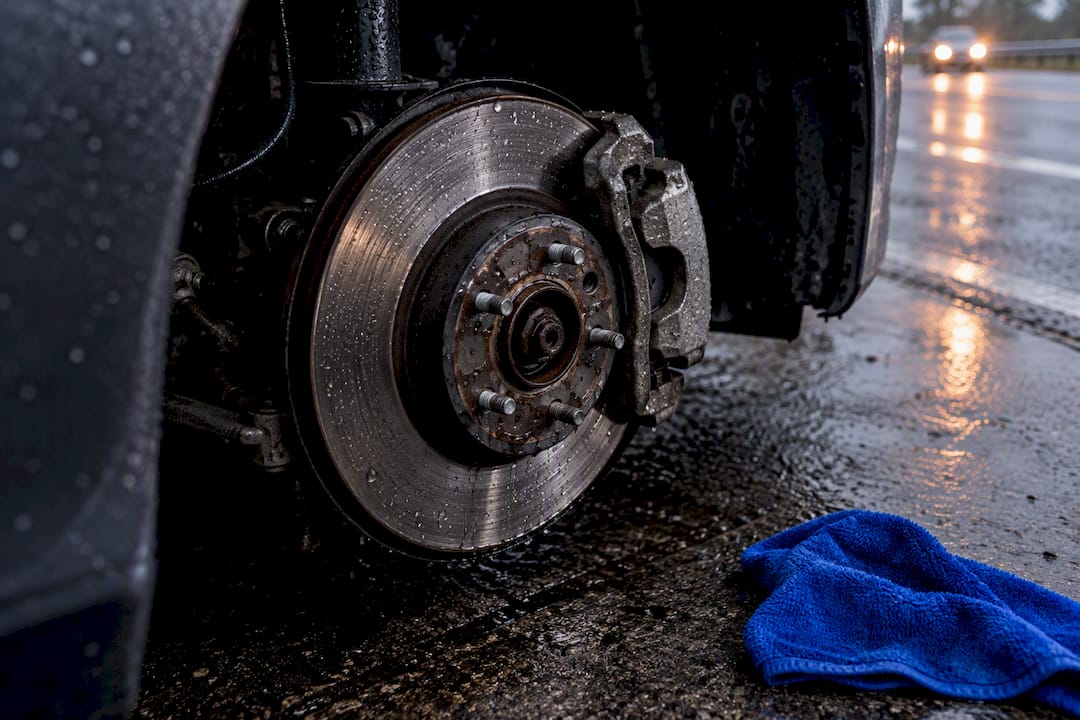
Wet brake fade is usually a temporary drop in friction between pad and rotor, caused by a thin water film at the contact surface. It is rarely a sign your brake system has failed. The priority is simple: increase your following distance right away, then dry the brakes with a few controlled, gentle stops. Book a shop visit only if the pedal feels unusually hard or stopping distance stays long after several dry stops.
TL;DR:
- Wet brake fade is a temporary friction loss caused by water films on the contact surface, especially at low speeds.
- Factors influencing wet fade include pad material, rotor design, wheel aerodynamics, humidity, and road water accumulation.
- Signs of wet fade include delayed braking response and quick improvement after a few stops, while mechanical issues show persistent symptoms.
- Immediate correction involves increasing following distance, performing gentle stops to dry brakes, and avoiding aggressive braking in rain.
- Long-term prevention depends on moisture-resistant pads, rotor condition, brake maintenance, and choosing weather-adaptive brake components.
Table of Contents
- What causes brake fade in rain?
- How do you tell wet fade apart from a real brake problem?
- What should you do right away if your brakes feel weak in the rain?
- What maintenance choices actually reduce wet-fade risk?
- When should you get a professional inspection?
- AAA Frictions’s approach to wet-weather braking
- Does weather severity change how bad wet fade gets?
- What happens to your brakes after repeated wet fade over time?
- What we think drivers get wrong about wet brakes
- Get weather-adaptive brakes built for wet roads
- Sources
- FAQ
What causes brake fade in rain?
Wet fade happens when water reaches the contact surface between pad and rotor before centrifugal force and heat can throw it clear. That thin film lowers or destabilizes the friction coefficient, especially at low speed, which is exactly when drivers notice it most, pulling out of a driveway or crawling through a parking lot. SAE research on moisture adsorption confirms this is a measurable, distinct phenomenon, separate from thermal fade, which comes from overheated friction material or boiled brake fluid after hard, repeated braking on a mountain descent, for instance.
Several factors interact to decide whether you feel wet fade at all:
- Wheel aerodynamics and spray path determine whether water is thrown at the rotor face or deflected away from it.
- Pad material affects how quickly moisture is absorbed and displaced at the friction surface, with humidity itself capable of modulating grip through capillary effects between the surfaces, according to research on meniscus and humidity effects on brake friction.
- Rotor design and surface condition change how fast heat builds to evaporate residual water.
- Ambient humidity and standing water depth on the road decide how much moisture reaches the contact patch in the first place.
That is why one car in a parking lot can feel spongy after a puddle crossing while the one beside it feels normal. Pad compound, rotor design, and wheel-well geometry all play a role, not just the weather.
How do you tell wet fade apart from a real brake problem?
Wet fade has a recognizable signature, and it is worth learning it so you are not guessing at highway speed.
- Delayed first bite. The pedal needs more travel than usual before the car starts slowing.
- Grabbing or squeal on the first one or two stops. This settles down as the pads dry.
- Inconsistent feel between the first stop and the third or fourth. Braking sharpens noticeably as moisture clears.
Those three signs point to wet fade, and they should improve within a short distance of normal driving. A different pattern means something else is going on:
- A hard, wooden pedal that needs far more force than normal. This often points to lost power assist rather than moisture. Transport Canada’s brake-assist guidance notes that effective stopping still depends on a properly functioning assist system, not just road conditions.
- A sudden, large jump in stopping effort that does not ease after a few gentle stops.
- Warning lights on the dash, especially the brake or ABS light, appearing alongside the odd pedal feel.
If you see any of the second set, treat it as a mechanical issue, not weather.
What should you do right away if your brakes feel weak in the rain?
Your first move is always distance, not diagnosis. Back off and give yourself more room before you try to figure out what is happening.
- Open your following gap immediately. The 4-second rule for wet roads gives you the buffer a shorter dry-weather gap simply does not.
- Slow earlier than you normally would, easing off the throttle well before you need to brake hard.
- Perform a few gentle, deliberate stops from low speed on a clear stretch, away from traffic. This lets friction heat evaporate the water film and restores the pad-to-rotor contact (AAA Frictions’s step-by-step drying guide walks through the technique).
- Reassess after three or four stops. If the pedal feels normal and stopping distance has shortened, you were dealing with wet fade.
- Stop driving and call for help if the pedal stays hard, if ABS or power assist seems to have dropped out, or if stopping distance has not improved at all. Do not keep testing a car that feels mechanically wrong.
Pro Tip: A short, measured cruise with light, deliberate braking dries pads more evenly than one hard stomp on the pedal. Aggressive braking generates heat unevenly and can mask a real problem instead of clearing it.
What maintenance choices actually reduce wet-fade risk?
Long-term prevention comes down to parts condition and a handful of driving habits, not luck.
- Pad material matters. Some ceramic formulations manage moisture at the friction surface better than others, which affects how quickly low-speed grip returns after water exposure.
- Rotor surface condition counts almost as much as the pad. Light surface corrosion, often called flash rust, forms quickly after a wet drive and a parked cool-down; a few normal stops usually clear it, but persistent flash rust is worth a look during your next service.
- Brake shields and ducting are a genuine trade-off. Tighter shielding keeps more water out but can also trap heat, so shops weigh symptom recurrence against cooling needs before changing a shield’s design, a balance also documented in wind-tunnel wet-fade testing.
- Tyre condition changes your stopping distance independently of the brakes. Worn tread loses grip on wet pavement well before the brake system reaches its limit.
- Brake fluid needs periodic attention. Contaminated or moisture-laden fluid lowers its boiling point and can produce a soft, spongy pedal that mimics wet fade but will not clear on its own.
- Regular wheel-well cleaning also matters. Contaminant buildup near the rotor face changes how water and debris interact at the friction surface, a point echoed in detailing guidance on wheel and brake-dust removal.
When should you get a professional inspection?
Some symptoms are not worth troubleshooting yourself. Book a shop visit promptly if you notice any of the following:
- A pedal that stays hard or unusually stiff, suggesting lost assist rather than moisture.
- Stopping distance that stays long even after several gentle, deliberate stops on dry pavement.
- Persistent squeal, grinding, or a spongy pedal that does not improve with driving, which can point to worn pads or fluid contamination rather than water on the surface.
- Any brake or ABS warning light, especially one that appears alongside a change in pedal feel.
When you book the appointment, ask specifically for a fade-and-recovery test and a water-recovery check, the same evaluations referenced in Canada’s technical standard for brake performance. Also request a brake-assist diagnostic and a rotor wear and contamination check. Naming the tests gets you a faster, more targeted diagnosis than a general “brakes feel off in the rain” complaint.
AAA Frictions’s approach to wet-weather braking
AAA Frictions built its HydroAdaptive ceramic technology specifically to address the moisture-related friction loss described above. According to AAA Frictions’s technology page, the system is engineered to clear moisture quickly at the friction surface and maintain consistent contact across rain, humidity, and snow, aiming at the exact symptoms this article covers: delayed first bite, inconsistent stops, and grabbing on the first application.
- Targets the wet-fade symptoms drivers report most: soft or delayed first stop and inconsistent pedal feel.
- Pairs a moisture-managing pad compound with rotor and caliper components designed for the same climate conditions.
- Suits drivers who face rain, humidity, or seasonal transitions regularly, not just occasional wet commutes.
| Component | What it targets |
|---|---|
| Type 03 Brake Pads | Every day wet-weather commuting, moisture-managing compound |
| Type 07 Brake Pads | Broader climate-adaptive range, including cold and humid swings |
| SC Type Rotors | Semi-coated surface aimed at reducing flash rust recurrence |
| GC Type Rotors | GEOMET-coated option for added corrosion resistance |
Drivers replacing worn pads or rotors after repeated wet-fade complaints can start with the Type 03 pads or Type 07 pads, paired with SC Type or GC Type rotors for a matched set.
Does weather severity change how bad wet fade gets?
Light drizzle rarely produces noticeable fade because there is not enough standing water to reach the rotor face in volume. Heavy, sustained rain is a different story: deeper puddles, more road spray, and saturated pavement all push more water toward the wheel well, which raises the odds of a delayed first stop.
Driving environment matters as much as rainfall intensity. Highway driving in rain tends to generate less wet fade than stop-and-go city driving, because sustained speed keeps rotor temperature higher and helps evaporate moisture continuously. A car that just sat parked overnight in humid weather, then pulls straight into traffic, often shows the strongest symptoms. This is the classic “first stop of the morning” complaint, and it lines up with what researchers have called capillary or meniscus effects between pad and rotor surfaces at low speed, described in studies on humidity and brake friction.
Cold, wet weather compounds the issue further. Low ambient temperature slows the evaporation that would otherwise clear residual moisture between stops, so pads and rotors can stay damp longer than they would on a mild, rainy afternoon. Mountain and rural driving in fog or persistent drizzle adds another variable: extended descents combine wet fade’s low-speed friction loss with the heat buildup of thermal fade, a combination that deserves extra following distance and earlier, gentler braking.

What happens to your brakes after repeated wet fade over time?
Occasional wet fade does not damage your brake system. It is a temporary friction change, not wear. Repeated exposure without proper drying, though, does leave marks over months and years.
Rotors that stay damp regularly develop flash rust more often, and while light surface rust usually wears off within a few stops, frequent recurrence can etch a rougher surface texture into the rotor face over time. That rougher surface changes pad wear patterns, sometimes unevenly, which can show up later as pulsation or vibration under braking.

Pad compounds absorb some moisture with each wet cycle, and materials that do not shed water efficiently can develop a slightly altered friction profile after extended exposure, contributing to more frequent low-speed grabbing or squeal even in only mildly damp conditions. Caliper components exposed to repeated moisture cycles are also more prone to corrosion at pins and slides, which can lead to uneven pad contact and, eventually, uneven pad wear across an axle.
None of this happens overnight, and none of it turns a single rainy commute into an emergency. But a vehicle that regularly sits in humid climates, or that faces frequent rain without ever getting a proper dry-out drive, tends to need brake service sooner than one that rarely deals with wet fade at all.
What we think drivers get wrong about wet brakes
Most drivers treat any softness in the pedal during rain as a single problem with a single fix, and that is where the conventional advice falls short. Wet fade and a genuine mechanical fault feel similar for the first second or two, but they demand completely different responses. Ease off and drive through wet fade with a few gentle stops. A hard pedal or a warning light needs a shop, not patience.
The bigger blind spot is prevention. Drivers fixate on the moment fade happens instead of asking why their setup makes it worse than a comparable car in the next lane. Pad material, rotor surface, and shield design all shape how much water reaches the friction surface in the first place, and that is a parts and maintenance question, not a driving-technique question.
If we had to prioritize one thing for readers of this guide, it would be this: learn the difference between “delayed but improving” and “hard and not improving” before you are stuck applying that judgment in traffic during a downpour. Everything else, drying technique, shop diagnostics, part upgrades, follows from getting that first read right.
— AAA
Get weather-adaptive brakes built for wet roads
If you are tired of that first-stop hesitation every time it rains, a parts upgrade solves what driving technique alone cannot. AAA Frictions builds its pads and rotors around HydroAdaptive ceramic technology specifically to clear moisture fast at the friction surface and hold consistent grip through rain, humidity, and snow, rather than leaving you to manage the symptom stop after stop.

Drivers dealing with recurring wet fade typically start with the Type 03 Brake Pads for every day wet-weather commuting, or the Type 07 Brake Pads if their climate swings between cold, wet, and dry through the seasons. Pairing either with SC Type Rotors or GC Type Rotors adds corrosion resistance where flash rust has been a recurring issue. Not sure which combination fits your vehicle? Check the guide to choosing the right brake pads for your specific make and model, then order the set that matches your driving conditions.
Sources
The claims in this guide draw on independent testing standards and peer-reviewed research, alongside AAA Frictions’s own troubleshooting resources:
- Effect of moisture adsorption on low-speed and moderate-speed braking
- Brake assist — Transport Canada
FAQ
Why do my brakes feel better once I have been driving in the rain a while?
Because the first stop or two clears the water film sitting between the pad and rotor. Once that moisture evaporates from friction heat, the pad regains normal contact, and the pedal feels sharper on subsequent stops, exactly the pattern SAE research on moisture adsorption describes.
Will brake fade go away on its own?
Wet fade almost always clears on its own after a few gentle, controlled stops as the pads and rotors dry. Thermal fade needs a longer cool-down period and, if it recurs often, a look at pad and rotor condition, since repeated heat cycling wears friction material faster than normal use.
Is it okay to brake normally while driving in the rain?
Yes, but give yourself more room to do it. Ease off the throttle earlier, extend your following distance using something like the 4-second rule, and expect the first stop or two to feel slightly delayed until moisture clears.
If my brakes are wet, how can I dry them out?
Perform a few deliberate, gentle stops from low speed on a clear stretch of road, which lets friction heat evaporate the water at the pad-rotor surface. AAA Frictions’s drying guide walks through the exact technique, and pads built with HydroAdaptive technology are designed to clear that moisture faster than standard ceramic compounds.