

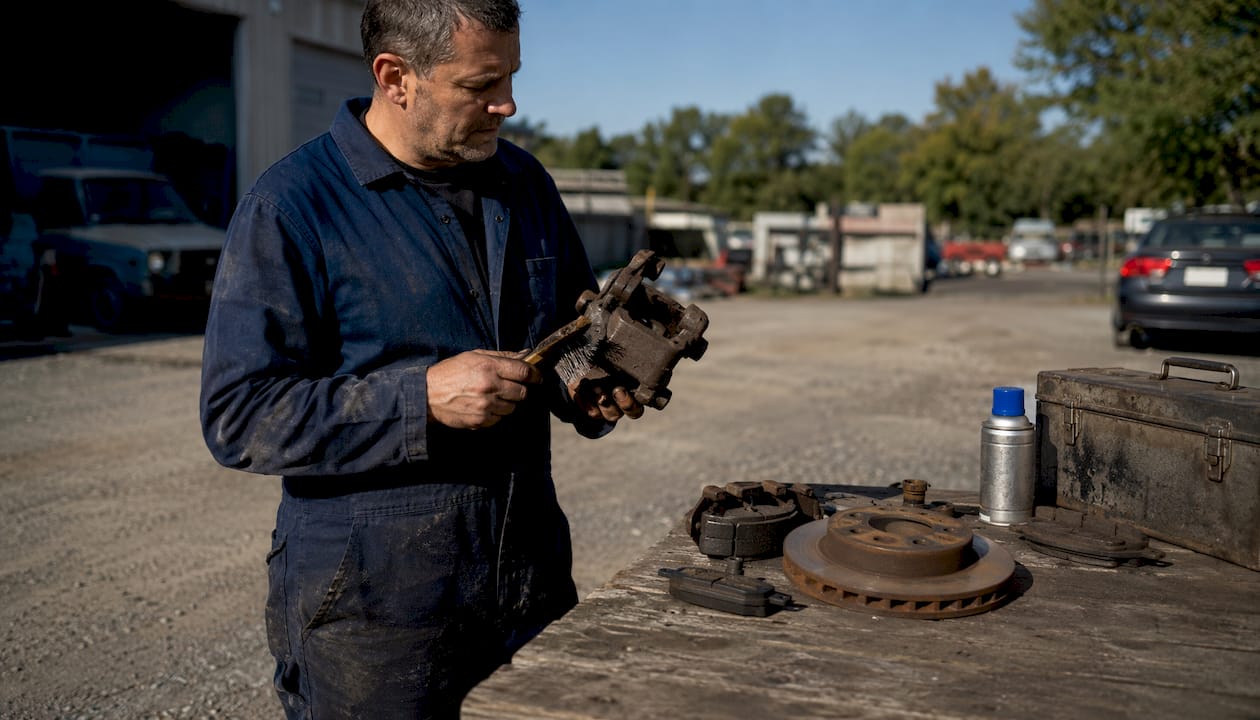
Brake caliper corrosion is one of the most common issues Ontario drivers face, and the answer to whether it’s a problem depends entirely on how far it has progressed. Surface rust begins almost immediately after installation in moist, salt-exposed environments, which means even new calipers can look rusty after a single wet week in Toronto or Hamilton. That orange tint is usually cosmetic. What’s not cosmetic is when corrosion works its way into the piston bores, guide pins, or seals.
Here’s the quick breakdown:
- Normal and cosmetic: Light surface rust on caliper housing, no noise, no pulling, no fluid leaks
- Needs attention: Squeaking or grinding during braking, uneven pad wear, or a soft pedal feel
- Safety risk: Seized pistons, binding guide pins, damaged seals, or visible fluid leakage near the caliper
- Critical: Brakes pulling hard to one side, complete loss of pad retraction, or brake fade under normal driving
Light surface rust is a cosmetic issue unless it’s accompanied by functional symptoms. Once corrosion reaches the sliding and hydraulic components, it can cause uneven pad wear, reduced braking efficiency, and in severe cases, brake failure. Regular inspection is the line between a minor maintenance task and a costly repair.
Table of Contents
- What causes brake caliper corrosion on Ontario vehicles?
- Common brake caliper problems that corrosion causes
- How to prevent caliper corrosion in Ontario’s climate
- How to repair corroded brake calipers safely
- Advanced braking solutions for corrosion and moisture management
- The types of corrosion that affect brake calipers
- How Ontario’s freeze-thaw cycles intensify caliper rust
- Protective coatings and treatments built for Canadian winters
- Environmentally safe cleaning agents for brake calipers in Ontario
- Cost and availability of corrosion-resistant calipers in Canada
- Aaafrictions builds brake systems for Ontario winters
- Key Takeaways
What causes brake caliper corrosion on Ontario vehicles?
Ontario’s climate creates near-perfect conditions for accelerated caliper rust. The province’s freeze-thaw cycles, heavy winter precipitation, and aggressive road treatment practices combine to attack exposed brake metal from multiple directions.
The primary culprits:
- Road salts and liquid brines: Calcium chloride and magnesium chloride used in Ontario’s liquid brine treatments are significantly more corrosive than traditional rock salt. They penetrate surface coatings faster and stay active on metal longer.
- Moisture and freeze-thaw cycling: Water infiltrates micro-cracks in caliper surfaces, then expands as it freezes. This mechanical stress accelerates oxidation and can crack protective coatings.
- Brake fluid contamination: A slow leak from a degraded piston seal introduces hygroscopic brake fluid to the caliper exterior, which draws additional moisture and accelerates rust formation.
- Mechanical wear: Scratches from road debris or worn guide pin boots expose bare metal directly to the elements.
- Infrequent driving: Vehicles parked for extended periods, especially outdoors in winter, accumulate moisture without the heat generated by regular braking to dry it off.
Local rustproofing specialists like Krown Rust Control and Auto Edge Rustproofing in Mississauga offer annual undercarriage treatments that address brake component exposure as part of a broader corrosion management program. Maintenance intervals of about two years for inspection and rustproofing are recommended for Ontario vehicles.
Common brake caliper problems that corrosion causes
Corrosion doesn’t just change how your calipers look. It changes how they function, and the mechanical consequences follow a predictable pattern.
- Seized pistons: Rust inside the piston bore prevents the piston from retracting after braking. The pad stays in contact with the rotor, generating heat, accelerating wear, and reducing fuel efficiency.
- Binding guide pins: Corroded or dry guide pins prevent the caliper from sliding freely. One pad wears faster than the other, and you may feel the vehicle pulling during braking. Uneven brake pad wear is one of the clearest early indicators of this problem.
- Damaged piston seals: Corrosion around the seal groove allows fluid to bypass the seal, causing leaks and a gradual loss of hydraulic pressure.
- Brake noise: Rusty calipers can produce squeaking or grinding and contribute to increased heat and brake fade during use.
- Reduced braking efficiency: When pistons seize or guide pins bind, the full clamping force of the caliper is never applied evenly. Stopping distances increase.
Corrosion accelerates brake caliper failure mechanisms across all these categories, and the damage compounds quickly once it starts. Catching it early through regular inspection is far less expensive than replacing a full caliper assembly.
How to prevent caliper corrosion in Ontario’s climate
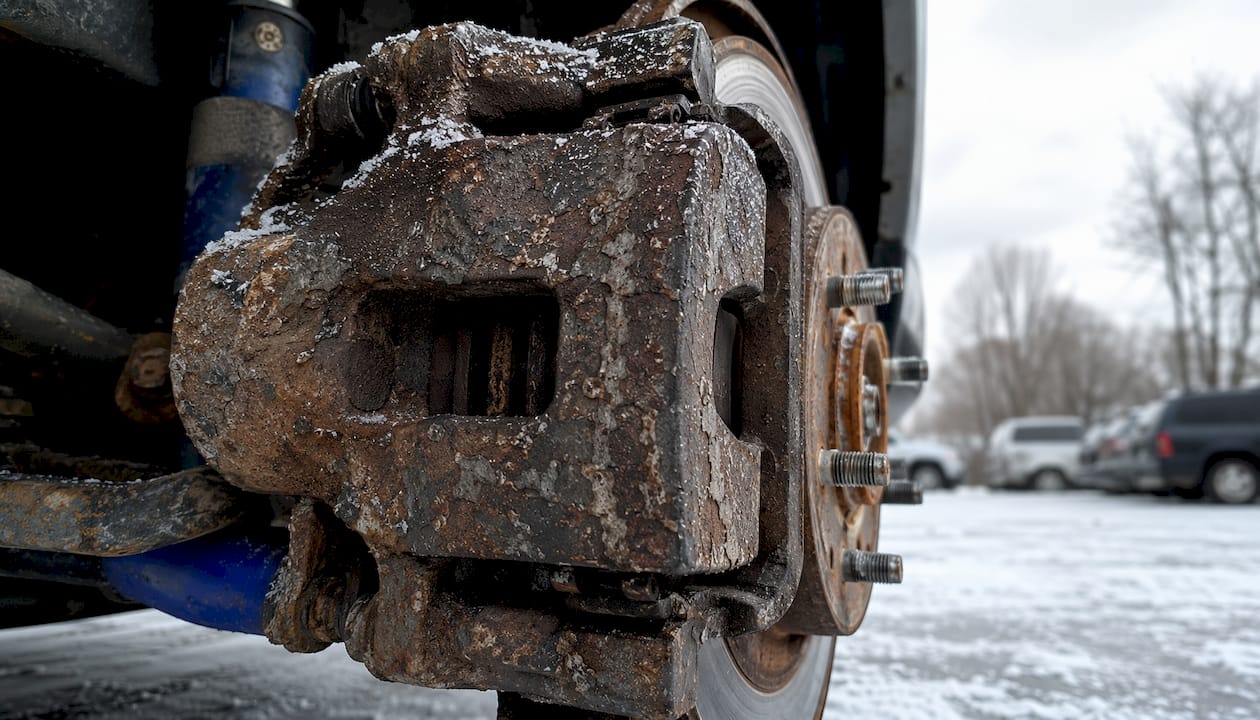
Prevention in Ontario requires more than a quick rinse. The combination of road salt, freeze-thaw cycling, and prolonged winter exposure demands a layered approach.
Practical prevention steps:
- Wash wheel wells and brake assemblies thoroughly after winter driving, especially after heavy salt exposure
- Apply a brake-specific degreaser to remove accumulated salt, grime, and brake dust every few months
- Lubricate caliper slide pins with a silicone-based or high-temperature brake lubricant at every brake service
- Use rust-inhibiting sprays on exposed caliper housing surfaces, avoiding friction surfaces and rotor faces
- Consider annual rustproofing treatments from providers like Krown Rust Control or Auto Edge Rustproofing
Caliper covers vs. painted calipers: which is better for Ontario winters?
| Protection Method | Corrosion Resistance | Cost (CAD) | Climate Suitability | Maintenance |
|---|---|---|---|---|
| Caliper covers | Physical barrier, moderate | — | Good, but traps moisture if improperly fitted | Low |
| Spray paint (high-heat) | Surface-level, limited | — | Adequate for mild conditions | Moderate (reapplication needed) |
| Electrostatic powder coat | High, seals metal fully | — | Excellent for harsh winters | Low |
| Professional rustproofing | Broad undercarriage protection | — | Excellent for Ontario conditions | Annual reapplication |
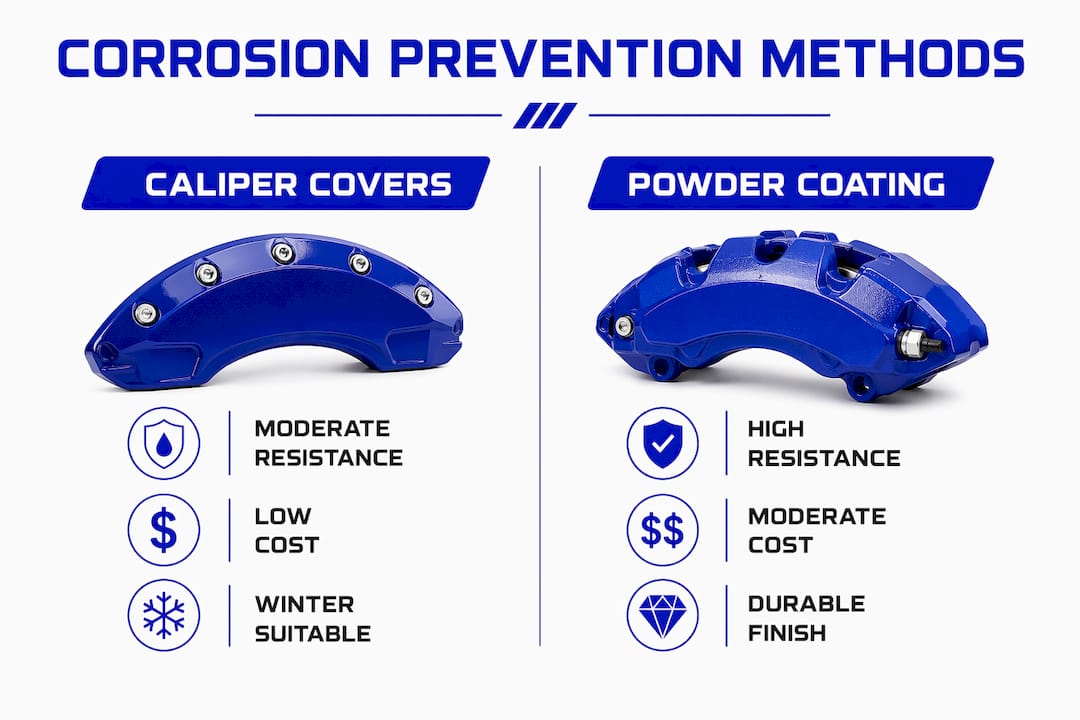
Electrostatic powder coating and galvanic finishes provide superior corrosion protection compared to spray paints, resisting moisture and salt by preventing trapped moisture under the coating layer. Caliper covers offer a physical barrier but can trap moisture if not fitted precisely, which is a real concern through Ontario’s wet spring thaws.
Pro Tip: Apply a thin layer of silicone-based lubricant to guide pin boots every time you rotate your tires. It takes two minutes and prevents the binding that leads to uneven pad wear.
How to repair corroded brake calipers safely
Knowing when to clean versus when to replace is the most important judgment call in caliper maintenance.
Inspection checklist for early detection:
- Listen for squeaking, grinding, or scraping during normal braking
- Check for uneven pad wear by comparing inner and outer pad thickness
- Look for brake fluid residue or wet spots near the caliper body
- Test for pulling: does the vehicle drift to one side when braking gently?
- Visually inspect guide pin boots for cracking or missing lubrication
Early detection mitigates the risk of caliper seizure and costly downstream repairs. If all symptoms are absent and rust is only on the outer housing, cleaning and recoating is appropriate.
DIY cleaning process:
- Remove the caliper and pads following standard brake service procedure
- Apply a brake-specific cleaner to dissolve salt deposits and surface oxidation
- Scrub with a wire brush or steel wool on non-sealing surfaces only
- Rinse thoroughly, dry completely, and apply a high-heat protective coating
- Lubricate guide pins and reinstall with fresh hardware if boots are cracked
If the piston won’t compress smoothly, the guide pins don’t slide freely after cleaning, or you find fluid leakage, professional inspection is the right call. Driving with a seized or leaking caliper is a safety risk that no coating can fix.
Advanced braking solutions for corrosion and moisture management
Aaafrictions’ ClimateFlex™ Brake Calipers are engineered specifically for the corrosion and moisture challenges that Ontario drivers deal with year-round. The design integrates corrosion-resistant materials and sealing systems that maintain reliable hydraulic function through repeated freeze-thaw exposure.
The broader Aaafrictions brake system ecosystem pairs these calipers with HydroAdaptive ceramic brake pads and GEOMET-coated rotors. HydroAdaptive technology rapidly clears moisture from the friction interface, maintaining consistent pad-to-rotor contact even in wet or slushy conditions. GEOMET coating on the rotors provides a zinc-rich barrier that resists rust formation on the rotor face and hat, reducing the surface rust that transfers to pad material during cold starts.
| Component | Technology | Corrosion Protection | Climate Performance |
|---|---|---|---|
| ClimateFlex™ Calipers | Corrosion-resistant seals and housing | High | Optimized for freeze-thaw cycling |
| HydroAdaptive Ceramic Pads | Moisture-clearing friction formulation | N/A | Consistent wet and cold braking |
| GEOMET Coated Rotors | Zinc-rich surface barrier | High | Resists salt and moisture oxidation |
| Type 07 Brake Kit | Full system integration | High | Engineered for variable climates |
The Type 07 Brake Pads + GC Rotors Kit combines all three components into a vehicle-specific kit, delivering a complete brake system upgrade rather than a piecemeal fix.
The types of corrosion that affect brake calipers
Not all caliper rust is the same. Understanding the type of corrosion helps you assess severity and choose the right treatment.
Uniform surface oxidation is the most common form. Iron in the caliper casting reacts with oxygen and moisture to form iron oxide across the exposed surface. This is the orange rust you see on a new caliper after a rainy week. It’s shallow, stable, and largely cosmetic.
Pitting corrosion is more serious. It develops when the protective oxide layer breaks down in localized spots, often accelerated by chloride ions from road salt. Small pits form in the metal surface, and because they concentrate stress and trap moisture, they deepen faster than they spread. Pitting on piston bores or guide pin channels directly compromises function.
Galvanic corrosion occurs when two dissimilar metals are in electrical contact in the presence of an electrolyte, which road brine provides readily. Aluminum caliper bodies paired with steel pistons or iron brackets are susceptible. The less noble metal corrodes preferentially. Anodized aluminum calipers with an oxide layer thickness between 15–25 microns, sealed with hydrothermal or nickel-free processes, can resist neutral salt spray exposure far longer than conventionally painted surfaces.
Crevice corrosion forms in tight gaps, such as between the caliper bracket and the knuckle, or under a poorly fitted caliper cover. Oxygen depletion in the crevice creates a localized electrochemical cell that accelerates metal loss.
How Ontario’s freeze-thaw cycles intensify caliper rust
Ontario’s winters don’t just bring cold. They bring repeated transitions between freezing and thawing that are mechanically destructive to brake components. A single week in February can cycle through these transitions multiple times, and each one stresses any coating or oxide layer on the caliper surface.
When water freezes inside a surface crack or under a paint layer, it expands by roughly 9%, forcing the crack wider. The next thaw fills that wider crack with more water, salt, and debris. By spring, what started as a hairline scratch in a powder coat has become an exposed metal channel feeding active pitting corrosion.
Road salt application in Ontario typically runs from November through March, with liquid brine pre-treatment becoming more common on provincial highways. This extends the period of chloride exposure and means calipers are under chemical attack for nearly half the year. Winterizing your vehicle before the first snowfall, including a fresh rustproofing treatment and brake system inspection, is the most effective single action an Ontario driver can take.
Protective coatings and treatments built for Canadian winters
The coating you choose for your calipers needs to handle thermal cycling from below -30°C to over 400°C at the rotor face, resist chloride penetration, and stay bonded through repeated wet-dry cycles.
High-heat powder coating is the most durable option for DIY or professional application. Electrostatic application creates a uniform film that bonds to the metal surface without the pinholes common in spray applications. It resists chipping from road debris and doesn’t trap moisture the way improperly applied liquid coatings can.
GEOMET coating, used on Aaafrictions’ GC-type rotors, is a water-based zinc-rich treatment applied at low temperature. It provides cathodic protection, meaning the zinc sacrifices itself to protect the underlying steel. This is the same principle behind galvanized steel, applied specifically to brake rotor geometry.
Ceramic-based thermal barrier coatings are used on high-performance calipers to reduce heat transfer to the brake fluid. They also provide a hard, chemically resistant surface that slows chloride penetration. These are typically applied professionally and are worth the investment on vehicles that see heavy winter use.
For aluminum calipers specifically, anodizing creates an oxide layer that is integral to the metal surface rather than applied on top of it. This makes it far more resistant to delamination under freeze-thaw stress than any paint or powder coat.
Environmentally safe cleaning agents for brake calipers in Ontario
Ontario’s environmental regulations and municipal stormwater guidelines discourage the use of petroleum-based solvents that can wash into storm drains. Fortunately, effective alternatives exist.
Aqueous brake cleaners use water-based surfactant formulations rather than chlorinated solvents. Brands like Permatex and CRC offer non-chlorinated, low-VOC brake cleaner options that meet Ontario environmental standards and are safe for use in home garages with adequate ventilation.
White vinegar is an effective light rust remover for surface oxidation on caliper housing. Soaking a cloth in undiluted white vinegar and applying it to rusted surfaces for 30–60 minutes loosens iron oxide without introducing harsh chemicals. It’s not suitable for internal components or sealing surfaces.
Citrus-based degreasers break down brake dust and road grime effectively and are biodegradable. They work well as a pre-clean before applying a rust treatment or protective coating.
Avoid using petroleum-based carburetor cleaners or chlorinated solvents near rubber seals and boots. These compounds degrade EPDM and neoprene rapidly, and a damaged piston boot is a direct path to caliper seizure.
Cost and availability of corrosion-resistant calipers in Canada
The Canadian market for rust resistant calipers has expanded significantly, driven by demand from provinces with heavy winter road treatment programs. Midland Calipers, distributed through major Canadian auto parts retailers, offers remanufactured and new calipers with protective coatings suited to Canadian conditions. Pricing for a single remanufactured caliper typically runs from $60 to $180 CAD depending on vehicle application, with premium coated units at the higher end.
Anti-Friction Durotech products, available through Canadian industrial and automotive distributors, include caliper and brake hardware treatments designed for high-corrosion environments. Their formulations are used in both OEM and aftermarket applications across Canada.
For complete brake system upgrades, Aaafrictions’ vehicle-specific kits are available directly through the Aaafrictions e-commerce store and ship across Canada. The Type 07 HydroAdaptive ceramic kit with GEOMET-coated rotors is priced competitively against mid-range dealer parts while delivering corrosion protection and moisture management that standard replacement parts don’t include.
Pro Tip: When pricing caliper replacements, factor in the cost of hardware kits, new guide pin boots, and fresh brake lubricant. Skipping these on a corroded caliper replacement is the fastest way to repeat the same problem within two years.
Aaafrictions builds brake systems for Ontario winters
Ontario drivers dealing with brake caliper rust don’t just need a cleaning guide. They need components engineered to resist the specific conditions that cause the problem in the first place.

Aaafrictions’ brake systems are built around that reality. The HydroAdaptive technology at the core of our ceramic pad formulation clears moisture from the friction interface on contact, maintaining consistent stopping power whether you’re braking on a dry highway or a slushy January on-ramp. Paired with GEOMET-coated rotors and ClimateFlex™ calipers, the full system addresses corrosion and moisture management as an integrated engineering problem, not an afterthought. Vehicle-specific kits ship directly to your door, and our product finder makes it straightforward to confirm fitment for your make, model, and year. If you’re ready to replace aging, corroded brake components with a system built for Canadian conditions, find your vehicle’s kit on the Aaafrictions store today.
Key Takeaways
Ontario’s freeze-thaw cycles and chloride-based road treatments make caliper corrosion unavoidable, but the difference between cosmetic rust and a safety risk comes down to where the corrosion reaches and how quickly you act.
| Point | Details |
|---|---|
| Surface rust is normal | Light oxidation on caliper housing is cosmetic and does not immediately affect braking safety. |
| Chloride brines accelerate damage | Calcium and magnesium chloride in Ontario road treatments are more corrosive than rock salt and attack calipers faster. |
| Pitting and galvanic corrosion are the serious types | These forms penetrate functional surfaces like piston bores and guide pin channels, causing seizure and fluid loss. |
| Powder coating outperforms spray paint | Electrostatic powder coat bonds uniformly to metal and resists freeze-thaw delamination better than liquid coatings. |
| Aaafrictions integrates corrosion protection | HydroAdaptive ceramic pads, GEOMET-coated rotors, and ClimateFlex™ calipers form a complete system engineered for Ontario conditions. |