

Humidity can cause phenolic brake piston material to absorb moisture and grow slightly in diameter, but this rarely happens on its own. The real culprits behind most sticking calipers are torn dust boots and moisture-saturated brake fluid, both of which let water reach the piston bore in the first place. Before assuming a piston problem, inspect the dust boots and run a brake-fluid moisture test. That single step clears up most misdiagnoses.
TL;DR:
- Moisture absorption causes phenolic pistons to grow slightly, but it is mainly moisture-saturated brake fluid and torn dust boots that lead to caliper sticking.
- Symptoms include uneven pad wear, pulling brakes, increased pedal travel, and wheel temperature disparities, which require simple inspections before removing the caliper.
- Regular heat cycling from driving can help drive moisture out of phenolic pistons, reducing the risk of binding, especially in daily drivers.
- Phenolic pistons are more resistant to corrosion but can swell with moisture, whereas steel pistons do not swell but are vulnerable to rust if not protected.
- Proper maintenance of dust boots and brake fluid moisture levels significantly reduces the risk of humidity-related caliper problems, regardless of piston material.
Table of Contents
- Recognizing symptoms of piston binding and how to diagnose them
- Why phenolic pistons absorb moisture and what the research shows
- Phenolic vs. steel pistons: the trade-offs that matter in humid climates
- How to prevent humidity-related caliper problems
- Which tests and tools confirm a moisture-related piston issue
- When to rebuild, replace the piston, or swap the caliper
- How climate-aware caliper and brake components fit into this picture
- A mechanic’s take on humidity and phenolic pistons
- Getting a climate-adaptive setup that matches this maintenance routine
- FAQ
- Sources
Recognizing symptoms of piston binding and how to diagnose them
A caliper piston affected by moisture uptake does not usually announce itself with a dramatic failure. It shows up as a collection of smaller signs that point toward dragging brakes rather than a clean mechanical fault.
Watch for these symptoms:
- A pull to one side under braking, often paired with a faint burning smell after a short drive.
- One wheel noticeably hotter than its opposite number after normal driving, checked with an infrared thermometer.
- Uneven pad wear from one side of the vehicle to the other, with one pad worn thinner than its partner.
- A spongy or inconsistent pedal feel that was not present before, sometimes with a slight increase in pedal travel.
- Reduced fuel economy or a vehicle that feels like it is working against itself at low speed.
Diagnosing the cause means working from the simplest explanation to the most involved. Start with slide pins and caliper mounting hardware, since seized pins mimic piston binding almost perfectly and cost far less to fix. Next, inspect the dust boots visually for cracks, tears, or displacement from the piston groove. Check wheel runout, since a warped rotor can produce symptoms that look like a dragging caliper. Take the vehicle on a short, steady drive and check temperatures at all four corners immediately after. Run a brake-fluid moisture test using a hygrometer or test strips. Only after these steps point toward the piston itself should you pull the caliper for a bench measurement of piston diameter against factory clearance specs.
A home garage can manage the visual checks and a basic fluid test. A shop with a lift and a proper hygrometer is worth involving once symptoms persist after the easy fixes, particularly if the vehicle has sat unused for weeks at a time.
Pro Tip: Log the temperature at each wheel after a few different drives, including one right after the car has sat overnight. Intermittent binding often only shows up on the first cold start of the day, and a written record helps separate a real pattern from a one-off reading.
Why phenolic pistons absorb moisture and what the research shows
Phenolic piston material is a resin composite, not a solid metal, which means it behaves differently with water than a steel piston does. Moisture does not just sit on the surface. It diffuses slowly into the composite matrix over time, and recent SAE research on moisture behaviour in friction materials models this process using Fick’s Second Law, showing that diffusion coefficients and surface saturation levels govern how much moisture a given piston picks up under specific conditions.
Once enough moisture is absorbed, the piston can grow slightly in diameter. A Workhorse/Bosch service bulletin on Bosch brake caliper assemblies documents this directly in field examples.
Field measurements showed piston growth up to a few thousandths of an inch against a specified new-piston clearance range. That means a piston starting near the tighter end of its clearance range can grow enough to meaningfully reduce the working gap, which is exactly the kind of margin loss that produces intermittent dragging rather than outright failure.
The same bulletin makes a point that changes how this risk should be read: heat from regular driving tends to drive moisture back out of the material before it accumulates. Binding shows up far more often in vehicles left sitting for extended periods than in daily drivers, because infrequent use gives moisture time to build without the heat cycling that would otherwise clear it.
There is a second, separate effect worth understanding: friction behaviour between the piston and its seal. SAE research on phenolic piston tribology found that:
- Phenolic pistons carry real weight and corrosion advantages over steel.
- Surface design on the piston changes the friction force against the seal.
- That friction difference directly affects pedal feel, independent of any moisture absorption.
Manufacturers use piston surface finish as a design lever specifically because of this friction relationship, which means pedal feel differences between phenolic and steel pistons are partly by design, not only a side effect of material aging.
Phenolic vs. steel pistons: the trade-offs that matter in humid climates
Choosing between phenolic and steel pistons is less about which material is universally better and more about matching the material to how and where a vehicle is driven. Our phenolic vs steel pistons comparison goes deeper into the engineering side; here is the practical summary.
Phenolic pistons bring real advantages:
- No corrosion risk from the piston material itself, since there is no bare metal to rust.
- Lighter weight than steel, which contributes modestly to reduced unsprung mass.
- Lower heat transfer into the brake fluid, which helps protect fluid from thermal breakdown.
- Decades of proven use across a wide range of production vehicles.
They also carry trade-offs specific to moisture exposure:
- Potential for slight diameter growth after extended moisture exposure, as documented in the Workhorse/Bosch bulletin above.
- Seal friction behaviour that differs from steel, which can shift pedal feel over the life of the part.
Steel pistons avoid moisture absorption entirely, since the material itself cannot swell. Their trade-off is the opposite one: bare steel corrodes in wet, salted-road environments unless it is plated or otherwise protected, and corrosion on a steel piston surface can score the seal and cause its own form of dragging.
For a vehicle driven regularly through wet or humid conditions, phenolic pistons paired with intact boots and fresh fluid perform well. For a vehicle that sits for long stretches, whichever material is fitted, the dust boots and fluid condition matter more than the piston material choice itself.
How to prevent humidity-related caliper problems
Preventing moisture-related binding comes down to protecting the two pathways moisture actually uses to reach the piston: a failed dust boot and saturated brake fluid. Everything else is secondary.
- Inspect dust boots at every brake service and replace any that show cracking, tearing, or displacement from the piston groove, since a compromised boot is the single most common entry point for moisture.
- Service slide pins with appropriate lubricant on the same schedule, since seized pins often get blamed on piston binding and mask the real issue.
- Test brake fluid moisture content directly rather than relying on a calendar alone, and change fluid once readings or moisture testing results suggest it, which commonly lands near the two-year mark for many daily-driven vehicles.
- Drive the vehicle regularly where possible, since the heat generated by normal braking is what drives absorbed moisture back out of phenolic material.
- Avoid long-term storage without cycling the brakes, and where storage is unavoidable, use a cover or garage and exercise the brake system periodically.
- Choose replacement boots that meet SAE J1570, the industry standard for rubber dust boots on disc brake pistons, which specifies performance testing and an operating temperature range of -40°C to 120°C.
- Bench test rebuilt calipers before reinstalling them, checking piston movement through its full range and documenting the result for warranty records.
Pro Tip: Keep a simple written log of fluid moisture readings and boot condition at every service. A pattern across two or three visits tells you far more about a vehicle’s real risk than any single reading.
Which tests and tools confirm a moisture-related piston issue
Confirming moisture involvement, rather than guessing, comes down to a short list of tools and procedures.
- A brake-fluid hygrometer or test strip gives a direct moisture reading; many shops treat a result approaching 3% water content by volume as a trigger for a fluid change, since absorbed water lowers the fluid’s boiling point.
- An infrared thermometer, used immediately after a controlled drive, flags a dragging caliper by showing one wheel running noticeably hotter than the others.
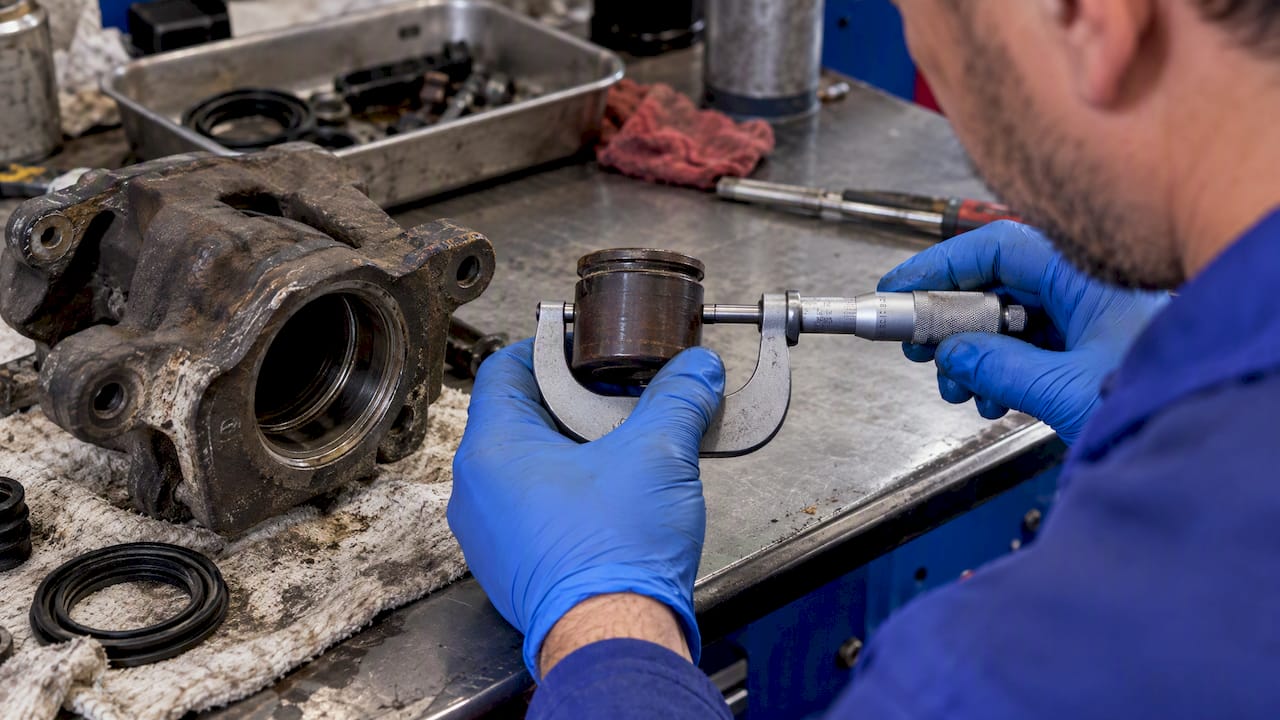
- A caliper bench measurement with a micrometer checks piston diameter against the manufacturer’s new-piston clearance spec, the same comparison used in the Workhorse/Bosch field data above.
- A simple feel test, pushing the piston back by hand with the caliper off the vehicle, often reveals stiffness or uneven resistance before any instrument does.
On-car checks are usually enough for a first pass: fluid test, temperature check, and a visual boot inspection. Pulling the caliper for a bench measurement makes sense once those checks point toward the piston itself, or when dragging persists after fresh fluid and new boots have already been installed.
When to rebuild, replace the piston, or swap the caliper
A few clear thresholds separate a simple fix from a full replacement.
- A torn, cracked, or displaced dust boot on an otherwise sound caliper calls for a boot and seal rebuild, the least expensive path.
- Measured piston diameter exceeding the manufacturer’s specified clearance, as seen in documented field cases, calls for piston replacement rather than a boot alone.
- Dragging that persists after fresh fluid, new boots, and serviced slide pins points toward bore damage or corrosion, which usually means a full caliper swap.
Confirm the root cause with the diagnostic steps above before buying parts. Replacing a caliper outright is sometimes the simpler call in labour terms, but it is rarely the cheapest one, and it is unnecessary when a boot and seal kit would have solved the problem.
How climate-aware caliper and brake components fit into this picture
Some brake technologies are designed to clear moisture rapidly and maintain consistent friction in wet and humid conditions, which speaks directly to the pathways covered above.
- Our ClimateFlex™ caliper line is built around managing moisture exposure at the caliper itself, complementing rather than replacing proper boot and seal maintenance.
- Pairing a climate-aware caliper with fresh brake fluid and intact dust boots can help reduce how often and how severely humidity-related symptoms show up.
- These are product claims about intended performance, not a substitute for the inspection and maintenance steps covered in this article.
- Boots, seals, and fluid condition still determine the baseline health of any caliper, phenolic or otherwise, regardless of which pads or rotors are paired with it.
A mechanic’s take on humidity and phenolic pistons
In practice, the order of operations rarely changes: check the boots, test the fluid, service the slide pins, and only then think about piston material or a climate-adaptive upgrade. Brake work affects safety directly, so hand off anything beyond a basic visual check to a qualified technician.
— AAA
Getting a climate-adaptive setup that matches this maintenance routine
Fixing the boots and fluid solves most humidity-related dragging on its own, but if you are already due for new pads or rotors, it is worth choosing parts engineered with moisture in mind rather than defaulting to a generic set.

Our Type 07 Brake Pads use our HydroAdaptive+ ceramic formulation, built to maintain consistent friction in wet and humid conditions rather than losing bite the moment water gets involved. For drivers who want a lighter-duty option, our Type 03 Brake Pads cover the same climate-adaptive approach at a different performance tier.
On the rotor side, our SC Type Rotors and GC Type Rotors pair naturally with either pad line, with the GC series carrying a GEOMET coating aimed at corrosion resistance, the same concern that makes steel pistons vulnerable in wet climates.
None of this replaces the boot and fluid maintenance covered earlier. A climate-adaptive pad and rotor set reduces how hard your braking system has to work against moisture, but it performs best on a caliper with intact seals and clean fluid behind it. If you are assembling a full brake refresh, our brake pad selection guide walks through matching pads to your vehicle and driving conditions, and our landing page is a straightforward place to browse the full lineup and check fit for your vehicle.

FAQ
What is the normal moisture content of brake fluid?
Fresh brake fluid typically contains very little water, but it is hygroscopic and absorbs moisture from the air over time, even in a sealed system. Many shops consider a reading approaching 3% water content by volume a practical trigger for a fluid change, since absorbed water lowers the fluid’s boiling point and increases corrosion risk.
What’s the difference between a phenolic piston and a steel piston?
A phenolic piston is a resin composite that resists corrosion and transfers less heat into the brake fluid, while a steel piston is solid metal that can corrode without proper plating. Phenolic material can absorb a small amount of moisture under certain storage conditions, as documented in a service bulletin on Bosch caliper assemblies, while steel pistons avoid that specific issue but face their own corrosion risk instead.
Which brake caliper is best?
The better caliper choice depends on driving pattern and climate rather than one material or design beating the other universally. For drivers who want components engineered specifically for moisture exposure, our ClimateFlex™ caliper line is built around clearing moisture quickly to maintain consistent friction in wet conditions.
How hot do brakes get during normal driving?
Brake temperatures during normal, moderate driving typically stay well within the operating range that dust boots are designed to handle, with SAE J1570 specifying boot performance across a range of -40°C to 120°C. Sustained hard braking or towing can push temperatures considerably higher, which is part of why boot and seal condition matters as much as the piston material itself.