

For drivers who need reliable stopping in rain and high humidity, HydroAdaptive ceramic pads paired with climate-adaptive calipers deliver the most consistent wet-weather braking available in a direct-to-consumer kit. The right purchase-ready setup includes:
- Pad: Aaafrictions Type 03 or Type 07 HydroAdaptive ceramic brake pad
- Calipers: ClimateFlex™ calipers with moisture-stable CryoSil™ silicone lubricant and climate-adaptive rubber seals
- Rotors: SC, GC, or GEOMET coated rotors matched to your vehicle fitment
- Hardware: Precision-matched hardware kit with HydroAdaptive Reserved Brake Grease
Together, this system delivers faster surface re-engagement after water contact, consistent pedal feel across humidity swings, and reduced slip effect during initial brake application in rain.
Table of Contents
- How does wet weather change your braking performance?
- What pad compounds actually perform best in wet conditions?
- What trade-offs should you expect with wet-focused brake pads?
- Does your whole braking system need attention for wet-weather consistency?
- How do you choose the right kit for your vehicle and budget?
- Installation and maintenance best practices for wet climates
- How do you confirm that new pads actually improve wet-weather stopping?
- Why Aaafrictions HydroAdaptive pads are the recommended choice for rain
- Key Takeaways
- The case for a system-first approach to wet-weather braking
- Get your HydroAdaptive brake kit for rain-ready driving
- Useful sources
How does wet weather change your braking performance?
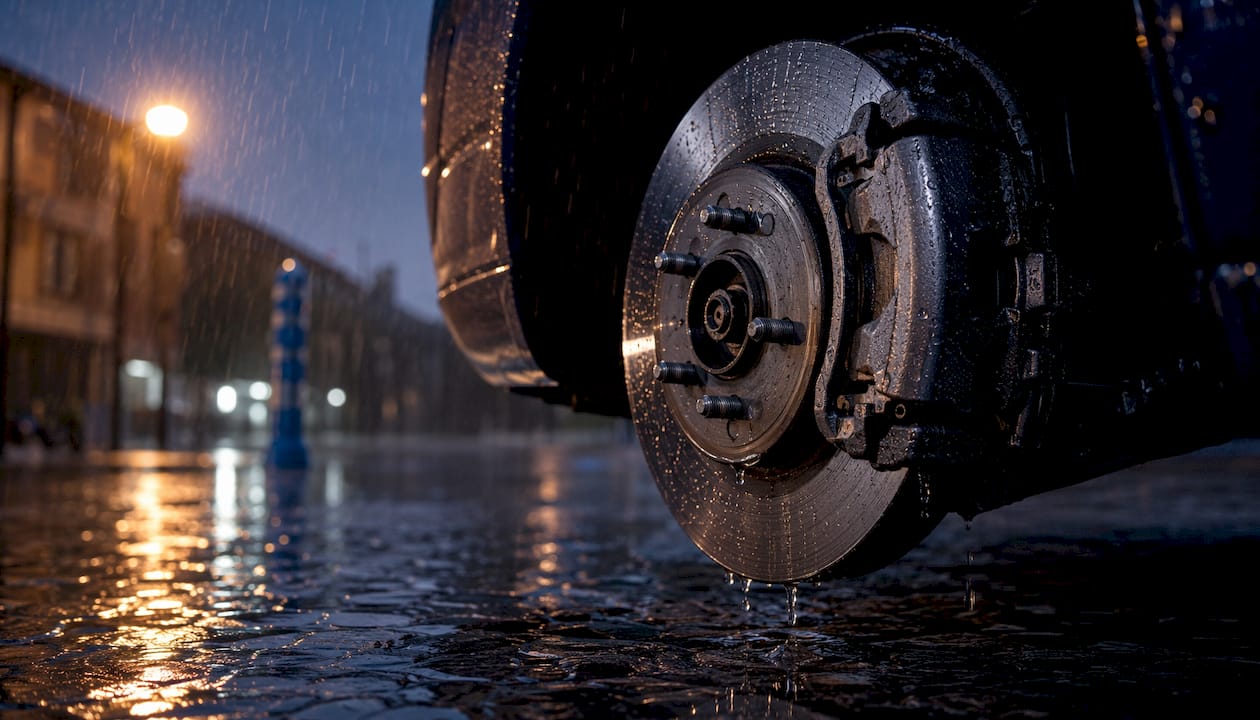
Rain, standing water, and humidity reduce braking effectiveness through a straightforward mechanical process: water forms a thin film between the pad and rotor, temporarily lowering the coefficient of friction and delaying initial bite. The result is longer stopping distances and unpredictable torque delivery until the pad clears that film.
Specific effects drivers and mechanics should recognize:
- Reduced friction coefficient: Water at the contact zone lowers the grip between pad and rotor surface.
- Delayed initial bite: The first application of the brakes feels soft or vague until moisture disperses.
- Glazing and contamination: Repeated wet stops with inadequate compounds cause glazing, where the pad surface hardens and loses its friction profile.
- Variable engagement: Humidity changes throughout a drive, so bite can shift from stop to stop without a consistent compound.
- Extended stopping distances: Even modest water film measurably increases the distance needed to reach a full stop.
Wet-weather braking problems are not limited to heavy rain. Coastal commuters, drivers in high-humidity climates, and anyone who parks outside overnight all experience moisture-related brake behavior regularly. For daily commuters, that delayed initial bite on the first stop of a wet morning is the most common and most dangerous effect.
What pad compounds actually perform best in wet conditions?
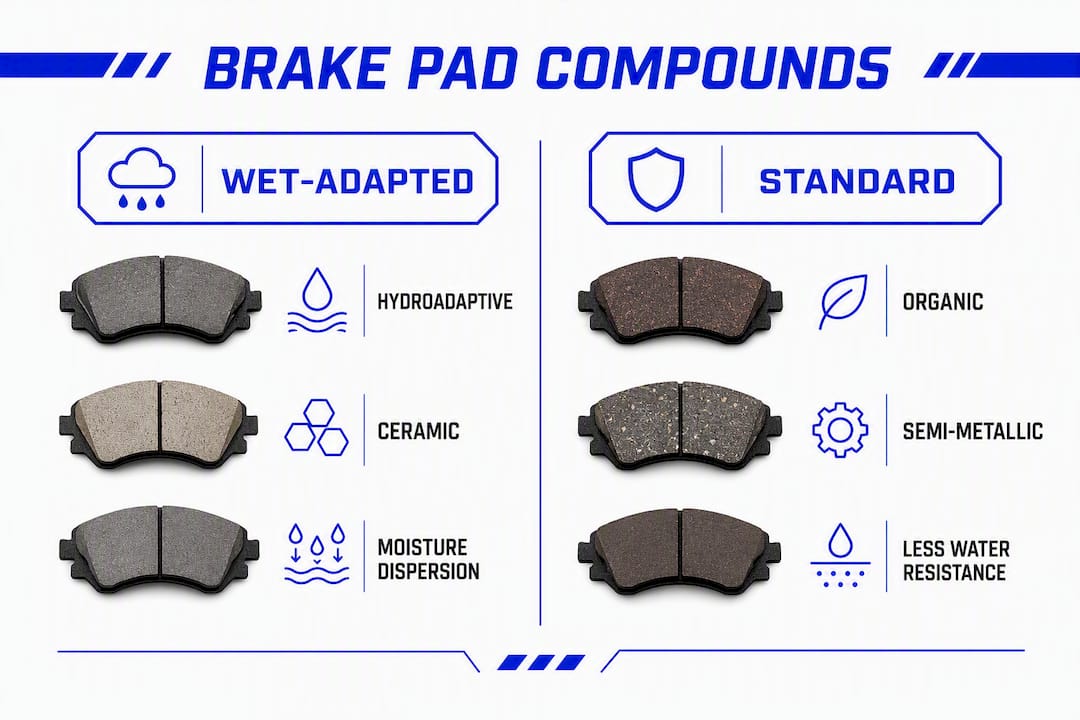
The highest-value features for wet-weather stopping are moisture-dispersion chemistry at the contact zone, compound stability across temperature and humidity swings, and a bedding behavior that builds a consistent transfer layer on the rotor. Sintered and metallic compounds handle damp contaminants and high heat more robustly than organic or resin pads, while HydroAdaptive ceramic technology targets moisture management directly at the friction interface.
| Feature | Ceramic HydroAdaptive | Sintered / Metallic | Semi-Metallic | Organic / Resin |
|---|---|---|---|---|
| Best for | Light to heavy rain, daily humid driving | Heavy rain, mud, high heat | Occasional wet, mixed conditions | Dry, light rain only |
| Compound & moisture management | Moisture-dispersion chemistry moves water outward from contact zone | Dense metallic matrix resists contamination | Resin-bonded with metallic content; moderate wet resistance | Resin-bonded; absorbs moisture, degrades faster |
| Wet-weather friction consistency | High; engineered for repeatable engagement | High; consistent bite even in mud | Moderate; better than organic, less than sintered | Low; bite fades quickly when wet |
| Noise / dust | Low noise, low dust | Higher noise, moderate dust | Moderate noise and dust | Quiet, low dust |
| Rotor compatibility / wear | Matched to coated rotors (SC/GC/GEOMET); low rotor wear | Higher rotor wear; requires robust rotors | Moderate rotor wear | Low rotor wear |
| Price / kit availability | Premium; full vehicle-specific kits available | Mid to high; often requires separate hardware | Mid-range | Entry-level |
| Vehicle fitment | OE replacement and upgrade; vehicle-specific kits | Upgrade; may require fitment check | OE replacement | OE replacement |
Quick guidance by driver profile:
- Daily commuter in rain-prone areas: HydroAdaptive ceramic pad with coated rotors is the most practical choice for consistent morning stops.
- Coastal driver: Full system kit with ClimateFlex calipers addresses both moisture and salt-air seal degradation.
- Heavy-duty or towing use: Semi-metallic or sintered compound with SC/GC coated rotors for heat and contamination resistance.
- Performance driver: HydroAdaptive ceramic for modulation and consistency; sintered if extreme heat is a factor.
The HydroAdaptive formulation is specifically engineered to move moisture outward from the pad-rotor contact zone, restoring surface engagement faster than conventional ceramics rather than waiting for heat to evaporate the film.
What trade-offs should you expect with wet-focused brake pads?
Wet-focused compounds cost more, may require matched rotors and calipers, and often need a more deliberate bed-in procedure than standard OE replacements. Softer compounds improve wet bite but wear faster; mixed compound approaches balance wet modulation against lifespan.
Key trade-offs to weigh:
- Noise: Sintered and semi-metallic pads are louder than ceramic options, particularly during the first few wet stops.
- Rotor wear: Higher-friction metallic compounds accelerate rotor wear; coated rotors (GEOMET/SC) help offset this.
- Bed-in complexity: HydroAdaptive pads require a proper wet bedding routine to build the transfer layer correctly.
- Dry vs. wet bite difference: Pads optimized for moisture management may feel slightly less aggressive on the first dry stop after a wet period.
- Lifespan: Organic pads wear significantly faster in wet and muddy conditions than ceramic or sintered alternatives.
Pro Tip: Evaluate trade-offs against your actual driving pattern. If you commute daily in a rainy climate or park outside year-round, the performance gain from a HydroAdaptive ceramic kit outweighs the higher upfront cost within a single pad lifespan. If you drive in dry conditions most of the year with occasional rain, a semi-metallic option may be the more practical balance.
Does your whole braking system need attention for wet-weather consistency?
Consistent wet braking requires system-level attention, not just a pad swap. A new pad on a corroded caliper with hardened seals will not deliver the performance the compound is capable of. Degraded seals, hardened rubber, and corroded slide pins can cancel the benefits of improved friction materials entirely.
Full system checklist for wet-weather resilience:
- Pad compound and bedding: Confirm the pad family matches your climate and follow the manufacturer’s wet bedding procedure.
- Rotor surface and coating: Use GEOMET, SC, or GC coated rotors to resist surface rust and maintain consistent pad contact.
- Caliper seals and slide pins: Inspect for cracking, hardening, or corrosion; replace with climate-adaptive rubber components where possible.
- Moisture-stable lubricants: Apply CryoSil silicone lubricant or equivalent to slide pins; avoid petroleum-based greases that harden in cold and wet conditions.
- Hardware and anti-rattle clips: Replace hardware with every pad change to prevent uneven engagement and noise.
- Brake fluid health: Check fluid condition and spec. Moisture-contaminated fluid lowers the boiling point and affects pedal feel. A brake fluid change is often overlooked but directly affects wet-weather pedal consistency.
Pro Tip: Slide pins are the most commonly neglected component in a wet-climate brake service. Corroded or dry pins cause uneven pad engagement that no friction compound can compensate for. Clean, re-lubricate, or replace them at every pad change using a silicone-based lubricant rated for temperature and moisture exposure.
How do you choose the right kit for your vehicle and budget?
Match your pad family and kit level to your vehicle’s use, local climate, and whether you need a full system upgrade or a pad-only replacement. For most rain-prone U.S. drivers, a HydroAdaptive ceramic pad paired with coated rotors is the right starting point.
Driver profiles and recommended kit levels:
- Daily coastal commuter: Type 03 or Type 07 HydroAdaptive pad + ClimateFlex calipers + GEOMET coated rotors. Full kit addresses moisture, salt air, and seal degradation together.
- Suburban commuter with seasonal rain: Type 07 HydroAdaptive pad + SC coated rotors. Pad-and-rotor kit without caliper replacement is sufficient for moderate wet exposure.
- Heavy towing or truck use: Semi-metallic or sintered pad + SC/GC coated rotors for heat and contamination resistance. A Type 07 kit with SC rotors covers this profile across many fitments.
- Electric vehicle: HydroAdaptive ceramic pad matched to your EV’s regenerative braking profile. Consistent modulation matters more than peak bite for EV brake behavior.
| Category | Typical lifespan | Kit availability | Best use case |
|---|---|---|---|
| Entry-level OE ceramic replacement | Standard | Pad-only | Dry climate, light rain |
| Premium HydroAdaptive ceramic kit | Extended | Pad + rotor + hardware | Rain-prone, coastal, daily commuter |
| Heavy-duty sintered / semi-metallic | High in wet/mud | Pad + rotor | Towing, off-road, high heat |
Always confirm vehicle-specific fitment before purchasing. Aaafrictions offers direct-to-consumer vehicle-specific kits, such as the Honda HR-V 2016–2022 kit and the Toyota Mirai 2016–2020 kit, to simplify fitment confirmation and eliminate guesswork on rotor compatibility.
Installation and maintenance best practices for wet climates
Proper installation and maintenance are essential to achieve the wet-weather gains a quality pad is engineered to deliver. Skipping the bed-in procedure or reusing corroded hardware will undercut performance regardless of compound quality.
Installation checklist:
- Inspect and replace all hardware, anti-rattle clips, and shims before fitting new pads.
- Clean rotor surfaces with isopropyl alcohol to remove oils and residue before bedding.
- Apply moisture-stable lubricant (CryoSil or equivalent silicone-based grease) to slide pins and caliper contact points only; keep lubricant away from rotor and pad friction surfaces.
- Torque caliper bolts to manufacturer specification; uneven torque causes pad tilt and inconsistent wear.
- Follow the HydroAdaptive wet bedding procedure: perform a series of light, progressive stops on a wet surface to build the transfer layer correctly before full-load braking.
For wet-climate maintenance, inspect pads and rotors every 6,000–8,000 miles or at each tire rotation. Check rotor condition for scoring, uneven wear, and surface rust between coated areas. Verify brake fluid condition annually; moisture absorption raises the fluid’s water content and softens pedal feel over time.
Pro Tip: Early caliper binding shows up as uneven pad wear (one side thicker than the other) or a pulling sensation under braking. If you notice either symptom after a wet season, inspect slide pins and seals before assuming the pad compound is at fault.
How do you confirm that new pads actually improve wet-weather stopping?
Low-speed controlled stops and repeatable wet-start braking are the fastest way to validate real-world improvement after installation. You do not need a test track; a quiet wet parking lot at low speed gives you reliable feedback.
Safe validation steps:
- Wet bedding routine: Complete the manufacturer’s recommended light-stop sequence on a wet surface before any performance assessment.
- Controlled low-speed stops: From 15–20 mph on a wet surface with clear margins, apply moderate brake pressure and note pedal feel, initial bite, and stopping distance relative to your pre-installation baseline.
- Pedal modulation check: Progressive brake application should feel linear, not grabby or spongy. Sponginess after wet exposure points to fluid or caliper issues, not pad compound.
- Visual inspection: After the first 50–100 miles, remove wheels and check for even pad contact across the full rotor surface.
- Document before and after: Note pedal travel distance and any pull or vibration before installation, then compare after the bed-in is complete.
If wet-weather behavior does not improve after a proper bed-in, inspect the caliper for binding before concluding the pad is the issue. A shop with a brake lathe and pressure gauge can confirm whether the caliper is delivering even force across both pads.
Why Aaafrictions HydroAdaptive pads are the recommended choice for rain
Aaafrictions HydroAdaptive technology is the recommended approach for rain and humidity-focused braking because it addresses moisture at the friction interface directly, rather than relying on heat alone to restore engagement. The Type 03 pad moves moisture outward from the contact zone to restore surface engagement faster than conventional ceramics, and the full kit includes hardware and HydroAdaptive Reserved Brake Grease formulated for moisture stability.
| Product | Best for | Compound & moisture management | Wet consistency | Noise / dust | Rotor compatibility | Fitment |
|---|---|---|---|---|---|---|
| Type 03 HydroAdaptive pad | Daily rain, humidity, coastal | Ceramic; moisture-dispersion chemistry | High | Low / low | SC, GC, GEOMET coated | Vehicle-specific OE replacement |
| Type 07 HydroAdaptive+ pad | Seasonal wet, winter-ready | Ceramic; HydroAdaptive formulation | High | Low / low | SC, GC, GEOMET coated | Vehicle-specific; broad fitment |
| ClimateFlex™ calipers | Full system upgrade | N/A (caliper component) | Supports consistent engagement | N/A | Pairs with Type 03/07 pads | Kit-matched |
| SC / GC / GEOMET coated rotors | Wet, coastal, winter | Coated surface resists rust film | High with matched pads | Low | Type 03 and 07 pads | Vehicle-specific kits |
| Vehicle-specific brake kits | Complete system upgrade | Full pad + rotor + hardware | Highest (system-level) | Low | Optimized pairing | Direct-to-consumer fitment |
Independent compound guidance from BikeRadar’s disc brake analysis confirms that organic pads lose effectiveness in wet and muddy conditions, while specialized wet ceramic and sintered mixes rank highest for consistent wet-weather friction. Aaafrictions’s HydroAdaptive ceramic formulation is positioned precisely in that high-performance wet category.
Pro Tip: Before installation, confirm that your kit includes the HydroAdaptive Reserved Brake Grease and that your caliper uses CryoSil-compatible seals. Using a standard petroleum-based grease with ClimateFlex rubber components can accelerate seal degradation and undercut the system’s wet-weather design.
Key Takeaways
HydroAdaptive ceramic pads paired with coated rotors and climate-adaptive calipers form the most complete and consistent wet-weather braking system available for U.S. drivers.
| Point | Details |
|---|---|
| Choose HydroAdaptive for rain | Type 03 or Type 07 ceramic pads move moisture from the contact zone for faster re-engagement in wet conditions. |
| Upgrade the full system | Replacing pads alone is not enough; coated rotors, ClimateFlex calipers, and CryoSil lubricant complete the system. |
| Follow wet bedding procedure | Light progressive stops on a wet surface build the transfer layer correctly before full-load braking. |
| Inspect every 6,000–8,000 miles | Wet-climate maintenance intervals should include rotor condition, slide pins, and annual brake fluid checks. |
| Aaafrictions vehicle-specific kits | Direct-to-consumer kits match pad, rotor, and hardware to your exact make and model for simplified fitment. |
The case for a system-first approach to wet-weather braking
The most common mistake we see is treating wet-weather braking as a pad problem. Drivers swap compounds, notice modest improvement, and conclude that better pads are not worth the cost. What they have actually experienced is a friction upgrade installed into a system that was never designed to support it: corroded slide pins, hardened seals, and moisture-contaminated fluid absorbing the gains before they reach the road.
Our position at Aaafrictions is that the friction material and the mechanical ecosystem around it must be engineered together. HydroAdaptive technology is not a coating applied to a standard ceramic pad. It is a formulation built around the specific behavior of water at the contact zone, paired with ClimateFlex rubber components and CryoSil lubricant that resist the same environmental conditions the pad is designed for. That coherence is what produces repeatable, confident braking in rain, not a single upgraded component.
Vehicle-specific kits, direct-to-consumer availability, and a broad fitment catalog mean you can confirm compatibility and order the complete system without sourcing parts from multiple suppliers. The engineering is only as good as the installation, and the installation is only as reliable as the system it goes into.
Get your HydroAdaptive brake kit for rain-ready driving
Rain-prone drivers and mechanics who want consistent, engineered wet-weather stopping have a direct path to the right system. Aaafrictions offers vehicle-specific HydroAdaptive kits that pair Type 03 or Type 07 pads with SC, GC, or GEOMET coated rotors and matched hardware, all available direct-to-consumer without a distributor markup.
Quick shopping checklist before you order:
- Confirm your vehicle’s year, make, and model using the fitment search tool.
- Choose your kit level: pad-only for moderate wet exposure, or full pad + rotor + caliper kit for coastal and heavy-rain driving.
- Add ClimateFlex calipers if your current calipers show seal wear, uneven engagement, or a history of wet-season binding.
- Verify that your kit includes HydroAdaptive Reserved Brake Grease and the correct hardware for your application.
Orders ship direct. Visit aaafrictions.ca to find your vehicle’s kit and place your order.
Useful sources
| Source | What it supports | URL |
|---|---|---|
| Aaafrictions Type 03 Brake Pads Set | HydroAdaptive moisture-dispersion technology and kit contents | https://aaafrictions.com/type-03-brake-pads-set/ |
| Aaafrictions Type 03 + ClimateFlex Kit | System-level caliper, lubricant, and seal guidance | https://aaafrictions.com/type-03-brake-pads-climateflextm-calipers-kit/ |
| Aaafrictions Type 07 + SC Rotors Kit | Winter/wet-ready kit availability and fitment range | https://aaafrictions.ca/type-07-brake-pads-with-type-sc-rotors-kit |
| Aaafrictions Landing Page | Vehicle-specific kit catalog and purchase | https://aaafrictions.ca/landing |
| BikeRadar: Disc Brake Pads Explained | Compound behavior in wet and muddy conditions | https://www.bikeradar.com/advice/buyers-guides/disc-brake-pads |
| Cycling Weekly: Best Rim Brake Pads | Softer compound wet bite vs. wear trade-off | https://www.cyclingweekly.com/group-tests/best-rim-brake-pads-for-road-bikes-465112 |
| Gorilla Brakes: Best Pads for Wet Weather | Compound priorities and wet-condition rankings | https://gorillabrakes.com/blogs/news/best-brake-pads-for-wet-weather-riding-gorilla-brakes |
| Kwik Kar: Why Change Brake Fluid | Brake fluid health and wet-climate maintenance | https://kwikkarwhitesettlement.com/general/why-change-brake-fluid |
| Kwik Kar: How to Inspect Brake Rotors | Rotor condition checks and inspection guidance | https://kwikkarwhitesettlement.com/general/how-to-inspect-brake-rotors |