

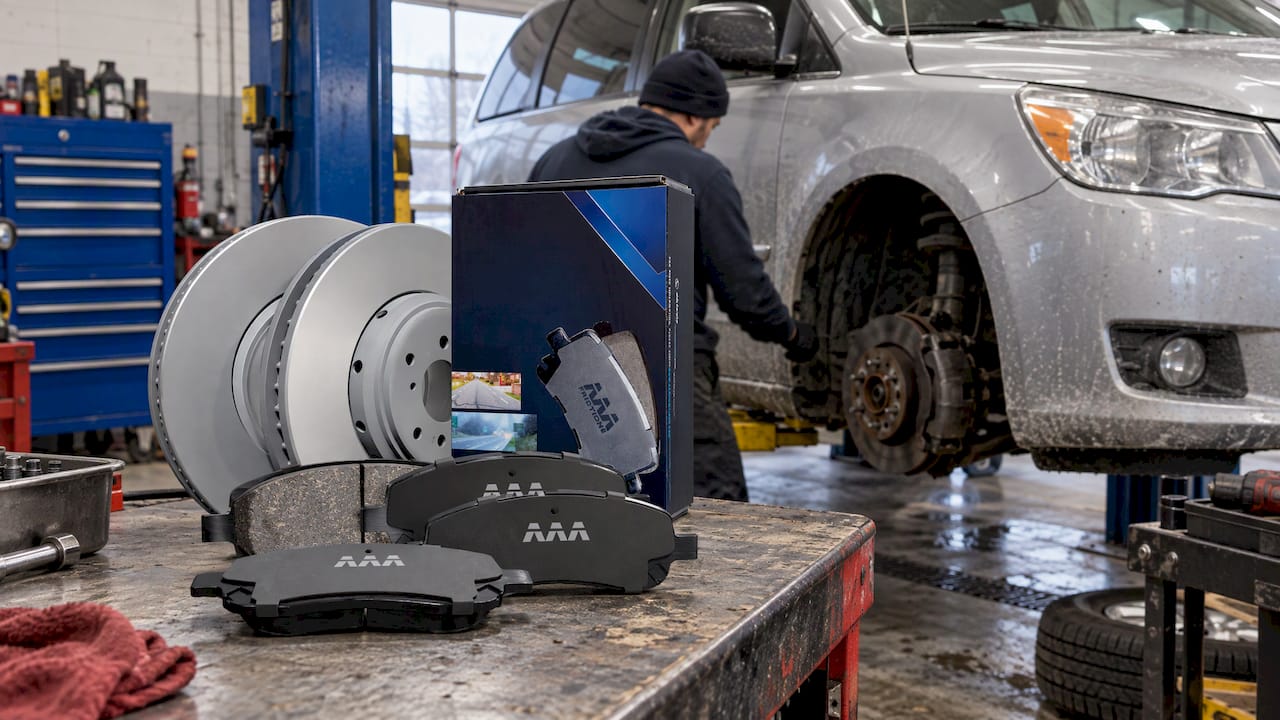
Choose a rotor coating by deciding which surfaces you need to protect and how much salt, moisture and idle time your vehicle sees. For most Canadian drivers, that points to a coated rotor: a coating such as GEOMET protects the hat, vanes and edges, which are the areas that never touch the pad. The pad-contact surface is meant to wear clean. The right rotor is the one whose coating, pad pairing and fit all match your vehicle and your winters.
This guide explains what a coating does, how the common types differ, what happens to the coating where the pads grip, and how to match a rotor to your driving.
TL;DR
- A rotor coating protects the non-contact areas (hat, vanes, edges) from corrosion. The pad-contact surface is designed to wear clean in normal braking.
- Common coating families are zinc-based, e-coat, GEOMET and powder coat. They differ in how they are applied and how they protect, so judge the system, not the label.
- Road salt, brine and repeated freeze-thaw cycles are the main reasons coating matters in Canada, especially if the vehicle sits or brakes lightly.
- Choose by vehicle fit, climate, driving pattern and pad pairing. Rotors and pads work best as a matched set.
- Our GC Type rotors use a GEOMET coating and are sold with compatible pads.
Table of Contents
- What a rotor coating actually protects
- What happens to the coating on the pad-contact surface
- The common rotor coatings compared
- Why coating matters more in Canada
- Coated or uncoated: how to decide
- Match the coating to how you drive
- Why the pad pairing matters as much as the coating
- Does a coating change how the rotor performs or lasts?
- How to choose: a short checklist
- Our perspective
- Find the right set for your vehicle
- Caring for coated rotors after a salty drive
- FAQ
- Sources
What a rotor coating actually protects
A brake rotor is cast iron. Iron rusts when it meets water and salt, and a rotor sits directly in the spray from the wheel. A coating is a thin barrier on the surface that slows that process.
The important detail is where the coating goes. A rotor has two very different zones:
- The friction surface is the swept ring where the pads clamp. It has to be bare metal to give a consistent bite.
- The non-contact areas are the hat (the centre section that mounts to the hub), the cooling vanes between the two discs, and the outer edge. These are the areas a coating is designed to shield.
That is why a coated rotor can look new around the hat and edges while the swept ring shows a normal metallic finish. The coating isn’t failing. It is simply not meant to be on the surface that does the stopping.
The vanes matter more than most drivers expect. They are hidden inside the rotor, hard to clean, and exposed to moisture and salt. Rust there can flake and build up over time, and you can’t see it without taking the rotor off.

What happens to the coating on the pad-contact surface
On a rotor that is coated across its whole face, the coating on the swept ring is removed by the pads during the first stops. This is normal and expected. Within a short time of regular driving, the pads have cleaned a bare friction track, and the coating stays in place everywhere the pads don’t reach.
Two practical points follow from this:
- Don’t judge a coating by the swept ring. A light film of surface rust on the friction track after a few damp days is normal. It clears with the next few stops.
- Judge it by the hat, vanes and edges. Those are the areas that tell you whether the coating is doing its job.
If you want to track coating condition over the life of the rotor, we explain how in our guide to measuring rotor coating wear, including how to read the stamped minimum thickness.
The common rotor coatings compared
You will see four families named most often. Each is a different way of putting a protective layer on cast iron.
| Coating | Typical idea | Where it is used | What to keep in mind |
|---|---|---|---|
| Zinc-based plating or paint | A zinc layer that protects the iron beneath | Non-contact areas on many aftermarket rotors | Protection depends on layer quality and coverage |
| E-coat | An electrically applied paint film that reaches into recesses | Hats and edges on many coated rotors | A paint-style film, so coverage and thickness matter |
| GEOMET | A water-based, zinc and aluminum flake coating that is baked on | Rotors built for road-salt climates | A thin, flake-based layer designed for corrosion protection |
| Powder coat | A dry powder that is baked into a hard finish | Hats and edges, sometimes in colours | Primarily a protective and cosmetic finish |
These families are not interchangeable. What matters is how well the coating is applied, how much of the rotor it covers, and what environment you drive in.
There is also a different route to corrosion protection that doesn’t rely on a paint-style layer. Engineering research published through SAE describes ferritic nitrocarburizing with post-oxidation as a treatment that addresses corrosion and could remove the need to paint rotors. The same paper reports that corrosion performance was validated with SAE J2334 cyclic corrosion testing over 36 cycles. It is a useful reminder that rotor corrosion protection is an active area of engineering, and that testing against a recognized cyclic corrosion method is how serious work in this field is judged.
Canadian research is moving the same way. The University of Windsor reported in 2022 that a project was developing a coating technology to make cast-iron brake rotors resistant to corrosion.
Why we use GEOMET
Our GC Type rotors are GEOMET-coated. We chose it because our focus is braking that stays consistent when the weather changes, and a rotor that is protected from moisture and road salt keeps its shape and surface for longer. Our approach is designed so that the coating protects the areas that corrode first while the friction surface does its work with the pad.
You can see the range on our GC Type rotors page.
Why coating matters more in Canada
Coating is a bigger decision here than in a dry climate. Several conditions stack up in a Canadian winter:
- Road salt and brines. Salt and liquid brines are spread on roads to keep them passable. They stick to wheels, calipers and rotors.
- Freeze-thaw cycles. Water gets into small gaps, freezes, thaws and brings salt with it. Repeating that over a winter is hard on any exposed iron.
- Wet, slushy driving followed by parking. A warm rotor that cools while wet and salty has the ideal conditions for surface rust.
De-icing chemicals vary across the country, and some are more aggressive on metal than others. If you are curious about how one common de-icer behaves around brakes, read our piece on magnesium chloride and rotor corrosion. For a practical routine after a salty drive, our same-day steps to protect rotors from brine corrosion walks through what to do.
The rotor is not the only part that suffers. Calipers and slider pins corrode too, and a seized slider can cause uneven pad wear and drag. That is the reason our range pairs coated rotors with ClimateFlex calipers, built for smooth operation through winter cold and summer heat. If you want to understand that side of the system, see our guide on caliper corrosion in Ontario.
Coated or uncoated: how to decide
Uncoated rotors are a legitimate choice, and the decision comes down to your conditions and habits. Use this as a checklist.
Choose a coated rotor if:
- You drive through salted winters or on roads treated with brine.
- Your vehicle sits for days at a time, which gives surface rust time to form.
- You want the hat and edges to stay clean, for appearance behind open-spoke wheels or for easier service later.
- You want corrosion protection built in rather than something you manage with frequent washing.
- You keep the vehicle for many years and don’t want rust building up in the vanes.
An uncoated rotor can suit you if:
- You are in a dry area and the vehicle is used daily.
- The wheels cover the rotor completely and appearance is not a concern.
- You are replacing rotors on a vehicle you will sell soon.
For most of the drivers we serve, in provinces such as Ontario, Quebec, Nova Scotia and New Brunswick, the first list describes the real situation. That is why we make coated rotors the core of our range.
Match the coating to how you drive
The best coating choice is the one that fits the vehicle’s duty. Here is how we think about common profiles.
Daily commuters. You brake often, so the friction surface stays clean, but the hat and vanes still face salt every day. A coated rotor keeps the non-contact areas protected through the whole winter.
Rideshare, delivery and high-mileage drivers. Heavy use means more heat cycles and more wet-road exposure. You want a rotor and pad combination built for stable friction as temperatures swing, and a coating that holds up over many months of salt.
Larger vehicles, such as minivans and SUVs. Heavier vehicles load the brakes harder and often have bigger rotors with more surface to protect. Fit matters here, so match by exact vehicle year, make and model.
Vehicles that sit. A car parked for days or weeks can develop rust on the friction surface quickly. A coating protects the rest of the rotor, and our guide on stored brake rust explains how to limit it.
Hybrid and electric vehicles. Regenerative braking slows the vehicle without using the friction brakes much, so the rotors can go long periods without a cleaning stop. That lets salt and moisture sit on the surface. A coated rotor helps protect the areas the pads never sweep, and the surface benefits from occasional firm stops to clear it. For more on how this works in winter, see our guide to regen braking on ice. If you are shopping for a used electric vehicle, this checklist of what to inspect before buying is a good reference for the wider vehicle, and the brakes belong on your list.
Why the pad pairing matters as much as the coating
A rotor coating is only one part of consistent braking. The pad has to work with the rotor surface, and the two wear each other in. This is why we develop rotors and pads as a matched system and sell our rotors only with compatible pads.
Our pads use HydroAdaptive ceramic technology, designed for moisture management and stable friction in rain, humidity, snow and cold. The goal is a predictable pedal feel from the first stop of a wet morning to the last stop of a dry afternoon.
Our pad lines are:
Our rotor lines are:
- SC Type rotors
- GC Type rotors, with a GEOMET coating
Does a coating change how the rotor performs or lasts?
A coating’s job is corrosion protection, not friction. The pad-contact surface is bare in use, so the braking itself depends on the pad and the rotor’s friction surface. Where a coating helps is in what surrounds that surface.
- Corrosion resistance. Less rust on the hat, edges and vanes means less scale and less seizing of the rotor to the hub over the years.
- Service. A rotor that hasn’t rusted onto the hub is easier to remove at the next brake job. When rotors do seize, our guide on removing a rusted rotor covers the soak time and puller technique.
- Appearance. Hat and edges stay clean behind the wheel.
A coating does not replace inspection. Check your brakes at least once a year, and more often in salted months, looking for pitting, seized slider pins and uneven pad wear. For a simple routine, our monthly road salt checks fit easily into a winter.
A cleaner rotor edge also lets you spot the wear that matters. Every rotor is stamped with a minimum thickness, and you should replace it before it wears below that figure, whatever the coating looks like.
How to choose: a short checklist
- Confirm the fit. Select by your vehicle’s exact year, make, model and axle (front, rear or both).
- Pick the coating for your climate. Salted roads and freeze-thaw winters call for coated rotors.
- Check what is coated. The hat, vanes and edges should be covered, and the friction surface is expected to wear clean.
- Buy rotor and pad as a pair. A matched set is designed to wear in together.
- Consider the whole brake. Calipers, slider pins and hardware face the same salt as the rotor.
- Plan the maintenance. Rinse the wheel wells after salty drives, and check the brakes yearly.
Our perspective
We built AAA Frictions around a simple question: what does weather do to a braking system, and how do we design for it? Rain and humidity affect the pad. Salt and moisture affect the rotor. Cold and heat affect the caliper. Each problem is different, so each part is engineered for its own job.
That is why we treat the rotor coating as part of a system and not as a feature on its own. A GEOMET coating protects the hat, vanes and edges from corrosion, while our HydroAdaptive ceramic pads are designed for stable friction on the swept surface. ClimateFlex calipers are designed to keep moving smoothly in the cold. When the parts are developed together, the result is meant to be predictable braking.
This is also why we sell our rotors only with compatible pads. We would rather you install a matched set that was engineered to work together than a mix of parts from different philosophies.
If you drive through Canadian winters, a coated rotor is, in our view, the sensible default.
AAA
Find the right set for your vehicle
If you are ready to replace your brakes, we offer vehicle-specific pad and rotor sets built for rain, snow, humidity and cold. Our GC Type rotors carry a GEOMET coating and come with compatible HydroAdaptive ceramic pads, so the whole set is designed to work together.

Browse the full range and find your vehicle at AAA Frictions, or start with the GC Type rotors. For a minivan example, see our front and rear brake kit for the Volkswagen Routan 2012-2014.
Caring for coated rotors after a salty drive
A coating does its best work when you give it a little help. These habits take minutes.
- Rinse the wheels and wheel wells with plain water after driving on freshly salted roads, to remove brine from the rotor edges and calipers.
- Make a few firm stops on a clear road afterward, so the pads clean the friction surface.
- Avoid parking right after a wet, salty drive when you can. A short drive on dry pavement helps the rotors dry out.
- Look at the hat and edges at each tire change. They show you how the coating is holding up.
- Treat ceramic wheel protection as a separate job. Products such as ceramic coatings for alloy wheels protect the wheel surface and are not a substitute for a rotor coating.
For a longer routine, our blog archive collects our seasonal brake care guides.
FAQ
Does a rotor coating cover the part the pads touch?
A coating is designed to protect the hat, vanes and edges. Where it is applied to the friction surface, the pads remove it during the first stops, leaving a bare track that brakes normally. The coating remains on every area the pads don’t reach.
Is GEOMET better than zinc or e-coat?
They are different methods, and results depend on application quality and coverage. We chose GEOMET for our GC Type rotors because it is a thin flake-based coating built for corrosion protection in road-salt conditions. Choose the rotor by fit, coating coverage and pad pairing, not by the coating name alone.
Why does a coated rotor still show a little rust on the swept surface?
The friction surface is bare metal in use, so a light film can appear after rain, a wash or a few days parked. It is normal and clears with a few ordinary stops. Rust on the hat or edges is the thing to watch for.
Do I need coated rotors on an electric or hybrid vehicle?
Regenerative braking means the friction brakes are used less, so salt and moisture can sit on the rotors for longer between cleaning stops. A coated rotor protects the areas the pads never sweep. Occasional firm stops on a clear road also help keep the friction surface clean.
Can I buy rotors without pads from AAA Frictions?
No. We develop rotors and pads as a matched system, and we sell our rotors only with compatible pads. This keeps the set working as it was engineered to.
Sources
- SAE paper 2025-01-0332 on corrosion-resistant nitrocarburized rotors
- University of Windsor: researcher teams up with Ford on a better brake rotor