

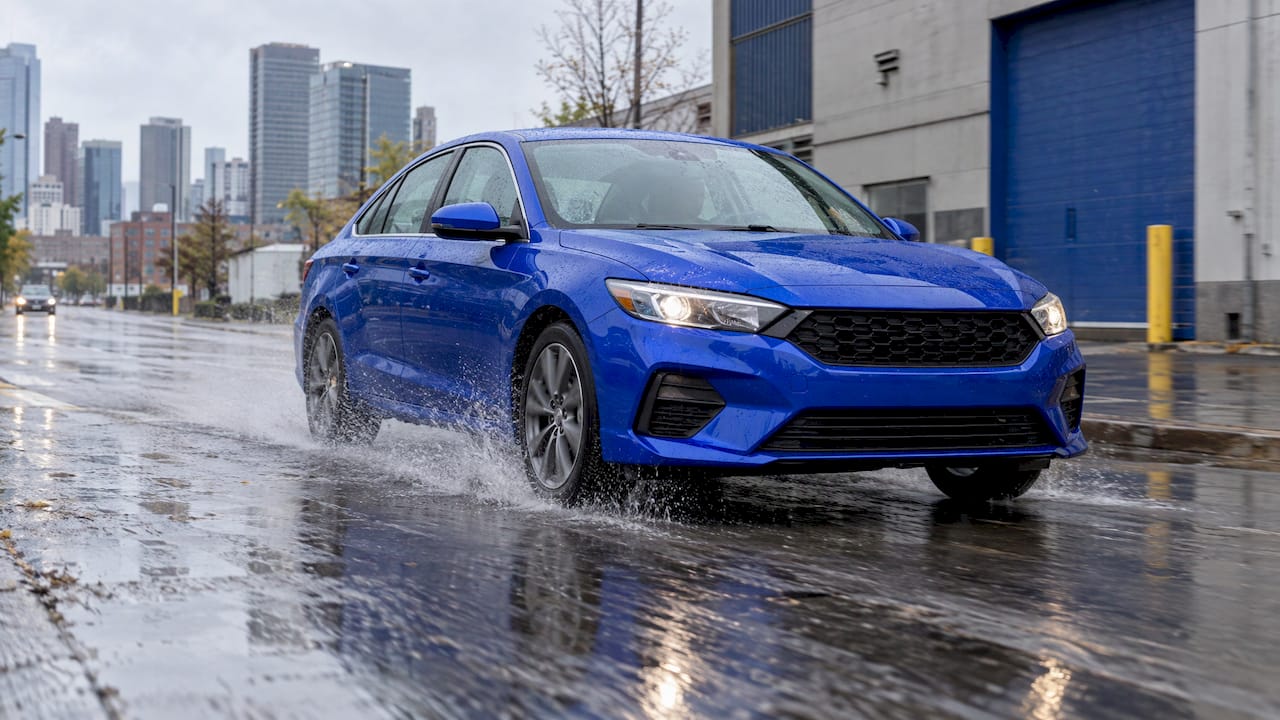
Brakes that pull to one side when wet are usually reacting to uneven moisture on the rotors and pads, and the pull should fade within a few gentle stops. If the pull stays after the brakes dry, or the pedal feels spongy, something in the system needs repair. This guide explains how to tell the two apart, how to dry the brakes safely, and what a persistent pull usually means.
TL;DR
- A brief pull in the first few stops after rain or a puddle can come from water on one side of the braking system. Drive slowly and apply the brakes lightly to dry them, as the Manitoba Driver’s Handbook advises.
- After deep water, test your brakes when it is safe. The vehicle should stop straight with a firm pedal, according to the Ontario driver’s handbook.
- Pulling or a spongy pedal that continues after the brakes have dried needs immediate repair.
- Pulling is a symptom, not a diagnosis. Brakes, tires, alignment, suspension and steering can all cause it.
- Our matched pad and rotor systems are designed for stable friction when conditions turn wet.
Table of Contents
- Why brakes pull to one side when they get wet
- Why brakes pull after a puddle
- Is the pull temporary or a brake problem?
- How to dry wet brakes safely
- When it is not the brakes
- Brake faults that can cause a pull
- When to get your brakes inspected
- Our perspective: matched components for wet weather
- Brakes built for wet roads, matched by vehicle
- FAQ
- Sources
Why brakes pull to one side when they get wet
Most passenger vehicles use a hydraulic brake system. Pressing the pedal sends force through non-compressible brake fluid to each wheel, and Manitoba Public Insurance describes this force as transmitted immediately and directly. That matters here because the system only brakes evenly when each wheel receives the same force and each pad meets its rotor with the same friction.

Water disturbs the second part. A thin film of water on a rotor face lowers friction until the pad wipes it away. If the left wheel is wetter than the right, or one rotor carries more surface rust than the other, the two sides briefly grip differently. The car drifts toward the side that grips harder.
This is most noticeable in a few situations:
- After a car has sat in rain overnight. Light surface rust forms on the rotor face and the first stops feel uneven.
- After driving through a puddle on one side. The wheels on the puddle side get soaked while the others stay drier.
- On roads with heavy spray. Water thrown from the lane beside you tends to hit one side of the car more than the other.
We cover the related grabbing behaviour in our guide to brakes that grab when wet, including what is typical in the first several stops and what is not.
Why brakes pull after a puddle
A deep puddle or flooded stretch of road is a bigger test than rain. The Manitoba Driver’s Handbook warns that brakes may pull to one side or may not work at all after deep water, and tells drivers to test them lightly once they are through.
Three things tend to happen:
- Uneven soaking. Water enters one side of the brake assembly more than the other, so the friction differs side to side.
- A lubricating film. Water between pad and rotor reduces grip until it is cleared.
- Hidden faults showing up. A caliper or pad that was already slightly off can behave differently once wet. We explain what to do after deep water in our flood water and brakes guide.
The Ontario handbook also advises avoiding puddles where possible, slowing down on wet roads, using smooth controls and leaving extra stopping distance, because water can affect both braking and vehicle control.
Is the pull temporary or a brake problem?
The test is time. A moisture pull fades as the brakes dry. A mechanical pull does not.
The Ontario handbook gives a simple check after flooded water: when it is safe, stop quickly and firmly at 50 km/h. The vehicle should stop straight, and the pedal should feel firm and secure. Do this only on a clear, quiet road with nobody close behind you.
| What you notice | Likely meaning | What to do |
|---|---|---|
| Slight pull in the first few stops, fades quickly | Moisture or light surface rust on the rotors | Brake lightly while driving slowly to dry them |
| Pull after a puddle, gone within a short drive | Water on one side of the brake assembly | Dry the brakes, then re-test |
| Pull continues after the brakes are dry | Possible mechanical fault | Have the brakes inspected promptly |
| Spongy or soft pedal | Possible hydraulic problem | Immediate repair, per the Ontario handbook |
| Pull with grinding or squealing | Possible worn or damaged parts | Inspection, as Transport Canada advises |
The Ontario handbook names continued pulling or a spongy pedal after drying as signs of trouble that need immediate repair. Transport Canada adds that pulling, a change in pedal feel, or unusual squealing or grinding may indicate the brake system requires repair.
If the pedal feels different in the rain, our brake pedal feel in rain guide walks through quick checks.
How to dry wet brakes safely
Drying brakes is a matter of gentle friction, not hard stops. Road Safety at Work advises slowing down in deeper water, applying the brakes gently to dry them, and confirming braking is even on all wheels before accelerating.
Here is the sequence we recommend:
- Slow down before and through the water. Speed pushes more water into the brake assembly.
- Once through, check your mirrors. Make sure no one is following closely.
- Drive slowly and press the brake pedal lightly. Light, repeated pressure builds a little heat and wipes the film off the rotors.
- Listen and feel for evenness. The car should slow in a straight line.
- Re-test once the road is clear. If everything is even, resume normal driving. If it still pulls, stop pressing on and plan a repair.
For a longer walkthrough, see our steps for drying brakes while driving. If the pads feel slick, our guide to restoring grip on wet brake pads covers that case, and brakes sticking after a car wash covers a very similar pattern.
When it is not the brakes
A pull under braking does not always come from the brakes. Canadian brake-diagnosis guidance stresses that pulling is a symptom, not a diagnosis, because brake, tire, alignment, suspension and steering faults can produce similar behaviour.
The same source lists uneven tire pressure and tire, alignment, suspension or steering issues among possible causes, and notes that the direction of the pull does not always identify the damaged side. Wet roads exaggerate these problems because grip is lower and small differences show up faster.
Before blaming the pads, check the simple things:
- Tire pressures. A difference between left and right is the easiest cause to fix.
- Tread depth. A worn tire on one side grips less on a wet road.
- Road crown. Many roads slope to the side, which can nudge a car in the same direction every time.
- Alignment history. A recent pothole hit that left the car pulling even when you are not braking points away from the brakes.
Brake faults that can cause a pull
If the pull continues once everything is dry, the cause is mechanical. The faults most often named are:
- A sticking or seized caliper. The pad stays pressed against the rotor on one side. A stuck caliper can cause a pull even when the brakes are not applied, and a non-contact infrared thermometer can help reveal a hot wheel.
- Uneven pad wear. One side has less friction material left.
- A restricted brake hose. Pressure reaches one side more slowly than the other.
- Contaminated friction material. Fluid or grease on a pad changes how it grips.
- Uneven rotor condition. Corrosion, scoring or uneven surfaces change friction.
- Hydraulic problems. Uneven pressure between sides.
The same trade publication notes that diagnosing the cause may involve checking for seized caliper mounting hardware, hose obstructions or uneven hydraulic pressure with specialized tools, which is a job for a qualified technician.
Noise often travels with a pull. Squealing after rain is often just moisture, and our brakes squeal when wet guide explains that, while brakes grinding after rain covers the cases that call for inspection.
When to get your brakes inspected
Get the brakes looked at when any of these is true:
- The pull continues after the brakes have dried.
- The pedal feels spongy, soft or different from usual.
- You hear grinding or persistent squealing.
- A brake warning light is on.
- The pull happens in dry weather too.
Transport Canada recommends following the manufacturer’s maintenance schedule in the owner’s manual so the braking system stays in top working condition. A professional independent mechanic inspection can show you what gets checked and give you a clear picture of the condition of the car, which helps when brake symptoms keep returning.
Ask the technician to measure pad thickness on both sides of an axle, check caliper slide movement and inspect the rotor faces. If you do your own brake work, a side-to-side comparison on the same axle is the quickest way to spot the difference that causes a pull.
Our perspective: matched components for wet weather
We build our range around a simple observation: weather affects each part of a brake system in a different way, so each part needs its own answer.
Moisture on a pad changes friction. Road salt and humidity attack rotor surfaces. Winter cold and summer heat change how a caliper moves. A pull in the wet is the moment those differences show up from side to side, so we engineer for consistency.
Our HydroAdaptive pads are designed for moisture management and stable friction. Our GEOMET-coated rotors are designed to protect against corrosion from moisture and road salt, which is the surface rust that can make the first stops uneven. Our ClimateFlex calipers are designed for smooth operation through cold and heat.
We develop rotors and pads as a matched system, and we sell rotors only with compatible pads. The aim is a friction profile that behaves cleanly across the temperature band a Canadian driver sees, from wet autumn commutes to freezing mornings.
AAA
Brakes built for wet roads, matched by vehicle
If you are replacing worn pads and rotors and want the set to behave consistently in rain, we offer vehicle-specific options. Our Type 03 brake pads use HydroAdaptive ceramic technology, and they pair with our SC Type rotors. We also offer complete front kits, such as the front brake kit for the Jeep Patriot 2016-2017.

Browse the full range on our storefront and choose the set made for your vehicle. For more on how weather affects braking, read the AAA Frictions blog.
FAQ
Why do my brakes pull only when it rains?
Water and light rust on the rotors can make friction uneven from side to side for the first few stops. If the pull fades as the brakes dry, that fits moisture. If it keeps happening, or the pedal feels spongy, have the brakes inspected, because the Ontario handbook lists both as signs of trouble.
Why do my brakes pull after driving through a puddle?
Water can soak one side of the brake assembly more than the other and briefly change grip. Drive slowly and apply the brakes lightly to dry them, then check that the car stops straight. If it still pulls, get it repaired.
Is it safe to keep driving if the brakes pull when wet?
A mild pull that clears as you dry the brakes is a normal cue to slow down and leave more distance. A pull that persists is not something to drive on. The Ontario handbook says continued pulling needs immediate repair, so book an inspection.
Can tires cause a pull that seems to come from the brakes?
Yes. Uneven tire pressure, tread differences, alignment, suspension and steering faults can all produce a pull, and wet roads make it more noticeable. Check pressures first, then have a technician look at the rest.
Which way will the car pull?
It does not reliably show which side has the problem. A stuck caliper can pull toward one side while the fault sits on the other, so inspect both wheels on the axle rather than guessing from direction.
Sources
- Manitoba Driver’s Handbook: Wet Brakes
- Manitoba Public Insurance: Air Brake Manual
- Ontario Driver’s Handbook: Driving at night and in bad weather
- Road Safety at Work: Driving for the Conditions
- Transport Canada: Preparing your vehicle for winter
- Brake & Front End: Finding the Cause of Brake Pulls
- CRS Automotive: How Do I Know If My Brakes Need Repair?