
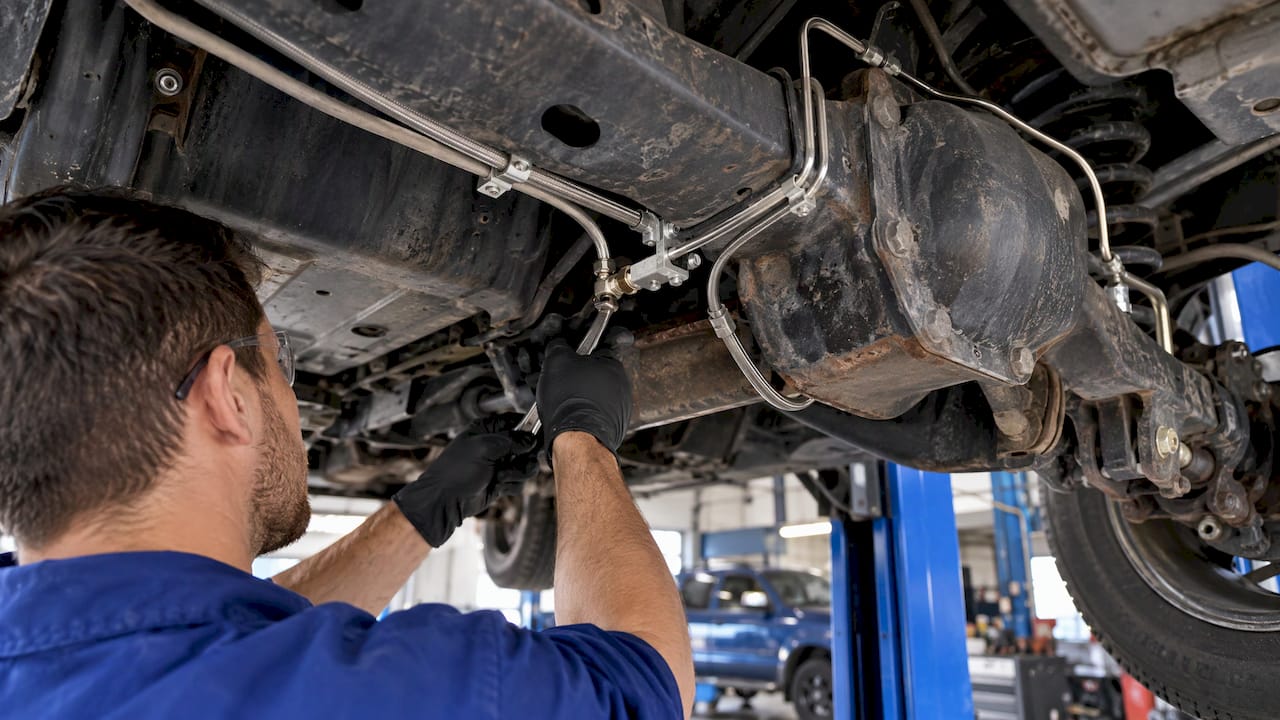
Stainless brake hardware is the set of stainless-steel parts that carry brake fluid and hold the system together: rigid hard lines, braided flexible hoses and their end fittings. Its job is to resist corrosion and keep fluid pressure steady, which matters in a country where road salt is part of every winter. It works alongside your pads, rotors and calipers, and the whole system performs only as well as its weakest part.
This guide explains what the hardware includes, how hard lines differ from braided hoses, what Canadian rules and inspection guidance say, how to confirm fitment, and how the hardware fits with the friction parts we build.
TL;DR
- Stainless brake hardware means hard lines, braided hoses and end fittings. Hard lines run along the chassis, and braided hoses connect them to parts that move, such as calipers.
- Road salt and slush make brake lines and fittings especially vulnerable to corrosion, so winter inspection matters more than the material alone.
- Braided stainless lines are reported to keep the pedal firm and responsive. Pad, rotor and fluid condition still decide how the brakes behave.
- In Canada, brake hoses fall under Transport Canada’s TSD 106, which sets labelling and pressure requirements.
- Confirm fitment with your VIN and brake configuration, not only year, make and model.
Table of Contents
- What counts as stainless brake hardware
- Why stainless matters in a Canadian winter
- Does stainless hardware change how the brakes feel?
- What to check before you buy
- Installation and fluid service
- Inspection: what counts as a defect
- Perspective
- Pads, rotors and calipers that work with your hardware
- A seasonal routine that protects the whole system
- FAQ
- Sources
What counts as stainless brake hardware
The term covers several different parts, and shoppers often mean different things by it. Sorting them out first avoids buying the wrong item.
- Hard lines: rigid tubing that runs along the frame or underbody from the master cylinder toward each wheel.
- Flexible hoses: the short sections that bridge the gap between a fixed line and a moving component, such as a caliper on a steering knuckle or an axle.
- End fittings: the connectors crimped or swaged onto a hose, plus the unions and flare fittings on a hard line.
- Mounting hardware: clamps, brackets and clips that hold lines clear of moving and hot parts.
Transport Canada’s brake hose standard, TSD 106, defines a brake hose as a flexible conduit that transmits or contains brake-system fluid pressure or vacuum. A brake hose assembly is a hose with its end fittings attached. That definition is useful when you read a product listing: a “line kit” may contain rigid tubing, flexible hoses or both.
Hard lines and braided hoses
The two do different work. In a documented stainless brake build, hard lines handle the chassis runs and braided hoses connect them to moving axle and caliper locations. A hard line cannot flex, so it would fatigue and crack if it were asked to follow suspension travel. A braided hose can flex, so it takes the last stretch to the wheel.
| Stainless hard line | Braided stainless hose | |
|---|---|---|
| Where it sits | Along the frame or underbody | Between a fixed line and a caliper or axle |
| Flexes with suspension | No | Yes |
| Main concern | Salt corrosion, wall thickness, leaks | Chafing, cracking, kinking, end-fitting condition |
| Installation | Bending and flaring to the right shape | Correct length, routing and fitting seal |
Some braided hoses carry a clear or coloured PVC jacket. Manufacturers use it to stop the steel braid from rubbing on suspension parts and seals, and to keep road salt and moisture away from the braid. If you drive through slush for months, a jacketed design is worth looking for.
Why stainless matters in a Canadian winter
Salt is the real adversary. Autosphere reports that road salt and slush leave brake lines and fittings particularly vulnerable to corrosion, and that a porous line can seep fluid. The same article says a flexible hose that is cracking, stretching or kinking should be replaced.

That is where stainless earns its place. A material that resists rust slows the thinning of line walls and the seizing of fittings, the failures that turn a routine brake job into a long one. It also helps at the other end of the year, when summer heat and humidity keep metal damp.
Stainless does not remove the need to look. The same Autosphere piece notes that moisture inside the brake system can also cause corrosion, so inspection and the manufacturer-recommended brake fluid service remain important. If you want the fluid side in detail, see our guide on brake fluid moisture and our comparison of DOT 3 and DOT 4 fluid and humidity.
Keeping the surrounding metal protected
Lines and fittings sit in the same salty spray as the underbody. Regular rinsing keeps salt from sitting on them, and guidance on road salt protection for cars covers the wider winter routine. For the brake-specific checks, our page on monthly checks to protect brakes from road salt corrosion lists what to look at and how often.
Does stainless hardware change how the brakes feel?
The commonly reported benefit is pedal feel. Braided stainless lines can keep the brake pedal firm and responsive and build driver confidence, especially on the track. The reasoning is that a braided hose swells less under pressure than a plain rubber one, so more of your pedal effort becomes clamping force.
Two points keep this in proportion for a daily driver:
- The reported gains are strongest in hard track use. On the road, the practical gain is a hose that holds up to age and salt.
- Pedal feel is a result of the whole system. Pads that stay stable when wet, rotors that stay clean, calipers that move freely and fresh fluid all show up at the pedal.
That last point is the core of how we think about braking at AAA Frictions. Hardware carries the pressure. Pads, rotors and calipers turn it into stopping force.
What to check before you buy
Construction and pressure ratings
Canadian rules give you a baseline to check against. Under Transport Canada’s TSD 106:
- Hydraulic brake hose assemblies need permanently attached end fittings, secured by crimping or swaging.
- At least one fitting must carry the manufacturer’s identification.
- Expansion requirements are set at 6,895 and 10,342 kPa, and at 19,995 kPa for hose no larger than 5 mm.
- Assemblies face a two-minute pressure test at 27,579 kPa.
- Minimum burst thresholds are 48,263 kPa for hose no larger than 3 mm and 34,474 kPa for larger hose.
In practice, look for a clearly marked manufacturer on the fitting, crimped or swaged ends instead of clamp-on connectors, and a listing that states material, size and fitting type rather than only a photo.
Fitment: more than year, make and model
The same car can leave the factory with different brake setups, so “fits a 2019 Jetta” is not enough. Confirm these before ordering:
- Your VIN, to confirm the exact vehicle.
- The brake configuration: front or rear, rotor size, caliper type, and whether the car has a parking brake integrated into the rear caliper.
- The exact part number, with any notes on exclusions or qualifiers.
- Thread type and length at each fitting.
Our brake parts by vehicle catalogue is organised the same way, by vehicle, so the pads and rotors you pick match the car you actually own.
Installation and fluid service
Fitting stainless hardware is detailed work, and a leak at a fitting is a safety issue, not an inconvenience. The documented practice from the stainless build mentioned above is straightforward:
- Use proper flaring tools for hard lines.
- Route lines clear of obstructions and heat sources.
- Secure them with clamps so nothing chafes.
- Bench-bleed the master cylinder, then bleed the system starting at the caliper farthest from it, and check the system afterwards.
If you are not confident flaring and bleeding, have a licensed mechanic do the work. Brake lines are not a place to learn by trial and error, and a mechanic can confirm the pedal is firm and nothing is leaking before the car goes back on the road.
After any hose or line replacement, the system is open to air and fresh fluid is part of the job. Moisture is the long-term enemy of brake fluid, which is why our guide for drivers and mechanics on brake fluid moisture is worth a read at the same visit.
Inspection: what counts as a defect
Canadian inspection guidance is specific. The Vehicle Inspection Manual treats visible damage as a defect when it reduces the wall thickness of a metal line, compromises structural integrity, causes a brake fluid leak or allows chafing. The inspection covers lines, fittings, hose covers and how securely everything is mounted.
A simple home check, done at every tire change:
- Look along each hard line for flaking, deep pitting or wet spots.
- Flex each hose gently by eye, looking for cracks, bulges, kinks or a frayed cover.
- Check the fittings for fluid residue.
- Confirm clamps and brackets are tight and that nothing rubs.
- Watch the fluid reservoir level and note any drop.
A soft pedal, a pedal that sinks slowly, or a fluid puddle near a wheel means the car should be seen by a mechanic before further driving.
Perspective
Stainless hardware is a good decision, and we see it as one layer in a larger design. Our approach starts from a simple observation: weather attacks a braking system in several different ways at once, so no single part can solve it.
Moisture changes how a pad grips, which is why we developed HydroAdaptive pads for moisture management and stable friction. Salt attacks the surface of a rotor, which is why our rotors carry a GEOMET coating designed to protect against moisture and road salt corrosion. Cold and heat change how a caliper moves, which is why our ClimateFlex calipers are designed for smooth operation through winter cold and summer heat.
We develop rotors and pads as a matched system, and we sell rotors only with compatible pads. That matters because a consistent pedal needs the friction surface and the pad compound to work together. When the hardware that carries fluid to those parts is in good condition, the whole system can deliver the predictable response it was engineered for.
Our advice to Canadian drivers is to treat the brake system as an ecosystem: protect the lines, keep the fluid fresh, and pair pads and rotors that were designed to work together.
AAA
Pads, rotors and calipers that work with your hardware
Once the lines and hoses are sound, the friction parts decide how the car stops in rain, slush and cold. Our range is built around that:
- Pads: Type 03 brake pads and Type 07 brake pads use HydroAdaptive ceramic technology designed for moisture management and stable friction.
- Rotors: SC Type rotors and GC Type rotors are designed for consistent behaviour across changing temperatures, and the GEOMET coating is designed to protect against corrosion from moisture and road salt.
- Calipers: ClimateFlex calipers are designed for smooth operation through winter cold and summer heat.
For winter rotor care between services, our same-day steps to protect rotors from brine corrosion are written for Canadian conditions.
Ready to match your brakes to the weather
If you are already working on your brakes, this is a good time to choose pads and rotors designed for Canadian weather. Find your vehicle in our brake parts by vehicle catalogue and order the matched pad and rotor set made for it. You can also start from the AAA Frictions storefront.

If you drive a Volkswagen, our Volkswagen brake parts by model page lists the models we cover, including the 2019 Jetta, 2023 Jetta and 2024 Jetta.
A seasonal routine that protects the whole system
A short calendar keeps the hardware, fluid and friction parts in step.
- Late autumn, before the first salt: inspect lines, hoses and fittings, and check the fluid level and condition. Confirm pads have life left for winter.
- Mid-winter: rinse the underbody when temperatures allow, and listen and feel for changes at the pedal.
- Early spring: wash off the accumulated salt, look again at lines and fittings, and check rotors for surface corrosion.
- Whenever the system is opened: bleed with fresh fluid and confirm the pedal is firm before driving.
For more articles in this vein, browse the AAA Frictions blog.
FAQ
Is stainless brake hardware the same as a stainless brake line kit?
Mostly, yes, though kits vary. Some contain rigid hard lines, some contain braided flexible hoses and some include both with fittings. Read the listing for the line type, material, size and fitting thread so you know what you are getting.
Does stainless steel stop brake lines from corroding in road salt?
It resists rust far better than plain steel, but salt and slush still make lines and fittings vulnerable, according to Autosphere. Keep rinsing the underbody, inspect at every tire change and service the brake fluid as the manufacturer recommends.
Are replacement brake hoses regulated in Canada?
Yes. Transport Canada’s TSD 106 sets labelling and performance requirements for brake hoses, brake hose assemblies and end fittings. That includes permanently attached fittings, manufacturer identification and pressure and burst testing.
How do I know a part fits my car?
Use your VIN to confirm the exact vehicle, then check the brake configuration and the exact part number, including any exclusions. Year, make and model alone can leave out differences between trims and brake setups.
Will braided lines make my pads and rotors perform better?
Braided lines are reported to give a firmer, more responsive pedal, mainly noticed in track driving. Stopping force still comes from the pads, rotors and calipers, so choose those for the weather you drive in.
Sources
- Brake Hoses, Transport Canada TSD 106
- Plumb Perfection, Classic Truck Performance, July 2023
- Safe and Secure: Analyzing Brake Hardware, Autosphere
- Does Your Car Really Need Braided Stainless Steel Brake Lines, MotorBiscuit
- Vehicle Inspection Manual 2025, Hydraulic Brakes
- Road salt protection for cars