

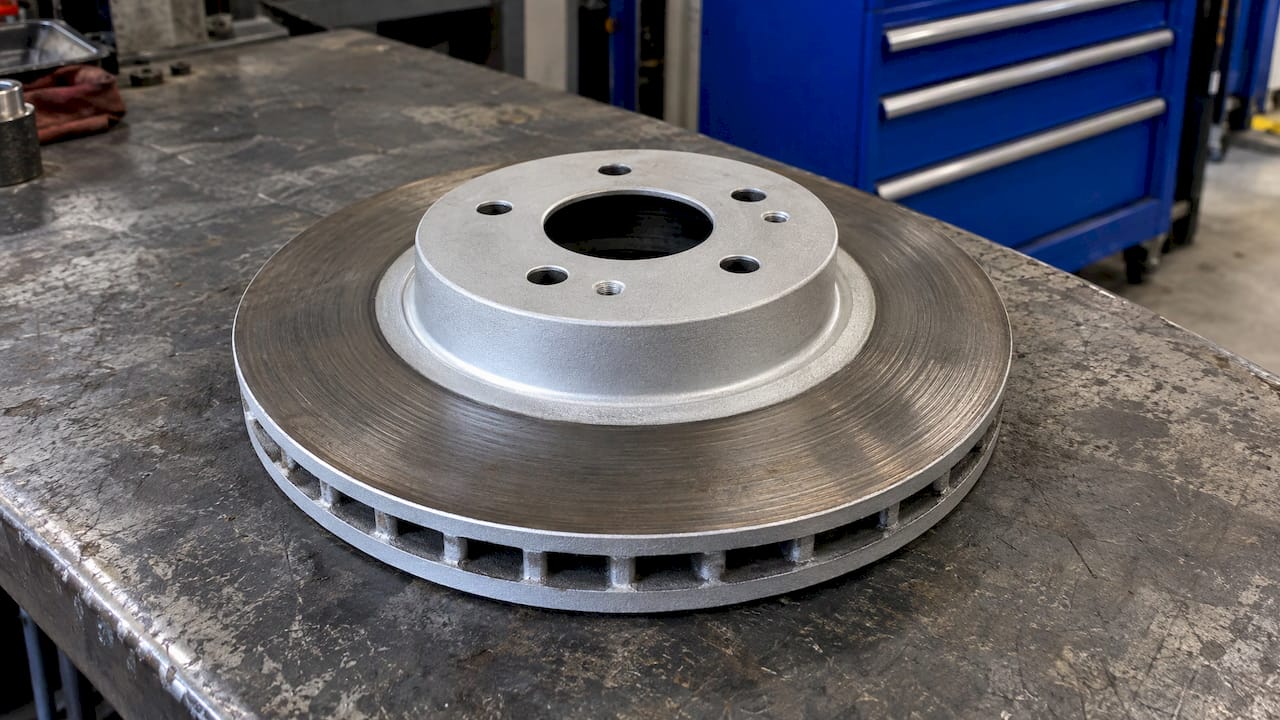
Brake rotor coatings fall into a few families: electroplated zinc, zinc-aluminum flake coatings such as GEOMET, polymer or resin-based finishes, and, in engineering research, harder surface treatments such as chrome plating and plasma electrolytic oxidation. On road rotors sold today, the choice that matters most is how well a coating protects the parts of the rotor that never touch the pad, and how it holds up to Canadian winters. This guide explains each type, where it sits on the rotor, and how to pick one.
TL;DR
- Most aftermarket coatings protect the non-contact areas of the rotor (hat, edges and, on vented rotors, the vanes), because the pad wears the coating off the friction surface within the first stops.
- The common coating families are electroplated zinc, zinc-aluminum flake (GEOMET), and polymer-based finishes. Chrome, laser cladding and plasma electrolytic oxidation are mostly research and specialty treatments.
- GEOMET is a water-based coating with zinc and aluminum flakes that forms a metallic silver film, which suits road salt and brine.
- Coating on the swept surface wearing away is normal. Light surface rust there clears with normal braking.
- Our GC Type rotors use a GEOMET coating and are sold as a matched system with compatible pads.
Table of Contents
- Why rotors need a coating at all
- The main rotor coating types
- Coating types compared
- What “semi-coated” means
- Why the coating wears off the braking surface
- Does coating affect braking, noise and bedding-in?
- Our perspective
- How to tell which coating you have and what to choose
- Our weather-ready brake range
- FAQ
- Sources
Why rotors need a coating at all
Most conventional rotors are cast iron. It is strong, relatively inexpensive and absorbs intense heat, but it rusts easily. The working surface has to stay bare metal so the pads can clamp directly onto it, since paint, grease or a traditional protective coating would interfere with friction.
That creates a design problem. The braking surface cannot be protected the way the rest of the rotor can. So the useful question is not whether a rotor is coated, but where the coating is, what it is made of, and how it behaves once the pads start sweeping the surface.
In Canada the problem is sharper. Road salt and brine sit on wheels for months, and a rotor that rusts around the hat and vanes looks poor, can seize against the hub, and can shed rust into the swept area. We cover the winter side in more detail in our guide to protecting rotors from brine corrosion.
The main rotor coating types
Electroplated zinc
Electroplated zinc is the classic sacrificial finish. A thin layer of zinc is deposited on the iron, and the zinc corrodes first. It usually has a silver look when new. It is among the zinc coating forms described in the research on brake disc coatings, alongside GEOMET and polymer-based types.
Zinc works well while the layer is intact. Where it fades or is scratched, protection drops in that spot. Our overview of zinc-coated rotor benefits goes through what owners should expect over time.
GEOMET (zinc-aluminum flake)
GEOMET is a proprietary water-based family of coatings. According to the Green Metafin technical information summarised in the IOPscience review, it contains metal oxides plus metallic zinc and aluminum flakes, and forms a metallic silver film. The flakes overlap in layers, which creates a barrier against moisture while the zinc still offers sacrificial protection.
That combination is why it is widely chosen for parts exposed to salt. It is also the coating we use on our GC Type rotors.

Polymer and resin-based coatings
These combine zinc particles with a synthetic resin. The resin binds the finish and helps it cover the rotor evenly. They are often applied to the hat and non-contact areas, and the finish can look matte or glossy depending on the product.
E-coating and powder coating
E-coating (electrophoretic deposition) and powder coating are paint-style finishes. They lay down a uniform organic film that seals out moisture. They are common on the hat and edges of aftermarket rotors. Because they are barrier coatings rather than sacrificial ones, a chip exposes bare iron, so the quality of the application matters.
Hard chrome plating
Chrome plating has been used for automotive applications, including brake discs, since the 1920s. The MDPI review of gray cast iron brake disc coatings notes its high hardness, wear and corrosion resistance and low coefficient of friction. It is a long-established engineering option rather than a typical finish on road rotors.
Plasma electrolytic oxidation (PEO) and laser cladding
These are newer, harder treatments. The IOPscience review groups nonthermal spray processes into four categories: hard chrome plating, PEO, laser cladding and plasma transferred arc.
PEO builds an alumina ceramic layer. A University of Windsor thesis (2024) describes it as a relatively new approach for cast iron rotors, aimed at reducing corrosion, emissions and noise, and found that the PEO-coated rotor had better corrosion and wear resistance than the ferritic nitrocarburized rotor used in the market. A 2026 MDPI study used a coating of about 50 microns and reported that PM10 levels of uncoated gray cast iron were reduced by around 75% for laser-clad cast iron and PEO wrought aluminum alloy.

This is promising research. For most drivers shopping for replacement rotors today, it is useful background rather than a shelf option.
Coating types compared
| Type | Material | Typical protection | Where it is usually applied |
|---|---|---|---|
| Electroplated zinc | Zinc layer | Sacrificial corrosion protection | Hat and non-contact areas |
| GEOMET | Zinc and aluminum flakes, water-based | Barrier plus sacrificial protection against moisture and salt | Hat, edges, non-contact areas |
| Polymer or resin | Zinc particles in synthetic resin | Barrier against moisture | Hat and non-contact areas |
| E-coat or powder coat | Organic paint-style film | Barrier against moisture | Hat and edges |
| Hard chrome | Chromium plating | Hardness, wear and corrosion resistance | Specialty applications |
| PEO, laser cladding | Ceramic or clad layers | Corrosion and wear resistance, lower emissions in studies | Research and specialty use |
What “semi-coated” means
A semi-coated (or partially coated) rotor has its coating on the non-friction areas only: the hat, the outer edge and, on vented designs, the cooling vanes. The swept surface where the pad makes contact is left uncoated or very lightly coated. This follows from the basic rule above: the friction surface must be bare metal to brake properly.
So “semi” is not a lower grade. It describes where the protection goes. A coating that covers the swept face would be gone after the first stops anyway, so the design puts protection where it lasts.
Why the coating wears off the braking surface
The pads sweep the friction face every time you brake, and that action removes whatever sits on it. This is expected. The braking surface is left exposed to oxygen and moisture, and normal braking usually removes light surface rust within the first few stops.
If you see an orange film after a wet night or after a car has sat, that is typically flash rust. Our guide to flash rust on rotors explains what it means and what to do. For vehicles parked for days, see our stored car brake rust steps.
Does coating affect braking, noise and bedding-in?
A coating on the non-contact areas should not change how the pads work, because the pads never touch those areas. Research on coated surfaces on the friction face is more varied. In a World Scientific study of coated rotors, four excessively worn rotors from a light commercial vehicle were recoated with different thicknesses, methods and powders. In bedding tests, the original rotor produced higher noise and a higher friction coefficient than the coated rotors.
The 2026 MDPI work found that all rotor materials reached a satisfactory friction coefficient against a suitable low-metallic pad, though a wrought PEO aluminum alloy measured about 0.65 against about 0.50 for the others. The takeaway is that the rotor and pad pairing matters. For more on how pad friction is described, see our brake pad friction guide.
The pad also affects corrosion. An SAE technical paper on rotor corrosion found that pad type influences rotor corrosion behaviour, since some pads transfer corrosion-active ferrous material onto the rotor. It also reported that friction-tested rotors kept the corrosion resistance of their ceramic coatings, with non-asbestos organic pads showing lower corrosion rates than semi-metallic pads.
Our perspective
We design rotors and pads as one system. A coating that protects the hat and edges is only half of the answer, because the pad that sweeps the friction face also shapes how the rotor behaves in rain, cold and salt.
That is why we use GEOMET on our GC Type rotors. Its zinc and aluminum flake structure is designed to protect the surfaces the pad never reaches, so the rotor keeps a clean look and stays free to expand, cool and release from the hub through a Canadian winter.
It is also why we sell rotors only with compatible pads. Our HydroAdaptive ceramic pads are designed for moisture management and stable friction, and the matched pairing is how we aim for predictable pedal feel from the first wet commute to the coldest morning.
AAA
How to tell which coating you have and what to choose
Start by looking at the rotor, ideally with the wheel off.
- Check the friction face. If the swept ring is bare and the hat is coloured or silver, the rotor is semi-coated.
- Look at the finish. Silver and slightly flaky or metallic suggests a zinc or zinc-aluminum finish. A matte or glossy uniform layer suggests a polymer, e-coat or powder coat.
- Check the vanes. On a vented rotor, look through the openings. Clean metal there, rather than orange rust, is a good sign of protection reaching the inside.
- Read the product listing or box. The coating name should be stated. If the listing only says “coated”, ask the seller which areas and which material.
- Match it to your driving. Salted roads, coastal humidity, long storage periods and high mileage all raise the value of a coating that protects the non-contact areas.
For a deeper comparison of coated and uncoated options on Canadian roads, see coated rotors vs plain. If you want to track how a coating ages, our piece on measuring rotor coating wear explains the checks. You can also compare brands in our rotor brand guide.
The same logic applies to the rest of your car. Surface protection thinking carries over to wheels too, and there is useful reading on protecting alloy wheels with ceramic coatings if you want to keep the whole corner of the vehicle looking clean.
Rotor design and coating
Coating is separate from rotor geometry. Drilled and slotted rotors are chosen for debris and gas clearing and heat management, and they can be coated like any other. If you are weighing these designs, read about drilled and slotted rotors and when slotted rotors beat blank ones.
Our weather-ready brake range
We build brake parts for consistent braking when the weather changes. Our GC Type rotors carry a GEOMET coating for protection against moisture and road salt corrosion. Our Type 03 and Type 07 HydroAdaptive pads are the matched partners, and our ClimateFlex calipers are designed for smooth operation through winter cold and summer heat. We also offer SC Type rotors.
For a complete set, vehicle-specific kits pair pads and rotors in one order, such as the front and rear brake kit for the Mitsubishi RVR 2011-2012 with GEOMET coated rotors.

Browse the full range on aaafrictions.ca and choose the set that fits your vehicle.
FAQ
What are the most common rotor coating types?
The most common are electroplated zinc, zinc-aluminum flake coatings such as GEOMET, and polymer or resin-based finishes. Paint-style e-coats and powder coats also appear on the hat and edges. Harder treatments such as chrome, laser cladding and PEO are mainly used in engineering and specialty applications.
Why isn’t the whole rotor coated?
The friction face has to be bare metal so the pads can grip it, and coatings, grease or paint there would interfere with braking. Coating goes on the hat, edges and vanes, where it keeps working for the life of the rotor.
What does semi-coated mean on a brake rotor?
It means the non-friction areas are coated and the swept surface is left uncoated or very lightly coated. The protection sits where it will last, while the pad contact area stays ready to brake.
What metal are brake rotors made of?
Most conventional rotors are cast iron, which is strong, relatively inexpensive and absorbs heat well. Because iron rusts easily, coatings on the non-contact areas help keep the rotor looking and working well in wet and salty conditions.
Sources
- Coating solutions for enhancing automotive brake disc (IOPscience, 2024)
- Coatings for Automotive Gray Cast Iron Brake Discs: A Review (MDPI, 2019)
- Comparative Study of Different Surface Treated Brake Rotors (University of Windsor, 2024)
- Friction Performance and Wear Emissions of Coated and Uncoated Brake Rotor Materials (MDPI, 2026)
- Investigation of Noise Characterization of Coated Rotors (World Scientific, 2020)
- Experimental Investigation of Corrosion of Cast Iron Rotors (SAE Mobilus, 2020)
- Why Brake Rotors Rust Overnight (Motor1)