

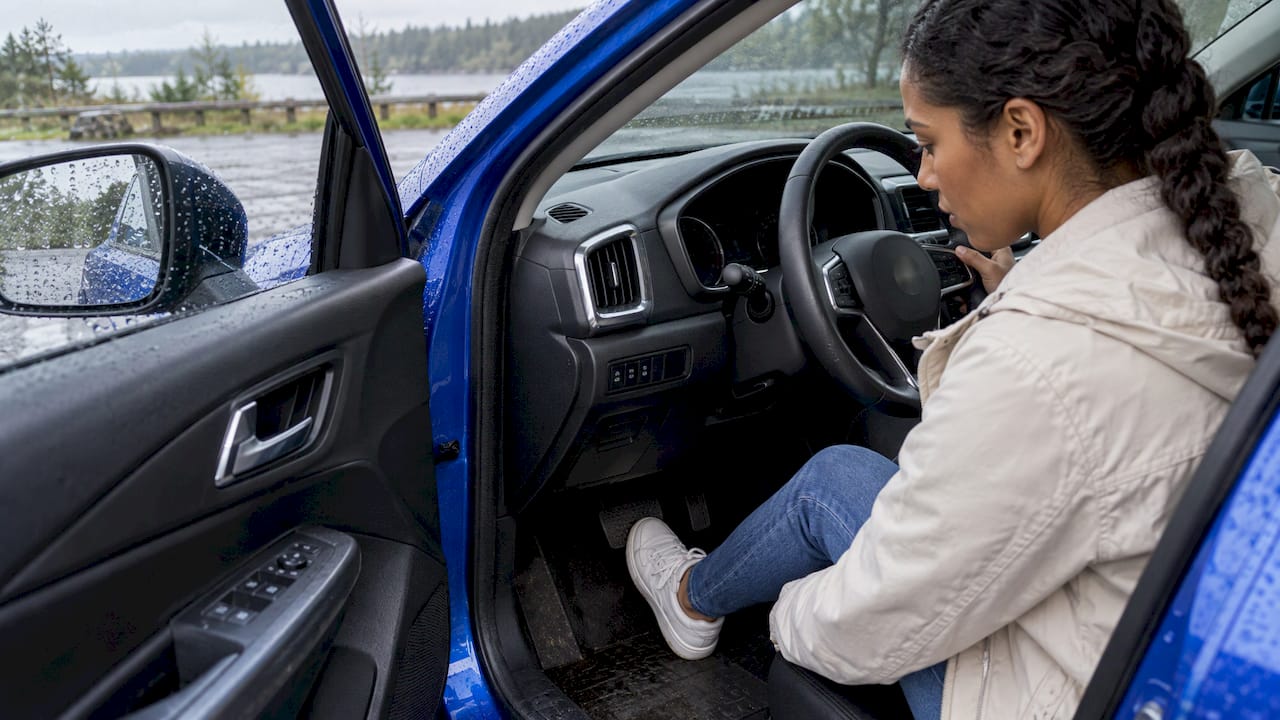
If your brakes feel stuck, grabby or noisy for the first few stops after rain, the cause is usually a thin film of surface rust or water on the rotors, and it clears within a few stops. If the problem stays after the car has warmed up, or the car pulls to one side, drags, or smells hot, a caliper, slide pin or parking brake is likely binding and the car needs inspection.
This guide helps you tell the two apart in a few minutes. It covers the three-stop check, the causes of genuine sticking, what to do on the spot, and how to cut down on the problem for good.
TL;DR
- Brief grabbing or scraping on the first stops after rain or a wash is common. Light rust forms on iron rotors and the pads wipe it away.
- Use the three-stop check: drive normally, brake gently a few times. A normal rain effect fades. A real fault does not.
- Pulling to one side, a soft pedal, grinding on dry roads, a warning light, or a wheel that stays hot point to a sticking caliper or slide pins. Get it inspected.
- Never spray WD-40 or other lubricants on pads or rotors. Contamination can reduce braking.
- Wet-weather design matters. Our HydroAdaptive pads, GEOMET-coated rotors and ClimateFlex calipers are built to keep braking consistent when conditions change.
Table of Contents
- What drivers mean by brakes stuck after rain
- Why rain changes how brakes feel
- The three-stop check
- When it is not just rain: signs of a sticking brake
- What to do right now
- What not to do: skip the spray
- How to prevent brakes sticking after wet weather
- Choosing parts built for wet and salty roads
- A quick checklist before you drive off
- FAQ
- Sources
What drivers mean by brakes stuck after rain
People use the phrase for three different experiences, and each has a different cause.
- Grabbing or a harsh first bite. The pedal feels over-sensitive or the car lurches slightly on the first stop. This is most often moisture and a light rust film on the rotor surface.
- Delayed or weak first stop. The pedal feels normal but the car slows later than expected. Water between pad and rotor reduces friction for the first application.
- True sticking or dragging. The brake does not fully release. The car feels sluggish, pulls to one side, a wheel is hot after a short drive, or you hear a pop when you first move off after parking.
The first two are weather behaviours. The third is a mechanical condition that rain and salt exposed. Knowing which one you have decides whether you keep driving gently or book a shop visit. If you mostly notice grabbing, our guide on why brakes grab when wet goes deeper on that symptom.
Why rain changes how brakes feel
Flash rust on the rotor
Most rotors are iron. Overnight moisture or a rainy drive leaves a thin layer of surface rust on the rubbing face. When you drive and brake, the pads scrape it off. During those first stops you may feel a rough bite or hear a squeal, and it usually fades after a few stops. CRC Industries explains this process and recommends an inspection if the noise persists.

The same mechanism applies after a wash. If your car’s brakes act up after cleaning, see our page on brakes sticking after a car wash.
A water film between pad and rotor
After heavy rain or deep puddles, a film of water can sit between the pad and rotor. Volvo’s support page notes that prolonged driving in heavy rain without braking may delay the first brake response slightly, and the same can happen after washing the vehicle. Their advice is to press the pedal a little harder and leave a bigger gap to the vehicle ahead.
That extra gap matters because rain already lengthens stopping distances. We cover that in our guide to stopping distance in rain.
Why it shows up more in Canada
Canadian driving adds road salt, slush and long cold spells. Driving.ca describes the exposed moving metal in a disc-brake system as its weak point. In winter, salt and moisture build rust on caliper sliders and pins, which can lead to dragging brakes, faster wear and, in bad cases, seized wheels.
The three-stop check
Before you worry, run this simple test in a safe, quiet spot, such as an empty lot or a low-traffic street.
- Pull away and drive normally at low speed.
- Brake gently three times, with some distance between each stop.
- Note what changes between stop one and stop three.
If the grab, scrape or noise fades, it is almost certainly normal. If it stays the same or gets worse, something mechanical is involved. This matches the rule of thumb used by repair shops: a symptom that disappears within two or three stops once the car has warmed up is normal wet-weather behaviour, while one that persists was already there and rain just revealed it.
It also helps to jot down when the problem occurs. Only after rain? Only after sitting overnight? Only on one corner of the car? A pattern is the most useful thing you can give a technician.
When it is not just rain: signs of a sticking brake
Rain does not usually cause a brake fault. It exposes wear and corrosion that were already building. These signs mean you should stop treating it as weather.
| Symptom | What it often means | What to do |
|---|---|---|
| Car pulls to one side when braking | A seized or partly seized caliper on one axle | Have it inspected before more driving |
| Spongy or sinking pedal | Hydraulic issue or a binding component | Do not continue normal driving; see a technician |
| Grinding on dry roads | Worn pads or metal contact | Inspect promptly |
| One wheel much hotter than the rest after a drive | Brake not releasing | Inspect caliper and slide pins |
| Loud pop when first moving after parking in slush | Pads rusted to the rotors | Cleaning and lubrication service |
| Brake warning light | System fault | Inspect promptly |
The pulling and spongy-pedal symptoms come from RAC’s guidance: a seized or partly seized front caliper usually pulls the car to one side and the pedal may feel spongy. The pop on moving off is described by Cochrane Automotive as a sign pads were likely rusted to the rotors and need a clean and lube service.
If you also hear a metallic rasp, read what to do about brakes grinding after rain. If the pedal feels soft, see spongy brakes in rain.
Common causes of a genuinely stuck brake
Firestone lists six frequent causes of stuck brakes and calipers: disuse, a bound-up parking brake, stuck slide pins, worn or damaged hardware, contaminated brake fluid and a faulty caliper. They also note that it is rarely one factor. Age, heat, moisture and normal wear combine over time, which is why a car can run fine for months and then misbehave after a wet week.
Two of these deserve extra attention for Canadian drivers:
- Slide pins and boots. Slush and salt can work past the rubber boots that protect the caliper slide pins. Once salt gets in, it dries the lubricant and the metal corrodes and swells, which can seize the caliper.
- Low-use brakes. Vehicles that rely little on friction braking, such as EVs and hybrids, can see pads stick slightly in their brackets in wet or salty conditions. JPS Garage recommends using the friction brakes deliberately now and then in a safe place, rinsing wheels and brakes where road salt is used, and keeping up periodic inspections so caliper slides keep moving freely.
Our page on caliper sticking in winter covers the cold-weather side in more detail.
What to do right now
If it is the normal wet-brake effect
Once you are on the road with clear space behind you, slow down and apply the brakes lightly to help them dry. The Manitoba Driver’s Handbook says to test the brakes lightly after a large puddle, because they may pull to one side or not work at all, and to dry them by driving slowly while applying them lightly. Road Safety at Work adds a useful check: make sure the brakes pull evenly on all wheels before you speed up again.
For the grab-and-squeal version of this problem, our wet pad grip guide and our page on brakes that squeal when wet explain the details.
If the brakes are dragging or the car pulls
- Ease off and pull over when it is safe. Do not keep driving hard on a dragging brake. Heat builds quickly and can damage the rotor, pad and wheel bearing.
- Check whether the parking brake is fully released. A parking brake that has frozen or bound up is one of the simpler causes.
- After the car has been driven briefly, carefully compare wheel temperature by holding your hand near, not on, each wheel. A noticeably hot wheel points to the stuck corner.
- Look through the wheel spokes with a flashlight for heavy rust, damaged boots or uneven pad wear.
- Book an inspection. A technician can clean and lubricate slide pins, replace damaged hardware, or service or replace the caliper.
If the pedal goes soft or the brakes fail
This is an emergency. The Ontario Driver’s Handbook advises that when brakes fail you should pump the pedal to try to restore hydraulic pressure, then apply the parking brake gently but firmly while holding the release button. If you manage to stop, do not drive away. Call for help. A tow company advises likewise: if the pedal goes to the floor or the car does not slow normally, do not drive another metre.
What not to do: skip the spray
It is tempting to reach for a can of lubricant when brakes squeak or stick. Do not. The maker of WD-40 states that its multi-use product should not be applied to braking surfaces or components where friction is required, as it may impair braking performance. It may be used in limited cases to free seized components during maintenance, but only while keeping it off friction materials and cleaning thoroughly before the system returns to service.
If spray does reach the pad, the safest fix is usually to replace the contaminated pads and clean the rotor with proper brake cleaner. Hitech Auto Repairs makes the same point: fix the cause rather than lubricate the braking surface.
The right lubricant is high-temperature brake grease on non-friction contact points such as slide pins, shims and clips, applied during service and kept off the pad face and rotor.

How to prevent brakes sticking after wet weather
Habits and parts both play a role. Start with habits.
- Brake lightly after puddles and washes. A few light applications in a safe spot help dry the rotors. Oegema, Nicholson & Associates notes that some vehicles do this automatically, but you can do it by hand too.
- Rinse off salt. In winter, a high-pressure underbody wash helps clear salt from wheel wells and brake components. Cochrane Automotive also recommends using the parking brake regularly and booking spring and fall inspections to clean and lubricate the sliders.
- Keep wheels clean. Built-up brake dust holds moisture and adds to noise. If you want a safe routine for wheels, here is a guide to removing brake dust safely with the right dwell time. Keep any cleaner away from the pad friction surface and rotor face as you work.
- Do not let the car sit wet. Cars that sit for days after a wet or salty drive are the ones that wake up with rusted-on pads. If a vehicle sits, drive it and use the brakes normally at least once a week.
- Inspect on schedule. Have slide pins, boots and hardware looked at during tire swaps or seasonal service.
Now the parts. Brake components differ in how they handle moisture, salt and temperature swings, and choosing parts designed for those conditions is the other half of prevention.
Our perspective: braking that stays consistent as weather changes
We build every AAA Frictions part around one question: what does weather do to a braking system, and how do we keep the response predictable anyway? Rain, humidity, snow, road salt and freezing mornings each stress a different component, so we treat the brakes as an ecosystem rather than a set of unrelated parts.
Our HydroAdaptive pads are designed for moisture management and a stable friction profile, so the first stops in wet conditions feel clean and predictable. Our GEOMET-coated rotors are designed to protect against corrosion from moisture and road salt, which addresses the surface rust that causes so much of the grabbing drivers notice after rain. Our ClimateFlex calipers are designed for smooth operation through winter cold and summer heat, which is exactly where sticking tends to begin.
We develop rotors and pads as a matched system and sell rotors only with compatible pads, so the friction pair works the way it was engineered to. For drivers who put on many kilometres, rideshare and delivery drivers, daily commuters and anyone driving a larger vehicle, that consistency is what builds confidence in the pedal.
AAA
Choosing parts built for wet and salty roads
If your brakes have worn out, or if you are already replacing parts because of rust and recurring wet-weather behaviour, this is the moment to choose components designed for it.
At AAA Frictions we offer Type 07 brake pads and Type 03 brake pads with HydroAdaptive ceramic technology, plus GC type rotors with a GEOMET coating, designed to protect against moisture and road salt. Our ClimateFlex calipers are designed to operate smoothly through cold winters and hot summers. Because our rotors and pads are developed as a matched system, rotors ship with compatible pads. Kits are vehicle-specific, so you can match them to your make, model and year on our site.

Prefer to start from the whole range? Browse everything on aaafrictions.ca and select your vehicle.
A quick checklist before you drive off
Keep this short routine for wet days.
- After heavy rain, puddles or a wash, brake lightly a few times where it is safe.
- Notice whether the car stays straight under braking.
- Notice whether the pedal feels firm and consistent.
- After a short drive, check that no wheel is much hotter than the others.
- If anything persists after a few stops, get it inspected rather than waiting for the next rain.
Treat the extra following distance as part of the routine. Even healthy brakes need more room on wet pavement, and the first application after heavy rain can be slightly slower to bite.
FAQ
Are squeaky or grabby brakes normal after rain?
Yes, briefly. Moisture leaves a thin rust film on the rotors, and the pads wipe it off over the first few stops. If the noise or grab disappears quickly, it is normal. If it continues once the car is warm, or shows up on dry days too, have the brakes inspected.
Can I spray WD-40 on brakes to stop squeaking or sticking?
No. The manufacturer says its product should not be applied to braking surfaces where friction is required, because it may impair braking. Use brake cleaner for residues and high-temperature brake grease only on non-friction contact points, during proper service.
Why does only one brake seem to stick after rain?
One corner usually has its own problem, such as a corroded slide pin, damaged boot or a caliper that is starting to seize. Moisture and salt reveal the weak spot. A car that pulls to one side or has one hot wheel needs inspection soon.
How long should I drive gently to dry wet brakes?
There is no fixed distance, but a few light applications at low speed in a safe spot usually do it. Drive slowly, apply the brakes lightly, and confirm the car brakes evenly before returning to normal speed. If it still feels off after a few stops, book an inspection.
Should I drive if my brakes feel stuck?
If the pedal is soft or sinking, the car will not slow normally, or a wheel is smoking or very hot, stop driving and call for a tow. For a mild grab that clears in a few stops, you can continue with extra following distance and get the brakes checked at your next service.
Sources
- CRC Industries: Why Are My Brakes Squeaking?
- Volvo Support: Braking on wet roads
- Driving.ca: Why brakes must be in top shape for cold weather driving
- Direct Brakes: Wet Weather Braking Dangers
- RAC Drive: What to do if your car brakes seize
- Cochrane Automotive: Salt, Slush, and Stopping Power
- Firestone Complete Auto Care: What Causes Brake Calipers to Stick
- JPS Garage: Why Does My EV Have Rust On The Brakes
- Manitoba Driver’s Handbook: Wet Brakes
- Road Safety at Work: Driving for the Conditions
- Ontario Official MTO Driver’s Handbook: Dealing with emergencies
- London Towing: Signs Your Car Needs a Tow
- WD-40 FAQs
- Hitech Auto Repairs: Can I Spray WD-40 on Brake Pads?
- Oegema, Nicholson & Associates: 9 Tips for Driving in the Rain
- Diamondbrite: Remove Brake Dust Safely