

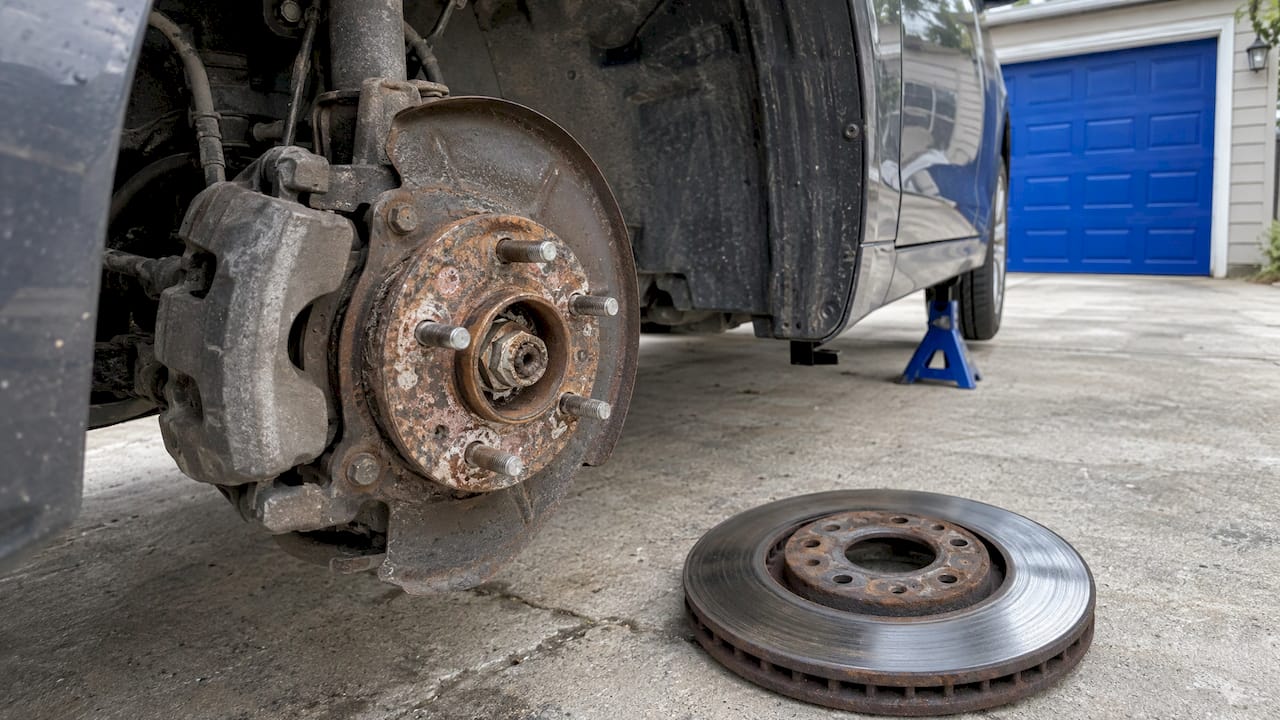
Rust on a wheel hub is mostly cosmetic. Rust on the flat face where the rotor sits is different: it can stop the rotor seating flat, and the result is a pulsing pedal, uneven pad wear and a rotor that wears out early. The fix is a clean, bright hub face every time a rotor is changed, plus a rotor and pad set built to cope with Canadian road salt. Our GEOMET-coated GC Type rotors and HydroAdaptive pads are made for exactly that second half of the job.
This guide explains where hub corrosion comes from, when it matters, how to clean a hub safely during a rotor change and how to slow it down in a salty climate.
TL;DR
- Light surface rust on a hub is normal. Scale on the rotor-mounting face is not, because it can tilt the rotor and cause runout and pulsation.
- Road salt and moisture drive most corrosion in Canada, and it keeps working after the snow melts.
- When you change rotors, clean the hub face to bright metal, keep grease off the friction surfaces and torque the wheel to specification.
- Rinse the underside after heavy salt exposure and avoid leaving a vehicle parked for weeks.
- A pedal that pulses, a spongy feel, grinding or a rubbing noise needs a prompt brake inspection.
Table of Contents
- What the hub does in your braking system
- Is rust on a wheel hub normal?
- What causes corrosion on brakes and hubs in Canada
- How hub corrosion turns into a pulsing pedal
- How to clean a corroded hub before fitting new rotors
- Matched parts finish what the cleaning starts
- Preventing hub and brake corrosion through a Canadian winter
- When hub corrosion is a safety concern
- Our view: the hub and the rotor are one system
- Ready to replace rotors and pads?
- FAQ
- Sources
What the hub does in your braking system
The wheel hub is the metal flange the wheel bolts to. On a disc brake the rotor slides over the hub and is clamped between the hub face and the wheel. The caliper then squeezes the pads against the rotor. The rotor has to spin flat, because the pads are only a fraction of a millimetre away from it when you are not braking.
That is why the hub matters for braking. Any bump, scale or rust build-up on the mounting face pushes the rotor slightly out of true. The error is small at the hub and larger at the rim of the rotor, so the pads touch the rotor unevenly every rotation. You feel that as a pulse through the pedal or a shudder in the steering wheel.
Is rust on a wheel hub normal?
Yes, up to a point. Iron and steel oxidise when they get wet, and a hub is bare metal exposed to water, brake dust and grime. General Motors’ corrosion bulletin separates ordinary surface corrosion on steel, cast iron and brake components, which can be purely cosmetic, from more extensive corrosion that causes thickness variation in the rotor and pulsation.
A simple way to sort what you see:
| What you see | What it usually means | What to do |
|---|---|---|
| Light orange film on the hub body or the rotor hat, no flaking | Surface rust, cosmetic | Clean it at your next rotor or pad service |
| Rust on the face where the rotor sits, rough or raised | Can stop the rotor seating flat | Clean to bright metal before any new rotor goes on |
| Scale or flakes that lift off in layers | Advanced corrosion | Clean fully and inspect hub and bearing condition |
| Rotor seized onto the hub | Corrosion has locked the parts together | Careful removal, then full cleaning of the hub face |
The last row is common in Canada. Driving.ca’s Corner Wrench column notes that corrosion on the hub’s rotor-mounting surface can lock the rotor in place, which is why a rotor that “will not come off” is usually a rust problem, not a design one.
What causes corrosion on brakes and hubs in Canada
The cause is simple chemistry made worse by climate. Rust is the oxidation of iron and steel when wet, and CAA Manitoba’s explainer on rust notes that winter road salt accelerates it, with the undercarriage most exposed to moisture and salt.
Three conditions stack up for Canadian drivers:
- Salt and brine on the road. Spray reaches rotors, calipers, hubs and lines. Salt stays on the vehicle after the thaw, and moisture reactivates it.
- Repeated wet-dry cycles. Slush, then a cold night, then a warm afternoon keep bare metal damp for months.
- Standing time. Rotors rust fastest when they sit. GM’s bulletin explains that brakes are generally self-cleaning in use, but extended humid storage can produce uneven corrosion on the rotor, including under the pads, and that thickness variation causes pulsation. If you park a vehicle for stretches, our guide on stored car brake rust covers the first few days in detail.
If you want the salt chemistry in more depth, we have also written about magnesium chloride and rotor corrosion and same-day steps against brine corrosion.
How hub corrosion turns into a pulsing pedal
There are two routes from rust to pulsation, and they are easy to confuse.
Route one: the hub face. Rust or scale between the hub and the rotor holds the rotor off-square. The rotor looks fine, but it wobbles by a tiny amount as it turns. The pads then wear a slightly uneven track, and the thickness of the rotor drifts over time. Our fuller write-up is in Hub Rust and Brake Pulsation.
Route two: the wheel face. Fender Bender reports that corrosion on the wheel-to-rotor mating face of an aluminum wheel can distort the rotor when the wheel is installed, and later contribute to pedal pulsation. The same guidance says that surface should be cleaned during brake service, together with checking hub-flange runout and bearing play and torquing the lug nuts to the vehicle’s specification.

The rotor itself can also cause pulsation after sitting in a humid place. For that case, GM’s bulletin describes a bed-in style drive: 10 to 15 moderate stops from 56 to 64 km/h, with cooling time between stops. If that does not clear the condition, it calls for further diagnosis. Do this on a quiet road with no traffic behind you.
Other causes to rule out first
Pulsation is not always rust. Before you pull a wheel, consider:
- Wheel nuts tightened unevenly or beyond specification
- Worn or loose wheel bearings
- Sticking caliper sliders or pistons
- A rotor that is already below its minimum thickness
If you feel play when you rock the wheel by hand at the top and bottom, that points to a bearing, not rust, and needs a qualified technician. Hub and bearing assemblies that are damaged are replaced to the manufacturer’s procedure, not patched.
How to clean a corroded hub before fitting new rotors
If you change your own brakes, or you are a mechanic doing it daily, this is the step that decides whether the new rotors run true. The procedure below follows the sequence in Professional Motor Mechanic’s hub-cleaning guide and the advice in Driving.ca’s column. Always follow your vehicle’s service manual for torque values and procedure.
- Lift and support the vehicle safely. Use stands on level ground, never just a jack, and remove the wheel.
- Remove the caliper and support it. Do not let it hang from its flexible brake hose. Hang it from the suspension with wire or a hook.
- Remove the old rotor. If it is seized, expect a fight. The cause is rust on the hub face, so work patiently and avoid hammering on the hub flange.
- Clean the hub face to bright metal. Use an abrasive disc, abrasive paper or a wire brush on the flat mounting face and the centre pilot. The goal is a clean, flat, rust-free surface with no raised scale. Finish with brake cleaner on the metal.
- Clean the back of the wheel’s mounting face too. Corrosion on an aluminum wheel can distort the rotor, as noted above.
- Apply lubricant sparingly, if at all. Driving.ca suggests a thin film of heat-proof grease or anti-seize on the non-friction mounting surface only, and none anywhere near the pads or the rotor’s braking surface.
- Fit the new rotor and torque to specification. Seat the rotor flat, then fit the caliper and bracket.
- Check the caliper sliders and pistons. They should move freely before the assembly goes back together.
- Torque the wheel in a star pattern to the vehicle’s specification.
- Pump the pedal before moving. The pistons need to be pushed back out to the pads, otherwise the first press can go to the floor.
A dial gauge on the hub face will show the exact runout figure if you want to confirm the job. Pulsation or noise after a rotor change usually points back to this surface.
Where it goes wrong
- Cleaning the visible rotor hat but not the hub face behind it
- Leaving a high spot of scale at one bolt
- Greasing the rotor surface or pad backing
- Overtightening wheel nuts with an impact gun
- Skipping the caliper slider check, which hides a different corrosion problem
Matched parts finish what the cleaning starts
A clean hub gives the rotor a flat seat. What the rotor and pads do next depends on how they are made. We develop our rotors and pads as a matched system, which is why we only sell rotors with compatible pads: friction material and rotor surface are engineered to work together across wet, cold and humid conditions.
Two of our parts speak directly to the corrosion problem:
- GEOMET-coated GC Type rotors are protected against corrosion from moisture and road salt, so a new rotor does not start rusting the first time it meets slush.
- HydroAdaptive ceramic pads are designed for moisture management and stable friction, supporting a consistent pedal feel in rain, humidity, snow and cold.
Our ClimateFlex calipers are designed for smooth operation in winter cold and summer heat. Caliper movement matters here because a seized slider or piston wears pads and rotors unevenly, a problem we cover in caliper corrosion in Ontario.
Preventing hub and brake corrosion through a Canadian winter
You cannot stop rust entirely, but you can slow it a great deal with a few habits.
Rinse the underside. Washing the vehicle with an undercarriage rinse when temperatures allow removes salt before it settles. Mercury Insurance’s winter road-salt guidance says moisture activates salt’s corrosive properties and suggests washing roughly every 10 to 14 days in winter. It also cautions against washing below freezing, because water can freeze around calipers and other parts. Avoid pointing a high-pressure jet directly at calipers or hoses.
Wash at the spring thaw at minimum. Salt left over from winter keeps working once the snow is gone. A thorough underbody and wheel-well wash in spring is the single most useful catch-up.
Use an underbody coating. CAA Manitoba’s source lists protective undercarriage coating as one way to slow salt and moisture corrosion, with annual application suggested for best results. For paint and surface protection on the visible parts of the car, road salt protection for cars explains which products help during winter.
Keep the vehicle moving. Rotors self-clean through use. A vehicle that sits for weeks in a damp garage or driveway rusts quickly, while a daily commuter keeps the braking surfaces polished by normal stops.
Check at seasonal changes. When you swap tires in fall and spring, the wheel is already off. That is the moment to look at the hub face, rotor edge, caliper sliders and brake lines. Our monthly checks for road salt corrosion give you a short routine to follow.

High-mileage and heavy vehicles
Rideshare and delivery drivers, and owners of larger vehicles, put brakes through far more stops and heat cycles. Rust is less likely to settle on a rotor that works every day, but the hub face and caliper hardware still sit in salt spray. Build the hub-face clean into every rotor change, and book brake checks by distance as well as by season.
When hub corrosion is a safety concern
Do not wait for the next scheduled service if you notice:
- A pedal that pulses or shudders under braking
- A spongy or soft pedal
- Squealing, grinding or a persistent rubbing noise
- A burning smell after driving
- Deep scoring, flaking or a visibly thinned rotor
- A seized piston or guide pin
- A leaking or blistered brake line
CAA National’s winter care guidance says a change in brake feel, squealing or grinding warrants brake service, because effective brakes matter most with black ice and unpredictable weather. CAA Manitoba’s article adds that severe underbody corrosion can attack brake sensor units and diminish their capacity over time. A pulsing pedal that does not clear after the GM-style stops above, or any play at the wheel bearing, should be looked at by a qualified technician before you drive further. If the brake line is leaking, do not drive the vehicle.
Pitting is the related rotor-surface problem, and our guide explains what rotor pitting actually is and how to prevent it before it starts.
Our view: the hub and the rotor are one system
Most corrosion advice treats the hub, the rotor, the pads and the caliper as separate jobs. On the road they behave as one system, and salt attacks all of it at once.
That is why we engineer our parts around the weather. HydroAdaptive pads manage moisture so friction stays stable. GEOMET-coated rotors protect against the corrosion that moisture and road salt cause. ClimateFlex calipers are built to keep moving through winter cold and summer heat. We develop rotors and pads as a matched system, and that is why our rotors are only sold with compatible pads.
A clean hub face gives any rotor its best start. A weather-engineered set gives you braking that stays consistent once the road turns to brine. Both matter, and the second keeps working long after the first has been done.
AAA
Ready to replace rotors and pads?
If your rotors are pitted, seized or pulsing, a rotor change is the right moment to clean the hub face and move to parts built for Canadian weather. Choose the Type 03 brake pads or Type 07 brake pads with our GC Type rotors or SC Type rotors, matched to your vehicle.

Browse the range at AAA Frictions and enter your vehicle to see the compatible sets.
FAQ
Can a bad hub cause brake problems?
Yes. Corrosion or damage on the hub’s rotor-mounting face can make the rotor run out of true, and that shows up as a pulsing pedal and uneven pad wear. A worn wheel bearing can cause similar symptoms and needs a technician’s inspection. Cleaning the hub face to bright metal at each rotor change removes the most common cause.
Is it normal to have rust on a wheel hub?
Surface rust on the hub body is normal because the metal is bare and exposed to water and salt. It matters when scale builds up on the face where the rotor sits, or when the rotor seizes to the hub. Clean that face whenever the rotor is removed.
What causes corrosion on brakes?
Water and oxygen oxidise iron and steel, and road salt speeds it up. In Canada, salt and brine stay on the vehicle after the snow melts, and a vehicle left parked in a damp place rusts faster than one driven daily. Regular underbody rinses reduce the exposure.
How do I stop wheel hubs from rusting?
Rinse the underside and wheel wells during winter when temperatures allow, and again at the spring thaw. Consider an annual underbody coating, and keep the vehicle driving rather than parked for weeks. At each rotor change, clean the hub face and apply only a thin film of high-temperature grease to the non-friction mounting surface.
Sources
- GM corrosion service bulletin (NHTSA, 2024)
- Corner Wrench: Don’t overlook minor rust when changing brakes (Driving.ca)
- Rust busters (CAA Manitoba)
- Properly clean the wheel bearing, hub and wheel during rotor service (Fender Bender)
- Why clean hubs matter (Professional Motor Mechanic)
- How to Protect Your Car from Road Salt Damage (Mercury Insurance)
- Winter Car Care (CAA National)
- Road salt protection for cars