

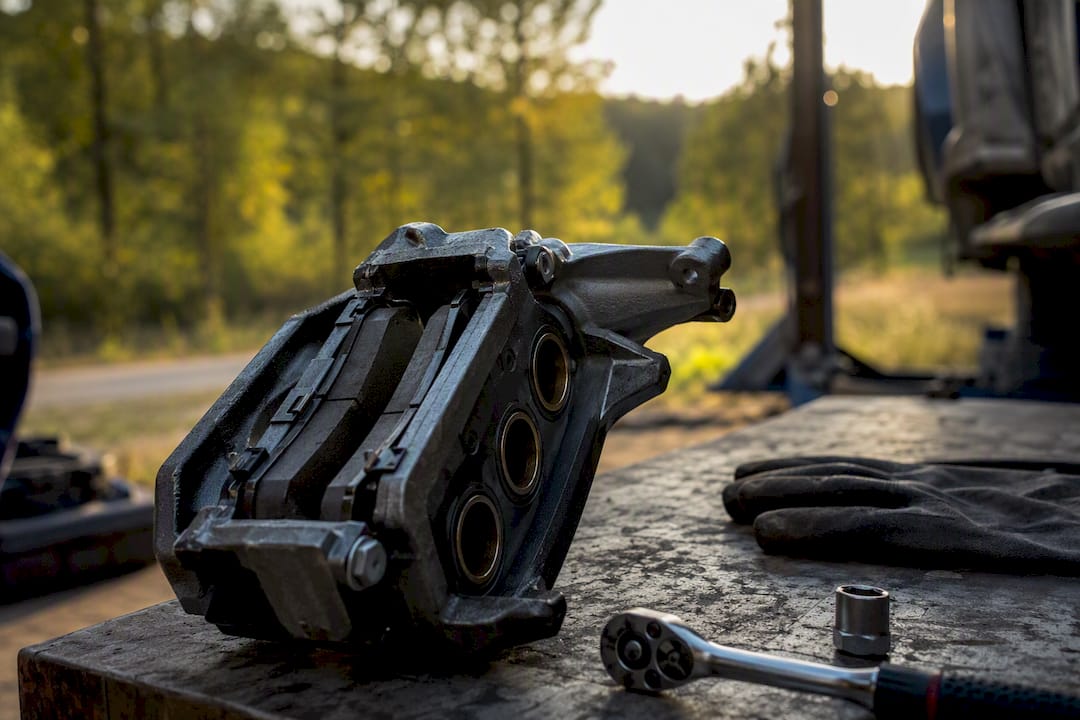
For sustained track use, choose a fixed caliper for its rigidity and thermal capacity. For most daily-driven cars, choose a floating caliper because it’s lighter, cheaper, and easier to fit. The real trade-off comes down to stiffness and heat capacity versus cost, weight, and packaging simplicity. Weigh those factors before you decide, and use the comparison below to see exactly where each design earns its keep.
TL;DR:
- Fixed calipers offer better heat dissipation and pedal feel but are heavier, more complex, and less suitable for daily driving due to higher cost and weight.
- Floating calipers are lighter, cheaper, and easier to fit, making them ideal for street cars, but they fade sooner and require more maintenance to prevent seizing.
- Wheel clearance and vehicle usage heavily influence caliper choice, with fixed models best for high-performance or track use, and floating models for everyday driving.
- Proper maintenance of floating calipers, especially lubrication of slide pins, can extend their lifespan and prevent issues like uneven pad wear.
- Matching pad profile, piston area, and brake bias is crucial when pairing pads with either caliper type, particularly for weather-resistant or climate-adaptive cooling technologies.
Table of Contents
- Floating vs Fixed Calipers at a Glance
- How Fixed and Floating Calipers Actually Work
- Why Pedal Feel and Fade Resistance Differ So Much
- Fitment, Weight, and Maintenance Realities
- Choosing Between Fixed and Floating: A Practical Flow
- HydroAdaptive Technology and ClimateFlex Caliper Compatibility
- The Real Trade-Off Nobody Argues Honestly
- Upgrade Your Braking Without Guessing at Compatibility
- Sources
Floating vs Fixed Calipers at a Glance
The two designs solve the same problem, clamping a rotor, in mechanically opposite ways. A fixed caliper bolts rigidly to the knuckle with pistons on both sides of the rotor. A floating caliper carries pistons on only the inboard side and slides on pins to pull the outboard pad into contact. That single difference cascades into everything else: stiffness, heat handling, weight, and how much wrenching you’ll do to keep it working.
| Factor | Fixed caliper | Floating caliper |
|---|---|---|
| Stiffness / pedal feel | Firmer, more linear, less flex under load | Softer, some travel from pin movement |
| Heat management / fade resistance | Better heat spread, stronger fade resistance under sustained load | Adequate for normal driving, fades sooner under repeated hard stops |
| Weight and packaging | Heavier, needs more wheel clearance | Lighter, compact, easier OEM fitment |
| Cost and complexity | Higher cost, more complex machining | Lower cost, simpler design |
| Maintenance | Simpler pad wear pattern, harder bleeding on multi-piston units | Slide-pin lubrication required, prone to pad taper if pins seize |
| Best applications | Track days, high-performance builds, heavy vehicles under load | Daily commuting, budget builds, most street cars |
A few things decide the choice more than any spec sheet:
- Your actual use case matters more than piston count. A six-piston fixed caliper on a car that never sees a track is dead weight, not an upgrade.
- Wheel clearance often rules out fixed calipers before budget even enters the conversation, since bigger calipers need bigger wheels.
- More pistons don’t automatically mean more stopping power. Total pad contact area and rotor pairing matter just as much as how many bores are pushing on it.
How Fixed and Floating Calipers Actually Work
The piston arrangement is the whole story. A fixed caliper mounts pistons on both sides of the rotor in a body that doesn’t move, so clamping force applies evenly and simultaneously from both faces. Disc brake engineering documentation confirms this rigid, dual-sided design produces more uniform pad pressure than a design that clamps from one side only. Fixed bodies come as monoblock castings (one solid piece, stiffer) or bolted two-piece halves (cheaper to machine, slightly less rigid).
A floating caliper works differently. Pistons live only on the inboard side, and the whole caliper body rides on sliding pins or bushings, letting hydraulic pressure push the inboard pad in while dragging the outboard pad along by reaction force. It’s a clever mechanical shortcut, and it’s why most factory cars use it.
Material choices matter on both designs. Aluminum bodies shed heat faster and save weight; cast iron holds up better under repeated thermal cycling but weighs more. Piston material affects heat transfer too: phenolic (composite) pistons resist conducting heat into the brake fluid, while steel pistons are more durable but transfer more heat toward the seals.
- Fixed: opposed pistons, rigid mount, monoblock or two-piece body
- Floating: inboard pistons only, sliding pins, single-side actuation
- Aluminum vs. iron and phenolic vs. steel pistons change heat transfer and corrosion resistance
Why Pedal Feel and Fade Resistance Differ So Much
Rigidity translates directly into pedal feel. A fixed caliper’s body barely flexes under clamping load, so pedal travel stays short and consistent, and modulation feels linear because the pressure you apply at the pedal maps predictably to clamping force at the rotor. A floating caliper has pin travel and a body that shifts slightly under load, so the pedal has a touch more give before bite arrives. Most drivers won’t notice this on a commute. On a track, where you’re braking from higher speeds repeatedly, that extra give becomes fatigue.
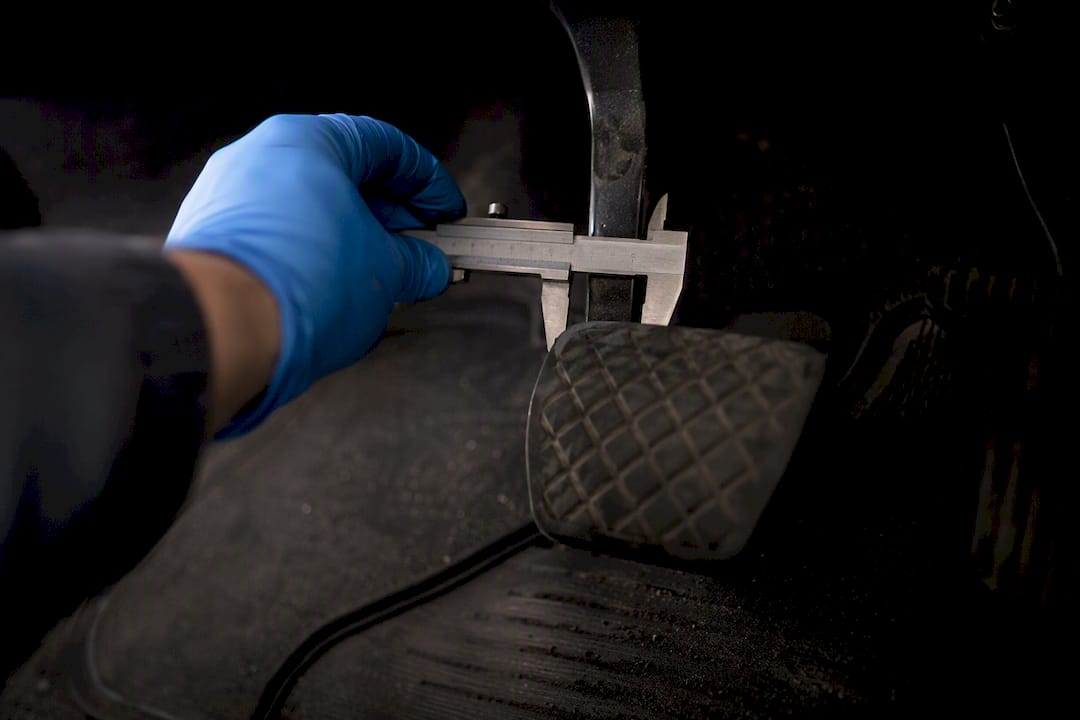
Fixed calipers generally provide better heat dissipation and fade resistance under sustained high thermal loads, largely because the caliper body itself acts as a heat sink and pistons on both sides spread thermal load more evenly across the pad surface. Industry testing on rigid caliper designs backs this up consistently.
Watch for these warning signs that a caliper design is being pushed past its comfort zone:
- Pad taper, meaning one edge of the pad wears faster than the other, often shows up first on floating units under hard use.
- A pedal that suddenly needs more travel to bite usually signals fluid boiling or pad fade, not a mechanical failure.
- Loss of initial bite after several hard stops in a row is the classic sign you’ve found the design’s thermal ceiling.
Fitment, Weight, and Maintenance Realities
Before you commit to either design, run through a short checklist. Measure rotor diameter and confirm caliper-to-wheel clearance, since bigger fixed calipers frequently demand aftermarket wheels or spacers. Check knuckle mounting points, because some fixed-caliper upgrades need adapter brackets that don’t exist for every chassis. Vehicle-specific fitment guides exist for exactly this reason, and skipping that step is the most common reason brake upgrades stall halfway through installation.
Weight matters more than most owners expect. A heavier fixed caliper adds unsprung mass, which can make suspension feel busier over rough pavement, especially on lighter cars.
- Check slide-pin lubrication on floating calipers at every pad change; seized pins are the single most common floating-caliper failure.
- Budget more time for bleeding multi-piston fixed calipers, since each additional bleeder screw adds a step.
- Expect floating calipers to cost less to buy and less to service over time.
- Expect fixed calipers to cost more upfront and more per repair if a piston seizes.
Pro Tip: Seized slide pins usually announce themselves as a faint scraping noise on one side of the car, well before you notice uneven pad wear. Catch it there and a $15 lube kit saves you a $400 caliper.
Choosing Between Fixed and Floating: A Practical Flow
Start with intended use, not budget. If your car is a daily driver that occasionally sees a highway on ramp with enthusiasm, a floating caliper paired with a quality pad almost always covers your needs. If you’re doing occasional track days, a well matched floating setup with upgraded pads can still work, but you’ll want to watch temperatures closely. Frequent track use or competition is where fixed calipers earn their cost and weight penalty.
Wheel clearance comes next, because it can eliminate an option before price ever matters. Then weigh your tolerance for maintenance: floating systems ask for periodic pin service; fixed systems ask for more patience during bleeding and a bigger repair bill if something seizes.
Before buying from any supplier, ask these questions:
- Does the kit list exact pad contact area, not just piston count?
- Is there a documented fitment guide for your specific wheel and knuckle combination?
- What’s the expected service interval for pins, seals, or boots?
A broader look at caliper rigidity and clamping force across performance builds echoes the same pattern: match the hardware to how the car is actually driven, not to how it might be driven someday.
HydroAdaptive Technology and ClimateFlex Caliper Compatibility
Weather is the variable most caliper comparisons skip, and it’s the one that determines whether your brakes feel confident in November or sketchy. Aaafrictions built HydroAdaptive ceramic technology to clear moisture fast and hold consistent friction through rain, slush, and cold soak, conditions where even a well-built caliper can feel inconsistent if the pad compound isn’t doing its job.
ClimateFlex™ calipers are engineered around that same climate-adaptive philosophy, and compatibility with either fixed or floating platforms depends on matching pad profile, piston area, and front-to-rear brake bias correctly.
- HydroAdaptive pads clear water film faster, restoring consistent friction sooner after wet contact
- ClimateFlex calipers are built for stable behavior across temperature swings, not just peak dry-day grip
- Pairing HydroAdaptive pads with either caliper type requires matching pad profile and piston area to avoid uneven bite
The Real Trade-Off Nobody Argues Honestly
Most caliper debates online treat this as a performance question when it’s really a use-case question. A fixed caliper on a grocery-getter isn’t smarter engineering, it’s a mismatch. Measure your wheel clearance, decide honestly how the car gets driven, and talk to an installer who can quote pad contact area, not just piston count. If you’re weighing an upgrade, our ClimateFlex caliper page is a reasonable next stop.
— AAA
Upgrade Your Braking Without Guessing at Compatibility
Choosing between fixed and floating calipers only solves half the problem. The other half is pad and rotor performance in the wet, cold, and slush that most caliper comparisons never mention. Aaafrictions builds around that gap: HydroAdaptive ceramic pads clear moisture fast enough to hold consistent bite through the exact conditions where standard pads fade behind.

If you’re running a floating caliper on a daily driver, our Type 07 Brake Pads Set is engineered to pair cleanly with common OEM piston layouts and pad profiles. For vehicles where a full refresh makes more sense, browse vehicle-specific brake kits built with GEOMET coated rotors for corrosion resistance. Compatibility depends on your caliper’s piston area and pad profile, so confirm fitment before you order. Check your vehicle against our current kit lineup and get a build that handles winter mornings as well as it handles dry pavement.