

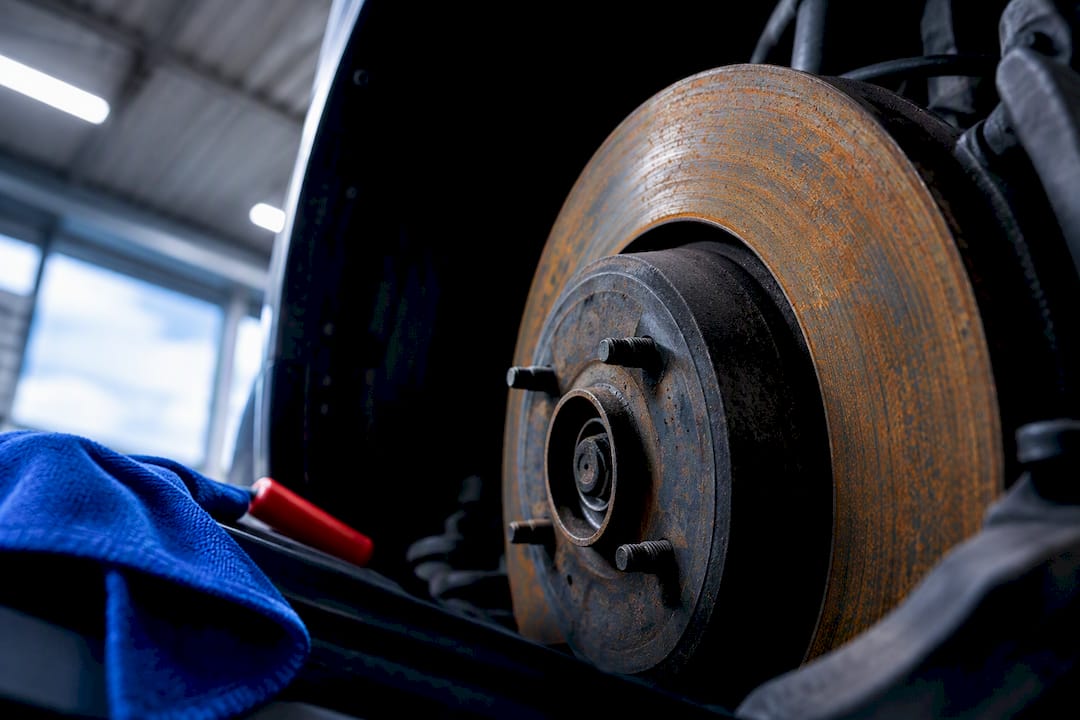
Most rust you see on brake rotors after a car has been sitting is light surface rust, and it typically clears on its own within the first few minutes of gentle driving. If a short, cautious drive with a few soft brake applications does not restore normal pedal feel, or if you notice grinding, vibration, or visibly deep pitting, stop and get the brakes inspected before driving further.
TL;DR:
- Surface rust can form on rotors within a few days of inactivity, especially in humid or salty environments, and usually clears after gentle driving.
- If rust persists, deep pitting, flaking, or uneven texture indicates possible damage that requires professional inspection and possibly rotor replacement.
- Regular short drives, cleaning the rotors with brake cleaner and soft brushes, and avoiding parking brakes on level ground help prevent rust buildup during storage.
- Rotor measurement and inspection at least once a year are recommended to detect excessive wear or pitting that can compromise safety.
- Using corrosion-resistant rotors and pads with moisture management technology can reduce rust formation and extend brake life in storage conditions.
Table of Contents
- Why rotors rust when a car sits and how quickly it happens
- Is rust on your brakes safe? How to tell surface rust from dangerous corrosion
- How to remove light surface rust safely: step-by-step methods and limits
- Preventing rotor rust during storage: a concise, practical checklist
- Inspection, measurement and deciding when to repair or replace rotors
- Publisher expertise and recommended product-class approach
- What stored-car rust really tells you about your maintenance habits
- How AAA Frictions can help and next steps
- Sources
- FAQ
Why rotors rust when a car sits and how quickly it happens
Cast iron rotors rust for a simple reason: iron reacts with oxygen and moisture in the air, and that reaction speeds up whenever a car sits still. While driving, the pads sweep the rotor surface clean with every stop. Parked for even a few days, that surface has nothing scrubbing it, so a thin film of oxidation builds where the pad normally rides.
Environment changes how fast this happens. Road salt, coastal humidity, and covered but damp parking spots all push corrosion along faster than a dry garage would. According to CAA National, surface rust can form on rotors in just a few days of inactivity, and if moisture exposure continues for an extended period, especially with residual salt on the undercarriage, that light film can progress into scabbing or pitting that will not simply brush away. Winter brine and slush are particularly aggressive; background on road salt and corrosion notes that professionals treat salt exposure as one of the biggest accelerants of rotor and undercarriage rust compared with dry storage.
A few storage habits shape the outcome as well:
- Leaving the parking brake engaged for long stretches can cause pads to bond to the rotor surface.
- Covered storage that traps humidity underneath a tarp can be worse than open air in a dry space.
- A vehicle parked directly on wet pavement or snowmelt tends to corrode faster than one on a dry, elevated surface.
None of this means storage causes permanent damage by default. It means the clock starts ticking the moment the car stops moving, and the environment decides how fast that clock runs.
Is rust on your brakes safe? How to tell surface rust from dangerous corrosion
A thin, even, brownish film across the rotor face is almost always cosmetic. It sits on the surface, it is uniform in colour, and it usually disappears after a short drive. Rust that concerns a technician looks different: patchy pitting, flaking edges, or a rough, scabby texture that catches a fingernail.
Your feel behind the wheel tells its own story:
- Mild vibration through the pedal or steering wheel often points to uneven rotor surface, sometimes from rust that has not worn off evenly.
- The car pulling to one side under braking can mean one rotor is corroded or gripping differently than the other.
- Grinding or scraping noises suggest something harder than light rust, possibly pad material contacting bare metal.
- A soft or sinking pedal is rarely a rust issue on its own and points toward a hydraulic or pad concern that needs prompt attention.
A quick self-check helps you decide which category you are in. Look at the rotor through the wheel spokes for colour and texture, listen for unusual sounds on your first few stops, and test the brakes gently in a safe, empty area before merging into traffic. Transport Canada flags unusual noises, pulling, or a changed pedal feel as clear signs that brakes need servicing rather than a wait and see approach.
How to remove light surface rust safely: step-by-step methods and limits
Most flash rust needs nothing more than motion. Here is the order to work through.
- Drive it off first. Find a safe, low-traffic stretch and apply the brakes gently several times from a low speed. Reporting on a car left sitting for six weeks found that controlled, low-speed braking is usually enough to strip flash rust without any tools at all, and CBC News similarly points to weekly short drives of 10 to 15 minutes as an effective way to keep rotors clear through normal braking.
- Clean by hand if driving does not fully clear it. Pull the wheel if you are comfortable doing so, spray the rotor with a proper brake cleaner, and work the surface with a soft wire brush or a scotch-brite pad until the loose rust lifts.
- Reassemble and retest with another gentle low-speed drive to confirm the pedal feels normal and there is no pulling or noise.
Stick to brake cleaner, soft brushes, and scotch-brite pads. Acidic rust removers and aggressive sanding can pit the rotor surface further or leave a residue that affects pad contact, and you want to avoid getting any oil or cleaner residue onto the pad material itself.
Pro Tip: Support the car on proper jack stands, never a jack alone, and torque the wheel back to the manufacturer’s spec once you are done.

Some situations are beyond a driveway fix. Deep grooves you can feel with a fingernail, a rotor that measures thin against its rated specification, or pads that show flaking or delamination all call for a shop visit rather than more scrubbing. Our explainer on flash rust on rotors walks through the diagnosis in more detail, and if the rust has reached the pad itself rather than just the rotor face, our piece on pad delamination and rust covers when that is still safe to drive on and when it is not.
Preventing rotor rust during storage: a concise, practical checklist
Prevention is mostly about limiting how long moisture and salt sit against bare metal. A few habits, followed consistently, do most of the work.
- Store the vehicle in a dry, ventilated space when one is available, and avoid covered spots that trap damp air underneath.
- Wash the undercarriage and wheels before storing, particularly after winter driving, to clear off salt and grit that hold moisture against the rotor.
- Connect a battery maintainer for extended storage, and avoid leaving the parking brake engaged if the vehicle is on level ground and cannot roll.
- Take the car for a short drive once a week; CBC News points to this routine as effective for both charging the battery and clearing light rotor rust through normal braking.
- Consider professional undercarriage rustproofing or a protective rotor coating if the vehicle will sit for an extended season, since a coated surface resists the early stages of oxidation better than bare cast iron.
Pro Tip: If the parking brake does stick after storage, do not force it. Our guide to freeing a frozen parking brake covers the safe steps to take before you drive off.
Fleet operators face the same problem at a larger scale, and their routines are a useful model for private owners. A preventive maintenance schedule built for small rental fleets follows the same 30, 60, and 90 day rhythm of cleaning and short runs that keeps rotors from progressing past light surface rust, and fleet winter readiness practices put the same weight on undercarriage washing that CAA recommends for a single stored car.

Inspection, measurement and deciding when to repair or replace rotors
A driveway check tells you whether rust is likely cosmetic. A proper inspection tells you for certain. Car Care Council recommends having the brake system inspected at least once a year, and that inspection should include measuring rotor thickness rather than relying on how the surface looks.
A technician’s checklist covers a few specific things:
- Rotor thickness, measured against the manufacturer’s minimum specification, since a rotor machined or worn too thin loses its ability to dissipate heat safely.
- Run-out, or how much the rotor wobbles as it spins, which shows up as pedal pulsation.
- Pitting depth, since shallow surface pitting can sometimes be machined away while deeper pitting cannot.
- Pad backing and caliper operation, because a rotor that looks fine can still be paired with a sticking caliper or a pad that has started to delaminate.
Resurfacing, sometimes called turning, is a practical option when pitting is shallow and the rotor still measures comfortably above minimum thickness. Once pitting runs deep or the rotor is already close to its minimum, replacement is the safer route, since machining it further can push it below a safe operating thickness. Our guide on minimum rotor thickness explains how that measurement is taken and what the numbers mean in practice. For a vehicle that spends part of the year in storage, an annual inspection catches this kind of progressive wear long before it becomes a safety issue on the road.
Publisher expertise and recommended product-class approach
AAA Frictions builds its pad and rotor lines around HydroAdaptive Technology, a ceramic friction system engineered to clear moisture from the pad and rotor interface quickly and maintain consistent friction in wet or humid conditions. For a car that spends stretches of time parked outdoors, that moisture management matters at the exact moment corrosion has the best chance to set in.
For deeper diagnosis of what you are seeing on your own rotors, our explainers on flash rust and pad delamination rust go further than a general overview can. Our note on HydroAdaptive pads and winter pitting covers how the same moisture-clearing behaviour applies to reducing pitting risk through cold, wet seasons.
None of this replaces a hands-on inspection. When rust has progressed to structural pitting or measurable thickness loss, replacement is the honest answer, and corrosion-resistant rotors and pads are one sound option among some once that decision is made.
What stored-car rust really tells you about your maintenance habits
The conventional advice on brake rust treats it as a minor footnote, a line at the bottom of a winterizing checklist. That undersells it. Rust is the most visible, earliest sign your storage routine has a gap, whether that is a damp garage, salt left on the undercarriage, or a parking brake left on too long.
Most owners overreact to the sight of rust and underreact to the habits that caused it. A brown film on the rotor after two weeks parked is not a crisis, but treating every stored car the same way, regardless of climate, salt exposure, or how it is parked, is where people get caught out. The reader’s real priority should not be memorizing removal tricks. It should be building a routine: clean before storing, drive regularly, and avoid using the parking brake on level ground when possible. Get that right and rust rarely becomes more than a cosmetic footnote instead of a repair bill.
— AAA
How AAA Frictions can help and next steps
If your rotors have moved past light surface rust into pitting or uneven wear, replacing worn parts with corrosion-resistant options is a reasonable next step rather than a repeated cleaning cycle.

Our Type 03 Brake Pads and Type 07 Brake Pads both use HydroAdaptive Technology to manage moisture at the pad face, while our SC Type Rotors and GC Type Rotors add a protective coating aimed at resisting the kind of corrosion that builds up during storage. Check fitment for your vehicle on the product pages, and have a qualified technician handle installation if you are not confident doing it yourself.
Sources
- How to maintain your vehicle while it’s sitting idle – CAA National
- Carcare
- Preparing your vehicle for winter – Transport Canada
FAQ
My car brakes are rusted from sitting. How can I fix it?
Start with a short, controlled drive and apply the brakes gently a few times at low speed. If flash rust does not clear that way, clean the rotor with brake cleaner and a soft brush, and get it inspected if grinding, pulsation, or pitting remain.
How to keep brake rotors from rusting during storage?
Clean salt and grit off the undercarriage before storing, park in a dry space where possible, and skip the parking brake on level ground. CBC News also recommends a short weekly drive of 10 to 15 minutes to keep rotors clear through normal braking.
Is it okay to have rust on your brakes?
A thin, even surface film is normal after a few days of sitting and usually clears with light driving, since CAA National notes it can appear within three to four days of inactivity. Deep pitting, flaking, or a rough scabby texture is not something to ignore and calls for an inspection.
How long can you drive with rusty rotors?
Light surface rust is safe to drive on right away since normal braking clears it within the first few stops. If you notice vibration, pulling, grinding, or a change in pedal feel, Transport Canada advises treating those as signs the brakes need servicing rather than continuing to drive on them.
One Response