

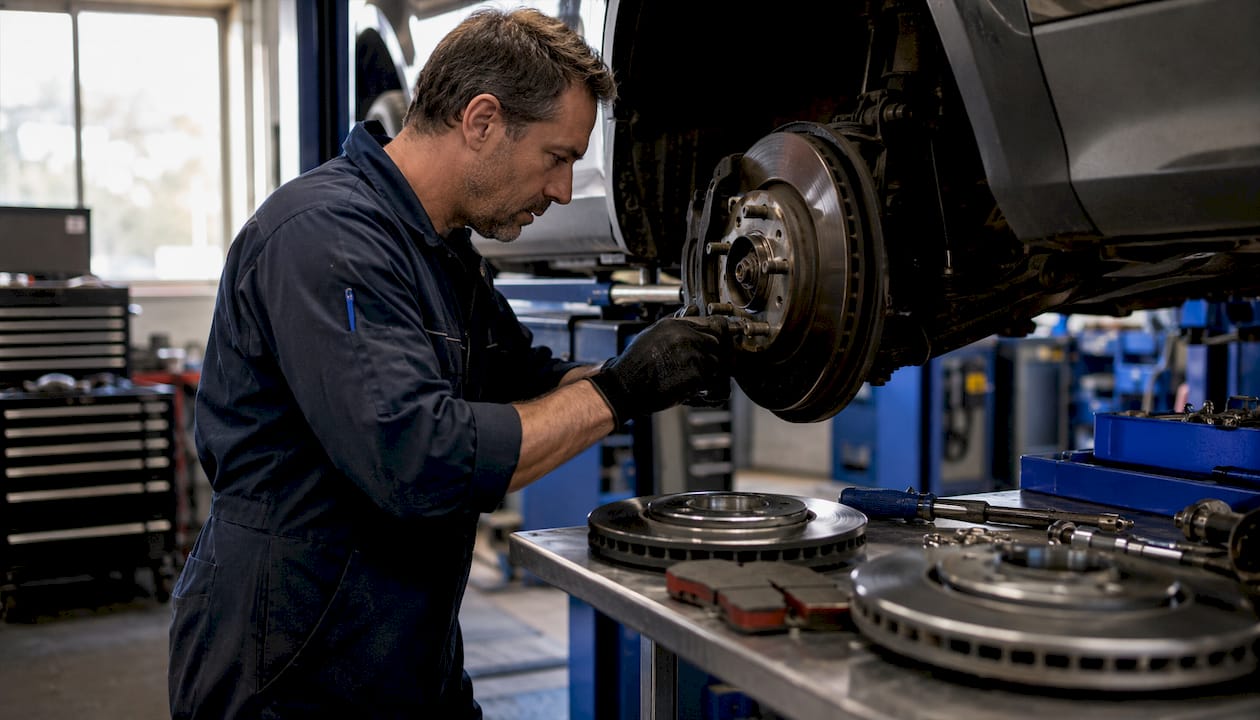
For most Canadian SUV owners, the best choice is the Aaafrictions HydroAdaptive rotor and pad kit. It combines GC Type GEOMET corrosion-resistant rotors with ceramic pads engineered to maintain consistent friction in rain, snow, and the salt-heavy road conditions common across New Brunswick and the rest of Canada.
Quick alternatives by use case:
- Heavy towing or mountain driving: Slotted or cryo-treated rotors paired with high-temp aramid-fiber or carbon-fiber ceramic pads for maximum heat management
- Winter-focused daily driving: Coated blank rotors with HydroAdaptive ceramic pads for reliable moisture management and low noise
- Budget OE-style replacement: Standard coated solid rotors with semi-metallic pads when cost is the primary constraint
Table of Contents
- What should you check before buying SUV brake rotors?
- Which rotor type actually works best for your SUV?
- Why pad pairing often matters more than the rotor itself
- What does an Aaafrictions rotor and pad kit include?
- How do you install and maintain new SUV rotors?
- Which rotor suits your SUV driving habits?
- What do rotors cost in Canada, and where should you buy?
- How do popular rotor types actually perform on Canadian roads?
- How long do rotors last on a Canadian SUV?
- What does the full rotor buying and installation process look like?
- Is cryogenic treatment worth it for a heavy-duty SUV?
- Which brake rotor brands and kits are best suited for SUVs?
- Key Takeaways
- Why the rotor conversation usually starts in the wrong place
- Aaafrictions Canada-ready rotor and pad kits
- Useful sources
What should you check before buying SUV brake rotors?
Before you click Buy on any rotor kit, run through these five checks:
- Fitment first. Confirm your vehicle’s year, make, trim, and OE rotor diameter and minimum thickness. A rotor that is even a few millimeters off spec will not seat correctly against your caliper.
- Coating for Canadian roads. Look for GC Type GEOMET or an equivalent anti-corrosion finish. Geomet-style coatings reduce rust and pitting on exposed rotor surfaces, which matters when roads are salted from November through April.
- Pad compound match. Ceramic pads suit daily commuting and winter use; semi-metallic pads handle higher heat but produce more dust; aramid-fiber blends balance both. Choose based on your primary use, not just price.
- Price band awareness. In Canada, a front axle rotor-and-pad kit typically ranges from roughly $80–$150 CAD at the budget end to $250–$450 CAD for a mid-range coated kit, and $500 CAD or more for premium cryo-treated or performance-grade options.
- Hardware inspection. When you pull the old rotors, check caliper slider pins and hardware. Worn or dry pins cause uneven pad contact regardless of rotor quality.
Pro Tip: Always replace rotors in axle pairs. Mixing a new rotor with a worn one on the same axle creates uneven braking force, which you will feel as a pull under hard stops.
Which rotor type actually works best for your SUV?
Not all brake discs are built the same, and the design you choose changes how your SUV behaves under load, in cold weather, and on long descents.
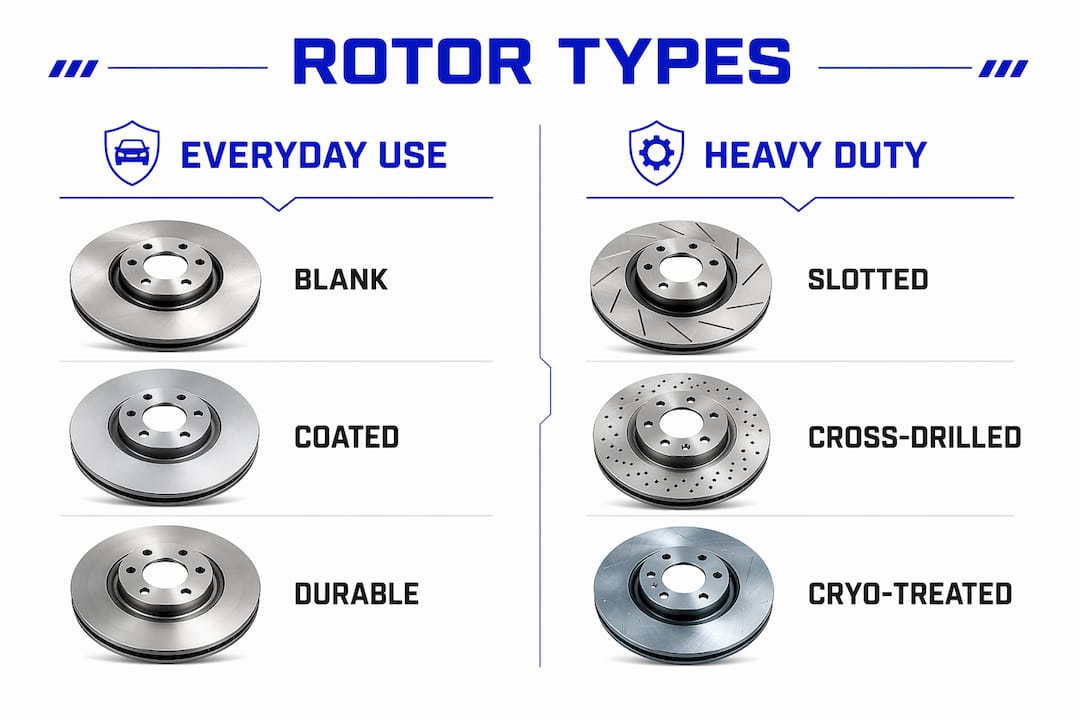
Blank (solid) rotors
Blank rotors are the simplest design and often the most underrated. Their uninterrupted surface preserves material strength, resists thermal shock, and is gentler on pads in mixed-use driving. For New Brunswick commuters dealing with stop-and-go traffic and wet pavement, a quality coated blank rotor is a dependable, cost-effective pick.
Slotted rotors
Slots cut across the rotor face pull cool air into the braking zone and channel heat, gas, and debris away from the pad surface. Slotted designs can significantly reduce operating temperatures, which directly reduces brake fade on long descents or during repeated heavy stops when towing. The trade-off is slightly faster pad wear and a modest increase in noise.
Cross-drilled rotors
Drilled holes improve initial bite and look aggressive, but through-drilled patterns reduce structural integrity and can develop stress cracks under severe thermal cycling. For heavy SUV towing, this is a real concern.
Dimpled (blind-drilled) rotors
Dimpled or blind-drilled patterns give you pad degassing benefits without fully penetrating the disc. For severe-duty use, this design is structurally superior to cross-drilled because it eliminates the stress-crack risk while still managing gas buildup at the pad interface.
Coated rotors (GC Type GEOMET)
A GC Type GEOMET coating protects the rotor’s non-swept surfaces from corrosion and salt-induced pitting. In Canadian winters, an uncoated rotor can develop surface rust within days of sitting idle. Coated rotors stay cleaner, seat pads more evenly, and look better longer.
Cryo-treated rotors
Cryogenic processing exposes the rotor to deep sub-zero temperatures, which increases tensile strength and wear resistance. The benefit is most pronounced for heavy-duty applications: towing, repeated mountain descents, or high-load commercial use. Cost is higher, but the extended service life can justify it.
| Rotor type | Best for | Heat dissipation | Corrosion resistance | Noise/NVH | Cost/value |
|---|---|---|---|---|---|
| Blank/solid | Daily commuting, wet roads | Moderate | High (if coated) | Low | Best value |
| Slotted | Towing, long descents | High | Moderate | Moderate | Mid-range |
| Cross-drilled | Light performance driving | Moderate | Moderate | Low-moderate | Mid-range |
| Dimpled/blind-drilled | Heavy towing, severe duty | High | Moderate | Moderate | Mid-to-high |
| GC Type GEOMET coated | Canadian winter, all-season | Varies by base design | Excellent | Low | Mid-range |
| Cryo-treated | Heavy-duty, high-mileage towing | High | Moderate | Low | Premium |
Stat callout: Slotted rotor designs can lower operating temperatures by up to ~200°F, a meaningful reduction for any SUV that tows regularly or navigates long downhill grades.
Why pad pairing often matters more than the rotor itself
Many owners replace rotors when the real problem is the pad compound. Factory soft metallic pads prioritize initial bite over heat tolerance, and upgrading to higher-grade ceramic or aramid-fiber pads typically delivers a more noticeable improvement in braking feel than a rotor swap alone.
Pad compound characteristics:
- Ceramic pads: Low dust, low noise, consistent friction across a wide temperature band. Ideal for daily SUV use and Canadian winter conditions.
- Semi-metallic pads: Higher heat tolerance and stronger initial bite, but more rotor wear and more brake dust. Better suited to performance or towing use.
- Aramid-fiber / carbon-fiber ceramic blends: The most heat-stable option for heavy towing. They maintain friction profile integrity at temperatures where standard ceramics begin to fade.
For Aaafrictions HydroAdaptive ceramic rotors, the recommended pairing is a compatible ceramic or aramid-fiber pad that shares the same temperature band adaptability. This keeps the braking ecosystem consistent: the rotor manages heat and moisture, and the pad maintains stable friction output. You can compare ceramic vs. semi-metallic pad compounds in detail to confirm which suits your driving pattern.
Pro Tip: When bedding in a new rotor and pad set, perform 8–10 moderate stops from 50 km/h, allowing 30 seconds of cooling between each. This transfers a thin, even layer of pad material onto the rotor face and prevents glazing.
What does an Aaafrictions rotor and pad kit include?
A typical Aaafrictions vehicle-specific kit is built around three core components working as a system, not as separate parts bolted together.
- HydroAdaptive ceramic pads: Engineered to rapidly clear moisture from the friction interface, maintaining consistent pedal feel in rain, slush, and humidity. The ceramic formulation stays within a stable friction profile across the temperature swings common in Canadian seasons.
- GC Type GEOMET coated rotors: The coating protects non-swept surfaces from salt corrosion and pitting. Rotors arrive ready to install without surface prep, and the coating extends the visual and structural life of the disc between pad changes.
- Hardware and lubricant (where included): Slider pin lubricant and caliper hardware are included in applicable kits, addressing the most common cause of premature pad wear from the first service interval.
Aaafrictions sells direct-to-consumer through its e-commerce storefront, with vehicle-specific kits covering a range of mid-size and full-size SUVs. Fitment examples include the Kia Sorento 2011–2013 and the Toyota Highlander 2008–2013, among others. Each kit is matched to OE specifications so no modifications are required at installation.
| Kit component | Function | Canadian benefit |
|---|---|---|
| HydroAdaptive ceramic pads | Moisture management, stable friction | Consistent pedal feel in rain and snow |
| GC Type GEOMET coated rotors | Corrosion and salt resistance | Extended rotor life on salted roads |
| Hardware/lubricant (where included) | Slider pin and caliper function | Prevents binding and uneven wear |
How do you install and maintain new SUV rotors?
Installation steps
- Lift the vehicle and remove the wheel.
- Compress the caliper piston fully before removing the caliper assembly.
- Remove the old rotor. Inspect the hub face for rust buildup and clean it before seating the new disc.
- Lubricate caliper slider pins with high-temp brake grease. Dry or corroded pins are a leading cause of uneven pad wear, even with new rotors installed.
- Install the new rotor, torque the caliper bracket to spec, and reinstall the wheel.
- Repeat on the opposite side of the axle.
Bedding-in procedure
Perform 8–10 moderate stops from 50 km/h with 30-second cooling intervals. Follow with 3–4 firmer stops from 80 km/h. Avoid hard braking for the first 300–500 km.
Maintenance and replacement signs
- Lateral runout above 0.05 mm: Causes pedal pulsation under braking.
- Thickness below minimum spec: Check your vehicle’s service manual; most passenger SUV rotors have a discard thickness stamped on the hat.
- Deep scoring or grooves: Accelerates pad wear and reduces friction contact area.
- Vibration under braking: Often indicates warping or uneven pad deposits, not always rotor damage.
Maintenance callout: Salt-season tip: rinse wheel wells and rotor faces after driving on treated roads. GC Type GEOMET coating protects non-swept surfaces, but keeping the assembly clean extends coating life and prevents caliper corrosion.
Which rotor suits your SUV driving habits?
| Use case | Recommended rotor type | Pad compound | Key trade-off |
|---|---|---|---|
| City commuting (salted roads) | Coated blank or slotted | Ceramic | Lowest noise, easiest on pads |
| Regular towing | Slotted or dimpled/blind-drilled | Aramid-fiber ceramic | Slightly faster pad wear |
| Winter/ice driving | GC Type GEOMET coated blank | HydroAdaptive ceramic | Best corrosion resistance |
| Light off-road | Slotted | Semi-metallic or ceramic | Moderate dust, good bite |
| Performance driving | Dimpled or cryo-treated | Carbon-fiber ceramic | Higher cost, premium feel |
- City commuters in New Brunswick get the most value from a coated blank rotor paired with a low-dust ceramic pad. Clean braking, minimal noise, and long service intervals.
- Towers and haulers need the thermal headroom of a slotted or dimpled design. Pair with aramid-fiber pads to maintain friction stability when the brake system is working hardest.
- Winter drivers should prioritize GC Type GEOMET coating above all else. Salt corrosion shortens rotor life faster than pad wear in most Canadian climates.
What do rotors cost in Canada, and where should you buy?
Canadian price bands for a front axle rotor-and-pad kit:
- Budget ($80–$150 CAD): Uncoated or basic-coated rotors with standard semi-metallic pads. Adequate for low-mileage or short-term replacement needs.
- Mid-range ($250–$450 CAD): GC Type GEOMET coated rotors with ceramic pads, typically sold as vehicle-specific kits. This tier covers most Canadian SUV owners well.
- Premium ($500+ CAD): Cryo-treated, high-thermal-capacity, or carbon ceramic options with advanced pad compounds. Justified for heavy towing or performance use.
Buying channels and their trade-offs:
- Aaafrictions direct (e-commerce): Vehicle-specific kits with fitment lookup, direct shipping to Canadian provinces, and hardware included in applicable kits. No middleman markup.
- Local mechanics: Convenient for combined supply-and-install, but parts selection is often limited to what the shop stocks.
- General e-commerce retailers: Wide selection, but fitment verification is the buyer’s responsibility and hardware is rarely included.
Shopper tip: Confirm that the kit includes a fitment guarantee, a warranty of at least one year, and whether slider pin lubricant and hardware are bundled. Missing hardware means an extra purchase and an extra trip.
How do popular rotor types actually perform on Canadian roads?
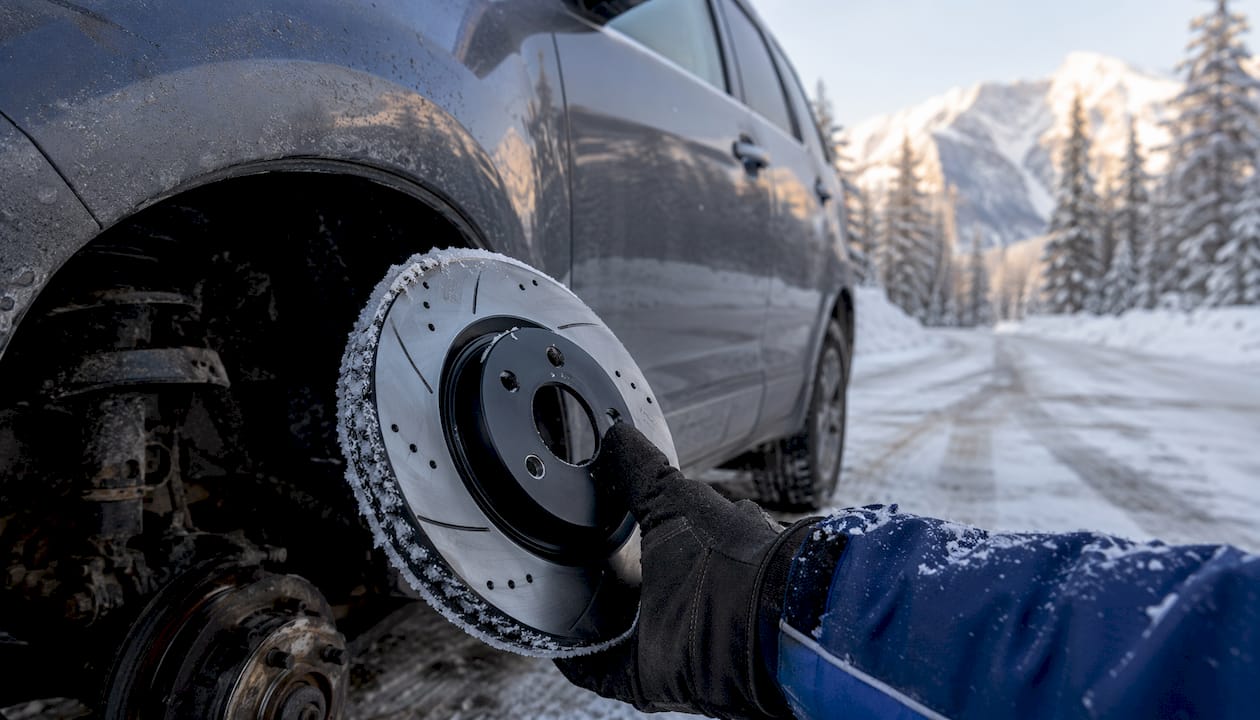
Real-world Canadian conditions put braking systems through a specific combination of stresses: freeze-thaw cycles that cause surface rust overnight, road salt that accelerates corrosion on uncoated surfaces, and temperature swings that stress rotor metallurgy from cold soaks to full operating heat within minutes.
Blank coated rotors handle this cycle best for everyday use. Their solid structure resists thermal shock from cold starts, and a GC Type GEOMET finish prevents the surface rust that forms on uncoated rotors after a single wet night. Slotted designs perform well for drivers who tow or load their SUV regularly, since the ventilation channel geometry actively manages heat during repeated stops. Cross-drilled rotors, while popular visually, show their limitations in Canadian winters: the thermal cycling from cold soaks to hard braking can accelerate stress cracking at the drill points over time.
How long do rotors last on a Canadian SUV?
Rotor lifespan varies by design, driving pattern, and road conditions. Under typical Canadian SUV use, blank/solid coated rotors generally offer the longest service intervals for daily commuting with ceramic pads, while slotted rotors have somewhat shorter intervals due to accelerated pad wear. Cryo-treated rotors provide extended lifespan in heavy-duty use due to enhanced material properties, and cross-drilled rotors tend to have shorter lifespans under severe Canadian conditions because of stress-crack risk from thermal cycling.
Pad compound matters as much as rotor design here. Upgrading from factory soft metallic pads to ceramic or aramid-fiber blends typically extends both pad and rotor life by reducing heat-induced wear at the friction interface.
What does the full rotor buying and installation process look like?
From decision to driving, the process breaks into four stages:
Stage 1: Research and fitment (Day 1–2). Confirm your vehicle’s year, make, trim, and OE rotor specs. Use Aaafrictions’ fitment lookup tool to identify the correct kit. Verify that the kit includes hardware and lubricant.
Stage 2: Order and delivery (Day 2–5). Order directly from Aaafrictions or an authorized channel. Canadian shipping typically takes 2–5 business days to New Brunswick. Inspect the kit on arrival: check rotor coating integrity and confirm all hardware is present.
Stage 3: Installation (2–3 hours). Follow the installation steps outlined earlier. Torque all fasteners to spec, lubricate slider pins, and confirm caliper movement is free before lowering the vehicle.
Stage 4: Bedding-in and break-in period (first 300–500 km). Complete the bedding-in procedure immediately after installation. Avoid hard stops for the first 300–500 km. After the break-in period, the rotor and pad surfaces are fully mated and the system performs at its rated friction profile.
Is cryogenic treatment worth it for a heavy-duty SUV?
Cryogenic treatment is a metallurgical process that exposes cast iron rotors to temperatures as low as -300°F, then slowly returns them to ambient temperature. The process realigns the grain structure of the metal, increasing tensile strength and wear resistance. For a standard commuter SUV, the cost premium is hard to justify. For an SUV that regularly tows near its rated capacity, descends mountain grades, or operates in commercial or fleet use, the extended service life and reduced fade risk make cryo treatment a legitimate upgrade.
The trade-off is cost. Cryo-treated rotors sit at the premium end of the price range, and they still require compatible high-temp pad compounds to realize their full benefit. Pairing a cryo-treated rotor with a standard factory pad compound wastes most of the metallurgical advantage. Pro mechanics recommend cryo treatment specifically for heavy-duty SUV applications where rotor replacement frequency and brake fade are documented problems, not as a universal upgrade for every vehicle.
Which brake rotor brands and kits are best suited for SUVs?
For Canadian SUV owners, the most practical recommendation is a vehicle-specific kit that pairs a GC Type GEOMET coated rotor with a climate-adapted pad compound. Aaafrictions builds its kits around exactly this pairing: the Type 07 HydroAdaptive pad and GC rotor kit is engineered for all-weather Canadian use, with moisture management built into the pad formulation and corrosion resistance built into the rotor coating.
For towing-focused builds, a drilled and slotted rotor paired with carbon-fiber ceramic pads is a proven combination for bolt-on stopping power under load. The key is matching the rotor’s thermal capacity to the pad’s heat tolerance. A high-thermal-capacity rotor paired with a standard ceramic pad will outlast the pad, while a standard rotor paired with a high-temp pad will outlast the rotor. Balance is the goal.
For drivers who want to understand how truck brake upgrades fit into a broader vehicle improvement plan, brakes consistently rank among the highest-value modifications for towing and safety.
Key Takeaways
For most Canadian SUV owners, the right rotor is a GC Type GEOMET coated disc paired with a HydroAdaptive ceramic pad, chosen by vehicle fitment and confirmed with compatible hardware at installation.
| Point | Details |
|---|---|
| Fitment is non-negotiable | Verify year, make, trim, and OE rotor diameter before ordering any kit. |
| Pair pads and rotors together | Upgrading pads alone often delivers more noticeable improvement than a rotor swap alone. |
| Corrosion coating for Canada | GC Type GEOMET coating protects against salt-induced pitting on New Brunswick roads. |
| Slotted rotors reduce heat | Slotted designs can lower operating temperatures by up to ~200°F, reducing fade under towing loads. |
| Aaafrictions kit recommendation | The HydroAdaptive rotor and pad kit covers fitment, corrosion resistance, and moisture management in one order. |
Why the rotor conversation usually starts in the wrong place
Most brake upgrade discussions focus on rotor design first, pad compound second. That order is backwards. The pad is the active friction element; the rotor is the surface it works against. When a Canadian SUV owner reports soft pedal feel or longer stopping distances in wet weather, the rotor is rarely the root cause. Factory soft metallic pads that prioritize initial bite over heat tolerance and longevity are far more often responsible.
The more useful question is not “which rotor is best?” but “which rotor and pad combination is engineered for my specific driving conditions?” In New Brunswick, those conditions include road salt from late fall through early spring, freeze-thaw cycles that stress rotor metallurgy, and humidity that compromises friction at the pad interface. Aaafrictions’ HydroAdaptive formulation addresses that last point directly: the ceramic compound is engineered to clear moisture rapidly and maintain a consistent friction profile rather than allowing a momentary drop in pedal response when braking in rain or slush.
The other overlooked variable is hardware. Caliper slider pins that are dry or corroded cause binding that produces uneven pad wear, and that wear pattern gets misread as a rotor problem. Address the hardware at every service interval, and the rotor and pad system performs as designed.
Aaafrictions Canada-ready rotor and pad kits
Canadian SUV owners need brakes that work in February slush and July heat alike. Aaafrictions builds vehicle-specific rotor and pad kits with HydroAdaptive Technology that manages moisture at the friction interface and GC Type GEOMET coated rotors that resist salt corrosion through every New Brunswick winter.
Each kit ships directly to your door across Canada, pre-matched to your vehicle’s OE specifications. No fitment guesswork, no separate hardware order. Browse the full kit lineup and confirm your vehicle’s fit at aaafrictions.ca/landing, or use the vehicle fitment search to find your exact kit in under a minute.
Useful sources
- EBC Stage 3 GD Greenstuff 6000 Brake Kit S3KR1189 — RealTruck: Technical details on slotted rotor temperature reduction and GC Type GEOMET coating performance
- Best Brake Rotors for High Performance Driving — DrivingLine: Comparison of blank, drilled, and slotted rotor designs with trade-off analysis
- 5 SUVs With Brakes That Last 80,000 Miles vs 5 That Need New Pads at 25,000 — DAX Street: Expert insight on pad compound impact and factory pad limitations
- Truck & SUV Markets — Frozen Rotors: Cryogenic treatment process and benefits for heavy-duty SUV applications
- Aaafrictions HydroAdaptive Technology: Technical overview of the HydroAdaptive ceramic formulation and GC Type GEOMET coating system
- Aaafrictions fitment lookup: Vehicle-specific kit search for Canadian SUV owners
Recommended
- Type 07 Brake Pads with Type SC Rotors Kit – AAA Frictions
- Front and Rear Brake Kit for Toyota Highlander 2008-2013, Type 07 HydroAdaptive+ Ceramic Disc Brake Pad and Rotor Set with GC Type GEOMET Coated Rotors
- Front and Rear Brake Kit for Toyota Sienna 2021-2024, Type 07 HydroAdaptive+ Ceramic Disc Brake Pad and Rotor Set with GC Type GEOMET Coated Rotors
- Type 07 Brake Pads + GC Rotors Kit – AAA Frictions