

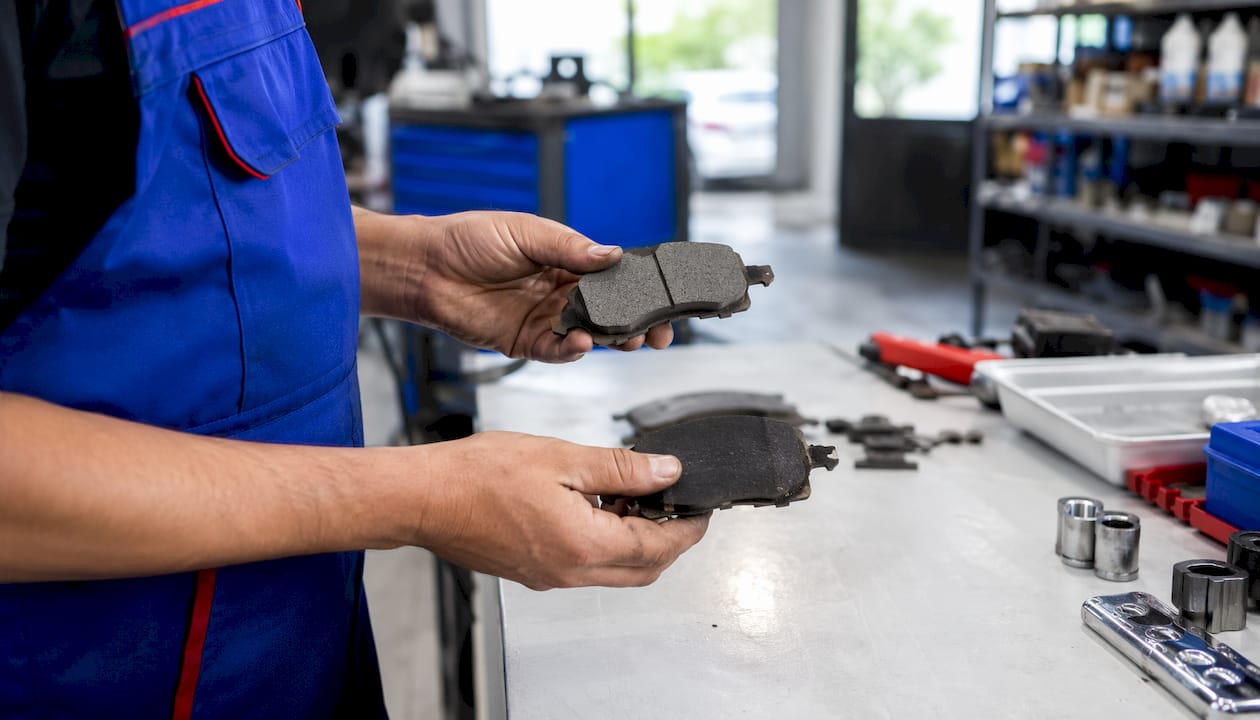
For most Canadian drivers, ceramic brake pads are the stronger everyday choice: quieter, cleaner, and gentler on rotors. Semi-metallic pads earn their place in heavy-duty, high-heat, and extreme cold scenarios where thermal capacity outweighs refinement.
- Choose ceramic if you drive a passenger car, crossover, or light SUV for daily commuting, value quiet operation and clean wheels, and want longer rotor life over the ownership period.
- Choose semi-metallic if you tow regularly, drive a heavy truck or performance vehicle, navigate long mountain descents, or need maximum cold-bite in sub-zero temperatures.
Always confirm your vehicle’s OEM pad specification before switching materials, and note that semi-metallic pads are often mandatory for heavy-duty load ratings.
Pro Tip: The ceramic vs semi-metallic choice is not about which material is universally better. It is about matching friction profile to vehicle mission.
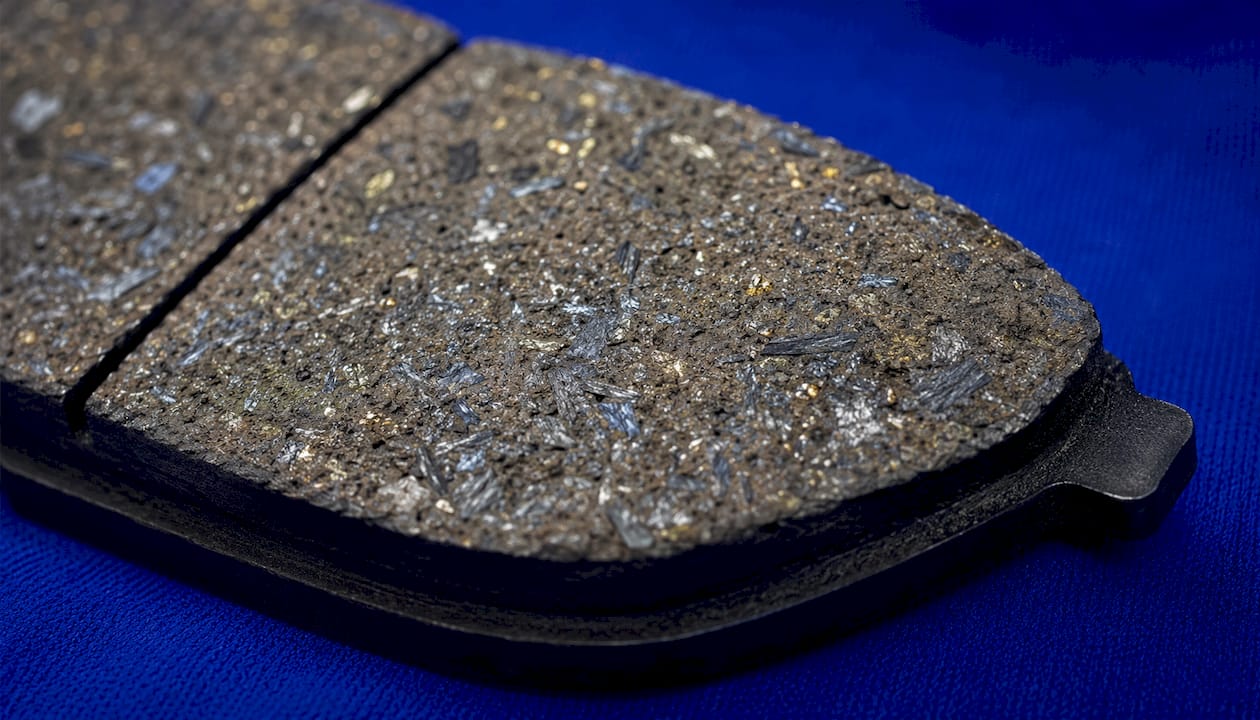
Table of Contents
- How disc brake pads actually create stopping force
- What semi-metallic brake pads are made of and how they behave
- What ceramic brake pads are made of and how they behave
- Ceramic vs semi-metallic: side-by-side comparison
- Which pad fits your driving situation in Canada?
- Cold-weather performance: what Canadian drivers need to know
- Lifespan, rotor wear, and long-term maintenance
- Common myths about brake pad materials, corrected
- How Aaafrictions’ HydroAdaptive ceramic technology addresses Canadian conditions
- Key Takeaways
- The case for matching friction material to your actual driving conditions
- Aaafrictions’ HydroAdaptive ceramic kits for Canadian drivers
- Sources and further reading
How disc brake pads actually create stopping force
Every time you press the brake pedal, hydraulic pressure clamps a pad against a spinning rotor. The friction between pad and rotor converts kinetic energy into heat, slowing the wheel. That heat has to go somewhere, and where it goes depends almost entirely on pad composition.
Three concepts shape everything that follows:
- Friction coefficient: The ratio of braking force to clamping force. Higher is not always better; consistency across temperatures matters more for street driving.
- Transfer layer vs. abrasive action: Some pads deposit a thin film of friction material onto the rotor face (adherent mechanism), creating smooth, low-noise braking. Others grind directly against the rotor surface (abrasive mechanism), generating stronger bite but more wear and noise.
- Heat path: Pads either conduct heat away from the contact zone into the rotor and caliper, or insulate against it, keeping heat within the pad compound itself.
Pro Tip: A proper bed-in procedure after installation deposits an even transfer layer on the rotor. Skipping it is the most common reason new pads squeal or feel inconsistent in the first weeks of use.
What semi-metallic brake pads are made of and how they behave
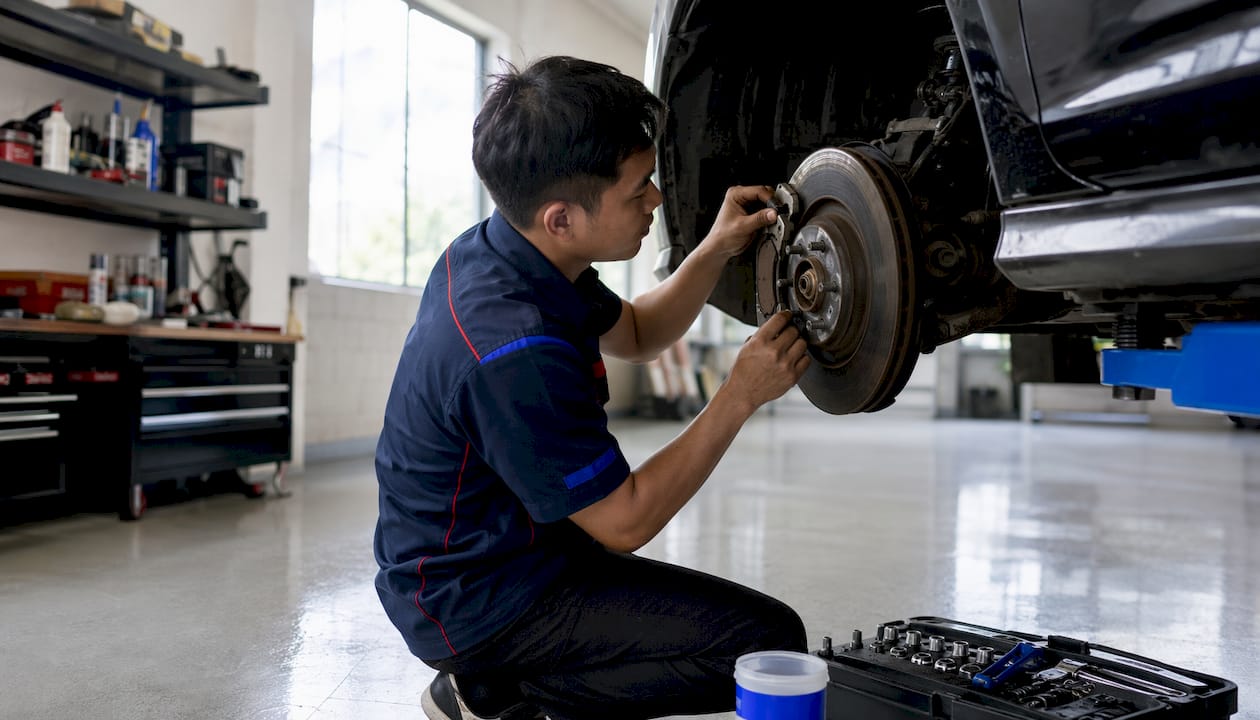
Semi-metallic pads are friction compounds built around a high proportion of metal fibers, typically 30–65% metal by weight, bonded with graphite lubricants, friction modifiers, and composite fillers. Common metals include steel, iron, and copper.
That metal content drives their core behavior:
- Heat conduction: Metal fibers pull heat away from the pad-rotor interface efficiently, which is why semi-metallics resist fade under sustained hard braking, towing, or mountain descents.
- Cold bite: Metal compounds grip the rotor quickly even before reaching operating temperature, giving drivers a firm, immediate pedal feel from the first stop of the day.
- Noise and vibration: Higher metal content transmits more vibration through the caliper and knuckle. Squealing under light or cold braking is a known characteristic, not a defect.
- Dust type: Semi-metallic dust contains iron particles that are dark, gritty, and corrosive to alloy wheel finishes.
- Rotor wear: The abrasive mechanism accelerates rotor surface wear, particularly when pads run hot or rotors are not high quality.
Pro Tip: Semi-metallic pads are the right call for towing a trailer on the Trans-Canada, hauling gear across Newfoundland’s interior, or any scenario where brake heat builds faster than a standard commute would generate.
What ceramic brake pads are made of and how they behave
Ceramic pads use dense, non-ferrous friction compounds built from ceramic fibers, fine metallic fillers, and resin binders. The ceramic fiber matrix acts as a thermal insulator rather than a conductor, which shapes nearly every performance characteristic the material is known for.
Key composition and performance points:
- Thermal insulation: Ceramic pads act as thermal insulators, forming a transfer layer on the rotor face that promotes smooth, low-noise friction. Under extreme repeated use, more heat shifts into the rotor face itself, which is a system consideration for fluid boiling point.
- Noise behavior: The ceramic matrix resonates at frequencies above the human hearing range, making these pads virtually silent during normal street braking.
- Dust type: Ceramic dust is lighter, finer, and non-corrosive. Wheels stay cleaner between washes, and the residue does not pit or stain alloy finishes.
- Rotor interaction: Because the adherent transfer layer mechanism is less abrasive than metal grinding, ceramic pads are generally gentler on rotors in typical street use.
- Regulatory compliance: Regulators have driven copper content reductions in brake friction materials, and ceramic formulations have been adjusted to comply while retaining friction performance.
- Compatibility: Ceramic pads are not universally compatible with every make and model. Confirm OEM recommendations before retrofitting ceramics to a vehicle originally specified for semi-metallics.
Ceramic vs semi-metallic: side-by-side comparison
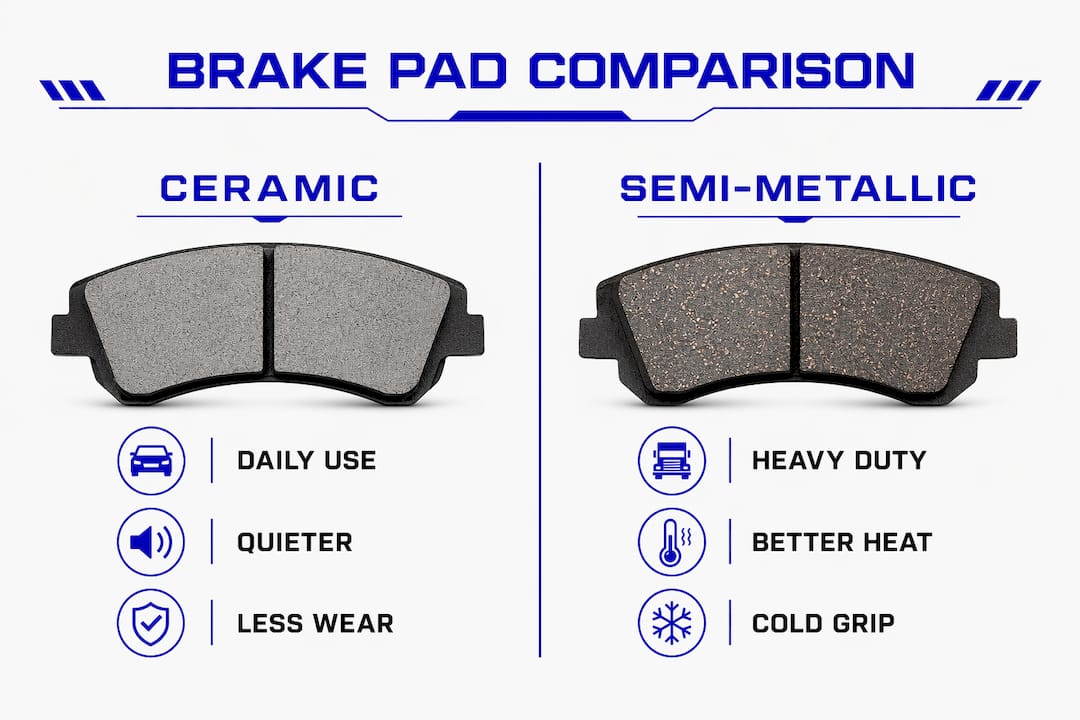
The core trade-off between ceramic and semi-metallic comes down to refinement versus thermal capacity. The table maps that trade-off across the dimensions that matter most to Canadian drivers.
| Dimension | Ceramic | Semi-Metallic |
|---|---|---|
| Best for / ideal use case | Daily commuting, family vehicles, light crossovers | Towing, trucks, performance, mountain driving |
| Noise | Near-silent; resonates above hearing range | Audible squeal possible, especially when cold |
| Dust type and wheel corrosion | Light, non-corrosive; wheels stay cleaner | Dark, iron-rich; can corrode alloy finishes |
| Heat tolerance and fade resistance | Good for normal use; can fade under sustained extreme heat | Superior; stable under heavy loads |
| Cold-weather bite and warm-up | Slower to reach full friction; less initial bite in freezing temps | Strong cold bite; minimal warm-up needed |
| Durability and lifespan | Longer in typical street use | May wear faster in moderate use; excels under heavy load |
| Rotor wear | Gentler; rotors last longer | More abrasive; can shorten rotor life |
| Upfront cost | Higher | Lower |
For most Newfoundland and Labrador commuters, the ceramic column wins on nearly every daily-use dimension. The semi-metallic column wins decisively for anyone hauling loads, driving a heavy pickup, or needing maximum stopping confidence on icy grades.
Which pad fits your driving situation in Canada?
Match the pad to the mission. Ceramic pads suit light-duty, comfort-focused driving; semi-metallic pads suit high-demand, high-heat applications.
- City and highway commuting: Ceramic. Quiet operation, clean wheels, and consistent pedal feel make them the natural fit for stop-and-go traffic in St. John’s or highway runs across the Avalon Peninsula.
- Family crossovers and sedans: Ceramic. Modern passenger vehicles are increasingly engineered around ceramic characteristics, and most OEM specs reflect that.
- Heavy trucks and large SUVs: Semi-metallic. Heavier vehicles generate more heat per stop, and the abrasive mechanism handles repeated high-load braking more reliably.
- Towing and hauling: Semi-metallic. Heat resistance matters far more than wheel cleanliness when a trailer is attached.
- Mountain and long-descent driving: Semi-metallic. Sustained brake application on grades like those along the Trans-Canada through the interior demands fade resistance that ceramic pads may not sustain.
- Performance and spirited driving: Semi-metallic. Aggressive initial bite and fade resistance under repeated hard stops are where metal content earns its keep.
- Drivers sensitive to noise and dust: Ceramic. If wheel appearance and cabin quiet are priorities, ceramic pads deliver both without compromise.
Pro Tip: If your vehicle is used for mixed duty, such as a pickup that tows occasionally but mostly commutes, lean toward semi-metallic. The cost of under-braking a loaded vehicle outweighs the noise and dust inconvenience.
Cold-weather performance: what Canadian drivers need to know
Semi-metallic pads provide stronger cold-temperature bite and require less warm-up than ceramic pads, which makes them the preferred choice in freezing climates when maximum initial stopping confidence is the priority.
Ceramic pads reach their full friction coefficient more slowly in sub-zero temperatures. The first few stops of a cold morning may feel slightly less assertive than they would with a semi-metallic compound. For most commuters, this difference is minor and manageable. For drivers navigating icy grades or making emergency stops in deep winter, it is worth factoring into the decision.
Practical steps for cold-climate readiness:
- Bed in new pads properly before winter arrives. An uneven transfer layer amplifies cold-morning inconsistency.
- Inspect pad thickness after salt season. Road salt accelerates caliper corrosion and can cause uneven pad wear that worsens cold-bite behavior.
- Check brake fluid condition. Moisture-contaminated fluid has a lower boiling point, which compounds heat-related issues when pads are working harder in cold conditions.
- Consider a climate-adaptive system if you drive year-round in Newfoundland’s coastal humidity and winter freeze-thaw cycles.
Pro Tip: After a salt-heavy winter, clean the caliper slides and inspect the hardware before installing new pads. Seized slides cause uneven pad contact that no friction material can compensate for.
Lifespan, rotor wear, and long-term maintenance
Ceramic pads often deliver better long-term value for average drivers despite higher upfront cost, because greater durability and lower rotor wear reduce total replacement frequency over the ownership period.
| Metric | Ceramic | Semi-Metallic |
|---|---|---|
| Typical pad lifespan (street use) | Longer in normal commuting conditions | May wear faster in moderate use |
| Rotor wear tendency | Gentler; rotors last longer | More abrasive; can shorten rotor life |
| Dust corrosion on wheels | Minimal; non-corrosive residue | Significant; iron particles corrode finishes |
| Performance under heavy load | Adequate for normal use | Superior under sustained high heat |
Research on wear behavior adds an important nuance: ceramic pads can exhibit lower material wear loss than semi-metallic pads under certain conditions, but high-speed or heavy-load scenarios can reverse that advantage. The lifespan claim holds for typical street driving, not track or towing use.
Maintenance checklist for both pad types:
- Inspect pad thickness every 20,000 km or at each tire rotation.
- Measure rotor thickness at inspection; replace rotors when they approach minimum specification.
- When switching pad types, have rotors inspected or resurfaced to guarantee proper contact surface.
- Clean caliper slides and hardware at every pad replacement.
Common myths about brake pad materials, corrected
Both materials have genuine tradeoffs. Neither is universally superior, and several widely repeated claims about each are either overstated or simply wrong.
- Myth: Ceramic pads always damage rotors. Reality: Ceramic pads are generally gentler on rotors than semi-metallic pads in typical street use. The abrasive mechanism in semi-metallics causes more rotor surface wear.
- Myth: Semi-metallic pads are better in all conditions. Reality: Semi-metallics excel at heat management and cold bite, but they are noisier, dirtier, and harder on rotors in everyday driving.
- Myth: Ceramic pads never fade. Reality: Under sustained extreme heat, ceramic pads can shift more heat into the rotor face and may lose friction consistency. They are not immune to fade; they are simply less likely to encounter it in normal use.
- Myth: You can always swap pad types without changing rotors. Reality: Switching materials changes the friction profile and wear pattern. Rotor inspection or resurfacing is recommended when changing pad types.
- Myth: More metal content always means better stopping power. Reality: Stopping power depends on friction coefficient, pad condition, rotor condition, and system pressure. Metal content improves heat capacity, not raw stopping force in isolation.
- Myth: Organic pads are a viable third option for most drivers. Reality: Organic pads wear faster and fade more readily than either ceramic or semi-metallic compounds. They are rarely the right choice for Canadian driving conditions.
How Aaafrictions’ HydroAdaptive ceramic technology addresses Canadian conditions
Aaafrictions’ HydroAdaptive ceramic formulation narrows the gap between ceramic refinement and semi-metallic thermal performance, specifically for the wet, cold, and freeze-thaw conditions common across Newfoundland and Labrador.
Standard ceramic pads carry two known limitations in Canadian weather: slower cold-bite on freezing mornings and reduced friction consistency when moisture enters the pad-rotor interface. HydroAdaptive technology addresses both through active moisture management at the friction surface. The formulation rapidly clears water film from the contact zone, maintaining reliable friction coefficient even in rain, slush, or high-humidity coastal conditions.
Additional engineering features relevant to Canadian drivers:
- GEOMET-coated rotors resist the accelerated corrosion that road salt and coastal humidity cause on bare cast iron.
- ClimateFlex calipers maintain consistent clamping force across wide temperature swings, preventing the caliper-side variability that can undermine even a well-chosen pad compound.
- Vehicle-specific kit matching confirms that pad, rotor, and caliper specifications align with OEM geometry and load ratings for your exact make and model.
Pro Tip: Aaafrictions’ HydroAdaptive formulation is particularly relevant for Newfoundland drivers who experience frequent coastal fog, salt spray, and rapid temperature changes between seasons. These are the exact conditions where standard ceramic pads show their limitations.
Key Takeaways
Ceramic pads are the right default for most Canadian passenger vehicles; semi-metallic pads are the right choice when heat, load, or cold-bite demands exceed what ceramic compounds are engineered to handle.
| Point | Details |
|---|---|
| Match pad to mission | Ceramic suits daily commuting and light vehicles; semi-metallic suits towing, trucks, and performance use. |
| Cold-weather bite | Semi-metallic pads provide stronger initial grip in sub-zero temperatures and require less warm-up. |
| Long-term rotor cost | Ceramic pads are gentler on rotors and often deliver better value over the full ownership period. |
| OEM compatibility | Always confirm your vehicle’s OEM pad specification before switching materials; not all vehicles accept ceramic retrofits. |
| Aaafrictions HydroAdaptive | Aaafrictions’ ceramic kits add moisture management and GEOMET rotor coating for consistent performance in Canadian weather. |
Pro Tip: Before purchasing, use Aaafrictions’ vehicle search tool to confirm the correct kit for your specific make, model, and year.
The case for matching friction material to your actual driving conditions
The brake pad debate often gets framed as a quality contest, as if one material is simply better than the other. We think that framing misses the point entirely. A semi-metallic pad on a daily commuter is over-engineered for the application and under-optimized for the driver’s actual priorities. A standard ceramic pad on a truck that tows every weekend is asking a refinement-focused compound to do a capacity job.
What we have observed in engineering climate-adaptive braking systems is that the real gap in the market is not between ceramic and semi-metallic. It is between pads designed for controlled test conditions and pads designed for the specific weather variability Canadian drivers face. Coastal humidity, salt exposure, freeze-thaw cycling, and cold starts are not edge cases here. They are the baseline.
That is the design premise behind Aaafrictions’ approach: ceramic performance characteristics, with the moisture management and thermal adaptability that Canadian conditions actually require.
Aaafrictions’ HydroAdaptive ceramic kits for Canadian drivers
If you want ceramic refinement without sacrificing cold-weather confidence or wet-road consistency, Aaafrictions’ HydroAdaptive ceramic brake kits are engineered specifically for that balance.
Each kit pairs Type 07 HydroAdaptive ceramic pads with GEOMET-coated rotors that resist salt corrosion, and optional ClimateFlex calipers for consistent clamping across Newfoundland’s seasonal temperature range. Kits are matched to your specific vehicle, so you are not guessing at compatibility. Whether you drive a Honda Pilot, a Toyota Highlander, or another family vehicle, there is a vehicle-specific kit built to OEM geometry. For drivers who want to understand the engineering before they buy, the HydroAdaptive technology page explains the formulation and its weather-performance rationale in full. Ready to find your kit? Browse Aaafrictions’ full catalog and confirm your vehicle fit at aaafrictions.ca/landing.
Sources and further reading
- Ceramic vs. Semi-Metallic Brake Pads: How They Work and What They’re Made Of — Advics Aftermarket
- Ceramic vs Semi-Metallic Brake Pads: Which Should You Choose? — AutoZone
- Ceramic vs Semi-Metallic Brake Pads: The Honest Truth — AME Motorsport
- Ceramic vs Metallic Brake Pads — Bridgestone
- Ceramic vs Semi-Metallic Brake Pads — BrakePadBoss
- What Are the Differences Between Ceramic and Semi-Metallic Brake Pads? — Jalopnik
- EPA Copper-Free Brake Initiative — EPA.gov
- Ceramic vs. Semi Metallic Brake Pads: Which Is Actually Better for Your Vehicle? — Aaafrictions
- HydroAdaptive Formulation — Aaafrictions
- Our Technology — Aaafrictions