

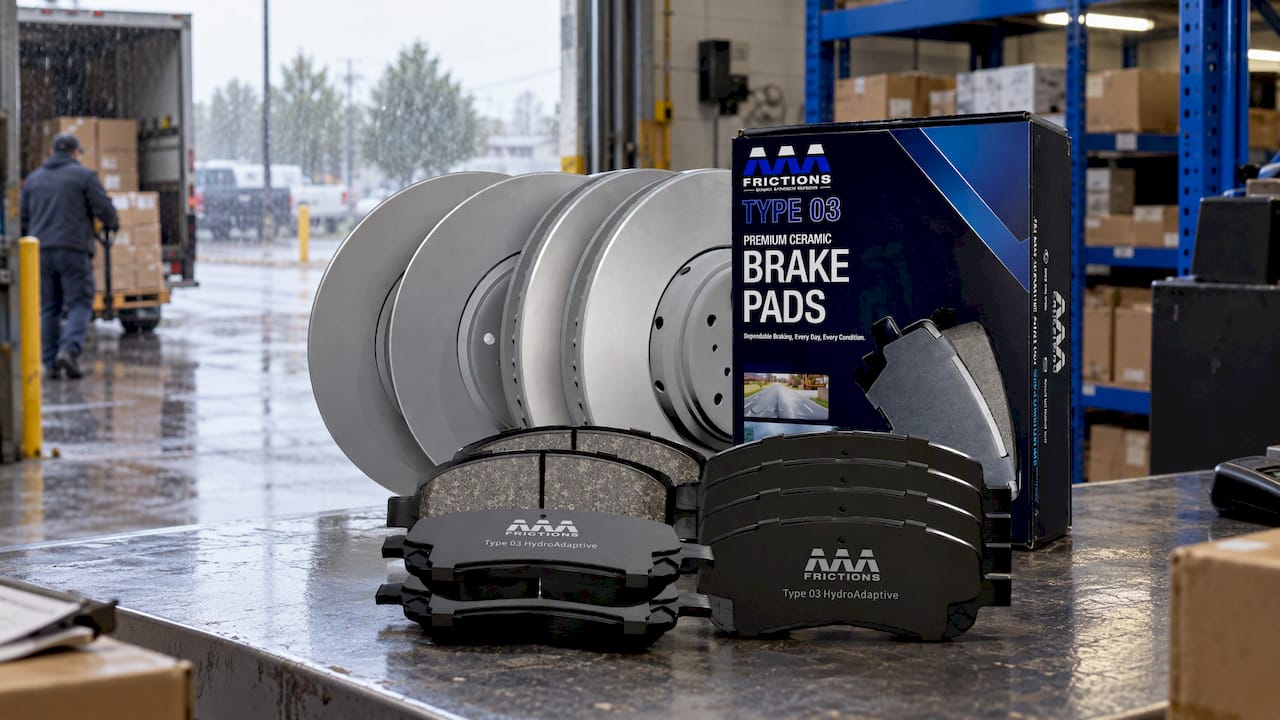
HydroAdaptive rotors are best understood as a rotor built to work with a moisture-managing pad as one matched system. At AAA Frictions, HydroAdaptive describes our ceramic pad technology for moisture management and stable friction. Our GEOMET-coated rotors protect the other half of the contact surface from moisture and road salt. Together they are meant to keep your pedal feel consistent from a rainy commute to a freezing morning. This guide explains what water and salt do to a rotor, what to look for in a set, and how to choose one for your vehicle.
TL;DR
- A rotor does not manage wet weather alone. The pad and rotor surface meet at the friction belt, so both have to be designed for moisture.
- Water between pad and rotor lowers friction, and corrosion makes the surface less consistent. Canadian road salt speeds up the second problem.
- Our GC Type rotors carry a GEOMET coating against moisture and road salt corrosion, and we pair them with HydroAdaptive ceramic pads.
- We only sell rotors with compatible pads, because the two are developed as a matched system.
- Choose by vehicle fitment first, then by how and where you drive: salted winter roads, heavy loads or high mileage.
Table of Contents
- What hydroadaptive rotors mean
- What water does between the pad and the rotor
- Why road salt makes the rotor the weak point
- How a GEOMET coating protects the rotor
- Why the pad and rotor should be a matched pair
- Our perspective
- How to choose rotors for your vehicle and driving
- Match your set to your car
- FAQ
- Sources
What hydroadaptive rotors mean
If you searched this phrase, you probably saw a lot of listings for coated, high-carbon rotors. Those are a useful reference point: the market is already moving toward rotors that handle heat, noise and corrosion better than a bare cast iron disc.
In our range, the idea is split across three components, each answering a different weather challenge:
- HydroAdaptive brake pads for moisture management and stable friction.
- GEOMET-coated rotors for protection against corrosion from moisture and road salt.
- ClimateFlex calipers for smooth operation through winter cold and summer heat.
So when we talk about a hydroadaptive rotor, we mean a carbon-based rotor with a protective coating, made to work with a HydroAdaptive pad. The rotor and pad are developed as a matched system for optimal performance, and that is why we sell rotors only with compatible pads.
We offer two rotor lines, SC Type rotors and GC Type rotors, and two pad lines, Type 03 and Type 07.
What water does between the pad and the rotor
Brakes work through friction. Anything that sits between the pad and the rotor changes how much grip you get.
A SAE dynamometer study found that with water on the disc, braking torque behaves as if friction falls as speed rises. In extreme cases, effective braking may not occur until near zero speed. It also found that cutting off the water gave substantially instant recovery to dry performance, so the effect is tied to water actually reaching the friction surface.
A 2020 study in the Journal of Nano- and Electronic Physics describes the mechanism. Water entering the friction belt creates a hydroplaning effect that significantly lowers the dynamic coefficient of friction. At the same pedal force, braking torque drops and braking distance grows. If one side wets unevenly, the braking forces can become unbalanced and the car can drift or skid.

Humidity and cold mornings are a milder version of the same thing. An MDPI Materials review notes that on damp mornings brakes can be noisy and friction may rise, but after a few applications the water evaporates and friction returns to normal. Soaking, on the other hand, forms a liquid or vapour film between the surfaces and reduces friction.
This is the problem a moisture-managing pad is designed for. Our HydroAdaptive pads are engineered to keep friction stable while moisture is present, so the first stops on a wet road feel closer to the last.
Why road salt makes the rotor the weak point
Water is only part of a Canadian winter. Salt turns every splash into an electrolyte, and the rotor face is bare iron that rusts fast.
Recent tribology research from January 2026 reports that moisture condensed on a disc’s friction zone acts as an electrolyte. It reduces the wear and friction properties and forms corrosion pits where polished and matte surfaces meet.
This matters for performance, not just looks. A University of Windsor team working with Ford Motor Co. of Canada and NUCAP Industries, in a project announced in 2022, is developing a ceramic coating for rotors. Professor Xueyuan Nie’s view is that rust-free rotors react faster, shorten braking distance and reduce sticking and slippage. Corrosion resistance is a performance feature.
The same university’s published work on brake wear particles found that a coating on a cast iron disc cut total brake wear by more than 70% in a road test. It also notes that corrosion on cast iron rotors can raise both the number and mass of brake wear particles by over 50%.
Two things follow for a Canadian driver. A rotor that stays clean keeps the pad’s contact surface consistent. And a car that sits still lets corrosion start sooner than you would expect, which is why we wrote about brake rust on stored vehicles and flash rust on rotors.
How a GEOMET coating protects the rotor
GEOMET is a zinc and aluminum flake coating in an inorganic binder. According to the GEOMET technical sheet, the brake-rotor grade averages about seven microns thick without a topcoat, repairs itself through migrating zinc oxides and carbonates, and does not cause hydrogen embrittlement. The sheet lists testing for heat, salt spray and humidity under SAE J2334, GMW 14872 and Ford CEPT:00.00-L-467.
Other rotor coatings exist, and it helps to know how they differ. Vehicle Service Pros describes zinc plating as a sacrificial barrier against moisture and salt that can wear away quickly in harsh conditions. It describes ceramic coatings as strong against rust and heat but costlier and more labour-intensive, and phosphate e-coating as more durable than zinc and common on replacement rotors.
The point of a coating on a rotor is practical. It protects the faces and hat of the rotor while the car sits in a salted driveway, so the surface is in good shape the first time you press the pedal in the morning. Our GC Type rotors use GEOMET for exactly that reason. If you want to read more about coatings in general, this piece on ceramic coatings for alloy wheels shows how protective films hold up against road grime.

Why the pad and rotor should be a matched pair
The contact patch between pad and rotor is where braking happens. A pad that manages moisture well on a rotor with a pitted, uneven face will still have an inconsistent surface to work with. A well-protected rotor with an unsuitable pad can be noisy or wear unevenly.
Trade guidance says the same. Vehicle Service Pros notes that rotor design plays a crucial role in brake performance, and that a rotor should match the pad’s performance and support outgassing and heat dissipation.
That is why we do not sell rotors on their own. Each rotor ships with compatible pads, so the system you install is the system we developed. Calipers complete the picture: our ClimateFlex calipers are designed for smooth operation through winter cold and summer heat, so the pad is applied consistently as well.
| Component | Weather job | Our product |
|---|---|---|
| Pad | Moisture management, stable friction | HydroAdaptive ceramic pads (Type 03, Type 07) |
| Rotor | Corrosion protection from moisture and road salt | GEOMET-coated GC Type rotors |
| Caliper | Smooth operation in cold and heat | ClimateFlex calipers |
Our perspective
Weather is the one variable a driver cannot control, so we start every design with it. A brake system is a chain: moisture reaches the pad, salt reaches the rotor, cold reaches the caliper. Strengthen one link and the others still decide how the pedal feels.
That is why we develop rotors and pads together. Our HydroAdaptive pads are designed for moisture management and stable friction. Our GEOMET-coated rotors are designed to resist corrosion from moisture and road salt. Our ClimateFlex calipers are designed for smooth operation in winter cold and summer heat. The result we work toward is predictable braking response, day after day.
For daily commuters, delivery and rideshare drivers, and anyone who covers high mileage in changeable weather, consistency is what builds confidence. We would rather give you one complete, matched system than a single part asked to do everything.
AAA
How to choose rotors for your vehicle and driving
Start with fitment, then match the set to how you drive.
- Confirm the vehicle. Year, make, model, trim and axle (front or rear) decide the rotor and pad size. Our kits are vehicle-specific, so you select your car and receive parts that fit it.
- Think about your salt exposure. If your car sees salted roads for months, or sits outside for days at a time, a coated rotor such as our GC Type is the sensible starting point.
- Consider your load and mileage. Larger vehicles and high-mileage drivers put more heat and wear through the system. Ask which pad type suits your use, and keep pad and rotor replacement together.
- Replace pads and rotors as a set. A new pad on a worn rotor does not give the pad a clean surface to bed into. A matched set avoids that mismatch.
- Plan for both axles. Front and rear kits are available for some vehicles, so the whole car brakes with the same behaviour.
How to inspect your current rotors
Before you order, look at the rotor faces with the wheel off or through the spokes. Light orange surface rust that clears after a few stops is common; our flash rust guide covers it. Deeper pits, a raised lip at the edge or visible grooves are different, and our rotor pitting checklist walks you through them. For the cause, see what rotor pitting actually is.
Warning signs that need attention now
Grinding, a pedal that sinks, a car that pulls to one side or a steady vibration are not things to drive on. This explanation of brake grinding and why it needs a check within a day shows why corrosion and wear matter to braking and not just appearance. Our own list of red flags to stop driving is a good reference. If you notice any of these signs, have a qualified technician inspect the brakes before you drive further.
Keeping a new set in good condition
After the install, a few habits protect the surface. Rinse salt from the wheels and undercarriage during the winter. Avoid leaving the car parked for long periods with wet brakes; a short drive with a few gentle stops clears moisture and light surface rust. Our guide on preventing rotor pitting lists the steps in full.
Match your set to your car
Our kits are vehicle-specific. For example, for the Honda HR-V 2016 to 2022 we offer a front and rear kit with Type 07 HydroAdaptive+ ceramic pads and GC Type GEOMET-coated rotors, a front and rear kit with Type 03 HydroAdaptive pads, and a rear kit.
For other vehicles, browse the full range at aaafrictions.ca and select your vehicle to see the matching pad and rotor sets.

Whether you replace parts yourself or hand the set to your mechanic, you get a matched pad and rotor system built around Canadian weather.
FAQ
Is hydroadaptive a standard rotor type?
Not as an industry category. In our range, HydroAdaptive describes the ceramic pad technology for moisture management and stable friction. The rotors paired with it are GEOMET-coated carbon-based rotors, developed with the pads as a matched system.
Does a coated rotor help in winter?
A coating protects the rotor surface from moisture and road salt, which is what drives corrosion in Canadian winters. Research from the University of Windsor links rust-free rotors to faster brake response and shorter braking distance. Our GC Type rotors use a GEOMET coating for this purpose.
Can I buy rotors without pads?
No. We sell rotors only with compatible pads, because rotors and pads are developed as a matched system for consistent braking.
What should I check before ordering?
Confirm your vehicle’s year, make, model and axle, then consider how much salt, load and mileage your driving involves. Check the current rotor faces for pitting or deep grooves, and replace pads and rotors together.
Sources
- SAE dynamometer investigation of the effects of water on brake pad materials
- Volchenko et al., Journal of Nano- and Electronic Physics, 2020
- Tribological behavior of friction materials of a disk-brake pad, MDPI Materials
- Performance of friction pairs of disc-shoe brakes in a wet environment, 2026
- University of Windsor: researcher teams up with Ford to build a better brake rotor
- Morphology and composition of brake wear particles, MDPI
- GEOMET technical sheet
- Modern brake rotor design, Vehicle Service Pros
- Ceramic coatings for alloy wheels
- Brake grinding: get the brakes checked within a day
Recommended
- Wet Weather Brake Pads: Best Kits for Rain and Humidity
- Weather Adaptive Brake Pads: How They Work and How to Choose
- Front and Rear Brake Kit for Honda Pilot 2003-2008, Type 07 HydroAdaptive+ Ceramic Disc Brake Pad and Rotor Set with GC Type GEOMET Coated Rotors
- Honda Pilot ’16-22 Brake Kit – Ceramic Pads & GEOMET Rotors