

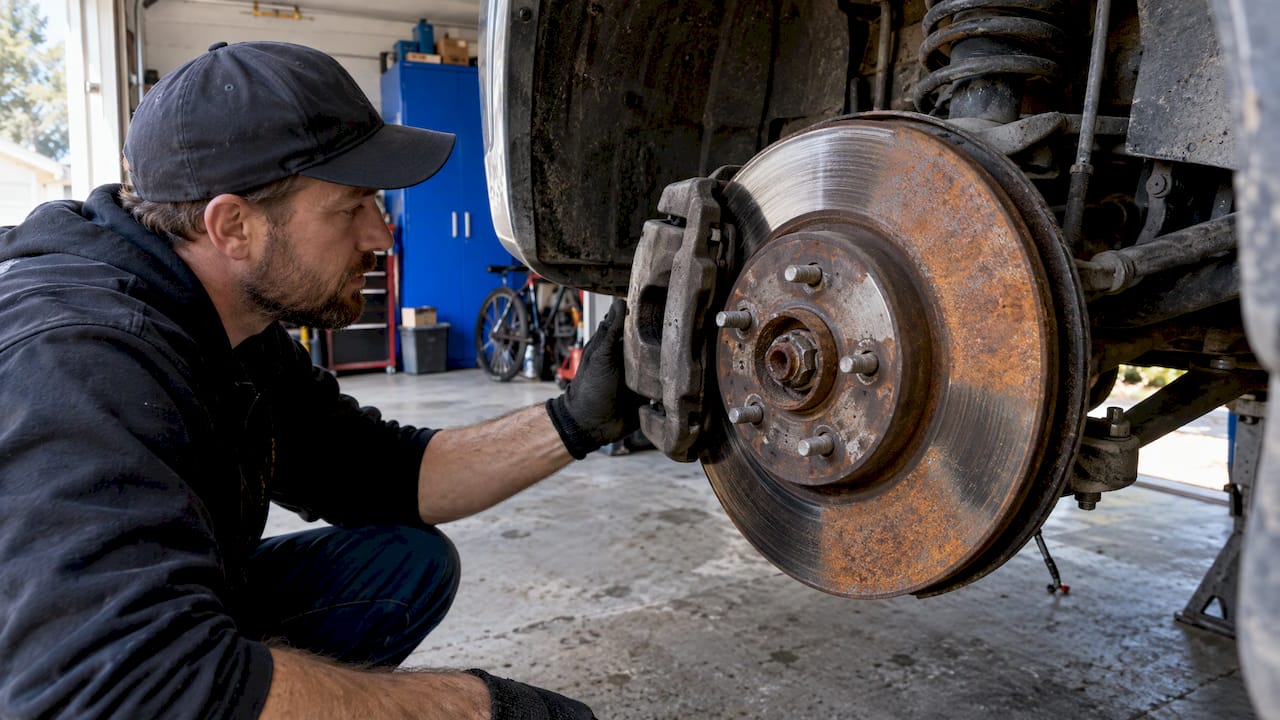
Humidity does not usually create brake judder from nothing. It forms a film of rust on the rotors, and if that rust is uneven, or the rotor was already slightly uneven, you feel it as a pulse through the pedal or steering wheel. A light, brief shudder that clears within two or three stops is normal surface rust. A pulse that stays through a whole drive points to rotor thickness variation, hub rust, or a sticking caliper. This guide shows how to tell which one you have, what to do about each, and how weather-ready parts such as our HydroAdaptive pads and GEOMET-coated rotors are designed to keep the problem from returning.
TL;DR
- Moisture-related judder is most often caused by rust on the exposed part of the rotor, or by pad material left on the rotor where the pads sat while the car was parked.
- If the vibration or scraping fades within 2 to 3 stops after the brakes warm up, it is normal wet-weather behaviour. If it persists, the brakes need diagnosis.
- Judder that gets worse, comes with pulling, grinding, a burning smell or longer stopping distances needs an inspection as soon as possible.
- The lasting fix is a straight, true rotor surface, a caliper that moves freely, and parts built to resist moisture and road salt.
Table of Contents
- What brake judder actually is
- How humidity and rain lead to judder
- Normal wet-weather behaviour or a real problem?
- Is brake judder dangerous?
- How to get rid of moisture-related judder
- Why the parts you fit matter in damp climates
- A quick note on squeaks and grunts
- Who this matters most for
- Our perspective
- Choosing parts for a vehicle that sees real weather
- FAQ
- Sources
What brake judder actually is
Brake judder, also called shudder or pulsation, is a vibration you feel through the brake pedal or steering wheel when you brake. The usual mechanical cause is uneven rotor thickness, often called run-out or thickness variation. A US federal service bulletin notes that even micron-size unevenness can cause judder, and that it is more noticeable when slowing from higher speeds. The same document explains that friction depends on pad material, temperature, humidity and braking force, which is why a brake can feel different on a damp morning than on a dry afternoon.
Put simply: the pads clamp a spinning disc. If one part of that disc is a few microns thicker, or has a different surface from the rest, the pad grips harder once per revolution. You feel that as a rhythmic pulse that speeds up and slows down with the car.
For a deeper look at the rotor itself, see our guide to measuring and fixing rotor thickness variation.

How humidity and rain lead to judder
Rotors are bare cast iron. They begin to rust quickly in damp air, and Motor1 reports that rotors can start to rust within hours from humidity, condensation, morning dew or car-wash water. Normally this is harmless. The pads scrape the thin layer away over the first few stops, and you may hear a light scraping sound or feel a slightly rough pedal that should disappear quickly.
A US safety bulletin describes the same thing: light rust forms on exposed disc surfaces from moisture, salt and dirt, the surface cleans itself during the first braking, and no repair is needed. Our page on flash rust on rotors covers what that rust looks like and why it appears so fast.

When the rust is not even
The trouble starts when the car sits. The part of the rotor covered by the pad stays protected, and the rest rusts. A federal bulletin on brake noise and judder explains that the rusted and un-rusted areas have different friction, and this difference may cause judder even after the rust wears off. The same bulletin says that repair means turning the rotors, and that replacement rotors must be indexed to the axle hub for minimum run-out.
Another bulletin describes the pad-mark version: when a vehicle sits for long periods, pad marks from prolonged moisture exposure can affect the rotor surface and cause judder or pulsation. Its advice is to drive regularly, and to make several stops to warm and dry the brakes before parking, especially after washing the car.
This matters for many Canadian drivers. A car parked outside through a wet week, a vehicle left at an airport lot, or a seasonal car brought out of storage all fit the pattern. In a UK case reported by The Telegraph, a BMW began to judder after 10 days parked in rain, and the manufacturer put it down to localised disc corrosion rather than warping. Our guide to stored-car brake rust sets out the steps for cars that sit for days at a time.
Salt makes it worse
In much of Canada, winter roads are treated with salt and brine, and these corrode bare metal quickly. Rust does not only attack the rotor face. It can build up on the hub where the rotor sits. A rotor mounted on a rusty hub can sit very slightly off true, and that tiny wobble is enough to cause pulsation. We cover that case in hub rust and brake pulsation.
Normal wet-weather behaviour or a real problem?
The single most useful test is time. Surface rust and a thin water film go away quickly once the brakes are working. A real fault does not. Use the table below as a first read.
| What you notice | Likely cause | What to do |
|---|---|---|
| Light scrape or mild pulse on the first stops after rain or overnight, gone within 2 to 3 stops | Surface rust or moisture on the rotor | Nothing. Drive normally. |
| Mild pulse that returns every time the car sits for days | Uneven rust or pad marks on the rotor | Park after a few warming stops, and have the rotor surface checked |
| Steady pulse at highway speed that does not fade as brakes warm up | Rotor thickness variation or hub rust | Measure run-out and thickness |
| Pulling to one side, one wheel hotter than the others | Sticking caliper or slide | Inspect the caliper and slides promptly |
| Grinding that continues after several stops | Worn pads or deep corrosion | Inspect as soon as possible |
The thresholds come from the sources above. Motor1 lists grinding that continues after several stops, pedal vibration, steering-wheel shaking, reduced braking, deep grooves or pitting, pulling to one side, a stuck pad or one wheel unusually hot as warning signs of heavier corrosion, and says that if noise, roughness or vibration remains after a normal drive, the brakes should be inspected.
A 10-minute self-check
- Note when it happens. First stop of the day only, or all day? Only from highway speed, or at low speed too?
- Make three firm stops from about 50 km/h on a clear road, with no one close behind you. Does the vibration fade?
- Check the pedal. A pulse that you feel in the pedal points to the rotors. A shake in the steering wheel points to the front axle.
- Feel for heat after a normal drive, carefully and not touching the metal. One wheel noticeably hotter suggests a caliper that is not releasing.
- Look at the rotor faces through the wheel for deep grooves, a dark ring or a heavily rusted edge.
If you want to clean off dust and light rust deposits from wheels and brake components safely before looking closely, this guide to removing brake dust safely explains the dwell times that protect the surface.
Is brake judder dangerous?
A very minor vibration does not mean the brakes are about to fail, but it should not be ignored indefinitely. If the shaking is severe, getting worse, or comes with reduced braking performance, grinding, pulling, a burning smell or a warning light, have the car inspected as soon as possible. Ford of Canada advises an inspection every 16,000 km, and sooner if you feel steering-wheel vibration, hear squealing or grinding, smell burning, or see deep gouges on the rotors. Mitsubishi Motors Canada suggests having the brakes checked at least twice a year, which is a natural fit for a spring and fall tire-swap routine.
If your car pulls hard to one side or the pedal sinks, stop driving it and have it towed to a qualified technician. Those are not humidity symptoms.
How to get rid of moisture-related judder
The steps below follow the federal guidance and apply whether you do your own brakes or hand them to a mechanic.
1. Dry the brakes before you park
After a wash, or a drive through heavy rain or slush, make several gentle stops before you park, so the heat evaporates water and keeps the pad area from marking the rotor. Our page on drying brakes while driving gives a safe routine.
2. Drive the car regularly
A bulletin from a federal safety regulator explicitly recommends driving regularly. Short, infrequent trips are where rust patches develop, and that applies to occasional-use cars and some electric vehicles that rely on regenerative braking and use the friction brakes less.
3. Measure, do not guess
The same bulletin says to diagnose judder by measuring rotor parallelism, run-out and thickness, and then to resurface or replace the rotors as conditions require. It also says to replace rotors and pads only if run-out cannot be corrected by resurfacing or there is excessive heat damage. Measuring takes a dial indicator and a micrometer. Do it with the rotor on a clean hub, because dirt under the rotor will give a false reading.
4. Clean the hub and caliper hardware
Before fitting any new rotor, wire-brush rust off the hub face and clean the caliper slides. A sticking slide keeps one pad lightly dragging, which heats one spot on the rotor and produces uneven wear.
5. Replace worn parts as a matched set
If the rotor is below its minimum thickness, deeply pitted, or the surface cannot be restored, replace it. Fit new pads at the same time so the new rotor face beds in against a fresh friction surface. Rotors that run against old, glazed or contaminated pads wear unevenly from the start.
Why the parts you fit matter in damp climates
A brake system sees salt, slush, humidity and temperature swings, and each of those puts a different load on a different component. That is how we have organised our range: three components, each aimed at one weather problem.
- HydroAdaptive brake pads are designed for moisture management and stable friction, so the pad’s grip stays consistent as conditions change from damp to dry.
- GEOMET-coated rotors are designed to protect against corrosion from moisture and road salt, the main trigger for rust-patch judder.
- ClimateFlex calipers are designed for smooth operation through winter cold and summer heat, which helps the caliper release properly.
None of the three works in isolation. Our rotors and pads are developed as a matched system, and we sell rotors only with compatible pads, so the friction surfaces are designed to work with each other from the first stop. Our weather-specific pages on grinding after rain and squeal when wet show how the same moisture shows up as noise instead of vibration.
A quick note on squeaks and grunts
Humidity brings noise more often than judder. Mitsubishi Motors Canada notes that sounds that start and then disappear after a few kilometres or stops can come from debris or moisture on the rotor, and brown surface-rust spots after rain or snow are quickly worn away by the pads. A squeal on the first stops of a damp morning that goes away is the same story. A squeal that stays, or a grind that stays, is a different one, and you should treat it as wear until proven otherwise.
Who this matters most for
- Daily commuters and rideshare or delivery drivers. High mileage means more brake cycles and more heat, so any rotor unevenness shows up sooner and costs more time off the road.
- Drivers of larger vehicles. Heavier vehicles load the brakes harder, so small variations in the rotor surface are felt more at highway speed.
- DIY drivers and mechanics. You control the hub cleaning, the run-out check and the choice of parts, which are the three places moisture-related judder is won or lost.
- Seasonal and occasional drivers. The cars that sit are the cars that rust unevenly.
Our perspective
Most judder complaints we hear described start with the same sentence: “It only happens when it is damp.” Moisture is the trigger, but the rotor surface decides what you feel.
We design the three parts of a braking system around the three things weather does to it. Moisture changes friction, so our HydroAdaptive pads are built for moisture management and stable friction. Salt and humidity attack bare iron, so our rotors carry a GEOMET coating to protect against corrosion. Cold and heat stiffen and loosen moving parts, so our ClimateFlex calipers are designed for smooth operation across the seasons.
We develop rotors and pads as a matched system, which is why we sell rotors only with compatible pads. A brake that is consistent in January slush and in August humidity is the goal behind every engineering decision we make.
AAA
Choosing parts for a vehicle that sees real weather
If your rotors are due for replacement because of corrosion or thickness variation, start with the rotor type. Our SC Type rotors and GC Type rotors are GEOMET-protected options, and each is paired with compatible pads. For the pads, see our Type 03 brake pads and Type 07 brake pads, built for vehicle-specific fitment.

Enter your vehicle details on the product page to see the matching front or rear set. If you want the complete picture of causes first, our brake judder causes in Canada guide walks through five checks before you replace anything.
FAQ
Can humidity alone cause brake judder?
Humidity starts it, but the lasting vibration comes from uneven rust or pad deposits on the rotor. Moist air puts a thin rust film on the rotor, which the pads normally wipe off within a few stops. If the car sits and part of the rotor rusts more than the rest, the friction difference can cause judder even after the rust wears off.
How long should moisture-related judder last?
Surface rust and a thin water film should clear within the first 2 to 3 stops once the brakes warm up. If you still feel a pulse after a full drive, it is not just moisture. Have the rotor run-out and thickness measured.
Why do my brakes judder after the car has been parked for a few days?
While the car sits, the rotor area under the pads is protected and the rest rusts, so the surface is uneven when you drive off. Pad material can also leave a mark where the pads rested. Making several warming stops before parking, and driving the car regularly, helps prevent it.
Is it safe to drive with a mild brake shudder?
A very mild shudder that fades quickly is usually not an immediate danger, but you should not ignore it for long. If it gets worse, or comes with pulling, grinding, a burning smell, a warning light or longer stopping distances, have the brakes inspected as soon as possible.
Will new rotors fix humidity-related judder?
New rotors fitted to a clean, true hub with free-moving calipers remove the uneven surface that causes the pulse. Replace pads with the rotors so both surfaces bed in together, and choose parts designed to resist moisture and salt so the surface stays even.
Sources
- NHTSA service bulletin on brake judder and friction variation (2019)
- NHTSA bulletin on brake noise, judder and pedal feel diagnosis (2023)
- NHTSA service bulletin on pad marks and moisture exposure (2021)
- NHTSA service bulletin on light rust on brake discs (2015)
- Motor1: Why brake rotors rust overnight
- The Telegraph: BMW brakes judder after 10 days parked
- Ford of Canada: When should I have my brakes inspected?
- Mitsubishi Motors Canada: Signs you need new brake pads
- Guide to removing brake dust safely