

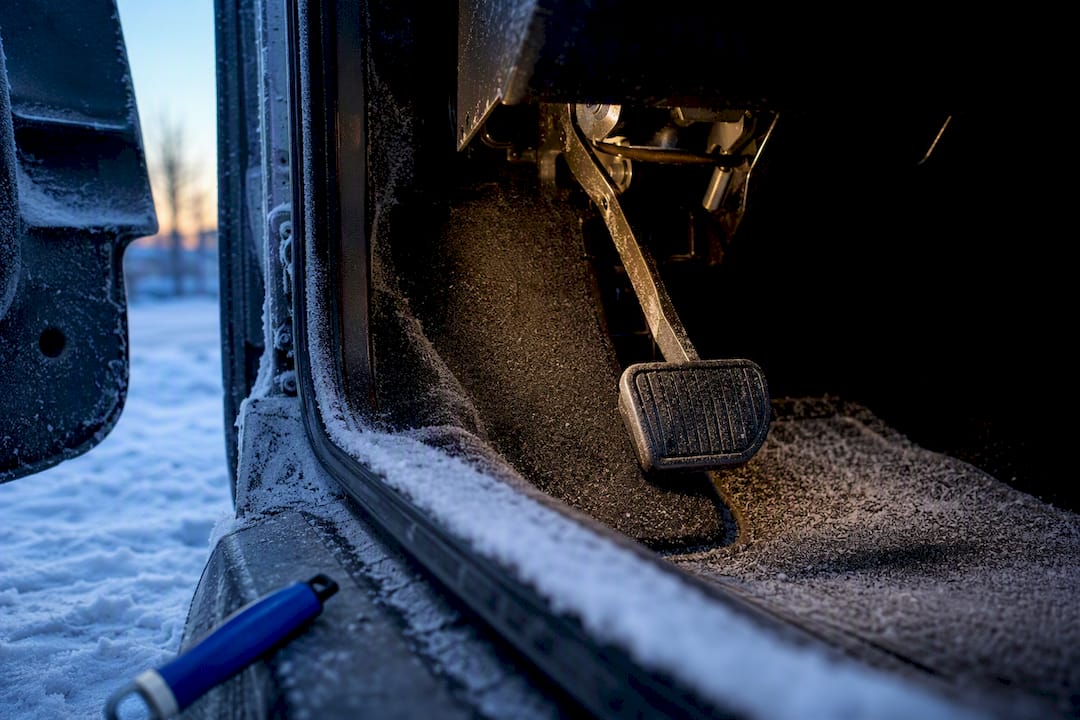
If your brake pedal sinks toward the floor or feels inconsistent in deep cold, the most likely culprits are moisture contaminated fluid or trapped air in the lines, with loss of vacuum assist as a secondary cause. Either condition can compromise stopping power. Do not drive at highway speeds until you’ve run through the checks below.
TL;DR:
- Moisture contamination in brake fluid gradually increases over years, raising the freezing point and risking hydraulic failure in cold weather.
- A firm pedal after pumping indicates a hydraulic issue, while a pedal that sinks suggests internal bypass or leaks requiring professional repair.
- Frozen vacuum assist causes a hard brake pedal on startup, which usually clears within 30 to 60 seconds as the moisture thaws.
- Cold contracts rubber seals and can cause minor air leaks, revealing pre-existing issues that may not have caused pedal changes in warmer conditions.
- Upgrading to moisture-resistant brake parts like HydroAdaptive pads and ClimateFlex calipers can help maintain consistent braking in freezing conditions.
Table of Contents
- What Does a Hard, Spongy, or Sinking Pedal Actually Mean?
- What Causes Brake Pedal Travel to Change in Cold Weather?
- What Should You Check Before Driving in the Cold?
- What Will a Mechanic Actually Do to Fix It?
- How Often Should You Flush Your Brake Fluid in Winter Climates?
- Can Hardware Reduce Cold Weather Brake Pedal Problems?
- Our Take on Cold Weather Brake Safety
- Where to Find Winter Ready Brake Parts and Technology
- Sources
What Does a Hard, Spongy, or Sinking Pedal Actually Mean?
Cold weather does not create brake problems out of nothing. It exposes issues that were already sitting in the system, waiting for the right temperature to show themselves. Learning to read what your pedal is telling you narrows down the cause before a technician even looks at the car.
- Rock hard pedal on startup: Usually means the power brake booster has lost vacuum assist because moisture froze in the booster hose or check valve. This typically clears within 30 to 60 seconds once the engine warms, since frozen moisture in the vacuum circuit tends to thaw quickly. Safe to warm up in place before moving.
- Spongy or long travel pedal: Points to trapped air pockets or an active fluid leak. This does not improve with warming. Treat it as an immediate concern.
- Pedal sinks to the floor: Suggests internal bypass inside the master cylinder or a serious leak. Stop and arrange a tow rather than driving to a shop.
- Pedal firms up after pumping: A temporary fix, not a real one. It masks trapped air or bypass without resolving it, and the effect wears off as soon as fluid redistributes.
What Causes Brake Pedal Travel to Change in Cold Weather?
Brake fluid is hygroscopic, meaning it absorbs moisture from the air over its service life whether you top it off or not. That absorbed water changes how the fluid behaves once temperatures drop.
Moisture and fluid contamination. Fresh glycol-based fluid resists freezing down to very low temperatures on its own. Once water content climbs, the fluid’s effective freezing point rises toward 32°F, and it can form slush or ice crystals that physically block narrow valves and channels. Contamination doesn’t happen overnight. It builds gradually, often pushing from roughly 1% moisture content toward nearly 2% over a few years of normal driving, and that rising water content is a big part of why hydraulic failure risk climbs as fluid ages.
Trapped air and master cylinder bypass. Air compresses under pressure instead of transferring force the way liquid does, which delays clamping and creates that sinking, spongy feeling. Internal bypass inside the master cylinder does something similar: worn seals let fluid slip past internally instead of pushing it out to the calipers, so pedal travel increases even though nothing is leaking outside the unit.
Vacuum assist loss. Moisture that freezes inside the booster hose, the check valve, or the booster itself removes power assist, which is why the pedal suddenly feels like stepping on a brick. This is a mechanical, not hydraulic, problem, and it’s a distinction worth understanding before you assume the worst.
Frozen or sticking components. Calipers can stick from ice or corrosion, parking brakes can freeze in the applied or released position, and surface rust on rotors can temporarily bind pads until the first few stops scrub it off. None of these directly change pedal travel, but the drag and inconsistency they cause often gets blamed on the pedal itself.
Cold also physically shrinks rubber seals throughout the system. That contraction can let a small amount of air in past a seal that was fine in warmer weather, or reveal a bypass that was borderline all along. If you’ve noticed a related soft pedal issue in milder weather too, cold isn’t creating a new problem. It’s just making an old one obvious.
What Should You Check Before Driving in the Cold?
Run through these steps in order before you pull out of the driveway on a frigid morning:
- Check the fluid reservoir level. Low fluid points toward a leak somewhere in the system.
- Look for visible leaks at the wheels, along brake lines, and underneath the master cylinder.
- Confirm the parking brake releases fully. A frozen parking brake can mimic pedal problems entirely unrelated to your hydraulics.
- Try one firm pump and hold it. A pedal that sinks slowly under steady pressure signals internal bypass or a leak, not a vacuum issue.
- Let the engine idle for a minute or move the car into a heated space if the pedal feels rock hard. If it firms up as the engine warms, vacuum assist was likely frozen.
Stop and call a tow if: the pedal sinks to the floor, a brake warning light illuminates, or you get an erratic ABS warning. None of these resolve themselves with time or warming, and driving on them risks a real loss of stopping power.
Pro Tip: A quick bench test technicians use is pumping the pedal several times with the engine off, then holding steady pressure for a minute. If the pedal slowly firms up, your booster is likely creating vacuum normally. If it stays soft or keeps sinking, the issue is hydraulic, not vacuum related.
If the parking brake itself is the frozen component, a step by step thaw process works faster and safer than force.
What Will a Mechanic Actually Do to Fix It?
Once you’re at a shop, the diagnostic path usually follows the symptom pattern you already noticed.
- Pressure bleeding pushes fresh fluid through the lines to remove trapped air pockets. This resolves most spongy pedal complaints that aren’t tied to a leak.
- A full fluid flush goes further, replacing all the fluid in the system rather than just clearing air. This becomes mandatory once moisture contamination is suspected, since topping off the reservoir alone won’t remove water that has already settled into low points of the lines.
- Master cylinder replacement is the fix when internal bypass is confirmed. Bleeding won’t help here. Worn internal seals need a new unit, not fresh fluid.
- Vacuum booster and hose inspection checks for ice, a collapsed hose, or a failed check valve. Technicians often pair a visual check with the bench pedal test described above to confirm power assist is actually being lost.
- ABS modulator service matters if you’ve had repeated hard-pedal or inconsistent-pedal events. Ice or crystallized fluid can lodge in the modulator’s narrow orifices, and while thawing sometimes restores function temporarily, repeated freezing usually calls for a full fluid service and ABS diagnostic to head off valve corrosion. Persistent sensor faults are also worth ruling out through pressure sensor diagnostics if the ABS light keeps returning.
- Caliper and parking brake hardware gets thawed, cleaned, or replaced outright if seizing has become chronic rather than a one time cold morning event.
How Often Should You Flush Your Brake Fluid in Winter Climates?
Many manufacturers recommend a fluid flush every few years, but cold weather driving makes skipping that interval riskier than it would be in a mild climate. Moisture accumulation is constant and invisible until it causes a symptom you can feel through the pedal.
- DOT 3 and DOT 4 fluids are standard for most vehicles, but DOT 4’s higher boiling point and slightly better moisture resistance make it the safer default where winters run long and severe.
- Low viscosity DOT 4 variants exist specifically because some ABS modulators use narrow valve solenoids that are sensitive to fluid thickness in sub-zero operation. Check your owner’s manual before assuming any DOT 4 fluid is interchangeable.
- Avoid long holds on the brake pedal in freezing temperatures when parked, since sustained pressure combined with cold can stress seals unnecessarily.
- Heated storage, even a basic garage, slows moisture accumulation and reduces the overnight cold soak pattern where moisture settles into low points of the system during long, cold, stationary periods.
- Corrosion resistant rotors and climate rated pads are worth considering if you’re already replacing worn components, particularly if you’ve dealt with rotor pitting or dust issues in past winters.
Can Hardware Reduce Cold Weather Brake Pedal Problems?
Aaafrictions built its HydroAdaptive ceramic technology specifically around one persistent problem: moisture sitting on friction surfaces between the pad and rotor. The formulation is engineered to clear that moisture rapidly rather than let it linger and interfere with consistent contact.
- HydroAdaptive pads address friction surface variability, the inconsistency you feel when moisture briefly reduces grip during the first few stops of a cold morning.
- ClimateFlex calipers are designed to manage moisture and cold related component behavior at the caliper itself, working alongside the pad material rather than replacing it.
- What this technology does not fix: internal master cylinder bypass, major fluid leaks, or a booster that’s lost vacuum assist. Those are mechanical and hydraulic failures that need actual repair, not better friction material.
If your symptoms point toward surface level inconsistency rather than a hydraulic fault, a HydroAdaptive formulation upgrade is worth a fitment check against your vehicle.
Our Take on Cold Weather Brake Safety
Too many drivers treat a strange pedal feeling as a wait and see problem, something that might sort itself out once the truck warms up or the roads clear. Aaafrictions doesn’t share that instinct, and the mechanics behind these symptoms explain why. A hard pedal that clears with warming is genuinely low risk. A pedal that sinks, even slightly, under steady pressure is not something to monitor. It’s something to stop for. The gap between those two outcomes is measured in feet of stopping distance on ice, and that gap is not one to test yourself. If you’re ever unsure which category your pedal falls into, get it in front of a licensed brake technician rather than guessing based on a forum thread.
— AAA
Where to Find Winter Ready Brake Parts and Technology
Standard pads lose grip consistency the moment moisture gets between the friction surface and the rotor, which is exactly the gap Aaafrictions engineered HydroAdaptive to close. If the checks above pointed you toward surface level inconsistency rather than a hydraulic fault, upgrading your friction material is a straightforward next step rather than a repair.

HydroAdaptive ceramic pads, full brake kits, and ClimateFlex calipers are available to manage moisture and maintain consistent contact through freezing mornings, slush, and everything between. Vehicle specific kits are available for a wide range of makes and models, each engineered around the same moisture clearing approach. If you’re not sure which parts fit your vehicle, the product finder matches you to the right kit in a couple of clicks, and support is available for any fitment questions before you order. Browse the full technology breakdown or head straight to the product finder to check what fits your vehicle today.
Sources
- Transport Canada — vehicle safety standards and technical guidance
- Transport Canada — motor vehicle safety regulations and technical standards
- Engineerskill
- TrustedLocalAuto — Spongy brake pedal winter driving danger
- Firestone Complete Auto Care — 4 cold weather brake problems to watch out for