

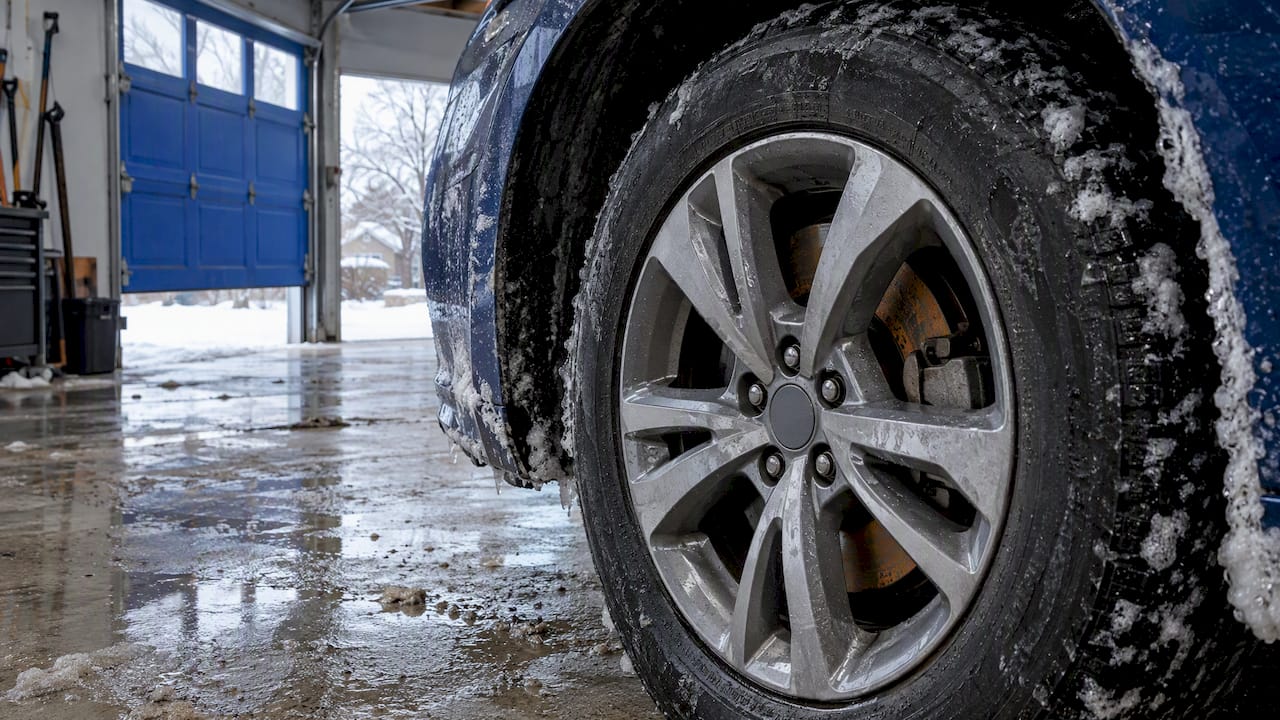
Condensation in a garage does not damage your brakes overnight, but it does leave a film of moisture on bare cast-iron rotors, and over a Canadian winter that film becomes surface rust, noise and, in neglected cases, seized hardware. The fix has two parts: bring less water into the garage, and let the air carry it out again. Below we explain where the moisture comes from, what is normal on a rotor, what is not, and what to do about both.
TL;DR
- A garage sweats when warm, wet air meets cold surfaces. A car coming in with melting snow and slush is one of the biggest sources of that moisture.
- A light orange haze on the rotor face after a damp night is normal and usually wears off within a few stops. Deep pitting, flaking or a wet pad or caliper is not.
- Wipe meltwater off the vehicle, squeegee the floor, and vent the garage after parking. A dehumidifier or humidistat-controlled fan helps long term.
- A bowl of salt is a weak fix for a whole garage. Airflow does far more.
- Fluid drops near a wheel are a different problem from condensation. Have a mechanic look at them.
Table of Contents
- Why a garage sweats when a car is parked in it
- What condensation does to brakes
- Condensation, surface rust or a leak: how to tell
- How to cut condensation in your garage
- Does a bowl of salt help?
- What to do about the brakes themselves
- When to see a mechanic
- Our perspective: moisture is a design problem, not just a housekeeping one
- Brake parts built for damp Canadian conditions
- FAQ
- Sources
Why a garage sweats when a car is parked in it
Condensation needs two things: moist air and a surface colder than the dew point of that air. The Canada Mortgage and Housing Corporation (CMHC) describes condensation on cold surfaces as the result of too much moisture in the air combined with too little exchange between indoor and outdoor air. A garage meets both conditions more often than most rooms.

The vehicle is the main supplier. A Winnipeg home inspector’s column notes that warm vehicles and air from the house, along with melting snow and ice, raise garage humidity, and that humidity can approach saturation when a warm car enters a cool garage, especially if the door to the house is opened. A Canadian garage door company adds that snow and slush carried under the vehicle melt onto the floor and then evaporate back into the air.
Then the overnight cool-down does the rest. The metal of a car sheds heat faster than the air around it, so a wet, cold-soaked surface in a closed space collects dew first. Brake rotors are exposed, unpainted iron and sit near the ground, where the wettest air settles.
The situations where it is worst
- Winter commuting. You drive through slush and brine, park, and close the door on a wet underbody.
- Spring and fall swings. Cold nights followed by mild damp days push the dew point up and the slab temperature down.
- Attached garages with a house door. Humid indoor air drifts in and finds the cold slab.
- Washing the car indoors. Hot water, then a sealed door, is the quickest way to a sweating garage.
What condensation does to brakes
Most of the effect is cosmetic and temporary. Bare rotor faces oxidize quickly in humid air, which is why you see a thin orange tint after a wet night. The pads sweep it off during the first braking applications. A Canadian service centre notes that morning brake noise after rain, snow, washing or overnight parking may be moisture or light rust, and if it clears after a few stops it may not be serious, while continued noise merits inspection.
The concern is what happens when moisture sits for weeks, or when it carries road salt. Then you see:
- Rust building on the rotor face and, more seriously, on the hat and edge, which does not wear off.
- Pad material bonding lightly to a rusted rotor, which can show as vibration or pulsing at low speed.
- Corrosion on caliper slide pins and pad abutments, which can leave a pad dragging or sticking.
- Rust on brake hardware and lines that you only see when something fails.
Moisture and corrosion also reach brake-related electronics in some vehicles. Transport Canada identified moisture buildup that could corrode electric vacuum pumps on certain 2011 to 2012 Ford F-150s, increasing pedal effort and potentially extending stopping distance. That is a model-specific defect, not a general garage effect, but it shows why moisture around brake components is worth taking seriously. If you want to know whether your own vehicle has an open recall, check the Transport Canada recall database by make, model and year.
For the longer story on how humidity changes feel at the pedal, see our guide on how humidity affects brake performance in Canada.
Condensation, surface rust or a leak: how to tell
People searching this topic often find moisture near a wheel and wonder which of three things they are looking at. Use this table as a first pass, not a diagnosis.
| What you see | Likely cause | What to do |
|---|---|---|
| Fine droplets on the rotor, wheel or caliper, dry within an hour or two | Condensation | Nothing. Drive normally and brake gently for the first few stops. |
| Uniform orange tint on the swept rotor face, clears after a few stops | Light surface rust | Normal. Reduce garage moisture to make it less frequent. |
| Deep pitting, flaking, or rust on the rotor edge or hat | Prolonged moisture, often with salt | Have the rotors inspected. Pitting does not wear away. |
| Oily, slippery drops at the back of a wheel, on the inside of a tyre, or under the car | Possible brake fluid leak | Do not rely on the brakes. Have the vehicle inspected before driving it. |
| Pedal sinks or feels soft | Hydraulic problem | Stop driving and get it checked. |
One way to think about fluid leaks is the grading used in Ontario’s passenger vehicle inspection standard. It defines level 1 as seepage insufficient to form drops, level 2 as seepage that forms drops that do not fall during inspection, and level 3 as drops that fall during inspection. Condensation never forms falling drops of fluid on a brake component, and it dries. A leak keeps coming back.
Two quick tests help. First, wipe a drop between your fingers: water is thin and odourless, while brake fluid feels slightly slick. Second, check the master cylinder reservoir level against its marks. A level falling below the minimum mark with wet spots near a wheel points to a leak, and the pads or lines need attention. Transport Canada has, for example, noted that on certain 2017 to 2019 GMC Savana and Chevrolet Express cutaway chassis, brake lines could be damaged by body mounts, causing a fluid leak and reduced braking. Reduced braking means longer stopping distances, so do not wait on a suspected leak.
How to cut condensation in your garage
Start with the cheapest steps and add equipment only if the garage still sweats.
1. Stop the water at the door
The garage door company’s advice is to wipe meltwater from the car, squeegee floor water, and open the door for 15 to 30 minutes after parking. Do it in that order. A few minutes with a squeegee and a towel on the lower body, wheel wells and the pooled slush removes litres of water that would otherwise evaporate overnight.

A Winnipeg inspector makes the same point: moisture buildup comes from using the garage, so leaving the door open after parking vents excess warm, moist air. In winter, balance this against the cold: you want the damp air out, not the garage at minus 20 all night.
2. Keep the house door closed
If the garage is attached, close the house door so warm, humid indoor air does not drift in and settle on the cold slab. The same CMHC guide recommends reducing moisture sources, providing ventilation and keeping surfaces warm.
3. Ventilate or dehumidify
For garages in daily use, a mechanical option is worth the money. Heat recovery ventilators are ideal but costly, so builders often turn to exhaust-only systems or dehumidifiers as common alternatives. A bathroom-style exhaust fan on a humidistat is a sensible budget route. Note that a standard home dehumidifier loses efficiency in a cold garage, so check the operating temperature range in the manual before buying.
4. Warm the door and walls
An insulated door keeps its interior face warmer, and polyurethane sandwich-built doors with higher R-values reduce condensation compared with uninsulated doors. Be careful with vapour barriers and insulation in damp spaces, since trapping moisture behind them causes its own trouble.
5. Aim for a humidity target
For vehicles, the Canadian Conservation Institute recommends keeping relative humidity below 70% to prevent rapid metal corrosion. It adds that lower temperatures slow corrosion as long as humidity stays under that line. A small hygrometer costs little and tells you whether your garage is under or over it.
Does a bowl of salt help?
Not much. Salt does draw water from the air, but only at high humidity. One report on the trick cites a German source saying that at up to 74 percent relative humidity and 20°C, salt does not absorb appreciable water vapour. A bowl in a garage that holds a wet car, a slab and several cubic metres of air will not change the dew point in any measurable way. Airflow and removing standing water do far more. If you want a passive helper, treat it as a small extra, and never leave open salt or salt-laden slush near bare brake parts, since salt speeds up rust.
What to do about the brakes themselves
The garage is only half of the picture. The other half is the way you treat the brakes at the end of a wet drive.
- Brake gently for the last minute or two where it is safe. A little pad contact and friction heat helps drive water off the rotor face before parking.
- Rinse brine off after salted roads, then let the car dry with the door open. Our same-day steps to protect rotors from brine corrosion explain the order. For an ongoing routine, see our monthly checks against road salt corrosion.
- Clean the wheels as well. Brake dust holds moisture and salt against the wheel. A guide on removing brake dust safely covers dwell times so the cleaner does the work without harsh scrubbing.
- Use the car. A vehicle that sits rusts faster. If yours will be parked for weeks, follow our steps on avoiding rotor damage in a stored car.
- Look at the calipers. Sticking slide pins and seized pistons are a corrosion problem. Read about caliper corrosion causes, prevention and repair.
First stops after a damp night
Expect a little noise or a slightly rough first application. If the pedal feels weak in rain, our page on restoring wet braking in three stops explains how to check tyres first and what to do next. If a shudder stays even on dry pavement, see wet brake shudder that persists.
When to see a mechanic
Book an inspection when you notice any of the following:
- Noise or roughness that continues beyond the first few stops of the day.
- Pitted or flaking rotors, or rust ridges at the outer edge that catch a fingernail.
- A pedal that sinks, feels spongy, or needs more effort than before.
- Wet, oily residue at a wheel, or a reservoir level that keeps dropping.
- One wheel much hotter than the others after a short drive, which suggests a sticking caliper.
A mechanic can measure rotor thickness and runout, check slide pins and pistons, and test fluid. Do not guess on anything that affects stopping distance.
Our perspective: moisture is a design problem, not just a housekeeping one
We build brake parts for the conditions Canadian drivers actually face: rain, humidity, slush, snow and cold nights. Garage condensation is a small version of the same challenge. Water is present at the rotor and pad interface, and the brake has to clear it and settle into stable friction quickly.
That is why we developed HydroAdaptive ceramic technology. Standard ceramic pads can show delayed bite and inconsistent pedal feel when the surface is wet or the air is humid. Our pads are engineered to clear moisture rapidly and maintain friction, so the first stops of a damp morning feel more consistent. Our rotors use corrosion-resistant coatings, and our climate-adaptive calipers and lubricants address the hardware that moisture attacks first.
We are also direct about limits. No pad or coating replaces good habits. Drying the car, venting the garage and inspecting the brakes each season will do more for longevity than any single component. Good parts and good habits work together as one braking ecosystem.
— AAA
Brake parts built for damp Canadian conditions
If your rotors keep rusting overnight or your pads feel slow to bite on wet mornings, upgrading the parts is a reasonable next step. We make Type 03 brake pads and Type 07 brake pads with HydroAdaptive ceramic technology, plus GC Type rotors and SC Type rotors. Check each page for fitment to your vehicle. If you do your own brake work, matched pad and rotor sets keep the system consistent from the first stop.

FAQ
Is condensation on my brakes in the garage harmful?
Usually not. A light film of moisture and a thin orange tint on the rotor face are normal and clear after a few stops. Repeated wet-dry cycles with road salt can lead to pitting and sticking hardware, so reduce the moisture and inspect the brakes each season.
Why do my brakes squeal in the morning?
Overnight moisture can leave a thin layer of rust on the rotors that the pads wipe off. A Canadian service centre says morning noise after rain, snow, washing or overnight parking may be moisture or light rust. If it continues after several stops, have the brakes inspected.
Should I leave the garage door open after parking?
For 15 to 30 minutes, yes, after wiping the car and squeegeeing the floor. That vents the warm, moist air. In very cold weather, close it afterwards so the garage is not left open overnight.
Does a dehumidifier protect brakes?
It helps by lowering relative humidity, ideally below the 70% line the Canadian Conservation Institute gives for metal. Choose a unit rated for cold rooms, and combine it with drying the vehicle and ventilating.
Sources
- CMHC: Moisture and Air, a guide for understanding and fixing condensation
- Ask the Inspector: Repairing garage, Winnipeg Free Press
- Garage door condensation: why your door sweats
- Brake noise diagnosis, Valvoline Express Care Scarborough
- Transport Canada: Ford F-150 brake vacuum assist preliminary determination
- Transport Canada Recall 2024543, General Motors
- Ontario passenger and light-duty vehicle inspection standard
- Canadian Conservation Institute: Caring for vehicles
- Northern Built: Garage ventilation
- IFLScience: Bowls of salt and condensation
- Removing brake dust safely